Imagine a pattern that keeps showing up
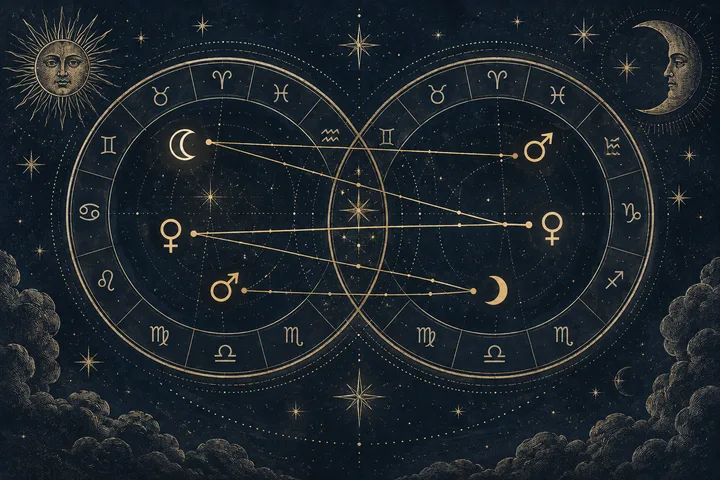
Imagine Maria and Daniel comparing supplied Moon, Venus, and Mars placements after a few months of dating. Maria’s Moon is six degrees from a square to Daniel’s Venus. Her Venus is five degrees from a trine to his Mars. Her Mars is four degrees from a square to his Moon. None is exact to the degree. Daniel asks whether the pattern means anything. Maria recognises the picture: affection arrives quickly, emotions rise quickly, and a small disagreement can become a long conversation.
The answer isn’t to discard the contacts. It isn’t to crown them proof of a rare bond, either. Each contact has to earn its place. Check the angle, the orb, the planets, and the signs. Then ask whether the contacts return to one question. Here, the question is pace: how quickly do feeling, affection, and desire move between them?
That is a thematic pattern. It needn’t be a formal T-square, Grand Trine, or other named figure. A formal figure has exact structural requirements. A thematic pattern is a smaller synthesis built from several contacts that point toward the same relationship function. The distinction matters because a chart can offer a useful theme without supporting a grand label.
Astrological aspects describe angular relationships between chart factors. When several factors connect, the arrangement can add meaning of its own, but the components still come first. Nicholas Campion’s aspect guide says to read the planets, signs, and houses separately before building the larger picture. In this placement-based comparison, houses aren’t part of the scope, so the same sequence becomes planets, signs, aspect types, and orbs.
This article uses supplied placements and optional degrees. It doesn’t calculate a natal chart from birth details, add houses, or predict a relationship outcome. The Maria and Daniel scene is illustrative. It shows how to judge a pattern without inventing a personal chart.
Sources: An Introduction to Aspects and Chart Shaping in Natal Astrology; Astrological Orbs Explained: Natal Charts, Transits and Synastry
Exactness is strength, not a permission slip
An exact aspect matches its target angle as closely as the calculation allows. A square aims for 90 degrees. A trine aims for 120. The orb is the distance between the actual separation and that exact angle. A 94-degree separation is a square with a four-degree orb. It is active under a six-degree rule, but it isn’t exact.
The working rule here is a six-degree orb for selected major synastry aspects. That is a method for this report, not a universal limit. Astrology sources use different allowances, and AstroNet notes that synastry readers often tighten their orbs so a comparison doesn’t fill with weak contacts. State the rule before you interpret. Otherwise, the boundary moves whenever a preferred pattern needs rescuing.
Think of the orb as volume. A two-degree contact speaks clearly. A six-degree contact speaks more softly. Both may belong in the reading, but the wider one shouldn’t outrank a close Moon, Venus, or Mars contact. The word exact should also be specific. Say exact to the degree, within one degree, or within six degrees. Those are different claims.
Calculate the smaller angular distance between the two supplied placements, compare it with the aspect angle, and record the difference. If the source rounds placements to whole degrees, mark the orb as approximate near the edge of the limit. A clean number made from rounded inputs doesn’t deserve false precision.
Synastry compares two fixed natal charts, so its interchart orb stays fixed once the positions are known. Applying and separating describe moving planets approaching or leaving an aspect, which belongs to transit timing. For this question, rank the static distance and the contact’s role in the pattern.
Yes, but only when the pattern is made of real contacts within one stated orb. Exactness gives a contact more force; it doesn’t decide the whole reading. With this article’s six-degree orb for selected major aspects, three non-exact contacts can still repeat one relationship theme, especially when the Moon, Venus, or Mars is involved. First write down the planets, signs, aspect types, degrees, and orbs. Then rank the closest personal-planet contact and test whether the wider contacts add the same meaning. If degrees are missing, stay with sign patterns and possible contacts. The most useful next step is a conversation about the theme the chart raises, not a verdict about the relationship.
Sources: An Introduction to Aspects and Chart Shaping in Natal Astrology; Astrological Orbs Explained: Natal Charts, Transits and Synastry; Exact aspect
A pattern needs a shared centre
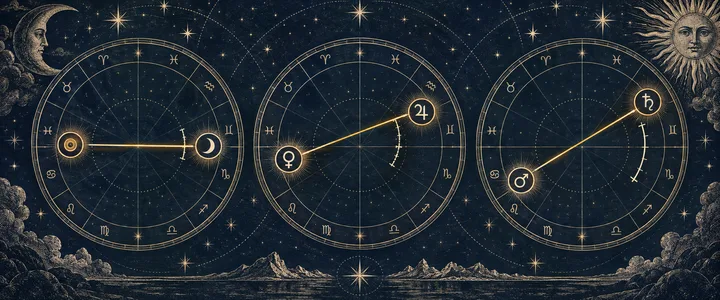
Three lines can look impressive and still describe three unrelated subjects. A pattern earns attention when its contacts share a centre. In the Maria and Daniel example, the Moon-Venus square joins emotional timing with affection. The Venus-Mars trine supports attraction and pleasure. The Mars-Moon square brings heat into instinctive reactions. They aren’t interchangeable, but they repeat one larger issue: feeling and desire move fast, while emotional pacing needs care.
That is more useful than calling the relationship intense. Intensity is a mood word. It doesn’t tell the couple what to notice. A repeated theme does. Maria and Daniel might ask what happens when one person reaches for reassurance and the other needs time to settle. The chart gives shape to that question. It doesn’t write the answer.
Different aspects can carry different parts of the same theme. A square may create pressure. A trine may make attraction easy. A sextile may show an opening that requires choice. An opposition can make two needs visible at once. Read the aspect as the style of exchange, then let the planets and signs tell you what is actually exchanging.
Use subtraction as a test. Remove the widest contact. Does the theme still stand? Remove the least personal planet. Does the relationship question remain clear? If the interpretation collapses when one loose line disappears, keep the pattern in the supporting layer. If the closer contacts still point to the same issue, the synthesis has earned more weight.
The Moon brings instinct, comfort, memory, and immediate feeling. Venus brings affection, taste, pleasure, and values. Mars brings pursuit, heat, assertion, and action. When those functions connect from several angles, you can describe a shared rhythm. Don’t turn the rhythm into a fixed personality label. Synastry describes an exchange between two people.
Sources: Astrological Orbs Explained: Natal Charts, Transits and Synastry; Synastry
Rank the contacts before naming the pattern
A good reading ranks its evidence. Otherwise the most dramatic shape wins, even when a quieter contact explains more. Start with the closest personal-planet aspect. Then ask whether the other contacts repeat its question. After that, read the signs and the aspect styles. Put the widest contact last unless it adds something the closer ones cannot.
Suppose a four-degree Moon-Saturn square appears beside a five-degree Venus-Mars trine and a six-degree Mercury-Mars sextile. The Moon-Saturn contact leads because it is close and touches emotional security. Venus-Mars may show warmth and attraction. Mercury-Mars may describe the couple’s way of handling blunt conversations. Together they suggest seriousness with desire still alive, plus a need to handle direct speech carefully.
The ranking is not a score. It is a reading order. Orb answers how close the contact is. Planet relevance answers whether it reaches a personal relationship function. Thematic fit answers whether it helps with the question the couple actually brought to the chart. Keep those questions separate.
Cafe Astrology describes synastry as the interplay between two individual charts. That keeps the person-to-person exchange visible. Don’t write that the relationship simply ‘has Mars energy.’ Ask who is expressing Mars, who receives it, and whether that role changes across the connected contacts. A Venus-Mars contact can feel different from each side of the exchange.
A useful order is simple: closest personal contact, repeated theme, sign expression, wider support, strongest exception. This prevents line-counting. Five wide contacts don’t automatically outweigh one tight Moon-Venus contact, and a harmonious contact doesn’t become the whole story because it looks pleasant.
Sources: Astrological Orbs Explained: Natal Charts, Transits and Synastry; Synastry
The strongest exception: a real pattern can still be weak
Several loose contacts don’t automatically make a strong pattern. A wide orb can spread across a chart until almost every line appears meaningful. That is why the formal shape must survive the stated method. If two supposed squares in a T-square fall outside six degrees, the figure isn’t confirmed in this reading. It may be worth checking under another method, but it can’t lead this one.
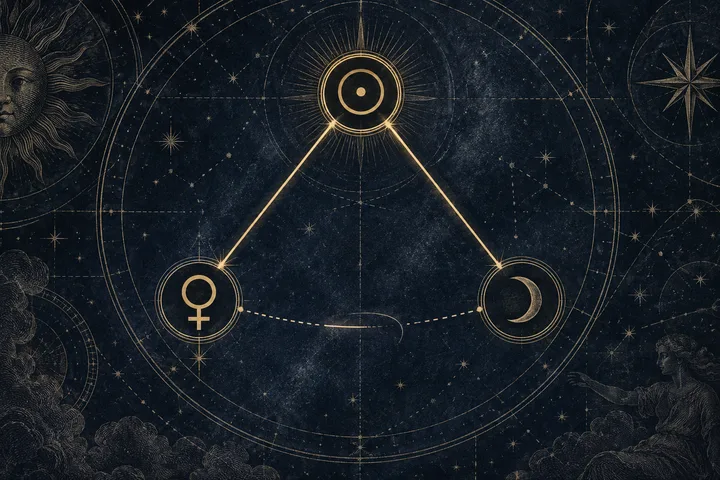
A thematic pattern has a similar limit. Two confirmed personal-planet contacts may repeat a question, while a third contact adds only atmosphere. Keep the first two in the main interpretation and place the third at the edge. Don’t let a neat diagram smuggle an unconfirmed line into the conclusion.
Outer-planet contacts need the same care. Saturn, Uranus, Neptune, and Pluto can colour a relationship, yet a slow-planet pattern may say less about the immediate texture of affection than a close Moon-Venus or Venus-Mars contact. Give it more weight when it has a clear personal-planet bridge. Otherwise, let it remain background.
Out-of-sign aspects are another qualified case. The degree geometry may be close while the signs describe different styles. Some astrologers keep the contact and read the mismatch as part of its tension. Others lower its weight. Either way, name both facts: close by degree, complicated by sign. Don’t present it as a clean expression.
The supported view is clear: a non-exact pattern can matter, but only as much as its confirmed parts allow. The strongest exception is also clear: several wide, uncertain, or outer-planet contacts can imitate a pattern without giving it enough technical weight to anchor the reading. Precision doesn’t make astrology colder. It tells you what to trust first.
Sources: An Introduction to Aspects and Chart Shaping in Natal Astrology; Astrological Orbs Explained: Natal Charts, Transits and Synastry; Exact aspect
Missing degrees change the kind of answer you can give
If both relevant degrees are supplied, you can calculate and rank an aspect. If one degree is missing, you can discuss a sign relationship and list a possible contact, but you can’t confirm its orb. Keep those statements apart. ‘Venus is in Libra’ is an input. ‘Venus may trine Mars’ is a possibility. ‘This is a Grand Trine’ is a structural claim that needs every required contact.
A sign comparison can still be useful. You can read shared elements or modalities, compare how two Venus placements express affection, or ask how two Moons seek comfort. Just don’t turn sign resonance into a degree-based aspect. If the supplied degrees later fall within six degrees, the possible contact can move into the confirmed layer.
The Moon deserves extra care when its degree or sign is uncertain. It moves quickly, so a birth-time problem can change the Moon placement and any Moon-based pattern. In a placement-only report, lower the confidence of that layer and let secure Venus or Mars information lead. The report can explain what changes without pretending to resolve missing data.
When two reports disagree, compare their inputs, zodiac reference, aspect list, and orb rules before comparing interpretations. Many arguments about meaning begin as disagreements about what was counted. A small record with three headings helps: confirmed, possible, unavailable. Put verified degree contacts in the first column, sign-based possibilities in the second, and houses or angles outside the supplied scope in the third.
That is the practical boundary of the Synastry Comparison Report. It can compare supplied Moon, Venus, and Mars signs, test selected major contacts when degrees are available, and show which pattern claims remain conditional. It doesn’t calculate natal positions from birth dates or houses. A narrow answer with visible inputs is stronger than a broad answer built from details nobody supplied.
Sources: An Introduction to Aspects and Chart Shaping in Natal Astrology; Astrological Orbs Explained: Natal Charts, Transits and Synastry; Synastry
Turn the pattern into one useful conversation
Return to Maria and Daniel. Their contacts suggest that affection and emotional reaction may accelerate together, while each person needs a different pace after tension. The useful question isn’t ‘Are we meant to be?’ It’s ‘What happens when one of us wants closeness and the other needs time to settle?’ That question belongs to the couple. The chart gives it a name.
They might begin with: ‘I think we connect quickly, but we also react quickly. When we get tense, what helps each of us feel close without pushing the other person?’ The sentence leaves room for both people. It doesn’t cast one partner as the difficult planet, and it doesn’t ask the chart to decide who is right.
Let the planet pair set the subject. Moon contacts point toward comfort and emotional response. Venus contacts point toward affection, pleasure, and value. Mars contacts point toward desire, action, and conflict style. Let the aspect set the movement. The sign gives the manner. The orb tells you how much weight to place on the contact.
Then bring in the exception. Say, ‘This pattern looks coherent, but one contact is wide. Does this theme actually show up for us?’ If the answer is yes, name one small practice. Ask whether advice is welcome before giving it. Take a pause before replying. Say whether you want comfort, space, or a plan. The practice should remain useful even if the chart language changes later.
So the final test is lived and simple. Write one sentence for the chart and one for the relationship. If they describe the same repeated exchange, the pattern has earned a place. If they don’t, narrow the interpretation. A loose pattern matters when it sharpens attention, not when it demands agreement. Ask your partner what would help when that theme appears, and listen to the answer.
Sources: Astrological Orbs Explained: Natal Charts, Transits and Synastry; Synastry
A little more clarity
Can a wide synastry aspect still matter?
Yes, if it falls within the stated orb and supports a theme shown by closer contacts. Treat it as softer evidence. Don’t let it carry the reading alone, and don’t include it when it falls outside the chosen limit.
What if none of the aspects in a synastry pattern is exact?
The pattern can still matter when each contact is genuine under one consistent method and the contacts converge on one relationship theme. Remove the widest line. If the theme survives through the closer contacts, it has earned more weight.
Can I read a synastry pattern without both people’s degrees?
You can compare signs and describe possible themes, but you can’t confirm the orb or rank the aspects accurately. Mark the contact as possible. If the Moon is uncertain, lower the confidence of any Moon-based pattern further.
Does a synastry pattern prove compatibility?
No single pattern decides a relationship’s outcome. It shows how chart functions may meet through ease, friction, attraction, or emotional timing. Use it to ask a sharper question, then notice how both people respond and repair.
Sources & further reading
- An Introduction to Aspects and Chart Shaping in Natal Astrology
Defines aspects and orbs, explains that tighter contacts carry more weight, and describes how component factors build a larger pattern.
- Astrological Orbs Explained: Natal Charts, Transits and Synastry
Gives the orb formula, distinguishes fixed synastry geometry from moving transits, and explains why restricted synastry orbs improve clarity.
- Synastry
Frames synastry as the interaction between two individual charts and supports keeping the person-to-person exchange visible in interpretation.
- Exact aspect
Shows that astrologers use exact aspect in more than one narrow sense, including a one-degree working definition.
Synastry Comparison Report
Enter known placements for two people. Get an input-by-input comparison, selected aspect calculations and a clear record of what remains uncertain.
Compare our placements