
With the birth moment, zodiac reference, and geocentric position convention held constant, birthplace latitude can change the Ascendant and house geometry without ordinarily changing Moon, Venus, or Mars signs. Compare supplied planetary placements first, then assess angles and house overlays using their birth-time, coordinate, and house-system inputs. If those inputs are unknown, keep the angle provisional while retaining the placements both reports support.
Which parts of a synastry comparison should stay stable?
The apparent contradiction is simple: birthplace can change an angle without changing the planets’ signs. If two chart comparisons use the same birth moments, zodiac reference, and geocentric planetary positions, moving a birthplace north or south changes the local frame more directly than it changes the Moon, Venus, or Mars. The planets’ signs describe their positions along the zodiac; the Ascendant describes where that zodiac meets the eastern horizon at a particular place and moment. The distinction matters in synastry because these are different kinds of evidence. A shared Moon sign or a Venus-Mars sign comparison can remain useful while an Ascendant contact is still uncertain. Swiss Ephemeris’s programming documentation makes the calculation inputs explicit: its house function takes Universal Time, geographic latitude, geographic longitude, and a selected house method. The result belongs to a specified time and location, not to a planet’s sign by itself. The Celestial Sphere, Reference Planes, and the Observer explains the geometry behind that local frame. It defines the Ascendant as the point where the ecliptic crosses the eastern horizon and notes that observers at different latitudes have different horizons. So latitude can move the rising degree even when the birth instant stays fixed. A degree shift does not always change the rising sign; it changes the sign only if the Ascendant crosses a sign boundary. For a fair comparison, rank the layers instead of forcing them to compete. Start with the supplied Moon, Venus, and Mars signs. Add degree-based planet-to-planet aspects only when the degrees are known and the comparison’s stated orb supports them. Then consider Ascendant contacts and house overlays as a separate, location-sensitive layer, calculated with a known birth time, coordinates, zodiac, and method. Each layer can add meaning, but each rests on different inputs. If a report changes both planetary signs and angles, pause before interpreting the difference. Check whether the birth moment was converted differently from local clock time, whether longitude changed, or whether the zodiac or geocentric/topocentric convention differs. Latitude alone is not a reason to discard placements that otherwise match. Keep those placements in view; hold the angle lightly until its calculation is clear.
Sources: Swiss Ephemeris Programming Interface; The Celestial Sphere, Reference Planes, and the Observer
What does latitude change in the chart calculation?
Geographic latitude sets the observer's orientation to the celestial sphere. The Ascendant is where the ecliptic crosses the eastern horizon; at the same sky moment, a different latitude gives that horizon a different relation to the ecliptic. House calculations also use geographic latitude, longitude, Universal Time, and a chosen house method. Latitude changes the local frame from which angles and house cusps are found. To compare charts fairly, keep those inputs visible instead of treating a city name as a complete calculation record.
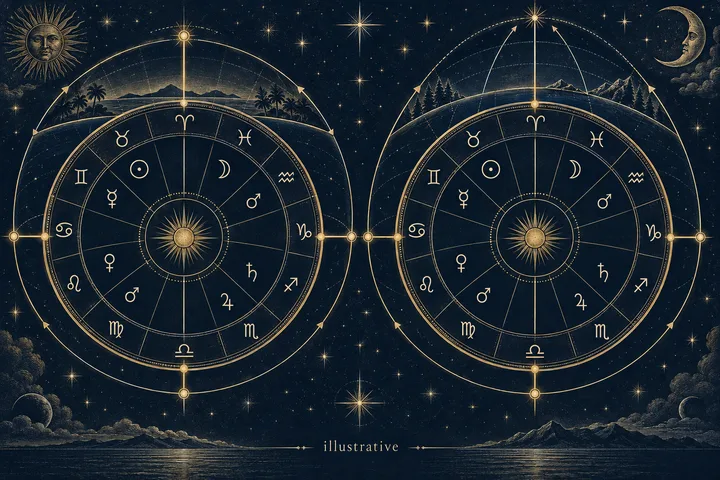
Picture the celestial sphere as a broad shell around Earth. The horizon divides the sky above you from the part below your ground. Latitude sets how that plane is tilted relative to the celestial poles. At the North Pole, the north celestial pole lies overhead; at the equator, it sits on the horizon; between them, it appears at an intermediate height. OpenStax's Astronomy 2e uses this relationship to explain why star paths change with latitude. The zodiac lies along the ecliptic, while the Ascendant is found where that path meets the local eastern horizon. Change latitude, and you change the geometry of that meeting place.
That is a geometric account, not yet an interpretation of what an angle means between two people. The Ascendant names a point in a chart's local frame. Astrology reads that point as part of how a person meets life and how another person's placements may engage their immediate presence. First establish which angle the inputs produce; then interpret the contact. A different latitude can change the angle or house boundaries without requiring a different Moon, Venus, or Mars sign, provided the birth instant, zodiac reference, and geocentric convention stay the same.
The Swiss Ephemeris programming documentation makes the input structure concrete. Its house calculation interface takes Universal Time, geographic latitude, longitude, and a house-system code. It specifically calls for geographic latitude, the observer's latitude, rather than geocentric latitude measured from Earth's center. The inputs do different jobs: Universal Time identifies the moment; longitude locates the observer east or west; latitude locates the observer north or south and shapes the local horizon; the house code selects a division method. Change more than one at once, and you may see a changed chart without knowing which input caused it.
The Celestial Sphere, Reference Planes, and the Observer, published by Kerykeion, describes the Ascendant as the ecliptic's eastern-horizon crossing and explains the horizon's dependence on latitude. Read alongside the Swiss Ephemeris interface, it separates the mechanism from the settings: latitude affects horizon geometry, while the house method governs how chart space is divided. A location change can affect the Ascendant and cusps, though the result depends on the inputs and chosen method. No shortcut tells you the shift without the birth moment and coordinates.
The clock is part of that record. A birth certificate gives local civil time, while chart software must place the moment on a common scale such as Universal Time. Use the correct historical time-zone offset, including daylight-saving rules. Once the moment is established, latitude and longitude describe where the observer was. A birthplace alone doesn't show which coordinates or time conversion the program used; calculators can display the same city and rely on different assumptions.
The zodiac reference must also match before you compare sign labels. A zodiac maps positions along the ecliptic into named signs; changing that reference can change a label even when location is untouched. A different planetary-position convention can also make outputs unlike each other. Neither is a latitude effect, but both belong in the input audit. Hold these choices steady when asking the narrow question: what did birthplace latitude change?
Record each chart's local birth date and time, Universal Time or conversion, geographic coordinates, zodiac reference, planetary convention if stated, and house system. Mark each known, assumed, or missing. Then keep two columns. In the planetary column, retain supplied Moon, Venus, and Mars signs that use the same moment and zodiac. In the local-frame column, list the Ascendant, MC, and houses, noting whether their inputs are documented. This keeps one missing coordinate from making all chart information seem equally uncertain.
A matching city name doesn't prove that two reports used the same coordinates, converted the local clock alike, or selected the same house method. Ask what inputs each report records. If latitude is the only changed value in a controlled recalculation, inspect the horizon-based angle and local house geometry. If the timestamp, longitude, zodiac, or house setting changed too, the comparison hasn't isolated latitude. Keep the planetary placements available while you resolve that difference. The local frame adds context; its reliability depends on its own inputs.
Sources: Swiss Ephemeris Programming Interface; The Celestial Sphere, Reference Planes, and the Observer; The Sky Above
Why latitude moves the Ascendant
The Ascendant can change when birthplace latitude changes because it marks a local meeting point: the place where the ecliptic crosses the eastern horizon. The shift might stay within one sign, or it might carry an Ascendant near a sign boundary into the next sign. The geometry is easier to picture as a change in the angle of the sky. The celestial sphere is a useful map: Earth’s axis extends outward to the celestial poles, while the observer’s horizon divides the visible sky from the hidden sky. In “The Sky Above,” OpenStax explains that the north celestial pole appears at an altitude equal to an observer’s latitude. At the equator, the poles sit along the horizon; at the pole, one pole appears overhead. That is why the Ascendant is not simply a second name for a planet’s sign. A planet’s zodiac position is measured along the ecliptic from a chosen zodiac reference. The Ascendant is a point on that same ecliptic selected by its intersection with the eastern horizon. “The Celestial Sphere, Reference Planes, and the Observer,” Kerykeion’s technical guide, describes the horizon as local and says that observers at different latitudes have different horizons at a given moment. It identifies the Ascendant as the ecliptic’s eastern-horizon crossing. The word “same” matters here. For a clean comparison, keep the birth instant in Universal Time, longitude, zodiac reference, and planetary position convention fixed. Change latitude only. Swiss Ephemeris programming documentation shows why those controls matter: its house calculation takes Universal Time, geographic latitude, geographic longitude, and a selected house method as inputs. Still, it gives a practical test: if two charts differ, write down what actually changed before assigning the difference to latitude. Now separate a changed degree from a changed sign. A rising degree can move within the same sign, leaving the rising-sign label unchanged while making a close angle-to-planet contact tighter or wider. If the original Ascendant sits near the edge of a sign, a latitude-driven shift can cross that boundary and change the label. In synastry, an exact contact may depend on degrees even when both reports show the same rising sign. Conversely, a new sign label does not establish that an angle contact is close. Check the actual degree and the chart inputs before interpreting either result. In practical terms, the sign describes a broad placement, while the degree tells you whether a claimed conjunction or other close contact is actually present under the chosen orb. The amount and direction of the shift depend on the sky moment and where the ecliptic meets the horizon. Kerykeion’s guide explains that different parts of the ecliptic rise at different rates, a pattern called oblique ascension. At the equator, its account says the ecliptic rises in equal time intervals; at higher latitudes, some zodiac signs rise more quickly than others. This is why a simple rule that every four minutes changes the Ascendant by one degree cannot describe every place and moment. The Ascendant responds to the changing intersection, and that response is not uniform around the zodiac or across latitudes. Consider this example, as an illustration rather than a personal chart. A couple has two reports that agree on the supplied Moon, Venus, and Mars signs. One report also lists an Ascendant contact to a partner’s planet; the other shows a different rising degree after a controlled recalculation at another latitude. The useful first conclusion is modest: their planetary sign comparison remains available, while the angle contact needs review. If the Ascendant moved but stayed in its sign, the sign-level description remains, yet the exactness of the contact may have changed. If the rising sign changed, the angle’s sign-based interpretation also needs to be reconsidered. Astrologically, the Ascendant adds a local and embodied layer to synastry. Readers often use it to consider immediate presence, recognition, first approach, and how one person’s manner meets the other person’s chart. Keep those steps distinct. A changed angle can refine the picture of how a connection is experienced, but it should not overrule a clear Moon-Moon or Venus-Mars comparison merely because it is visually striking in a chart wheel. A useful reading therefore ranks the evidence. First, retain personal-planet signs when the birth moment, zodiac, and geocentric convention match. Next, use degrees to assess planet-to-planet aspects only when those degrees are available and the report’s orb rule is clear. Then consider an Ascendant-to-planet contact if the birth time, coordinates, and calculation settings are known. It keeps each conclusion tied to the inputs that support it. When those inputs are incomplete, “provisional” is a real interpretive status: it lets you keep what is known without pretending the uncertain angle has been settled. So treat a latitude-driven Ascendant change as a meaningful refinement, not a reason to discard stable planetary synastry. Confirm the exact rising degree and the time and place settings before giving an angle contact extra weight. If the degree is verified, interpret the contact as another layer alongside the personal planets. If it is not, keep the Moon, Venus, and Mars comparison in view and leave the angle open. That is the fair comparison: preserve the stable layer, test the local one, and let each say only what its inputs can support.
Sources: The Sky Above; The Celestial Sphere, Reference Planes, and the Observer; Swiss Ephemeris Programming Interface
Why the MC needs a separate comparison
The MC and Ascendant are both chart angles, but they answer different geometric questions. The Midheaven, or MC, marks where the ecliptic crosses the upper meridian. The Ascendant marks where the ecliptic crosses the eastern horizon. That difference matters when you compare charts from different latitudes: latitude changes the observer’s horizon, while the MC is tied more directly to the meridian and local sidereal time. The technical reference The Celestial Sphere, Reference Planes, and the Observer defines the local meridian as the great circle passing through the observer’s zenith and the celestial poles. Its upper half crosses the ecliptic at the MC. The same source defines the Ascendant at the eastern horizon and explains that observers at different latitudes have different local horizons. In plain terms, the MC is a meridian intersection; the Ascendant is a horizon intersection. They should not be treated as two versions of one location-sensitive point. This gives you a useful way to test a latitude claim. Imagine a controlled recalculation in which the birth instant in Universal Time, longitude, zodiac reference, and calculation settings all stay fixed while latitude changes. The local horizon changes, so the Ascendant can move. The meridian reference remains tied to the same time and longitude, so latitude does not enter the MC in that same direct way. This is why a different Ascendant alongside a stable MC can fit a latitude-driven difference. Swiss Ephemeris programming documentation makes the inputs visible. Its house-calculation function takes Universal Time, geographic latitude, geographic longitude, and a selected house method, and returns both the Ascendant and MC. That list alone does not mean every output responds identically to every input. The angles are built from different intersections. The Celestial Sphere, Reference Planes, and the Observer states the complementary relationship: the right ascension of the MC equals local sidereal time. In the controlled comparison, holding the time and longitude reference fixed holds that meridian framework steady, while changing latitude alters the local horizon geometry used for the Ascendant. The control matters. If you compare two chart screenshots with no record of their inputs, you cannot attribute a changed MC or Ascendant to latitude alone. A birthplace change can also bring a different longitude, and longitude affects local sidereal time. A changed local birth-time conversion can produce a different Universal Time, which changes the sky moment being calculated. The selected house method, zodiac setting, or software convention may also differ. A simultaneous change in both angles is a prompt to audit those inputs, not proof that latitude moved both in the same way. For an angle-by-angle check, write down the birth time as entered, its Universal Time conversion if available, the birthplace coordinates, the zodiac reference, and the named house method. Then compare the MC and Ascendant separately. If the time and longitude match but latitude differs, an Ascendant change with a stable MC is consistent with the geometric distinction described above. If the MC also changes, check the time and longitude reference first, then inspect the software settings. You need the controlled inputs before you can tell which cause fits. In synastry, these angles contribute different interpretive emphasis. Astrologers may read an Ascendant contact as immediate presence, recognition, or the way two people meet each other in daily life. An MC contact may be read through direction, public expression, vocation, or aims a pair brings into view. Those are astrological interpretations of the angles, not conclusions supplied by the geometry itself. Neither contact automatically outranks the other; its usefulness depends on the question being asked and on whether the angle was calculated from dependable inputs. So keep the comparison specific. A latitude-sensitive Ascendant contact can add context once its degree and birth data are clear. A reported MC contact deserves its own check against time, longitude, and calculation settings. When the MC remains stable while the Ascendant changes under a controlled latitude comparison, the result is coherent. When both shift between unverified reports, leave the cause open until the meridian and clock inputs have been checked.
Sources: The Celestial Sphere, Reference Planes, and the Observer; Swiss Ephemeris Programming Interface
Could time, longitude, or a time-zone error look like latitude?
Yes. A difference blamed on latitude may come from longitude or from the clock conversion that turns a recorded local birth time into Universal Time (UT). Either can change the chart angles. Birthplace enters the calculation in two ways: its coordinates locate the observer, while its time-zone history helps establish the instant being cast. So compare the inputs before interpreting the changed chart. Start by copying each report’s stated birth date, local time, birthplace, latitude, longitude, time-zone offset, daylight-saving adjustment, zodiac reference, and calculation settings. If a report omits an item, mark it unknown. Astrodienst’s explanation of natal chart settings distinguishes birthplace and birth time, which determine the Ascendant and houses, from a reference place used to display local transit times. A current residence is therefore not a substitute for birthplace when checking a natal angle. The cleanest test changes one input at a time. First, preserve the reported instant in UT and hold longitude, zodiac, and calculation convention constant. Change only latitude. That comparison isolates the latitude effect on the local horizon and the Ascendant. It doesn’t show what would happen at the person’s actual birthplace if that place also has a different longitude or if the recorded clock time was converted incorrectly. It is a controlled comparison, not a replacement chart. Next, restore the recorded latitude and vary longitude alone while keeping UT fixed. Longitude changes the observer’s local sidereal time, so it can affect the angles even when the sky moment remains the same. Then check the clock conversion separately: take the recorded local time and date, identify the historical offset that applied there, and verify the resulting UT. A mistaken offset changes the instant itself. That can move both angles, and it can also affect time-sensitive planetary degrees. Don’t attribute a difference to latitude when the two reports represent different instants. | Input changed | What it can affect | What it cannot establish by itself | | --- | --- | --- | | Latitude, with UT and longitude fixed | The local horizon and Ascendant geometry | That another report used the same time or coordinate convention | | Longitude, with UT and latitude fixed | Local sidereal time and chart angles | That latitude caused the angle difference | | Historical time-zone or daylight-saving conversion | The UT birth moment, angles, and time-sensitive degrees | Which conversion is correct without the recorded place and date | | Zodiac or position convention | How positions are represented or labeled | That a location change caused a planet-sign difference | In a synastry reading, planetary placements and local angles answer different questions. If the birth moment and zodiac agree, keep the Moon, Venus, and Mars comparison in view while you investigate a disputed Ascendant or house overlay. If the time itself is uncertain, mark any time-sensitive degree comparison for its own check rather than treating the chart’s location as the only unknown. Coordinate signs offer another easy source of confusion. Swiss Ephemeris documents geographic longitude with east positive and west negative. Its house interface takes UT, geographic latitude, geographic longitude, and a selected house method. NOAA’s older Solar Position Calculator explicitly says it uses a non-standard convention: it treats longitude and time zone as positive to the west, and its instructions warn that choosing a city can fill or overwrite coordinate fields. NOAA’s page is a solar calculator, not an astrology chart authority. Its value here is narrower: it shows why a number copied between tools must travel with the convention that gives the number meaning. don’t assume that a minus sign or an east-west label means the same thing in every program. Read the selected tool’s input notes. Record whether the location was selected from a city list or entered manually, and check that an automatic time-zone value wasn’t left in place after changing the city. If the software reports the time zone but not the coordinates or conversion basis, retain that uncertainty in your comparison instead of quietly treating the displayed angle as exact. A practical audit can fit on one page. Put the two reports side by side. Mark the birth date and recorded local time first; then write the historical offset and UT each report used, if shown. Add latitude and longitude with their signs, the zodiac reference, and the house or position settings. Circle the first mismatch. If the only mismatch is latitude, test the local-frame difference. If longitude differs, test that separately. If the UT values differ, settle the time conversion before reading angle contacts. When several fields are absent, the responsible result is “unresolved,” not “latitude changed it.” This order protects the useful part of the comparison. An Ascendant can differ because latitude changed the horizon, but a longitude mismatch or clock error can produce a similar visible discrepancy. Until the inputs match, the screenshot alone can’t tell you which cause is responsible. Keep confirmed planetary signs provisionally when their instant and zodiac agree; give a disputed angle extra weight only after the coordinates and time conversion are clear. The next useful question is specific: which input changed between these two charts?
Sources: Swiss Ephemeris Programming Interface; Solar Position Calculator instructions; Astrolog: Natal chart settings and reference place
When a personal-planet sign can appear to be the exception
A birthplace change does not ordinarily change a geocentric Moon, Venus, or Mars sign when the birth instant and zodiac stay the same. The narrow exception to check is a topocentric calculation, which refers a planet's position to the observer's location. Swiss Ephemeris documentation says this location-based effect can reach several arcseconds for planets and more than a degree for the Moon. That describes a possible positional difference, not a routine sign change. If a reported placement sits near a sign boundary, check the calculation convention and the unrounded degree before deciding that latitude changed the sign. “Geocentric” and “topocentric” name the center from which a position is calculated. A geocentric position is referred to Earth's center; a topocentric position is referred to a place on Earth's surface. The Swiss Ephemeris guide lists topocentric positions as a selectable calculation mode, separate from ordinary planetary calculations. Its programming manual likewise identifies a topocentric flag and requires geographic settings for that mode. So when two reports disagree, first ask whether they used the same center. A location-sensitive position is a different calculation choice from a geocentric one. It isn't evidence that the ordinary geocentric planetary sign changes whenever a person is born farther north or south. The distinction matters most when the displayed degree is close to the line between signs. A zodiac sign is assigned by dividing the ecliptic into twelve named spans. A small change in longitude can leave the label untouched for most placements, yet move a boundary-near position from one span into the next. That's why the sign label alone cannot settle a close disagreement. Compare the underlying longitude, its precision, the zodiac reference, and the position center. Swiss Ephemeris documents both geocentric and topocentric options, and its guide discusses multiple zodiac references, including sidereal settings. Two calculators can therefore present different labels because they used different conventions, even when the recorded birth moment is the same. Keep the claim modest. The Swiss Ephemeris guide's statement that a topocentric lunar position can differ by more than a degree gives a reason to inspect a Moon close to a boundary. It does not say that the Moon usually changes signs when birthplace latitude changes, nor that every chart program uses topocentric positions by default. The wording describes the possible scale of a topocentric versus geocentric position difference. It doesn't establish that a particular couple's Moon changed signs, or that latitude alone caused a reported difference. No personal placement can be inferred from that general technical note. There is a more common confound: identical local clock readings do not necessarily identify identical Universal Time. A birth recorded at the same hour in two cities may correspond to different instants because civil clocks use local time rules. If a chart is recalculated after changing place, the software may also apply a different historical time-zone or daylight-saving offset. Then the planetary positions can differ because the moments differ. That is a time-input change, not a latitude effect. The programming manual describes planetary calculations as functions of Universal Time, which makes the audit straightforward: compare the resolved Universal Time, rather than assuming matching wall-clock times mean matching sky moments. A zodiac mismatch creates another apparent exception. Tropical and sidereal calculations use different zodiac references, so the same ecliptic longitude can receive different sign labels under those conventions. The Swiss Ephemeris guide devotes a section to defining the zodiac and documents sidereal calculations with selectable settings. If one chart uses a tropical zodiac and another a sidereal zodiac, their sign names should not be compared as though only the birthplace changed. State the convention first. Then compare like with like. For synastry, this keeps the placement reading useful. If the supplied Moon, Venus, and Mars signs were calculated for the same birth moments, zodiac, and geocentric convention, retain those signs as the stable planetary layer while you check a disputed angle or house overlay. If one degree is boundary-near, mark that placement for verification rather than treating all three personal planets as uncertain. The exception is specific to the position and settings that create it. It doesn't erase separate sign comparisons whose inputs agree. A clean disagreement check follows a short order. Compare each chart's recorded local birth time and resolved Universal Time. Confirm both use the same zodiac reference. Check whether both planetary positions are geocentric or whether one explicitly uses topocentric positions. Then inspect the full degree, not just the rounded sign label, for any planet near a boundary. The Swiss Ephemeris documents support these as distinct inputs and calculation choices; they do not tell us which settings an uninspected chart report used. If the reports don't disclose them, call the disputed sign unresolved rather than assigning the cause to latitude. The practical rule is simple: preserve matching geocentric signs when time and zodiac agree, and investigate only the placement whose degree could cross a boundary under a different convention. For a disagreement, compare timestamp, zodiac, and geocentric/topocentric setting first. Ask for degree-level verification only where the boundary makes it relevant. This protects a meaningful Moon, Venus, or Mars comparison from being discarded because one report's local chart frame remains uncertain, while leaving room for a genuine topocentric exception when the calculation actually used that convention.
Sources: Swiss Ephemeris documentation; Swiss Ephemeris Programming Interface
What changes again when the house system changes?
House overlays add a second choice after the local angles have been calculated: the house system determines how the chart is divided. Whole Sign, Equal, and quadrant systems can place the same partner's planet in different houses while its zodiac longitude and the chart's angles remain fixed. A placement near a house boundary is especially sensitive to that choice. So when one report says a planet falls in a particular house and another does not, first ask whether the reports use the same house system.
A house system maps the local sky onto twelve houses. The Swiss Ephemeris documentation describes multiple systems because they use different constructions, Equal houses divide the zodiac into twelve thirty-degree houses starting from the Ascendant. Whole Sign makes the Ascendant's sign the first house, with each complete sign forming one house. Quadrant systems use the chart's angular framework and divide the space between angles according to a chosen method. Swiss Ephemeris describes distinct procedures for Placidus, Koch, Campanus, and Regiomontanus. These are calculation definitions, not a ranking of which tradition should interpret a relationship.
The useful distinction is between a planet's position and the house boundary used to describe where that position falls. Hold the birth moment, coordinates, zodiac, and planetary positions constant. Then change only the house-system setting. The planet retains its zodiac longitude; the house cusps can be drawn differently, so a planet close to one of those boundaries may receive a different house label. A planet comfortably within the same house across the methods you compare is more robust to that choice. This is method sensitivity, not evidence that the planet changed signs or that the relationship itself changed.
Whole Sign and Equal can look similar because each divides the zodiac into twelve equal portions, but their starting points differ. In Whole Sign, the Ascendant's sign identifies the first house, even when the Ascendant degree falls partway through it. In Equal houses, the Ascendant degree begins the first thirty-degree house. Those rules can produce different cusps and overlays, especially for a planet near a boundary. Quadrant methods use the angles and their own divisions; they need not match either equal-house arrangement. That is enough here. There is no need to turn this into a contest over which system every astrologer must use.
Synastry also asks whose houses receive whose planets. If Partner A's Venus falls in Partner B's fifth house, that describes one direction of the overlay: A's Venus is being read through B's house structure. Reverse the charts and ask where B's Venus falls in A's houses. It may be a different house, because each person's chart has its own angles and house divisions. Keep the names attached to both sides when recording the result. A bare note such as “Venus in the fifth” loses the crucial information about whose Venus and whose fifth house are meant.
Try a robustness check with two chart reports. First record each named house system, Ascendant, and birth data. Then compare one chart under its stated system and one alternative, keeping the birth moment, coordinates, zodiac, and planetary positions fixed. Note which of the other person's planets remain in the same houses and which cross a cusp. Repeat for the second chart. This is a comparison procedure, not a claim that a chart has been recalculated here. An overlay that survives the declared alternatives depends less on house-system choice. If it changes, keep it conditional and name the method that produces it.
That result can still be useful. A house placement is an interpretive layer, and a conditional layer can add texture when its assumptions are visible. But it should not outrank a stable planet-to-planet contact merely because one report prints a vivid house label. Ask whose planet enters whose house, which system supplies the house, and whether the planet sits near a cusp. Then compare the overlay with signs and degree contacts that remain the same under agreed settings. The goal is not to erase house symbolism; it is to know what claim it supports.
Latitude adds a practical check, especially at high latitudes. The Swiss Ephemeris documentation says that beyond the polar circle, Placidus and Koch cusps sometimes can and sometimes cannot be computed. It describes one behavior in which this library switches to Porphyry and returns a warning under a specified condition. It also notes different handling for other systems and situations. This describes one implementation. It does not establish that every astrology program uses the same fallback or that every high-latitude chart fails. Check the software's selected method and any warning instead of assuming a silent result represents the requested method.
The Swiss Ephemeris programming documentation lists Universal Time, geographic latitude, geographic longitude, and a house-method code as inputs to its house calculation. First verify the reports use the same birth moment and location data; then identify each house method; only then compare overlays. If the method differs, the label may change while the planet's position does not. Record any high-latitude warning or fallback. Without the method label, readers cannot tell whether an overlay is stable or conditional.
For a couple, record four things: whose planet, whose house, the house system, and whether the overlay persists under a second declared method. Note any software warning or fallback. If the placement stays put, treat it as a stronger house-level theme within that framework. If it shifts across systems or sits near a cusp, describe it conditionally and give more weight to planetary signs and degree contacts that remain stable. Report the overlay, name the method, and show what changes when the method changes.
Sources: Swiss Ephemeris technical documentation; Swiss Ephemeris Programming Interface
How should a couple compare the two reports fairly?
A fair comparison starts by separating planetary placements from the local frame of angles and houses. Put the supplied Moon, Venus, and Mars signs in one column, with degree contacts that both reports support. Put the Ascendant, Midheaven (MC), house system, and angle contacts in another. For each item in that second column, record the birth time and place inputs behind it. This split keeps a disputed rising sign from erasing planetary information the reports share.
The Swiss Ephemeris Programming Interface lists Universal Time, geographic latitude, geographic longitude, and a house-system code as inputs to its house calculation, which returns cusps and the Ascendant and MC. That is one library's documented method, and a useful model for an input audit. It shows why an angle or overlay carries assumptions about time, place, and method. A supplied planetary sign can still be compared while an uncertain Ascendant remains open. For a controlled latitude comparison, hold Universal Time and longitude fixed while varying latitude; test longitude and house method separately.
Use this sequence to compare reports without inventing chart data or guessing what the other person meant.
1. **Transcribe the inputs.** Copy the local birth time and birthplace exactly as shown, plus any coordinates, zodiac label, house system, and position convention. Mark gaps as unknown. Don't fill them with a guessed time or city-center coordinate. If a report doesn't display a setting, write “not stated.” That tells you where confidence must stop.
2. **Align the birth instants.** Convert each local civil time using the historical time-zone and daylight-saving offset for that date and place, then compare the resulting Universal Time values. Swiss Ephemeris documents house calculations using UT and separately documents time conversions. The point isn't to calculate an ephemeris by hand. It's to avoid treating equal clock readings as the same sky moment when they belong to different places or dates. If the birth instant is uncertain, mark time-sensitive angles conditional.
3. **Check zodiac and position conventions.** Reports can use different zodiac references or calculation settings. Compare sign labels only after checking what each report states. Keep this distinct from latitude: a changed label doesn't show that latitude changed a planet's sign. It means an input or convention needs to be identified first.
4. **Compare personal planets and degrees.** Read Moon, Venus, and Mars signs, then compare degrees only when both reports provide them. Signs support a broad reading of emotional style, affection, and desire. Degrees allow more exact planetary contacts, under the declared orb. Don't turn a sign-level resemblance into a precise aspect or fill in a missing degree. If signs, timestamps, and zodiac convention agree, preserve that shared layer while you inspect a local-frame difference. When degrees are available, record the exact aspect and orb the report applies; the Synastry Comparison Report uses selected major aspects with a six-degree orb. That stated limit keeps a broad sign comparison distinct from a degree-based contact.
5. **Audit angles when their inputs are visible.** Compare Ascendant and MC labels and degrees, attaching each to its stated time, coordinates, and convention. If one report gives an Ascendant and the other doesn't, that's one documented result and one unknown, not a disagreement. If both show different Ascendants, inspect the inputs before blaming latitude. A different time conversion or longitude can also shift angles. The report names alone don't reveal which variable changed.
6. **Compare overlays under a named house system.** Record whose chart receives the other person's planet. “Their Venus in my fifth house” and “my Venus in their fifth house” are distinct observations. Then check whether the reports use the same system. The Astrodienst Swiss Ephemeris documentation describes Whole Sign houses as beginning the first house at the start of the Ascendant's sign; Equal houses from the Ascendant begin at its degree and divide the zodiac into twelve thirty-degree houses. These definitions show why a planet's house assignment may change with method even when its zodiac position hasn't moved. Compare the overlay under the stated method and, if useful, one named alternative. Keep each result method-specific.
7. **Label confidence plainly.** Use three labels: stable, conditional, or unresolved. “Stable” means relevant placements and conventions agree. “Conditional” means the reading depends on a stated input, such as the house system. “Unresolved” means a key input is missing or the reports conflict without explaining why. This is a comparison aid, not a compatibility score. It stops a conditional overlay from outweighing a planetary contact both reports support.
Consider an illustrative couple whose reports show matching supplied Moon, Venus, and Mars placements but different Ascendants for one person. That difference doesn't cancel the shared planetary comparison. Ask whether the recorded times resolve to the same Universal Time, whether coordinates and zodiac match, and whether each report names its house method. If these details don't agree, the comparison hasn't isolated latitude. Keep the planetary column; mark the angle conditional or unresolved. The method needs no invented signs, degrees, or relationship outcomes.
If you want to resolve the mismatch, ask which birth time and birthplace each report used, how local time was converted, what coordinates were entered, and which house system was selected. A corrected time can change the local angles; corrected coordinates can change the local frame; a different declared convention can explain different labels. Which explanation applies depends on those inputs, not on a general rule that one report is more trustworthy.
Then read the layers together without blending their certainty. Planetary signs and supported degree contacts describe one part of synastry. Angles and house overlays can add a local emphasis when the birth data and method are documented. If an angle or house placement doesn't survive the input check, set that piece aside. You can still interpret shared placements, and you know which information could change the angle reading.
Sources: Swiss Ephemeris Programming Interface; Swiss Ephemeris technical documentation; Astrolog: Natal chart settings and reference place
What can a placement-only synastry report tell you?
A placement-only synastry report can compare supplied Moon, Venus, and Mars signs, then examine selected major aspects if both people’s degrees are available. It can help you see how emotional needs, affection, and desire may meet across the two charts. But those supplied placements do not reveal either person’s Ascendant, Midheaven (MC), house cusps, or house overlays. Those require a separate chart calculation using birth time, birthplace coordinates, zodiac reference, and a named house method. That distinction matters in this question. You may have useful planetary information even when the local chart frame remains unknown. Keep the two layers separate. A placement comparison can stand on its own; an angle or house reading needs its own inputs and method. The Moon, Venus, and Mars each bring a different question to the comparison. The Moon describes emotional rhythm, familiar responses, and what helps a person feel at ease. Venus points to affection, attraction, values, and the ways someone gives or receives pleasure. Mars describes desire, initiative, assertion, and how energy moves toward what a person wants. In synastry, these planets let you compare distinct parts of relating. They don’t collapse into one score, and one placement shouldn’t be asked to speak for the whole relationship. Start with the signs you actually have. If one person’s Moon is in a known sign and the other person’s Venus is also known, you can consider how emotional comfort and affection might support each other or ask for adjustment. A sign-level reading describes a broad style. It does not establish an exact aspect between those planets. The same is true of Venus and Mars: comparing their signs can open a useful question about attraction and pace, but the signs alone don’t tell you how close the planets are by degree. That’s where optional degrees add precision. An aspect is an angular relationship between two chart points. To decide whether a particular contact falls within an orb, you need the planets’ degrees as well as their signs. This report’s selected major-aspect calculations use a six-degree orb when degree data is supplied. The orb is the allowed distance from an exact aspect; a contact farther away falls outside that stated range. The rule makes the comparison reproducible. It doesn’t turn the result into a verdict about the pair. Without degrees, keep the reading at sign level. Two planets in signs associated with a familiar aspect pattern may invite a closer look, but don’t call the contact exact or tight without the positions needed to measure it. With degrees, you can ask whether a selected aspect qualifies under the report’s declared orb and then interpret what the two planets are doing together. The sign describes their style; the aspect describes a relationship between their positions. Those are related observations, but they are not interchangeable. An angle contact belongs to another layer. If a separately calculated chart shows one person’s planet contacting the other person’s Ascendant, that can add a local, immediate quality to the synastry reading. The MC contact brings a different angle into view. Yet the supplied Moon, Venus, and Mars signs alone cannot show whether either contact exists. They do not contain the birth-time and location information needed to calculate those angles. A placement-only report therefore can’t confirm, reject, or calculate an Ascendant or MC connection from birth details. The same boundary applies to houses. A house overlay asks where one person’s planet falls in the other person’s chart. To answer it, you need the receiving chart’s houses, which depend on a calculated local frame and the chosen house system. Swiss Ephemeris’s programming documentation lists Universal Time, geographic latitude, geographic longitude, and a house-system code among the inputs to its house calculation. That technical list shows why a planet-sign report and a house-overlay reading are different jobs. A known Venus sign doesn’t disclose which house it occupies in another person’s chart. If you already have angle or house information from a separate calculation, you can bring it into your reflection as an additional layer. Keep the labels attached: note whose chart supplies the angle, whose planet makes the contact, and which house method produced the overlay. If the angle’s birth time or coordinates are uncertain, mark that layer provisional. You can still discuss supplied planetary placements while you resolve the missing chart inputs. For a practical comparison, make two short lists. Put each person’s supplied Moon, Venus, and Mars signs in the first, adding degrees only when you have them. Record any qualifying selected aspects under the stated six-degree orb. In the second list, place separately calculated Ascendant, MC, and house contacts with their source inputs and method. This keeps the reading honest and useful: you can begin with the placements you know, while giving location-sensitive angles the weight they earn from verified calculations. If you want to compare known signs and optional degrees, the Synastry Comparison Report can help with that layer. It won’t calculate a natal chart, angles, or houses from birth details.
Your next step: keep the stable layer and verify the angle
Keep the Moon, Venus, and Mars comparison when both reports use the same birth moment and zodiac. Before an Ascendant or house contact carries extra weight, check the inputs that locate it. Three steps will show what is settled and what remains open. First, write down where each placement came from. Mark the birth time, birthplace coordinates, and calculation settings beside each angle. The Swiss Ephemeris programming documentation lists Universal Time, geographic latitude, longitude, and house method as inputs to house calculations. A place name alone doesn't show that two reports used matching settings. Next, compare the angle degrees and house methods. The Swiss Ephemeris documentation on topocentric positions distinguishes observer-based from geocentric planetary positions, with the Moon deserving special care near a sign boundary. At high latitudes, Swiss Ephemeris documents method-specific house limits and possible fallback behavior. Check the actual chart tool before applying those details. Then identify the one missing or corrected datum most likely to settle the difference: a time-zone conversion, a coordinate, or a named house method. Latitude changes the local chart frame, especially the Ascendant and house geometry; ordinary geocentric personal-planet signs stay stable when the instant and zodiac match. If the angle survives that input check, read it as added synastry context. If it doesn't, leave it provisional. Keep the placements both reports support.
Sources: Swiss Ephemeris Programming Interface; Swiss Ephemeris documentation
Sources & further reading
- Swiss Ephemeris Programming Interface
Documents the Universal Time, geographic latitude and longitude, and house-system inputs used for house calculations.
- The Celestial Sphere, Reference Planes, and the Observer
Defines the Ascendant at the ecliptic's eastern-horizon crossing and distinguishes it from the MC at the upper meridian.
- The Sky Above
Explains how an observer's latitude relates to the celestial pole's altitude and changes the apparent paths of stars.
- Swiss Ephemeris documentation
Distinguishes geocentric and topocentric positions and describes the potentially larger topocentric positional effect for the Moon.
- Swiss Ephemeris technical documentation
Documents house-system differences and Swiss Ephemeris's method-specific handling of some high-latitude house calculations.
- Astrolog: Natal chart settings and reference place
Distinguishes birthplace and birth time used for natal Ascendant and houses from a reference place used to display local transit times.
- Solar Position Calculator instructions
Shows that coordinate and time-zone sign conventions can differ between tools and should be checked before comparing inputs.
Synastry Comparison Report
Enter known placements for two people. Get an input-by-input comparison, selected aspect calculations and a clear record of what remains uncertain.
Compare our placements