Imagine the easy evening and the same old argument
Imagine Maria and Daniel cooking together on a quiet Friday. She notices that he has had a long day before he says a word. He lowers the music, puts water on the table, and lets her choose the pace of the evening. They seem to understand one another without much effort. Later, Maria asks whether they can make plans for a trip. Daniel wants to decide tomorrow. She hears hesitation. He hears pressure. The conversation circles, grows sharp, and ends with both people feeling misread.
This is an illustrative scene, not a report about a real couple. It gives us the right question. What does a synastry reading do when the chart shows one clear strength and one clear strain? It doesn’t pick the pleasant contact and ignore the difficult one. It doesn’t add them like points on a scale. It asks how the two patterns work together in a relationship that has to move through ordinary moments, including dinner, money, sex, plans, silence, and repair.
The strength might describe recognition, affection, emotional warmth, or a shared rhythm. The strain might describe a difference in pace, a clash of needs, or a pressure that keeps returning until the couple names it. One makes contact easier. The other makes a particular kind of attention necessary. A useful reading holds both in view, then ranks them. Which contact is tighter? Which planets are involved? Does the same theme appear more than once? Where does it show up in life?
That question keeps the symbolism close to experience. If a Venus-Moon contact suggests tenderness, look for the care loop. Does one person offer warmth in a form the other can receive? If Mars-Saturn suggests friction, look for the bottleneck. Is it initiative, timing, anger, sexual pacing, work, or fear of consequences? The chart gives the pattern a language. Your shared life gives it a scene.
The strongest conclusion is simple. A balanced synastry reading should leave you with a resource and a practice. The resource is the contact that comes alive with less effort. The practice is the conversation or boundary that helps you handle the strain. This is more useful than asking whether the chart is positive. Relationships aren’t built from positive and negative numbers. They’re built from repeated choices made inside a pattern.
Sources: Free Synastry Chart Calculator - Astrology Geeks; Synastry shows where two charts make contact - Astrology.ac; Synastry - Skyscript Glossary
What synastry is actually comparing
Synastry compares two natal charts directly. In the classic image, one chart is placed beside or over the other so an astrologer can study the contact between the two sets of planets, angles, and other points. Skyscript describes it as chart comparison through aspects between planetary positions and angles. Astrodienst’s Comparative Astrology entry places synastry beside composite and Davison methods within the wider practice of comparing charts. The method is relational from the start. It asks how one person’s chart meets another person’s chart.
That means a synastry contact has two sides. Your Venus may touch your partner’s Mars. Your Venus remains your Venus, with its own sign, house, dignity, and natal story. Your partner’s Mars remains their Mars, with a different sign, house, and condition. The cross-contact describes what happens when those two functions meet. It doesn’t erase either person’s separate chart. It also doesn’t turn the relationship into a third chart. That would be composite work.
Begin with the planets. They tell you what is meeting. The Moon speaks to feeling, habit, comfort, and the instinctive response. Venus speaks to affection, pleasure, values, and the way warmth is offered. Mars speaks to desire, initiative, assertion, anger, and physical energy. Mercury brings words, thought, learning, and argument. Saturn brings time, limits, responsibility, and structure. The Sun brings identity, vitality, and self-expression. Jupiter enlarges, encourages, and gives meaning. Each planet changes the kind of strength or strain you are reading.
Then read the aspect. A conjunction joins and concentrates. A sextile opens a cooperative channel that still needs use. A trine often carries ease and fluency. A square creates friction, pressure, and the need to adjust. An opposition brings polarity, projection, and a strong meeting of differences. These are not moral labels. A trine can make a pattern so effortless that nobody develops it consciously. A square can keep two people engaged with a problem until they learn how to work it.
Only after that should you bring in signs and houses, if those data are available. The sign describes how the planet operates. The house describes where the partner’s planet lands in the other person’s life. A Venus contact can feel very different when it activates romance, work, home, friendship, or intimacy. A missing birth time limits house and angle work. Known placements and optional degrees can still support a focused planet-to-planet reading, but the scope must stay honest.
This order prevents a common reading error. Someone sees that a partner’s Venus falls in the seventh house and announces partnership before asking what Venus is doing by aspect or sign. Someone else sees a square and announces conflict before checking whether the planets are personal, slow, or echoed elsewhere. The layers belong together, but they don’t all carry the same weight in every question. Start with the function you’re trying to understand, then let the chart show how it enters the relationship.
For a comparison focused on known Moon, Venus, and Mars placements, the first pass can stay small. Write down each person’s sign. Mark the cross-aspects you can support. Circle the closest personal contact. Then ask which planet is offering, which planet is responding, and what kind of exchange the aspect creates. You’re not missing the whole chart because you began with a manageable slice. You’re choosing a clear path through it.
A balanced synastry reading gives the strength and the strain different jobs. The strength shows where connection comes more naturally. The strain shows where the relationship asks for skill, patience, or a new agreement. Neither contact cancels the other. Read the planets first, then the aspect, signs, degree distance, and any repeated theme. A close Moon-Venus trine may describe an easy care loop, while a close Mars-Saturn square may show where desire meets timing, restraint, or frustration. That combination isn’t automatically good or bad. It’s a pattern with a gift and a task. Start by naming one behavior the strength supports and one recurring situation the strain describes. Then ask what choice would let the gift help with the task. If you have supplied Moon, Venus, and Mars placements, with optional degrees, a Synastry Comparison Report can organize those contacts using a stated six-degree orb. It doesn’t calculate a natal chart from birth details or decide the relationship for you.
Sources: Aspect - Astrodienst Astrowiki; Free Synastry Chart Calculator - Astrology Geeks; Synastry shows where two charts make contact - Astrology.ac; Synastry - Skyscript Glossary; Comparative Astrology - Astrodienst Astrowiki
How to rank the clear strength
Don’t rank a strength by how flattering its description sounds. Rank it by contact, planet, exactness, repetition, and expression. A loose Venus sextile may be pleasant. A tight Moon-Venus trine may be felt quickly and often. A Sun-Moon contact may connect identity and emotional life in a way that gives the couple a natural sense of recognition. A Venus-Mars contact may wake affection and desire. The meaning depends on the actual planets and their conditions, not on a promise attached to the aspect name.
A close aspect has more weight than a wide one within the method used. An orb is the distance between the exact angle and the observed angle. If two placements are 120.5 degrees apart, the trine is tighter than one at 125 degrees. Astrology.ac makes the useful point that exactness describes the strength of the contact, not whether the contact is good or bad. That distinction matters. A tight square deserves attention because it is loud. It doesn’t deserve automatic fear.
Next ask whether the strength repeats. Suppose her Moon trines his Venus, and his Moon also connects smoothly with her Venus. The theme of giving and receiving care appears more than once. Suppose instead there is one wide Venus sextile with no other support for affection or pleasure. It can still matter. It simply shouldn’t carry the whole reading. Repetition doesn’t mean counting every line. It means noticing when several contacts point to the same relational function.
Then name the behavior. A Moon-Venus strength might look like small acts of comfort, an easy response to vulnerability, or pleasure in making a shared space feel kind. A Mercury-Jupiter strength might show up as generous conversation, curiosity, humor, or the ability to keep a difficult subject open. A Saturn-Moon strength might offer steadiness during practical hardship, though it can also feel heavy if the Saturn person becomes the authority. The strength earns its place when you can see how it behaves.
Finally, ask who feels the contact and who carries the action. In synastry, the person whose planet receives the other person’s planet may experience the contact differently from the planet person. There is no need to reduce that difference to a rigid rule. Notice it. If his Saturn contacts her Moon, she may feel his structure as containment or restriction, while he may feel responsible for the emotional field. A balanced reading names both experiences. That is already more precise than calling the aspect simply supportive.
Separate availability from reliability. A sextile can offer a skill that appears when somebody chooses to use it. A trine may arrive without planning, yet remain underused because both people assume it will always be there. A conjunction can be powerful and consuming, but the planets still decide whether that intensity feels affectionate, competitive, or overwhelming. The aspect describes the channel. The planets and repeated behavior show whether the channel carries what the couple needs. Ask which contact answers the question in front of you, then give that contact the clearest place in the reading.
For Maria and Daniel, the Moon-Venus trine earns priority because it answers the care question with repeated, observable acts. It doesn’t automatically outrank every other contact in a complete chart. It outranks the contacts that don’t touch their present concern. That is the point of ranking: not to crown a winner, but to keep the interpretation attached to the question the couple is actually trying to answer.
Sources: Aspect - Astrodienst Astrowiki; Free Synastry Chart Calculator - Astrology Geeks; Synastry - Skyscript Glossary; Comparative Astrology - Astrodienst Astrowiki
How to rank the clear strain
The strain deserves the same careful ranking. Start with the planets, not the word hard. Mars-Saturn is different from Moon-Saturn. Venus-Pluto is different from Mercury-Pluto. A square between two personal planets may show a recurring collision between needs or actions. An opposition may create a powerful pull in which each person embodies a quality the other struggles to integrate. The aspect tells you the shape of the meeting. The planets tell you the subject of the meeting.
A strain can be active, slow, or hidden. Mars-Mars may appear in quick disagreements, competing plans, or different ways of pushing forward. Moon-Saturn may appear as a pause before comfort, a fear of burdening the other, or a pattern in which practical concern replaces emotional response. Venus-Uranus may bring excitement and unpredictability around closeness. Mercury-Neptune may blur words, timing, or assumptions. These are interpretive possibilities. The recurring scene tells you which one is alive.
Pay attention to the planet person’s role without turning it into a permanent identity. If his Mars contacts her Saturn, he may feel slowed or judged, while she may feel that his actions create consequences she must manage. Reverse the emphasis and she may feel that his force activates her fear of disorder, while he feels asked to prove desire through speed. Both descriptions can be true in the same exchange. A good reading lets the roles move, because people do.
Treat a square as a task, not a sentence. The friction may force a couple to translate instinct into language. One person acts immediately. The other needs time. One asks for reassurance. The other offers a plan. One wants direct truth. The other softens every edge. The relationship may keep producing the same disagreement until the pair learns to make the invisible rule visible. What counts as urgent? What counts as care? When does a pause help, and when does it abandon the conversation?
An opposition needs a different question. Where do the two of you stand across from each other? Who owns which side of the polarity? A Sun-Saturn opposition can bring respect and seriousness, but also a feeling that one person is always being evaluated. A Venus-Mars opposition can bring magnetic difference, but it may also expose different ways of pursuing and receiving desire. Don’t force the couple to become identical. Look for a fair exchange across the axis.
The strain becomes central when it is tight, personal, repeated, and visible in the same life area. A distant outer-planet contact may describe a generational background unless it touches a personal planet or angle closely. A wide aspect may sit behind the story without driving it. If a supposed difficult contact never appears in lived experience, hold it lightly. A chart reading should sharpen attention, not make you distrust what you actually know.
Also distinguish a difficult exchange from a difficult outcome. Mars-Saturn may describe blocked initiative, but the couple might turn that into careful pacing, shared work, or frustration that stays private until it erupts. Venus-Pluto may describe intensity around attachment, but the lived expression could be deep loyalty, jealousy, creative fascination, or a struggle over access. Keep the symbolic possibilities open only long enough to find the repeated behavior. Then choose the clearest expression and say why it wins.
This protects the reading from two opposite mistakes. A reader can dramatize a hard aspect because its language sounds severe. Or a reader can soften it because the couple also has a beautiful trine. Name the contact, state the likely task, and identify the evidence that would confirm or weaken that interpretation. The strain becomes central when it keeps asking for the same repair.
Sources: Aspect - Astrodienst Astrowiki; Free Synastry Chart Calculator - Astrology Geeks; Synastry shows where two charts make contact - Astrology.ac; Synastry - Skyscript Glossary
What one strength can do for one strain
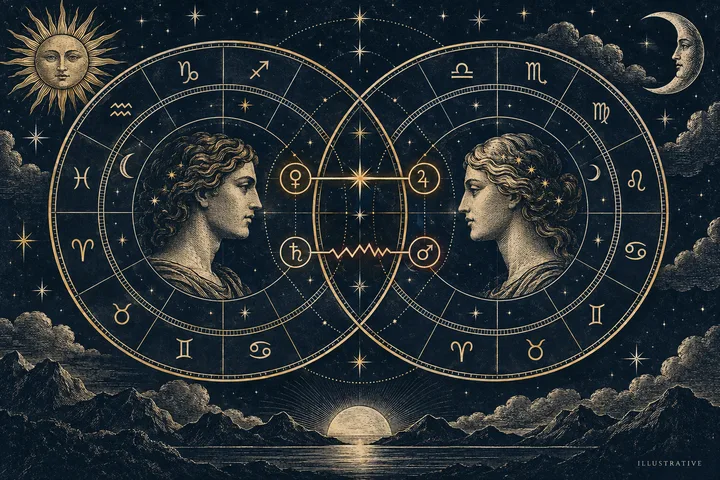
The most useful synthesis asks how the strength can help the couple meet the strain. Don’t say the strength cancels it. It doesn’t. Say the strength offers a channel through which the difficult pattern can be handled. If Moon-Venus makes tenderness easy and Mars-Saturn makes initiative tense, the couple may use warmth to discuss timing without turning the discussion into a test of love. If Mercury-Jupiter supports open conversation and Venus-Pluto intensifies attachment, honest language can give intensity a shape instead of letting it become suspicion.
Consider an example. Maria’s Moon trines Daniel’s Venus, while her Mars squares his Saturn. She feels cared for when he notices small needs. He feels loved when she invites him into ordinary life. But when she wants a decision now, his caution reads as refusal, and her pressure reads as recklessness. The strength is not a magic cushion. It is evidence that care already has a working form. They can use that form when the argument begins: first name the care, then name the practical limit, then choose a time to act.
A theme says, ‘You have emotional warmth.’ A tool says, ‘When the Mars-Saturn pattern appears, begin with the reassurance you already exchange successfully.’ That gives the couple a sequence: identify the trigger, state the need, agree on a next action, and revisit it before resentment makes the conversation harder.
The strength may also reveal what the strain is protecting. A Venus-Saturn contact can look like restraint, but the relationship may be trying to protect reliability, loyalty, or a fear of losing control. A Mars-Jupiter strength can create enthusiasm, while a Saturn square asks whether enthusiasm has a plan. The easy contact shows what the couple wants to grow. The difficult contact shows what must be made durable. That pairing often produces a better reading than either contact alone.
There is a limit. A supportive contact can’t make coercion tender, dishonesty wise, or disrespect romantic. A chart pattern may describe attraction or pressure, but behavior still has to be named plainly. If the lived situation contains fear, control, or a repeated refusal to honor a boundary, no harmonious aspect should be used to soften that fact. Balanced astrology includes the whole picture. It doesn’t use beauty in one part of the chart to excuse harm in another.
Sources: Free Synastry Chart Calculator - Astrology Geeks; Synastry shows where two charts make contact - Astrology.ac; Synastry - Skyscript Glossary
The strongest exception: when the strain carries the relationship
Here is the meaningful exception to a simple strength-first reading. Sometimes the difficult contact is the most alive part of the relationship. The couple may return to it because it creates heat, movement, desire, or a problem neither person can ignore. Crossedskies notes that friction aspects can mark places where people have to negotiate, while a chart made only of easy contacts may feel pleasant but low-stakes. The point isn’t that conflict is required. It’s that ease and vitality are not the same thing.
A tight Mars-Venus square may bring strong attraction and equally strong differences in pace or pursuit. A Saturn contact may create commitment through responsibility, even as it tests patience. An opposition may keep both people aware of the other’s point of view because neither can simply absorb the difference. The strain carries the relationship when both people can engage it without punishment, contempt, or exhaustion. It becomes a shared craft rather than a permanent injury.
The exception has a boundary. Difficulty isn’t automatically depth. Repeated hurt isn’t proof of a profound bond. A couple can feel intense because the pattern is unstable, not because it is sustaining. That is why the reading must return to behavior. Do the two people repair? Can they disagree without making ordinary life smaller for one another? Does the strain lead to clearer agreements, or does it keep demanding the same sacrifice from one person? Those questions decide how the aspect should be weighted in practice.
This distinction matters when the supportive contact is quiet. A Moon-Moon sextile may not create a dramatic first impression. It may show itself in the way two people share silence, recover after a crowded day, or understand why the other needs a familiar routine. A loud Venus-Pluto contact may dominate the story at first, but the quiet lunar ease can tell you more about whether daily life has somewhere to rest. Rank by consequence, not spectacle.
The same contact can also change meaning across time. Early in a relationship, Mars-Uranus may feel thrilling and liberating. Later, the same pattern may ask for more reliable plans. Moon-Saturn may feel cautious at first, then become a source of steadiness during family pressure. Venus-Pluto may begin as fascination and later require honest agreements about privacy, jealousy, and power. The natal charts don’t change, but the life in which they meet does.
So rank the strain by its response, not only its intensity. A loud contact that two people handle with skill may become a place of strength. A mild contact that one person uses to excuse a pattern of withdrawal may become more consequential than its geometry suggests. Astrology offers the map. Repetition, choice, and repair tell you what the road is like.
Sources: Synastry shows where two charts make contact - Astrology.ac; Synastry - Skyscript Glossary
How signs, degrees, orbs, and missing birth information change the reading
Once you have ranked the planets and aspects, bring in the signs. A Moon-Venus trine between earth signs may express care through practical help, routine, and physical steadiness. The same trine between air signs may live through conversation, ideas, and social ease. A Mars-Saturn square between cardinal signs may collide over who initiates and when. In fixed signs it may resist change and hold a position long after the first spark of anger has passed. In mutable signs it may scatter energy, revise plans, or argue over what the problem even is.
Signs don’t replace aspects. They give the aspect a style. A square still has friction. The signs tell you how the friction moves. A trine still has ease. The signs tell you what kind of ease is available. This is why a sign-pair shortcut can’t carry a complete synastry reading. Two people can share compatible elements and still have a tight personal-planet square. They can have different sign styles and still build a strong exchange through close aspects and mutual respect.
Degrees make the ranking more exact. The article’s report scope uses selected major aspects with a stated six-degree orb. Within that scope, a contact at one degree is given more attention than one at five degrees, while both may be included if they meet the chosen rule. The orb is not a universal law that every astrologer handles in exactly the same way. It is a declared method. State it, apply it consistently, and don’t pretend a borderline contact is as loud as an exact one.
Watch for sign boundaries. Two placements can be close by degree yet sit in signs that change the tone of the aspect. A contact near the end of one sign and the beginning of another deserves a careful note rather than a careless label. The geometry and the sign relationship are both part of the reading. When degrees are unknown, stay with what the supplied placements can support. Don’t invent a close aspect because the signs sound compatible.
If two tools show different contact lists, check their orb rules, points, house systems, and time handling before deciding that one reading is wrong. Astrology Geeks explains that different settings can produce different displayed aspects. A clean article or report should make its calculation scope visible. That small act builds trust. It also protects the interpretation from the common mistake of treating software output as the reading itself.
A borderline contact deserves a borderline sentence. If a placement sits just inside the six-degree rule, say that it qualifies under the declared method but carries less weight than a one-degree contact. If a different setting moves it just outside the orb, don’t turn the disagreement into a crisis. Keep the contact as a possible background note, then build the main reading from the aspects that remain stable across the data and the lived pattern. This is especially helpful when a couple is comparing a saved chart with a new report. Record the degrees, the chosen orb, and the aspect list you’re using. Readers can then see why one interpretation leads and another stays secondary.
Known placements are useful, but not every chart layer survives missing data equally well. A birth time matters most for the Ascendant, Midheaven, houses, and other angles. It can also affect the Moon’s degree and, near a sign boundary, the Moon’s sign. Astrology Geeks explains that an uncertain time makes house overlays and angle contacts more cautious. That doesn’t erase the comparison. It tells you which conclusions belong in the center and which belong at the edge.
With supplied Moon, Venus, and Mars signs, you can compare the relationship functions that many readers want first: emotional habit, affection and values, desire and initiative. If degrees are supplied, you can inspect selected major aspects within the declared six-degree orb. If degrees aren’t supplied, you can still discuss sign-based resonance and contrast, but you shouldn’t call an aspect exact or close. Precision is part of interpretation, not an administrative detail added afterward.
Without reliable birth times, avoid claiming house overlays. You don’t know whether a partner’s Venus falls in the fifth, seventh, eighth, or another house. You also shouldn’t build the reading around the Ascendant. An angle can be powerful, but only when the angle is known well enough to use. The honest move is to shift the center of gravity toward the placements and aspects you actually have.
This is also where the two sides of synastry matter. If one person’s degree is uncertain, the contact may move in or out of the chosen orb. A Moon can change quickly. A time estimate that feels close enough for a casual conversation may not be close enough for a degree-specific interpretation. Mark the uncertainty. Then rank the stable themes above it. A strong, confirmed Venus-Mars contact is more useful than a dramatic angle claim resting on a guessed time.
The report offered here follows that boundary. It uses supplied placements and optionally supplied degrees. It can organize Moon, Venus, and Mars comparisons and selected major aspects under a six-degree method. It doesn’t calculate natal positions from birth details, calculate houses, or produce a relationship success verdict. That limitation makes the next step clearer. Gather the placements you know. Mark the degrees you know. Leave the unknowns visible.
Sources: Aspect - Astrodienst Astrowiki; Free Synastry Chart Calculator - Astrology Geeks
Turn the reading into a decision aid
A good synastry reading should change the next conversation. Start with the recurring scene, not the aspect label. Where do you lose one another: timing, money, sex, privacy, anger, planning, or family? Describe the scene in ordinary words. Who acts first? Who pauses? What does each person assume that the other person should already know?
Then place the chart beside that scene. If a Moon-Venus contact suggests easy care, ask how care actually arrives: words, touch, food, time, or practical help. If Mars-Saturn suggests pressure around action, ask what responsible timing means to each person. One may mean deciding before an opportunity closes. The other may mean waiting until the risks are understood. The chart gives the pattern a name; the conversation gives it a fair definition.
Now build one bridge from the strength to the strain. Maria and Daniel could use their easy care loop before discussing a trip: name what each person appreciates, state the decision that needs an answer, set a deadline, and leave room for Daniel to explain the risk he is weighing. The agreement fits the symbolism without pretending that tenderness removes the square. It gives both planets a job.
Make the comparison concrete on paper. In the first line, write the supportive contact and the behavior that shows it, such as ‘Moon trine Venus, notices when the other needs quiet.’ In the second, write the strain and its scene, such as ‘Mars square Saturn, urgency meets caution when plans require a commitment.’ In the third, name the hidden translation each person makes: ‘delay means rejection’ or ‘urgency means danger.’ Then write the request each person can answer without guessing. Maria might ask for a decision by Saturday evening. Daniel might ask for the exact cost and cancellation terms before agreeing. The final line is the test: did they keep the time, answer the question, and repair the conversation if they missed it? This record lets the chart guide attention without taking over the facts.
Test the bridge in one small situation. Write down the trigger, each response, the meaning each person assigned to it, and the repair that followed. Ask who initiated, who received, who named the problem, and who carried the consequence. Reverse those questions too. The same contact can feel different to the person whose planet acts and the person whose planet receives.
If the scene keeps matching the interpretation, the contact has a useful place in the reading. If it doesn’t, revise the interpretation. A wide aspect, missing degree, uncertain house, or different natal context may matter. So may the simple fact that the couple’s real pattern is not the one the first reading suggested. Keep the chart in service of the question.
Choose an agreement you can observe, not a promise that sounds noble. ‘We’ll communicate better’ is too loose to test. ‘We’ll pause for twenty minutes, say when we’ll return, and answer the planning question before bedtime’ gives the pattern a form. The first agreement may need revision. That isn’t failure. It tells you whether the strain needs more time, clearer limits, or a different kind of care.
Sources: Free Synastry Chart Calculator - Astrology Geeks; Synastry shows where two charts make contact - Astrology.ac; Synastry - Skyscript Glossary
Return to the chart with a better question
Return to Maria and Daniel. Their illustrative pattern doesn’t say stay or leave. It shows an easy care loop beside a recurring struggle over timing and initiative. The better question is narrower: can they make decisions without treating delay as rejection or urgency as control?
Their answer should come from one agreement and its results. Which decisions need an answer tonight? Which can wait? When does the waiting end? If Daniel explains the risk and Maria knows when she’ll receive an answer, the square has become a structure they can work with. If the agreement repeatedly fails, that failure matters too.
Rank the evidence in this order: the closest relevant personal contact, the repeated theme, the life area if birth-time data supports houses, and the couple’s response when the pattern appears. A quiet Moon contact may matter more to daily life than a dramatic outer-planet story. A tight aspect that never appears in experience should not outrank what the couple can actually observe.
That is what a balanced synastry reading does with one clear strength and one clear strain. Compare the placements you have, state the orb you’re using, and ask what you already do well together and what you keep asking the other person to guess. Start there.
Sources: Aspect - Astrodienst Astrowiki; Free Synastry Chart Calculator - Astrology Geeks; Synastry shows where two charts make contact - Astrology.ac; Synastry - Skyscript Glossary
A little more clarity
Does one difficult synastry aspect outweigh one supportive aspect?
Not by itself. Rank both contacts by the planets involved, exactness, repetition, and the life area they touch. A tight personal-planet square may deserve more attention than a wide sextile, but attention isn’t the same as doom. Then compare the chart with the recurring situation you actually know. A supportive contact can offer a way to handle the strain, while a difficult contact can reveal a skill the relationship needs. Read the pattern as a whole, and name the practical agreement that would help.
Can I get a balanced synastry reading without birth times?
You can compare many supplied planet placements without exact birth times, especially when the signs and degrees are known. Missing times make the Moon degree, Ascendant, angles, and house overlays less certain, so don’t build the reading around those layers. The Synastry Comparison Report uses supplied Moon, Venus, and Mars placements and optional degrees, with selected major aspects read through a stated six-degree orb. It doesn’t calculate a natal chart from birth details or decide whether the relationship should continue.
Sources & further reading
- Aspect - Astrodienst Astrowiki
Defines major aspects, angular relationships, orbs, and the need to read the planets involved before assigning meaning in a complete astrological interpretation.
- Free Synastry Chart Calculator - Astrology Geeks
Explains chart comparison inputs, inter-chart aspects, personal planet themes, house limits, and why settings affect displayed contacts across different tools and methods.
- Synastry shows where two charts make contact - Astrology.ac
Clarifies that orb measures exactness, that squares and oppositions are not automatically bad, and that the full pattern matters more than an isolated label.
- Synastry - Skyscript Glossary
Places synastry in the tradition of comparing nativities through planetary aspects, angles, and interlocking configurations within the broader practice of relationship astrology.
- Synastry 101: Reading Two Birth Charts Together - Crossedskies
Offers a current practical triage of personal placements and explains why one hard aspect should be read within the whole pattern.
- Comparative Astrology - Astrodienst Astrowiki
Defines comparative astrology and distinguishes synastry, composite, and Davison methods for relating two charts.
Synastry Comparison Report
Enter known placements for two people. Get an input-by-input comparison, selected aspect calculations and a clear record of what remains uncertain.
Compare our placements