Start with the pair, not the score
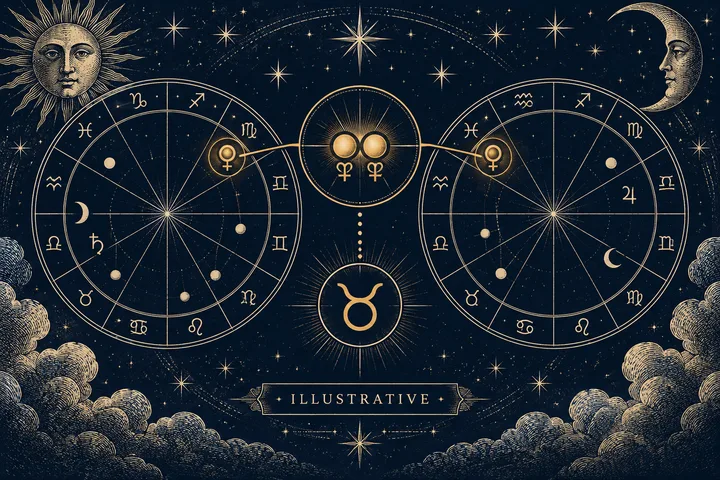
When a synastry report says “Moon conjunct Venus” and then praises the pair for sharing a sign, pause before treating those as two compatibility points. If both descriptions refer to the same two placements, begin with one contact. Let the sign explain its tone; don’t let a second label quietly give the same configuration extra weight. That distinction matters because a reading and a score do different jobs. A reading can describe one contact from several angles: which planets meet, what signs they occupy, and how those symbols combine. A numerical score turns selected features into counted units. If one configuration earns a point as a conjunction and another as shared-sign compatibility, the total may make one piece of chart testimony look like two independent pieces. Our working rule is to record the contact once, then attach its sign context. This keeps the interpretation without inflating its weight. Cafe Astrology’s “Synastry: Love and Relationship Astrology” presents sign comparison and interchart aspects as related but distinct parts of a synastry reading: it recommends comparing Venus signs, then checking whether Venus aspects the other chart’s planets. It also says signs involved in an interchart aspect can illuminate how that interaction is expressed. That supports a layered reading, though it does not set a universal scoring rule. Context can deepen a contact without becoming another vote. There is an exception. A named sign-based method may assign sign relationships their own testimony, even apart from a degree-based conjunction. In “Synastry Compatibility Score: The Discepolo Method,” the scoring guide says not to count certain aspects again in later steps and withholds a sign bonus when a specified Sun aspect has already been scored. Those are rules for that method, not laws for every chart reading. Name your approach before adding points. Then you can audit the result: one contact with sign context, or two separately defined forms of testimony kept distinct. The next step is to identify exactly which placements and relationships each label describes.
Sources: Synastry: Love and Relationship Astrology; Synastry Compatibility Score: The Discepolo Method
What exactly counts as the same evidence?
Two statements repeat evidence when they describe the same two chart placements through the same zodiac relationship. “Moon conjunct Venus” names a planetary contact; “both placements are in Taurus” describes the sign setting of that same pair. Those phrases can add different detail to a reading, but they do not automatically describe two independent contacts. If a report gives both a full aspect point and a full sign-compatibility point, pause and ask what each point measures. A useful identity key keeps the comparison concrete: whose planet is involved, which planet it is, what relation joins the placements, and which zodiac frame the reading uses. In a cross-chart comparison, “Person A’s Moon to Person B’s Venus” is one pair. The aspect label records their relationship under the chosen method; the sign labels, elements, and qualities describe conditions that shape how an astrologer interprets that pair. Different wording does not create another pair. Nor does a list of several sign traits turn one relationship into several measured contacts. That distinction preserves interpretation. In “Synastry: Love and Relationship Astrology,” Cafe Astrology advises comparing the partners’ Venus signs and then checking whether Venus aspects the other person’s planets or points. The page treats these as related steps in a synastry reading: sign comparison gives one kind of context, while an interchart aspect gives another view of how placements interact. “Aspects Between Charts” likewise says to consider the signs involved when interpreting an interchart aspect. So sign context matters. The question is whether a scoring system treats it as a modifier of the contact or as separate testimony with its own rule. For example, imagine Person A’s Moon and Person B’s Venus are both in Taurus, and their degrees also meet the reader’s declared conjunction orb. The ledger can record one cross-chart row: A Moon to B Venus, conjunction, Taurus context. “Same sign,” “earth emphasis,” or “fixed quality” may help explain the contact’s style, depending on the interpretive approach. They remain notes attached to that row unless the method defines and labels a separate sign-based judgment. This is an illustrative comparison, not a personal chart or a claim that every astrologer assigns Taurus the same meaning. Now compare a different pair: Person A’s Venus to Person B’s Moon. It may deserve its own row because the placements are different, even though the same two people and the same planetary names appear. Whether the reverse-direction contact receives separate treatment depends on the report’s stated method and on the placements’ actual geometry. Distinct rows also need not carry equal weight. A new planet pair is a new candidate for interpretation, not proof that it matters as much as the first contact. A small bookkeeping test helps when labels multiply. Cover the description and keep only the chart inputs: are the same two placements still underneath? If yes, the new phrase may sharpen meaning without adding a second contact. “Both are water signs,” for instance, classifies the signs; it does not introduce a third planet or a new pair. The signs can still be meaningful in a sign-based reading, but the reader should be able to see that interpretive choice on the page. This simple check separates richer description from a larger tally. “Synastry Aspects: Cross-Chart Meanings” from GetBirthChart separates contacts between charts from sign interpretation, a distinction that helps with this audit. Start with the placements behind each statement. If both statements point back to A’s Moon and B’s Venus and the same sign relationship, keep one contact and nest the sign description beneath it. If the second statement uses another planetary pair, verify that pair on its own. If it invokes a sign-based framework, record the framework by name and state what additional testimony it contributes. That way you can tell whether two rows are independent evidence or two descriptions of one configuration.
Sources: Synastry: Love and Relationship Astrology; Aspects Between Charts; Synastry Aspects: How Two Charts Interact
Verify the conjunction before interpreting sign compatibility
In a degree-based method, compare the two supplied longitudes around the zodiac and measure the shortest separation from 0°. The distance from exact conjunction is the orb. The pair qualifies only under the orb policy you state; sign names alone cannot establish that degree-based conjunction. That order matters. If you begin with “we share Taurus” or “our Moons are both in Cancer,” you know the placements occupy the same signs, but you do not yet know how close they are. A conjunction is an angular relationship between two planetary positions. The reference page “Astrological Aspects” defines aspects as measured angular relationships between calculated longitudes and identifies conjunction with 0°. It also stresses that sign names alone do not prove an aspect. In synastry, the two positions come from different charts, but the geometry is still measured between the points. To check it by hand, first put both placements on the same zodiac frame and write each as a longitude from 0° Aries. Aries begins at 0°, Taurus at 30°, Gemini at 60°, and each sign adds another 30° in sequence. Add the planet’s degree within its sign. This converts a label such as 12° Taurus into 42° of zodiac longitude. The conversion is a way to compare positions; it does not add a new interpretive rule. Next, subtract one longitude from the other and use the shorter arc around the 360° circle. If the raw difference is greater than 180°, subtract it from 360°. The resulting distance is the separation from exact conjunction, whose target angle is 0°. Then compare that distance with the conjunction orb selected for the reading. A pair separated by 3° has a 3° conjunction orb. A pair separated by 9° has a 9° orb. Those statements describe geometry; whether either pair counts as a conjunction depends on the method’s stated allowance. For example, imagine one supplied planet at 12° Taurus and another at 15° Taurus. Taurus begins at 30° Aries, so the positions are 42° and 45° of zodiac longitude. Their shortest separation is 3°. Under a declared six-degree conjunction orb, the pair qualifies. Record one measured conjunction with an orb of 3°, then interpret the signs and planets as context for that contact. The six-degree allowance is a working convention in this example, not a universal rule for every astrologer, planet pair, or synastry method. The distinction between exact angle and orb keeps the label honest. Exact conjunction is 0° separation. The orb tells you how far the observed positions sit from that exact angle. “Astrological Aspects” describes orb in this way and cautions against treating one allowance as universal. “Synastry Aspects: How Two Charts Interact” likewise describes the contact through measured separation, canonical angle, and resulting orb, then places the planets and signs in the interpretive context. These are useful steps to keep separate: measure, apply the declared rule, interpret. The zodiac is circular, so the shorter-arc step matters near its end and beginning. Imagine positions at 28° Pisces and 2° Aries. Pisces begins at 330°, making the first position 358°; the second is 2°. The straight subtraction gives 356°, but the shorter separation across the Aries boundary is 4°. With a six-degree working orb, that is within the chosen allowance. Without the circular comparison, the reader could mistake a close conjunction for a distance of almost a full circle. The sign boundary does not break the zodiac’s continuity. Keep the zodiac frame consistent, too. If both placements are given in tropical signs, compare their tropical longitudes; if a source uses a different zodiac frame, do not combine its sign-degree label with a position from another frame as though both were measured on the same wheel. The “Synastry Aspects” reference treats signs and cross-chart aspects as grounded in planetary positions. The practical point is simple: the two values being compared must describe positions in the same coordinate system. If the source does not identify its frame, do not quietly assume that its degree labels are interchangeable with another source’s. Rounding can change a borderline result. A printed degree may be rounded to the nearest whole degree, while the underlying position carries minutes or finer precision. If a displayed pair appears exactly at the orb limit, the unrounded values could place it just inside or outside. Do not imply more precision than the supplied data offers. Preserve the displayed values, note that the result sits at the boundary, or consult the underlying positions if the comparison needs a definitive classification. “Astrological Aspects” describes the orb as calculated from planetary longitudes; a rounded label is only as precise as the value shown. Signs without degrees do not let you perform this test. “Both planets are in Taurus” establishes same-sign placement, but the two positions might be close together or many degrees apart. So, if you have signs only, mark the degree-based conjunction status as unknown. You can still describe the sign relationship according to a sign-based method, provided you name that approach. Do not convert shared sign labels into an assumed zero-degree contact, and do not manufacture a midpoint or likely orb from incomplete inputs. Once the measurement is settled, give the contact a label that preserves what you know: “degree conjunction, 3° orb, under a six-degree working rule,” or “same-sign placements; degree conjunction unverified.” The first label records an angular relation and its declared criterion. The second records sign resonance without claiming an aspect. That difference prevents a sign description from becoming a second contact in the tally, while leaving the next step clear: ask what the planets bring together and how their signs color the contact.
Sources: Astrological Aspects; Synastry Aspects: How Two Charts Interact; Synastry: Love and Relationship Astrology
What the aspect contributes and what the sign contributes
In synastry, the aspect and the sign answer different questions. The aspect names the measured relationship between two planetary functions. The sign describes how that relationship may express itself. For a conjunction, begin with the two planets working together, then use their signs, elements, and qualities to give the contact a particular character. This keeps the sign’s meaning without turning it into a second vote for the same pair. Imagine two people’s Moon and Venus placements form a conjunction, and both fall in Taurus. The Moon speaks to emotional habits and instinctive needs; Venus speaks to affection, pleasure, and appreciation. Read together, the contact can describe a meeting between emotional comfort and affectionate expression. It doesn’t promise that the people will always understand each other or that their relationship will succeed. It offers a symbolic theme to consider. Taurus makes that theme more specific. As an earth sign, it is often associated with steadiness, sensory experience, comfort, and continuity. In this illustrative reading, those qualities might point toward reliable routines, familiar surroundings, or tangible gestures as ways affection and reassurance are expressed. A preference for continuity could also make change feel disruptive. These are possibilities to explore, not fixed traits assigned to everyone with Taurus placements. This is interpretation, not arithmetic. “Moon conjunct Venus” and “Moon and Venus both in Taurus” refer to the same two placements. The first names their angular relationship; the second gives their shared sign setting. If a reader records the conjunction as one supportive feature and adds another full point for the Taurus pairing, the tally may reward the same configuration twice. Instead, record one contact and nest the sign context beneath it: Moon–Venus conjunction, Taurus expression, possible emphasis on dependable affection and comfort. The sign adds detail; the contact remains one item in the main tally. That distinction doesn’t make sign interpretation optional. Cafe Astrology’s “Synastry: Interchart Aspects” explains that the planets involved shape the roles in an interchart contact, while signs and houses influence how the interplay is expressed. The useful sequence is to identify the planetary functions that meet, then ask how their placements color that meeting. The aspect supplies the relation; sign context refines its texture. It can change the reading without creating another angular event. Elements and qualities add more interpretive vocabulary. Cafe Astrology’s “The Elements in Astrology” groups signs by element and describes elements as broad tendencies, while qualities describe modes of activity or expression. In this example, Taurus’s earth element might prompt reflection on practical forms of care; its fixed quality could raise questions about persistence or resistance to changing a routine. They are prompts, not measures of either person. Don’t convert them into extra points unless a named method explains why they count separately. A useful reading moves from structure to expression. Name the planetary pair and contact. Ask what those planets signify in the tradition you’re using. Then describe the sign setting, including element or quality only when it sharpens the interpretation. Finally, turn the symbolism into a question the people can test in their lives: what forms of affection feel reassuring to each of us, and how do we respond when comfort and change pull in different directions? The sign can qualify how a reader describes the conjunction. Sharing a sign gives the pair a common context, but “same sign means easy” flattens the symbolism. In the imagined Moon–Venus example, a reader might explore whether both people value similar comforts and whether they expect affection to look alike. One may experience consistency as care; the other may want more variety or verbal expression. Chart language can help frame a conversation. It can’t establish that a difference exists or replace listening. Keep the technical description distinct from this symbolic synthesis. A degree-based conjunction is identified by angular separation under a chosen orb policy. The sign reading interprets the placements’ zodiac setting. GetBirthChart’s “Aspects” reference separates measured longitude, aspect angle, and orb from later sign interpretation, and cautions against inferring an aspect from sign combinations alone. Use degrees to establish a degree-based contact and signs to interpret its style. With sign names alone, you can discuss sign context but can’t confirm the degree distance. Some astrologers use sign-based or whole-sign approaches, where relationships among signs carry their own testimony. That is a distinct method. The practical difference is between reading a sign as the context of a degree-based conjunction and counting a sign relationship as separately defined evidence. You don’t need to strip the sign of meaning to avoid duplication. Show which layer you’re interpreting and which rule gives it independent weight, if any. For a clear synastry ledger, keep the contact in one row and let the sign deepen its meaning. Record the planetary pair, its status under the declared method, and the sign interpretation together. If another method treats sign relationships as separate testimony, label that entry and keep its weight distinct.
Count a cross-chart conjunction once in your main tally. First verify the planetary pair and its angular separation under a stated orb; then use the signs to interpret the contact’s style. Add a separate entry only for a different eligible planet pair or for sign-based testimony that a named method defines independently. Keep those methods labeled so one configuration does not receive extra weight simply because it has several descriptions.
Sources: Aspects Between Charts; The Elements in Astrology; Astrological Aspects
Three cases that deserve three different labels
The distinction becomes clear when you place the signs beside the degrees. Use the same working rule in all three examples: a degree-based conjunction is a separation of no more than six degrees from 0°. Six degrees is the convention for this comparison, not a universal allowance. The placements below are invented solely to show how the labels change. They are not a couple’s chart. | Illustrative placements | Degree separation | Degree-based label | What the sign adds | | --- | ---: | --- | --- | | 12° Taurus and 15° Taurus | 3° | Conjunction | Same-sign context | | 4° Taurus and 24° Taurus | 20° | No conjunction under this rule | Same-sign resonance, if your method reads it | | 29° Aries and 2° Taurus | 3° across the sign boundary | Close conjunction under this rule | Out-of-sign context to qualify | In the first case, the two placements share Taurus and sit three degrees apart. The angular relationship qualifies as a conjunction under the stated six-degree convention. Record one contact: a conjunction, with Taurus as its sign setting. You can then interpret the planets involved through that setting. The sign describes the manner in which the contact may operate, but does not create another contact between the same two planets. If a report lists “conjunction” and “same-sign compatibility” as separate findings, ask whether the second label adds a distinct method or merely restates the first row’s sign context. Without a distinct rule, keep one entry and nest the sign reading beneath it. This way of separating geometry from interpretation follows the sequence in *Astrological Aspects*: first confirm the angle, then read its orb, then add the signs and other chart context. The reference defines a conjunction by its 0° relationship and says sign names alone do not prove an aspect. *Synastry: Love and Relationship Astrology* also recommends looking at a planet’s sign and then checking whether it aspects planets in the other chart. One establishes the contact; the other gives you material for interpreting it. The second pair shares Taurus too, but its placements are twenty degrees apart. That exceeds the six-degree working orb by a wide margin. In a degree-based reading, call this sign resonance, not a conjunction. You may discuss shared-sign resonance separately if your method gives it meaning. Do not let the word “conjunction” slip in because both placements carry the same sign label. *Astrological Aspects* makes the technical distinction plainly: sign combinations alone do not establish a measured angular relationship. It remains available for interpretation, but has a different status from a verified aspect. That distinction matters because common explanations sometimes use “conjunction” loosely for planets in the same sign. *What’s Your Sign? An Intro to Synastry Charts and Astrological Compatibility* describes several same-sign planetary pairings as conjunctions, yet it also says planets have assigned degrees and gives an orb preference of six degrees or less within its own explanation. Read that page as a public example of mixed shorthand, not as a reason to treat every same-sign pair as a close degree conjunction. When you compare placements, write down which meaning you intend. “Same sign” is easy to establish from sign data. “Within orb” requires degrees and a declared rule. The third pair sits on either side of a sign boundary: 29° Aries and 2° Taurus. Measured along the zodiac, the shortest separation is three degrees, so it falls within our six-degree example orb. A degree-based approach may therefore identify a conjunction even though the placements have different sign names. This is often called an out-of-sign conjunction. The label records geometry without erasing the Aries–Taurus difference. Interpret the conjunction through both signs, and say that the contact crosses a boundary. The planets are close by degree, while their sign settings differ. That combination calls for a more qualified reading than the same-sign conjunction in the first row. Here the method deserves care. Some astrologers give more weight to sign-based relationships and may not treat an out-of-sign conjunction as equivalent to a conjunction within one sign. Others begin with measured longitude and then interpret the signs as context. Their rules differ. *Astrological Aspects* presents the angle and orb as calculated evidence, while its interpretive guidance adds sign context afterward. The synastry overview from *Cafe Astrology* likewise says to consider an interchart aspect and then the signs involved in understanding how the interaction is expressed. Neither source turns the six-degree example here into a rule for every school. A useful label makes the choice visible. Under a degree-based method, the third pair can be recorded as “conjunction, 3° orb, out of sign,” followed by the separate Aries and Taurus context. Under a sign-based method, describe the sign relationship using that system’s own terms and state how it treats the degree separation. Avoid blending the labels into an unexplained “extra compatible” point. If you use both lenses, keep them in different columns or paragraphs. The reader can then see that one observation concerns proximity by longitude and the other concerns the signs’ relationship. The table’s three rows are not three grades of compatibility. They are three classifications. The first supports one degree conjunction and a same-sign interpretation. The second supports a shared-sign observation but not a conjunction under the declared orb. The third supports a close degree conjunction with a sign boundary to account for. Keeping categories apart prevents duplicate weight without discarding sign meaning. When you audit your own comparison, start with the exact data available. If you know only that both planets are in Taurus, you can identify a same-sign pairing, but you cannot determine whether they are three degrees or twenty degrees apart. Leave degree-based conjunction status unverified. If you have both degrees, record the shortest separation and compare it with the orb rule you chose. Then attach the signs as context, noting a boundary crossing where relevant. Label each observation before interpreting it. The practical answer is simple: same sign and within orb means one conjunction with same-sign context; same sign outside orb means sign resonance without a degree conjunction; different signs close by degree may mean an out-of-sign conjunction, depending on the method. Use those labels consistently. Your reading will preserve both the contact and its sign expression without turning one pair of placements into two votes.
Sources: Astrological Aspects; Synastry: Love and Relationship Astrology; What’s Your Sign? An Intro to Synastry Charts and Astrological Compatibility
A fair comparison: distinct testimony or duplicate geometry?
A degree-based reading treats the conjunction as the measured contact and sign compatibility as its context. A sign-based method may treat sign relationships as testimony in their own right. Either approach can be coherent when its rules are named. The problem begins when one relationship receives full weight twice, once as an angular conjunction and again under a sign label, without an explanation of what the second entry adds. The practical rule is simple: choose the method before tallying. If you want to preserve more than one method, record their conclusions in separate, named columns. Then you can compare them without pretending that they are automatically independent evidence.
That distinction matters because astrologers do not all ask the same question of a chart. A degree-based method asks how closely two planetary positions meet a particular angle. A sign-based approach can ask how the signs relate within the zodiacal order, even when the planets sit far apart by degree. The first gives priority to measured proximity under a declared orb. The second may give priority to the relationship between whole signs. A reader who uses only the first method might call sign compatibility interpretive context. A reader using the second might treat it as testimony in its own right. The disagreement is about the reading framework, not about whether one label sounds more persuasive.
The strongest case for keeping sign testimony distinct is that it can carry a rule of its own. In whole-sign approaches, the signs occupied by two planets can form a recognized relationship as signs, while the planets’ exact degrees describe another layer of contact. If an astrologer deliberately reads both layers, removing the sign relationship as mere decoration would narrow the chosen method. But that does not mean both layers should be added as separate points without qualification. The reader still needs to know whether the score treats sign testimony as a separate factor, as context for the aspect, or as a second description of the same underlying arrangement.
A point system shows why explicit rules help. The Kerykeion guide, “Synastry Compatibility Score: The Discepolo Method,” gives one named scoring procedure, not a universal formula. In its steps, qualifying Sun contacts are counted in designated categories, and the guide says not to count an aspect again in a later category if it was already scored. It also describes a cross-quality Sun connection, but excludes those points when a Sun square or opposition has already been scored; in that method, the shared modality points apply when the major aspect has not registered. The useful lesson is the visible anti-duplication rule. Its particular bodies, categories, or point values do not transfer automatically to another reader’s system.
That example also shows why a sign-based factor is not always a duplicate. In the Discepolo guide’s stated rule, the modality connection can receive its own points in a case where the designated Sun aspect is absent or does not qualify. The method therefore defines when the sign factor stands alone and when it is suppressed as overlapping with an already counted contact. A reader can disagree with the design, but can still inspect it. The rule states what is counted, what is excluded, and under which condition. That is more informative than seeing a total with no account of how its entries relate.
Paired Stars takes a different route in “The seven classical aspects between signs.” It argues that on a twelve-sign wheel, sign distance determines element and mode relationships. On that account, describing a pair as sharing an element, sharing a mode, and standing a certain number of signs apart can repeat one geometric relationship in three forms. The page says its own compatibility engine was rebuilt around angle after the earlier approach stacked such descriptions. That is a clear statement of the site’s method and reasoning. It is not a consensus rule for astrology, and its evaluations of particular aspects are not needed here. Its relevant contribution is the warning that several names do not prove several independent factors.
Put the two examples side by side and a useful distinction appears. A scoring method may count sign testimony separately when it defines a condition under which the factor stands on its own. A method may instead regard element, mode, and sign distance as related descriptions and avoid adding them together. Those choices differ, but both can be audited. The careless version is to list every available label as a new vote simply because it has a different name. A conjunction, same-sign placement, shared element, and shared mode may all describe aspects of one arrangement; a second tally needs a reason that survives the question, “What does this factor measure that the first one does not?”
You can keep that question visible with a two-column ledger. In the first column, record the degree-based contact: the two placements, their angular separation, and whether they meet the chosen orb. In the second, record sign-based testimony: the signs’ relationship and the rule used to interpret it. Add a short method note such as “sign relation read independently” or “sign tone attached to conjunction.” Do not add the two entries into one compatibility total unless the scoring method explains why they measure separate things and how their weights work. A separate column is not a claim that the interpretations are unrelated. It is a way to show their relationship honestly.
This approach also gives room for a genuine exception. Some readers intentionally use degree aspects and whole-sign relationships together because each answers a different interpretive question in their practice. In that case, collapsing the sign reading into the aspect description would hide part of the method. Keep both observations, but state their jobs. For example, the aspect column can identify a close contact under the selected orb, while the sign column can describe a whole-sign relationship under the chosen tradition. If the reader then produces a score, the scoring rules must say whether those are two dimensions or one contact viewed twice. Without that account, the safest reading is descriptive rather than additive.
The same caution applies when a report uses a polished number. A total can look precise while combining categories that overlap. The number itself does not tell you whether the categories are independent; the stated method does. Ask what a sign-based point represents, whether the same planetary pair has already earned aspect points, and what happens when the aspect is absent or outside its orb. Those questions do not dismiss the score. They reveal its architecture, so you can understand what it claims to summarize and where its limits lie.
The verdict is not that sign relationships never count, or that degree aspects always outrank them. It is that a reader should not silently treat two accounts of one zodiac arrangement as two independent confirmations. Choose one primary tally, or keep angular contact and sign testimony in separate labeled columns. Combine them only when the method defines a distinct role for each and tells you how overlap is handled. That preserves the richness of a sign-based reading and the precision of a degree-based one, while leaving the reader able to see what each contributes.
Sources: Synastry Compatibility Score: The Discepolo Method; The Seven Classical Aspects Between Signs; Aspects Between Charts
When a second row is a real second contact
Add another contact when a different pair of placements forms its own eligible relationship, not when the first contact receives another sign adjective. Keep natal patterns, sign-only resonance, and cross-chart aspects in separate labeled categories. That way, you can preserve several useful themes without making one configuration appear to be several independent contacts. Test independence in three steps. Identify whose planets are compared, name the relation (aspect, sign relationship, overlay, or natal pattern), then ask whether it has its own rule in your method. If two entries use the same placements and relation, the second may add interpretation without adding another contact. This distinction follows the way synastry is organized in “Aspects Between Charts.” The reference lists interchart contacts by planetary pair, then advises readers to consider the signs and houses of the planets involved because those settings change how the interaction is expressed. “Synastry Aspects: How Two Charts Interact” likewise defines a synastry contact as a relationship between one person’s planet and another person’s, and separates that contact from a single-person placement. In other words, the pair is the contact; sign and chart context help explain it. Consider an illustrative example. One person’s Moon forms a conjunction with the other person’s Venus, and both placements are in Taurus. Record the cross-chart Moon–Venus conjunction as one contact. Then attach the Taurus setting to that row: it gives the reader a specific symbolic tone through which to consider the joining of emotional habits and affection. If you also describe the pair’s shared element or quality, those terms can deepen the sign reading. They do not become additional Moon–Venus contacts simply because the description has acquired more detail. Now suppose the same two charts also contain a Venus–Mars contact, formed by one person’s Venus and the other person’s Mars. That is a distinct pair of placements, so it can earn a second row if it meets the method’s aspect rules. The second row asks about a different planetary interaction. It may bring another theme into the reading, even if the first contact’s sign context remains relevant to how that first theme is expressed. Keep both rows, but do not let a sign adjective from the Moon–Venus row migrate into the Venus–Mars row unless it accurately describes those placements too. A clean ledger makes the difference visible. Record each person’s placements, the cross-chart pair, the relation, degree or orb status when known, and a short context note. One row might read: “A Moon to B Venus; conjunction under the selected orb; both in Taurus.” A separate row could record: “A Venus to B Mars; aspect verified; context assessed for this pair.” This reading aid shows what each entry refers to without multiplying the evidence. The categories matter. A natal placement describes one person’s own chart. It may help explain how that person approaches affection, care, desire, or another planetary theme. But A’s natal Venus is not itself a new cross-chart contact with B. It becomes part of a synastry contact when it is compared with a placement or point in B’s chart under a stated method. Keep natal context in a separate note, then connect it to the contact only where it clarifies the interpretation. Sign-only resonance needs its own label as well. If you know that two placements share a sign but lack degrees, you can describe that shared sign under a sign-based reading. You cannot use the sign label alone to claim that a degree-based aspect falls within a chosen orb. Nor should the same sign fact be entered once as a conjunction and again as an independent sign bonus unless the scoring method explicitly defines those as separate testimonies. The Discepolo-method guide offers one example of an explicit scoring rule: it says not to count contacts already scored in earlier steps and withholds a cross-quality sign bonus in the specified case where a Sun–Sun aspect has already been scored. That is a feature of that named method, not a rule to transfer wholesale to every chart reading. The direction of a pair also deserves care. With different planets, A’s Moon to B’s Venus and A’s Venus to B’s Moon are different pairs and can describe distinct contacts if each qualifies under the chosen method. With the same planet in both charts, however, “A’s Moon to B’s Moon” and “B’s Moon to A’s Moon” simply reverse the wording of one mirrored pair. Do not count it twice merely because you can describe each person’s role. “Synastry Aspects: How Two Charts Interact” treats same-planet contacts as a shared rhythm rather than assigning a fixed role to each person. Other methods may organize directional roles differently, so state the convention you use and keep it consistent. House overlays show why the relation itself must be named. A planet in another person’s house is a different comparison from a planet-to-planet aspect. “Synastry Aspects: How Two Charts Interact” describes overlays as directional: A’s planet in B’s house differs from B’s planet in A’s. A reading may discuss both an aspect and a supported overlay, but should label each and avoid calling the overlay another aspect. The quick rule is simple: a new row needs a new eligible pair or a clearly defined, separate method of testimony. A new adjective does not qualify. When you are unsure, trace the description back to the chart inputs and ask what calculation or interpretive rule produced it. Then mark it as a cross-chart contact, a sign-only observation, a natal context note, or another named relationship. The reader keeps the richness of the chart while seeing exactly where one contact ends and another begins.
Sources: Aspects Between Charts; Synastry Aspects: How Two Charts Interact; Synastry Compatibility Score: The Discepolo Method
How to audit a report that gives the conjunction two votes
Trace both entries back to the placements they describe. If an aspect line says that one person’s Moon is conjunct the other person’s Venus, and a second line awards points because those same placements share a sign, the second line may be describing the first contact’s setting rather than a new contact. Keep the sign meaning in the reading. Remove its extra weight from a combined tally unless the report names a separate sign-based rule and explains what that rule measures.
Start by copying the two placements exactly as the report gives them: which person, which planet, which sign, and, if available, which degree. Then label the relation. Is it a degree-based conjunction under the report’s stated orb? Is it same-sign resonance without a qualifying degree conjunction? Is it a second aspect between another pair of planets?
A ledger makes that audit visible. Imagine a report with an A Moon and a B Venus in the same sign, and with their supplied degrees falling within the report’s conjunction orb. Its first row might read: A Moon / B Venus; degree conjunction; within stated orb; shared sign noted; method: degree-based synastry; weight: one measured contact. The sign description belongs in the context column. It can deepen the reading without becoming another vote.
Now imagine the same two signs, but the degrees fall outside that orb. The row should say: A Moon / B Venus; no qualifying degree conjunction; same-sign resonance; method: sign comparison; weight: sign-only, if the chosen method includes it. This is not a weak conjunction. It is a different category. A third row should appear only if another eligible relation exists, such as A Venus to B Mars. That would be a separate contact because the planet pair has changed, not because the original pair received another adjective.
A useful ledger needs only a few columns: placements; relationship type; degree and orb status; sign context; method; and weight. The labels can stay plain: “one measured contact,” “sign-only,” or “separate contact.” If a report supplies a total, add a note showing which rows contributed to it. When degrees are missing, record the orb status as unknown. Sign names alone cannot verify a degree-based conjunction, so an unknown must not quietly become a second confirmed feature.
This matters because a compatibility score is a model output. Its meaning comes from the categories it chooses and the weights it assigns. Adding two numbers does not prove that the underlying categories are independent. The same contact could appear under an aspect heading, a sign heading, and an element heading while still tracing back to one relationship between two placements. A reader should be able to follow each point back to its source and see why it belongs in the total.
There are scoring systems that make such rules explicit. “Synastry Compatibility Score: The Discepolo Method” tells readers not to count certain interchart aspects again in a later scoring step. It also says its cross-quality Sun points do not apply when a Sun–Sun square or opposition has already been scored. That is evidence of how one named system handles overlap, not a universal rule for every astrologer. Its specific categories and point values belong to that method and should not be imported into another report without explanation.
“Astrological Aspects” on GetBirthChart offers an audit sequence: confirm the measured angle, read the orb, then add the planets and signs as context. Its page says sign combinations alone do not prove an aspect and avoids setting one orb allowance for every body or context. For a degree-based reading, that distinction helps separate the measured contact from the language used to interpret it. It also gives the reader a precise question to ask: which supplied positions and orb rule produced this line?
Another approach may score sign relationships on their own terms. “The Seven Classical Aspects Between Signs” at Paired Stars argues that element, mode, and sign distance can be several descriptions of one sign geometry, rather than three independent facts. That is the site’s stated method, not a settled rule across astrology. The practical lesson is narrower: a report should disclose when its categories overlap and why it still treats them as separate. If it cannot explain the distinction, keep the descriptions in separate labeled columns instead of treating their sum as stronger testimony.
When you review a report, ask three things: Which exact placements generate each entry? What rule qualifies each entry? Does the second rule add a distinct testimony, or restate the same relationship in different words? If the answers show one measured conjunction plus its sign tone, preserve both in the interpretation and count the contact once. If a method deliberately reads sign testimony independently, record that as a separate method rather than disguising it as another degree aspect. You can then compare the report’s explanation with your own notes, and ask its provider how the total handles overlap. A clear ledger does not settle every school’s practice. It does let you see what the score actually counts.
Sources: Synastry Compatibility Score: The Discepolo Method; Astrological Aspects; The Seven Classical Aspects Between Signs
Turn the one contact into a useful relationship question
Once you have counted a contact once, let its symbolism lead to a question you can take into the relationship. The chart can help you notice a theme; the conversation and the lived pattern tell you how that theme actually shows up between you. For an illustrative example, imagine a Moon–Venus conjunction. Read the Moon as one person’s emotional habits and Venus as the other person’s way of giving or receiving affection, then let the signs describe the style of that meeting. The result is one contact with a particular tone, not a second compatibility point and not a verdict about the couple.
That distinction keeps the reading useful. Cafe Astrology’s “Synastry” overview recommends looking at individual placements by sign and then comparing interchart aspects, while its “Interchart Aspects” page explains that the planets involved take different roles and that sign context changes how a conjunction is expressed. Those are interpretive layers. They can help you form a more precise question, but they don’t establish what either person does in daily life. A chart may suggest where to look; it cannot replace looking.
So ask about an observable moment. When one person wants reassurance, what kind of response feels caring to the other? How does each person show affection when the day is ordinary, not dramatic? If they differ, can they name what helps? These questions keep the symbolism open long enough for both people to answer. A sign may suggest a preference for steadiness, expression, privacy, or spontaneity within an astrological reading, but it does not prove that someone behaves that way. Let each person describe their own experience, and compare that account with what you have seen over time.
The next step is to separate the chart prompt from the evidence of the relationship. If the imagined Moon–Venus theme points you toward comfort and affection, notice the actual exchange: one person asks for closeness, the other responds, and both can say whether the response landed well. One warm moment doesn’t settle a pattern, and one awkward exchange doesn’t define it either. The useful question is whether each person can learn what care means to the other and respond with attention. That is a question for the people involved, not a result hidden inside a score.
This is also why two descriptions of the same contact should not become two votes. “Moon conjunct Venus” names the relationship between the placements; a shared sign, element, or quality may help describe its manner. Attach that context to the same row in your notes. Then use the row to ask what the symbolism invites you to explore. If you create another row, make sure it refers to a different eligible planetary pair or to a separately named sign-based method. Otherwise, a useful interpretive detail can start to look like extra proof simply because it appears twice.
For the Synastry Comparison Report, you need to supply the Moon, Venus, and Mars placements you want compared; you may also supply degrees. With sign placements, you can explore sign context. Without degrees, though, you can’t use this report to verify the exact separation between two placements or confirm a degree-based conjunction. The report works from supplied placements and optional degrees; it doesn’t calculate natal positions from birth details, houses, or a complete chart. Keep the scope clear when you turn a contact into a conversation prompt.
Make the question concrete enough to answer. Instead of asking whether the chart says you are compatible, ask, “When I need comfort, what response helps you understand that?” Then make room for the other person’s answer and offer your own. If you prefer practical help, say so; if you want a quiet moment together, describe that. The chart language can give you a shared starting point, but neither person has to accept a description that doesn’t fit. You can refine the interpretation in light of what each person says, or set it aside when the experience points elsewhere. That flexibility is part of reading thoughtfully: symbolism opens a line of inquiry, while attention to one another gives it meaning for yourselves.
A clean reading therefore ends in an open question rather than a relationship prediction: what does this planetary meeting help you notice, and what have the two of you actually learned about care or affection? Keep the conjunction as one contact, use its sign style to make the interpretation more specific, then listen for the answer in real exchanges. The symbolism gives you a place to begin. The people in the relationship decide what it means in practice.
Sources: Synastry: Love and Relationship Astrology; Aspects Between Charts
Make one clean comparison, then decide what you need
Make the comparison auditable. Write down the two placements, the aspect method and orb you chose, and whether the pair qualifies. Put the sign reading on that same row. Add a second row only for a different planetary pair or for sign testimony that belongs to a separately named method. If you have signs but not degrees, record the sign relationship and leave degree-based conjunction status unresolved. Missing information is not a second vote.
Then turn the clearest theme into a question you can answer through conversation and observation. If the symbolism points you toward comfort, for example, ask what each of you finds reassuring and how you show it. Let the chart suggest what to explore; let your shared experience shape the answer. The goal is a useful comparison, not a verdict about the relationship.
The Synastry Comparison Report can organize supplied Moon, Venus and Mars signs, optional degrees, and selected major contacts under its stated six-degree orb. It does not calculate natal positions from birth details. The reference page “Astrological Aspects” at GetBirthChart explains why degree separation and orb matter to an aspect judgment; your own comparison still needs a stated method. Name the placements, mark what you know, and leave the rest open. That gives you one clear contact and a grounded next question.
Sources: Astrological Aspects
A little more clarity
Do two planets in the same sign always form a conjunction?
No. A degree-based conjunction depends on the planets’ angular separation and the orb rule being used. Same-sign placements establish sign resonance, but without degrees they do not establish whether the pair falls within a chosen conjunction orb.
Can a sign relationship count separately from a conjunction?
Yes, when a named sign-based method defines it as separate testimony. Label that method and keep its entry distinct from the degree-based contact. Do not silently add both as independent points unless the scoring rules explain what each measures and how overlap is handled.
What if the conjunction crosses a sign boundary?
A degree-based method may classify close placements on either side of a sign boundary as an out-of-sign conjunction. Record the separation and the boundary crossing, then qualify the interpretation according to the method you chose.
Sources & further reading
- Synastry: Love and Relationship Astrology
Supports treating sign comparison and interchart aspects as related layers of synastry interpretation.
- Synastry Compatibility Score: The Discepolo Method
Documents one named scoring method's rules for avoiding repeated aspect points and suppressing an overlapping sign bonus.
- Aspects Between Charts
Supports interpreting the planetary pair first and using sign context to describe how an interchart contact is expressed.
- Astrological Aspects
Supports defining aspects through measured longitude, target angle, and orb, while distinguishing degree geometry from sign interpretation.
- Synastry Aspects: How Two Charts Interact
Supports distinguishing measured cross-chart contacts from sign interpretation and other chart context.
- The Elements in Astrology
Supports describing elements and qualities as sign classifications with interpretive roles.
- What’s Your Sign? An Intro to Synastry Charts and Astrological Compatibility
Shows public synastry explanations using same-sign shorthand alongside degrees and an orb preference.
- The Seven Classical Aspects Between Signs
Provides one publisher's stated argument that element, mode, and sign distance can describe overlapping sign geometry.
Synastry Comparison Report
Enter known placements for two people. Get an input-by-input comparison, selected aspect calculations and a clear record of what remains uncertain.
Compare our placements