What does the phase actually describe?
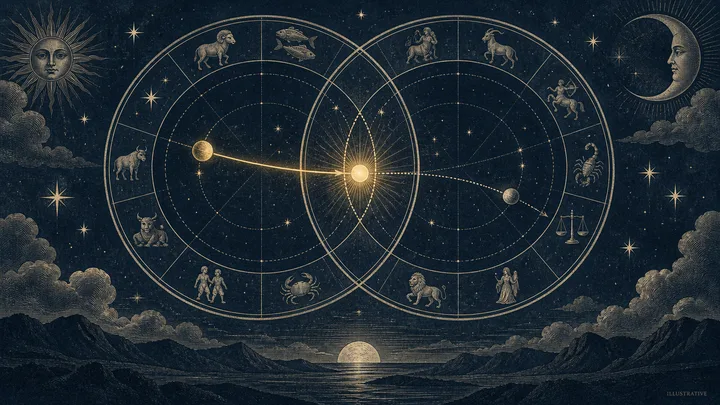
Applying and separating describe direction. When two planets move toward the exact angle of an aspect, the aspect is applying. When they have passed that exact point and the distance is growing, it is separating. The orb is the distance from exactness. A zero-degree orb is the peak of the aspect.
That gives the phase a useful symbolic job. Applying can describe a contact that is gathering expression, asking to be noticed, or becoming more specific. Separating can describe a contact whose pattern is already familiar, practiced, or easier to recognize after the peak. The aspect itself still carries the main meaning. A trine offers flow. A square creates friction. Venus and the Moon speak differently from Mars and Saturn.
Astrologers often give applying aspects more weight, especially when the two phases have the same orb. That’s a ranking tradition, not a law that makes every applying aspect better. A close separating Moon-Venus trine can describe a strong, established channel of affection. A wide applying Venus-Saturn square can describe a question that is growing, but its wider orb still asks for careful wording.
The short answer is this: applying may show what is still taking shape, while separating may show what has already left an imprint. Neither label predicts a meeting, a breakup, or a future event. It changes the question you ask of the contact.
Sources: Applying & Separating - Evolving Door Astrology; An Introduction to Aspects and Chart Shaping in Natal Astrology - Skyscript; Aspects in Astrology: The Five Major Configurations - The Astrology Podcast
What information do you need before using A or S?
Start with the raw placements. You need both planetary longitudes, the aspect you’re testing, and the orb policy used by the report. If you’re reading a selected personal-planet comparison here, the working limit is a six-degree orb for major aspects. A contact outside that limit doesn’t become relevant just because it is applying.
Consider an example. Imagine Maria has the Moon at 14°20' Taurus and Daniel has Venus at 17°05' Virgo. Their shorter angular distance is 122°45', so they sit 2°45' from an exact 120° trine. The arithmetic supports a Moon-Venus trine within this six-degree policy. It does not, by itself, prove whether that trine is applying or separating.
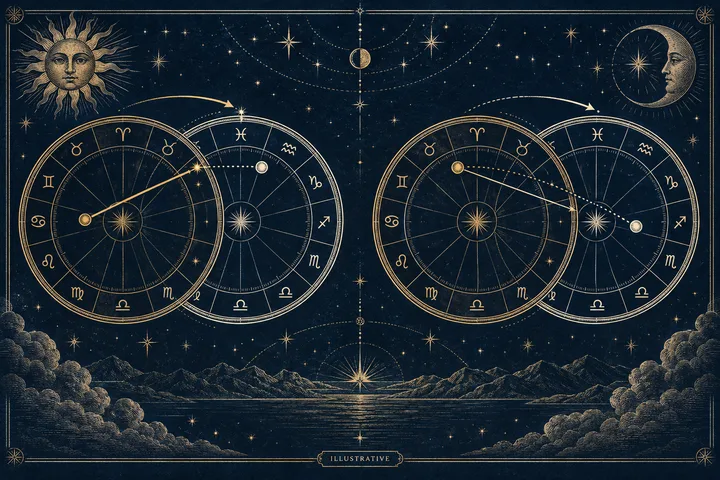
That last step needs motion. In an ordinary natal chart, the faster planet’s motion tells you whether the aspect is closing or opening. Retrograde motion, a station, or a change in speed can reverse an apparently simple label. A sign order cannot settle it. Neither can the fact that the Moon is usually faster than Venus. Use the actual motion shown by the calculation method.
If you have signs but no degrees, stop at the supported layer. You can discuss the Moon’s needs, Venus’s style of affection, and the relationship between Taurus and Virgo. You can’t honestly call the contact a 2°45' applying trine. Missing degrees remove phase precision. That’s all, but it matters.
Sources: Applying & Separating - Evolving Door Astrology; An Introduction to Aspects and Chart Shaping in Natal Astrology - Skyscript; Aspects in Astrology: The Five Major Configurations - The Astrology Podcast
Why synastry needs a method note
Here’s the important wrinkle. A natal aspect is read within one chart cast for one birth moment. Synastry places two natal charts side by side. The planets in that overlay are fixed records from different moments, not two bodies moving through one shared event chart. The geometry is clear. The cross-chart phase label is less uniform.
Some reports still mark a synastry contact A or S. They may apply a natal aspect rule to the two placements, use a relative-motion calculation, or follow a house style that the report doesn’t explain on the screen. Those choices can produce different labels from the same pair of degrees. The label is usable only when you know the convention behind it.
So don’t present one formula as the universal synastry answer. For a supplied-placement reading, say what the report supplies and what you’re borrowing from traditional aspect practice: ‘This contact is marked applying by the report’s stated motion rule.’ If no rule is available, keep the phase provisional. Interpret the planet pair, aspect, sign relationship, and orb without forcing A or S.
This is not a small technicality. It keeps a symbolic phase from pretending to be a shared timeline. Applying in synastry can suggest an aspect with a more developing or forward-leaning quality under the chosen convention. It cannot mean the relationship itself is moving toward a guaranteed moment of perfection.
Sources: Applying & Separating - Evolving Door Astrology; Aspects in Astrology: The Five Major Configurations - The Astrology Podcast; Applying vs. Separating Aspects - Learn Astrology
How does an applying contact change the reading?
Read the planets first. In Maria and Daniel’s illustrative Moon-Venus trine, the Moon brings feeling, comfort, and immediate needs. Venus brings affection, pleasure, attraction, and the style of giving value. The trine offers a smooth channel between them. If their report marks the contact applying, add one idea: that channel may still be becoming more exact in the way they live it.
That might look like learning the other person’s preferred form of care. Maria may need steady reassurance. Daniel may show affection by making practical details pleasant. The aspect does not tell you that these two people will understand each other automatically. It gives you a question: what makes warmth visible instead of assumed?
The same phase works differently with a hard aspect. Imagine a 4° applying Venus-Saturn square. Venus wants pleasure and a freely offered response. Saturn asks for limits, proof, patience, or structure. The square names the work between those needs. Applying can make that work feel more present, as if the pair is still discovering what reliability costs in time, money, pace, or commitment.
Keep the verb modest. Say the theme is gathering expression, not that conflict will intensify or love will deepen. The rest of the chart can support, soften, repeat, or contradict the contact. Phase gives direction to the interpretation. It doesn’t write the ending.
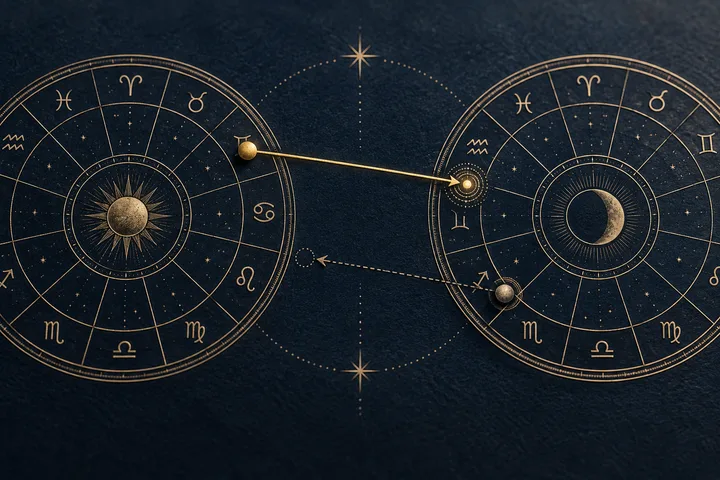
An applying aspect is moving toward exactness. A separating aspect has passed exactness and is moving away. In synastry, that difference can add a sense of a contact still finding its form versus one that already feels familiar. It doesn't outrank the planet pair, the aspect, the orb, or repeated themes in both charts. There’s also a method point many quick readings skip: synastry overlays two fixed natal charts, so the usual applying language comes from aspect practice and must be tied to a stated calculation convention. A report that gives only signs cannot support an applying or separating label. If degrees are supplied, record the exact aspect and orb first, then use the phase as a refinement. Read it as a question about how the connection expresses, not as a promise about what the relationship will do.
Sources: Applying & Separating - Evolving Door Astrology; An Introduction to Aspects and Chart Shaping in Natal Astrology - Skyscript; Aspects in Astrology: The Five Major Configurations - The Astrology Podcast
What can a separating contact reveal?
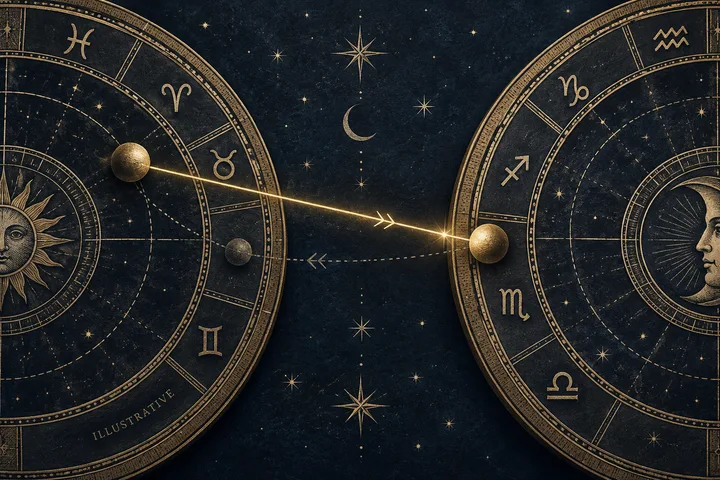
A separating contact has passed exactness but remains within the chosen orb. Its symbolism can feel familiar rather than newly demanding. In the Moon-Venus example, move the Moon to 16°50' Taurus while Venus stays at 17°05' Virgo. The trine is now 120°15' and separating, assuming the stated report convention marks the Moon as having crossed exactness.
The warmth hasn’t vanished. The phase changes the emphasis. This pair may already know how kindness works between them. They may offer comfort so naturally that they stop naming it. A separating contact can describe a resource that’s available, a habit already formed, or a pattern that has become ordinary enough to overlook.
That can help with difficult aspects, too. A separating Moon-Saturn square might describe emotional restraint the pair already recognizes. A separating Mars-Uranus opposition might show a recurring spark they’ve learned to manage. Established doesn’t mean harmless. A familiar pattern can be a skill, or it can be a groove that keeps pulling both people back.
The strongest exception is a very tight separating aspect. A 0°20' separating contact may matter more in the reading than a 5°40' applying contact because exactness and planet weight come first. Don’t dismiss separation as weak or finished. Ask what the aspect has already taught the connection, and whether the pair is using that knowledge consciously.
Sources: Applying & Separating - Evolving Door Astrology; An Introduction to Aspects and Chart Shaping in Natal Astrology - Skyscript; Applying vs. Separating Aspects - Learn Astrology
How should you rank the phase before starting a conversation?
Use a clear order. First, confirm that the contact exists under the chosen aspect and orb. Second, read the planets involved. Third, judge the aspect itself and the sign relationship. Fourth, look for repetition among the personal planets or other supplied chart layers. Fifth, use applying or separating to describe the contact’s phase. This keeps one small label from becoming the whole reading.
A practical comparison might contain three contacts: a 1°10' separating Moon-Venus trine, a 3°20' applying Mars-Moon square, and a 5°50' applying Venus-Mars sextile. The close Moon-Venus trine leads the emotional reading. The applying Mars-Moon square deserves the next look because it names an active friction point. The wide Venus-Mars sextile supports attraction or cooperation, but it shouldn’t headline the comparison simply because it is applying.
The report in this publication can compare supplied Moon, Venus, and Mars signs, plus optional degrees and selected major aspects within the stated six-degree orb. It doesn’t calculate a natal chart from birth details or assign houses. If your data stops at signs, keep the reading at signs. If degrees are available, add geometry. If a report gives A or S without its rule, quote the label as reported and mark the calculation basis as unknown.
Then choose one conversation. For an applying contact, ask, ‘What is becoming clearer between us, and what small action would help it take form?’ For a separating contact, ask, ‘What do we handle so automatically that we’ve stopped naming it?’ Write down the planet pair, aspect, orb, and phase. Add one real moment that fits and one that doesn’t. The chart offers the question. Your exchange gives it a life.
Sources: Applying & Separating - Evolving Door Astrology; An Introduction to Aspects and Chart Shaping in Natal Astrology - Skyscript; Aspects in Astrology: The Five Major Configurations - The Astrology Podcast; Applying vs. Separating Aspects - Learn Astrology
Sources & further reading
- Applying & Separating - Evolving Door Astrology
Defines application and separation through the shrinking or widening orb, and distinguishes both from waxing and waning.
- An Introduction to Aspects and Chart Shaping in Natal Astrology - Skyscript
Explains exact aspects, orbs, the traditional applying and separating distinction, and the role of aspect type.
- Aspects in Astrology: The Five Major Configurations - The Astrology Podcast
Covers planetary motion, exactness, sign-based and degree-based aspects, retrograde complications, and synastry as chart comparison.
- Applying vs. Separating Aspects - Learn Astrology
Describes applying and separating as building and releasing phases, while noting retrograde motion and the fixed natal-chart moment.
Synastry Comparison Report
Enter known placements for two people. Get an input-by-input comparison, selected aspect calculations and a clear record of what remains uncertain.
Compare our placements