The answer turns on what each chart is meant to show
The same word can do different work in different charts. That is the trap.
Horary begins with a question asked at a particular moment. The astrologer assigns significators to the people or matters involved, then watches their applications and separations. The chart describes a situation in motion. Synastry compares two natal charts. It shows how one person's planetary pattern meets another person's pattern, not what their relationship must do next.
So applying carries more formal weight in horary. It can show significators moving toward perfection, provided the rest of the judgment supports that promise. Separating can point to a contact already made or a condition already passing. In natal synastry, an astrologer may give an applying contact a sense of immediacy, growth or unfinished development. A separating contact may feel known, settled or inherited from the start.
Those meanings can enrich a reading. They don't turn the comparison into a clock. An applying Venus-Mars contact cannot prove that someone will call, commit or return. The supported position is simple: read phase as a modifier in ordinary synastry, and as part of the event sequence in horary.
Not in quite the same way. In horary, applying and separating describe the motion of significators in a chart cast for a live question. Application can show a matter moving toward perfection, while separation can describe contact that has already happened. In ordinary synastry, you compare two natal charts as fixed records. Some astrologers read an applying natal contact as more immediate or developing and a separating one as more familiar, but that is a secondary interpretation, not a relationship countdown. Supplied degrees let you check an aspect and its orb. They do not, by themselves, calculate the planets' motion at either birth or establish an applying or separating phase. Read the planets, aspect, signs, reliable houses and natal condition first. Use phase only when the chart data and method actually support it. For present timing, examine a named transit, progression or horary chart.
Sources: Application - Skyscript Glossary; Applying vs Separating Aspects in Astrology; A review of the astrological tradition concerning the perfection of significators and its denial
What applying and separating measure
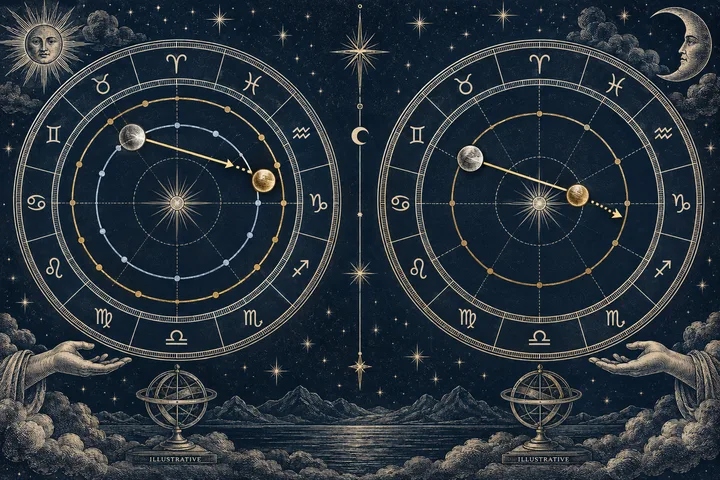
An aspect is an angular relationship between two chart points. A conjunction aims at 0 degrees, a sextile at 60, a square at 90, a trine at 120 and an opposition at 180. The orb is the distance from that exact angle.
If two planets sit 87 degrees apart, their square has a 3-degree orb. If their distance later becomes 88 degrees, the orb has narrowed to 2 degrees and the square is applying. If it becomes 86 degrees, the orb has widened to 4 degrees and the square is separating. The aspect tells you the kind of contact. The changing distance tells you its phase.
That definition depends on motion. Retrograde motion can reverse the apparent direction. A station can slow a planet, pause the pattern or produce another pass after exactness. Skyscript's entries on application and separation both warn against reading the label from zodiac order alone. Actual movement matters. Applying does not mean easy, and separating does not mean weak.
Waxing and waning are different terms. They describe a broader cycle, often from conjunction toward opposition and back again. Applying and separating describe movement toward or away from one chosen aspect. For this publication's comparison scope, six degrees is the maximum orb for selected major contacts among supplied Moon, Venus and Mars placements. That rule does not calculate motion, retrograde status, a station or a phase.
Sources: Application - Skyscript Glossary; Separation - Skyscript Glossary; Applying vs Separating Aspects in Astrology
Why horary gives application a formal job
Horary asks a time-shaped question. Will the message arrive? Will the agreement come together? Will these two people meet? The chart is cast for the moment of inquiry, so its houses and planetary positions describe the condition of the matter then.
In traditional language, perfection occurs when the relevant significators come together by conjunction or major aspect. An applying aspect can show movement toward the exact contact. But application is only the beginning of the judgment. The astrologer also considers reception, dignity, speed, house placement and intervening conditions.
Graeme Tobyn's review of the tradition lists several ways perfection can be denied. Refranation can occur when a significator turns retrograde. Another planet can prohibit the contact. A sign change can interfere. Translation or collection of light can alter how the matter comes together. Read the whole horary structure.
Consider an example. A querent asks whether a person will contact her again. The significators apply, but a third planet intervenes before perfection. In a horary judgment, that intervention has a technical role. It may describe help, obstruction or another condition that changes the route. The applying aspect shows movement, not a complete promise by itself.
Sources: Application - Skyscript Glossary; A review of the astrological tradition concerning the perfection of significators and its denial
What phase can add to a natal synastry reading
Synastry starts with two natal charts. Person A's Venus may contact Person B's Mars, while Person B's Moon contacts Person A's Saturn. Each contact has a direction between the charts, but neither person disappears into the comparison. The natal chart underneath still matters.
Some astrologers use applying and separating as a tone. An applying contact may feel more immediate, as though the pair keeps discovering what the contact asks of them. A separating contact may feel familiar, as though its pattern appears quickly and already knows its route. Use those as interpretive possibilities, not measurements of love or evidence of a future event.
Start with the planets. Venus and Mars describe a different exchange from Moon and Saturn. Then read the aspect, signs, reliable houses and natal condition. A square presses and provokes. A trine offers an easier flow. An opposition creates a polarity that both people have to hold. Only after those layers should phase enter the sentence.
'This close Venus-Saturn contact may feel established, and a separating label could reinforce that sense of familiarity' is measured. 'This applying contact means he will choose you' is not. Phase cannot reveal private intention, consent or character. It can help you name a pattern you are willing to examine.
Sources: Separation - Skyscript Glossary; Applying vs Separating Aspects in Astrology; What Is Synastry? Classical Relationship Astrology
A six-degree comparison that keeps the method honest
A useful example should show what the supplied data can support. Consider an example in which Person A has Venus at 22 degrees Taurus and Person B has Mars at 24 degrees Scorpio. That is a 2-degree opposition by longitude. Now compare Person A's Venus at 5 degrees Gemini with Person B's Mars at 11 degrees Libra. That is a 6-degree trine, right at this report's selected limit.
Neither example establishes applying or separating from those four degrees alone. To know phase, you need a chart calculation or report that includes the relevant planetary motion at the birth moments, the coordinate settings and the method used to assign the label. This report compares supplied placements and optional degrees. It does not recreate that motion or fill in missing chart data.
Even without phase, the first contact deserves the closer look. A 2-degree Venus-Mars opposition is tighter than a 6-degree trine. It joins affection and desire through polarity, so you might explore attraction, values and the push-pull between closeness and autonomy. The second contact may describe an easier style of exchange, but its wider orb calls for modest language.
If a trusted chart report separately verifies that one contact is applying and the other separating, phase can refine the reading. It still doesn't reverse the ranking automatically. Compare orb, aspect type and planetary relevance first. Then ask whether application adds a developmental tone or separation adds familiarity.
Sources: Application - Skyscript Glossary; Separation - Skyscript Glossary; Applying vs Separating Aspects in Astrology; What Is Synastry? Classical Relationship Astrology
When applying really does describe current movement
The distinction changes when one chart is moving. In a transit, a planet in the current sky approaches a natal planet. Application describes that approach; separation describes the period after exact contact. The natal point stays still in that comparison. This is not the same as an applying label on the original synastry table.
Progressions create another time framework. So do a progressed relationship chart, a composite chart read through transits, or a Davison chart used with its own technique. Name the moving chart before you interpret the phase. Otherwise one familiar word hides several different calculations.
Retrogrades deserve care in any moving technique. A planet can apply, perfect, separate and apply again. Near a station, the orb may shrink, pause and widen without reaching exactness. Horary adds another layer because its application belongs to a judgment of significators, houses and perfection. Reception, translation, collection and prohibition belong to that chart type.
Imagine a couple with a close natal Venus-Saturn contact who wants to understand a difficult month. Their synastry may describe the bond's standing pattern. A current Saturn or Jupiter transit to one person's Venus may describe the present season. Read both if the data supports both, but keep the questions separate. One says what they carry. The other says what is being activated.
Sources: Application - Skyscript Glossary; Applying vs Separating Aspects in Astrology; A review of the astrological tradition concerning the perfection of significators and its denial
A practical order for reading your comparison
Begin with the information you actually have. Record each person's planet, sign and degree. If a degree is missing, say so. You can discuss sign relationships and possible aspects, but you cannot state an exact orb. You cannot assign a phase from sign names alone.
Next, apply one aspect set and one orb rule to both charts. In this report, supplied Moon, Venus and Mars placements can be compared for selected major contacts within a six-degree orb. Houses, natal positions not supplied by the reader and planetary motion are outside that scope.
Then rank the contact. First ask whether the aspect is real and close enough for the chosen method. Next read the planets, signs and reliable houses. Look for repetition across the comparison. Only then consider a verified applying or separating label, and treat it as a shade of meaning rather than the headline.
Translate that shade into a question you can answer in daily life. A close Moon-Mars contact might prompt, 'What helps us slow down before a disagreement becomes a fight?' A Venus-Saturn contact might prompt, 'Which promise needs a dependable action behind it?' The chart gives the question. The people answer it through behavior.
If current timing is what you want, choose the right tool. Use a transit or progression when the sky's movement is the subject. Use horary when you have a live question and a chart cast for it. Use synastry when you want to understand the standing exchange between two natal patterns.
The final check is short. Can you name the contact without phase? Can you explain what phase adds without predicting an outcome? Can you point to one observable conversation or choice? If yes, the reading has stayed clear. Then stop. A good synastry reading leaves you more able to meet the relationship, not waiting for a label to decide it for you.
Sources: Separation - Skyscript Glossary; Applying vs Separating Aspects in Astrology; What Is Synastry? Classical Relationship Astrology
A little more clarity
Can supplied synastry degrees prove that an aspect is applying or separating?
No. Supplied degrees can establish the angular relationship and orb when the placements use the same zodiac reference. Applying or separating requires planetary motion and a stated calculation method. This report compares supplied Moon, Venus and Mars placements and optional degrees within a six-degree scope; it doesn't calculate birth-chart motion, retrograde status or stations. If a separate chart report supplies a phase label and its method is clear, use it as a secondary interpretive detail.
Sources & further reading
- Application - Skyscript Glossary
Defines application through motion toward exactness and connects applying aspects with developing events in horary astrology.
- Separation - Skyscript Glossary
Defines separation as motion away from exactness and explains why retrogrades and stations can change the apparent phase.
- Applying vs Separating Aspects in Astrology
Explains measuring orb changes, checking signed motion, distinguishing natal synastry from transits and treating phase as interpretive.
- A review of the astrological tradition concerning the perfection of significators and its denial
Describes horary perfection through applying significators and the reception, intervention and denial conditions that modify it.
- What Is Synastry? Classical Relationship Astrology
Supports reading synastry as a comparison of two natal charts through planets, aspects, houses and overall chart condition.
Synastry Comparison Report
Enter known placements for two people. Get an input-by-input comparison, selected aspect calculations and a clear record of what remains uncertain.
Compare our placements