The first question is not which label sounds stronger
You have two synastry reports open. One calls the Venus-Mars contact applying. The other calls it separating. The aspect itself looks familiar, the orb looks close, and both reports seem confident. Which one should you believe?
The disagreement is technical before it is romantic. Applying and separating describe motion through an aspect, and the difference may come from the chart moment, supplied degrees, retrograde treatment, or the report’s definition of the contact. Find that change before you decide what the aspect means.
The supported rule is simple. An aspect applies when its angular distance is shrinking toward exactness. It separates when that distance is growing after exactness. Astrologers often describe the first as building and the second as releasing. That language adds texture, but it doesn’t turn application into a blessing or separation into a failure. The square can apply. The trine can separate.
Synastry needs one extra sentence. A standard synastry comparison places one natal chart beside another. Those charts come from two different birth moments, not one shared event moment. So an applying or separating label needs a stated convention: which pair’s motion is being followed, whether the software evaluates relative motion at each birth moment or uses a later timing layer, and whether the label is being used symbolically rather than as a literal event forecast.
If the inputs and scope match, don’t average the labels. Find the mismatch. If the reports answer different questions, keep both labels and name their layers. Then read the common ground: planets, exact angle, orb, signs, and repetition.
That approach rejects an attractive shortcut. Many readers want applying to mean future promise and separating to mean a bond that has already peaked. Sometimes that metaphor describes the lived experience. It cannot do the whole job. A separating Moon-Venus contact may be deeply familiar, affectionate, and active in daily life. An applying Saturn contact may be difficult, hesitant, or slow to express. Motion gives direction. It does not erase planetary nature.
Before interpreting, record the two planetary positions, aspect, orb, zodiac, reference moment, and retrograde status. That small audit keeps a motion label in its proper place.
When two reports disagree, first ask whether they calculated the same thing. Applying means the angular distance is shrinking toward exactness; separating means it is widening after exactness. In synastry, the label also depends on the chart moment, the motion convention, and whether you’re reading the natal comparison or a later transit or progression. Keep the stable evidence in charge: the planet pair, exact aspect, degree, orb, signs, and repeated contacts. Applying can show a theme gathering shape. Separating can show a pattern with history. Neither is a dating verdict. A Synastry Comparison Report can organize supplied Moon, Venus, and Mars placements and optional degrees, but it doesn’t calculate a full natal chart or fill in missing data.
Sources: An Introduction to Aspects and Chart Shaping in Natal Astrology, Skyscript; Beginners Astrology Course, Lesson 10: Applying and Separating, Skyscript
What applying and separating actually measure
An aspect is an angular relationship. A conjunction aims at 0 degrees, an opposition at 180 degrees, a square at 90 degrees, a trine at 120 degrees, and a sextile at 60 degrees. The orb is the distance between the actual separation of the bodies and that exact angle. If Venus and Mars sit 3 degrees from an exact trine, the aspect has a 3-degree orb.
Keep sign-based and degree-based language separate. Two planets can occupy signs that make a traditional relationship while sitting far apart by degree, or they can form a close degree aspect across a sign boundary. A report may count one and omit the other. That choice can change which contact receives an applying or separating label, so record the aspect definition before you compare interpretations.
Application and separation describe what happens to that orb as the bodies move. If the orb decreases, the aspect applies. If it increases, the aspect separates. Exactness is the turning point. At exactness the orb is zero. Before it, the contact gathers toward its peak. After it, the contact moves away from the peak while remaining within whatever orb your method allows.
That last phrase matters. An aspect can be separating and still be meaningful. It does not vanish at the instant of exactness. It remains in the chart while it stays within orb, though many astrologers give the applying phase more emphasis when all other factors are equal. A tight separating aspect can matter more in practice than a very wide applying one because closeness is one of the first measures of emphasis.
Applying and separating are not the same as waxing and waning, and they do not depend on which sign comes first in the zodiac. They depend on whether the distance to the exact angle is shrinking or growing. A planet can appear to move away by zodiacal longitude while still applying to a trine if the relevant angular distance is closing.
In interpretation, applying can describe a theme that feels unfinished or gathers shape. Separating can describe one with history that is being integrated. Those are useful symbolic verbs. They aren’t fixed personality types, and they don’t promise what either person will do.
Exactness is also a useful boundary in your language. Say ‘within a 6-degree orb and applying’ when that is what the data show. Say ‘close and separating’ when the aspect has passed exactness.
Sources: An Introduction to Aspects and Chart Shaping in Natal Astrology, Skyscript; Aspects: Geometry, Orbs, and Exact Timing, Kerykeion Learn Astrology
Why two calculations can give opposite labels
A disagreement doesn’t always mean one astrologer made a mistake. It may mean the reports did different work. Separate a changed input, a changed motion rule, and a changed chart layer.
The most common change is the chart moment. A natal synastry comparison uses the positions at each person’s birth. A transit layered over that synastry uses a later date and time. A progressed chart uses a symbolic time scale. An event chart uses the moment something began. A contact can be separating in the natal picture and applying in a later transit to one of the natal planets. Both statements can be true because they refer to different moments.
The second change is the data itself. A recorded birth time may be rounded to the hour. A birth date may be entered in the wrong calendar format. A location may carry a different time-zone or daylight-saving setting. A planet close to a sign boundary may change sign when the time changes. In a close aspect, a small shift can alter the displayed degree, orb, house placement, and sometimes the motion label.
The third change is the aspect engine. Reports may use different ephemerides, different interpolation intervals, or different conventions for deciding which body is applying. Some systems examine the exact relative motion at the chart moment. Others compare positions over a chosen future interval. Some give special treatment to stations and retrogrades. If a planet is nearly stationary, the answer can be sensitive to the rule.
The fourth change is the aspect definition. A report may treat a 6-degree contact as active while another uses a tighter orb. One may list an out-of-sign aspect, while another requires both planets to occupy signs that support the classical geometry. One may include a minor aspect. Another may show only major aspects. The applying label is not useful until you know which contact the label belongs to.
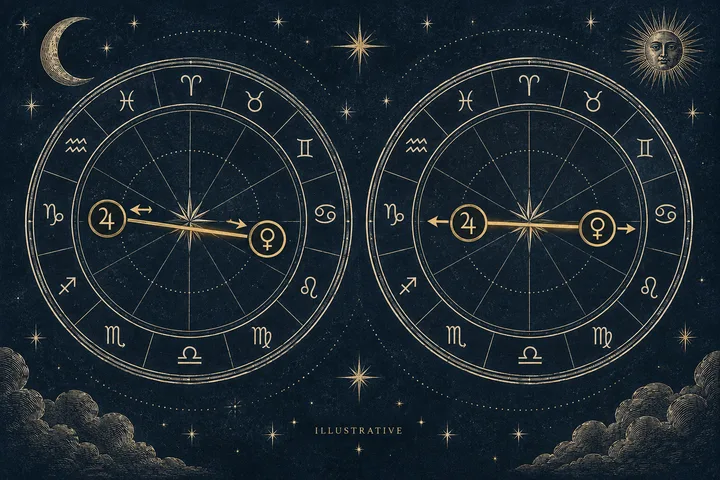
The fifth change is direction. In a bi-wheel, the angular relationship is mutual, but reports may assign applying language to one planet, the other, or the pair as a whole. ‘Venus applying to Mars’ and ‘Mars separating from Venus’ might be two descriptions of one geometry, or they might reflect different motion rules. Ask what the report means by the subject of the verb.
Consider this example: one report lists Venus at 14 degrees Taurus and Mars at 20 degrees Capricorn, a trine with a 6-degree orb. Those positions establish the angle and distance. They don’t, by themselves, establish whether the orb is shrinking. You need the bodies’ relative motion at the stated chart moment. A later transit calculation may then describe the contact as separating after exactness, while the natal comparison keeps its own status.
When the reports disagree, make a two-column note: shared geometry on one side, disputed motion or timing on the other. Interpret only what the shared column can carry.
Sources: Beginners Astrology Course, Lesson 10: Applying and Separating, Skyscript; Aspects: Geometry, Orbs, and Exact Timing, Kerykeion Learn Astrology
Read the common aspect before the moving layer
Once the scope is clear, read the part both calculations can support: which planets or points connect, what exact aspect they make, how close the orb is, and which signs hold them. That is the backbone of the synastry reading.
The planets describe the functions meeting. Moon contacts speak to feeling, safety, habits, and the ways two people respond when they need care. Venus contacts speak to affection, taste, pleasure, and the way love is offered or received. Mars contacts add desire, initiative, heat, irritation, and the way conflict moves. Mercury contacts shape speech, naming, timing, and the exchange of ideas. Saturn can add weight, boundaries, endurance, and responsibility. No single planet pair settles the whole relationship, but each pair gives the contact its subject.
The aspect describes the shape of the exchange. A conjunction fuses or concentrates the planets. A trine can make expression feel natural, though easy flow may go unnoticed. A sextile offers cooperation that often grows through choice. A square creates friction that can become skill when both people engage it. An opposition places two ends of a polarity across from each other, asking for negotiation rather than a simple winner. These descriptions are broad. The signs and the individual charts decide how the pattern speaks.
That order matters in a relationship reading. If Venus meets Mars, begin with attraction, desire, pleasure, and action. If Saturn joins the contact, add limits, promises, patience, and responsibility. The aspect tells you whether those functions blend, cooperate, press against each other, or stand across a divide. Only after that foundation is clear should a motion convention suggest whether the theme feels new, familiar, or ready for another round of attention.
The orb ranks immediacy. A contact at 0 degrees 40 minutes deserves more attention than the same aspect at 5 degrees 55 minutes when both use a 6-degree working orb. That does not make the wider contact empty. It changes how loudly you read it. The closer contact is easier to notice and harder to ignore. The wider contact may need repetition elsewhere in the chart before it becomes a central theme.
The sign relationship adds style. Venus in a water sign and Mars in an earth sign may seek closeness through steadiness, touch, and practical care, while fire and air may move through play, speed, candor, and shared stimulation. These are not boxes. They are the language in which the aspect speaks. A square between compatible elements can be worked through differently from a trine between signs that do not easily understand each other’s pace.
Then check repetition. If the same planet pair is echoed through another aspect, a house overlay, a sign ruler, or a strong natal placement, the theme rises in rank. If the applying or separating label is the only reason a weak, wide contact seems important, lower it. A synastry reading becomes clearer when you read the individual charts and the larger network of contacts instead of treating one interaspect as the entire relationship.
Only then add motion. An applying status can make a contact feel like a conversation approaching its form. A separating status can make it feel like a pattern with history. The Venus-Saturn contact remains Venus-Saturn in either phase. It still asks how affection meets limits and whether care becomes concrete.
Sources: Beginners Astrology Course, Lesson 10: Applying and Separating, Skyscript; Aspects: Geometry, Orbs, and Exact Timing, Kerykeion Learn Astrology
The strongest exception is a near miss or a changed chart layer
The strongest exception is a near miss. A planet can change speed or direction before the aspect reaches exactness. The contact applies, slows, and begins to separate without perfecting. A retrograde turn can create that pattern, while a station can make the motion especially sensitive.
A near miss deserves careful wording. Do not write that the aspect became exact when it did not. Write that the contact moved toward exactness, encountered a change in motion, and then widened. This preserves the developmental story without pretending the perfection occurred. The combined symbolism may still be noticeable, particularly when the stationing planet is central to the chart or the orb is tight, but the interpretation should carry the unfinished quality of the contact.
The other exception is a changed chart layer. A natal synastry aspect does not become a transit merely because the reader looks at it again. But a later transit can activate one or both natal planets. A progressed planet can bring another timing story. A composite chart shifts the question from how your planets affect each other to how the relationship operates as a distinct entity. These methods belong together in a larger reading, but they are not interchangeable.
Consider an example. The natal comparison shows a separating Moon-Mars square with a 2-degree orb. That may describe a familiar emotional and reactive pattern, one that has already established its rhythm. Six months later, a transit planet applies to the natal Moon while also contacting the partner’s Mars. The new calculation may show application. It does not reverse the natal story. It describes a current activation of an existing pattern.
Several wheels on one page can hide this distinction. Name the layer in the heading: person A to person B, a transit to one natal chart, a progressed contact, or a composite aspect. If the page doesn’t say, pause before interpreting.
The strongest exception therefore supports the main rule. Applying and separating can change without anyone being wrong when the relative motion changes or the chart moment changes. The answer is not to choose the label that feels more hopeful. The answer is to say what moved, when it moved, and what question that movement answers.
Use phrases such as ‘applying but non-perfecting,’ ‘separating after exactness,’ or ‘applying in the later transit layer.’ They are more useful than calling a contact simply strong or weak.
Sources: Aspects: Geometry, Orbs, and Exact Timing, Kerykeion Learn Astrology; Applying vs. Separating Aspects, Kerykeion Learn Astrology
A practical ranking for your synastry reading
You don’t need to solve every technical dispute before you can read a chart. You need to know which uncertainty changes the meaning. Use this order: stable contact first, chart context second, motion last.
First, rank data integrity. Confirm the birth date, time, place, time zone, and whether the chart uses the intended zodiac. If the birth time is unknown or rounded, say so in your working notes and lower confidence in angles, houses, and fast-moving placements. A report that uses supplied placements and optional degrees can still compare known signs and aspects, but it cannot quietly fill in missing information.
Second, rank the planet pair and aspect. Name the exchange in plain words. A Moon-Venus trine is not the same question as a Mars-Saturn square, even if both are applying at 4 degrees. A conjunction does not automatically mean ease, and an opposition does not automatically mean failure. Read what the planets bring together and what the aspect asks them to do.
Third, rank exactness and orb. Note degrees and minutes when they’re available. A tight contact deserves a close look; a wide one needs support. Use one orb rule across the comparison.
Fourth, rank repetition and chart context. Does one person’s natal chart already emphasize the planet? Does the contact repeat through a second aspect? Does it land in a known house when reliable birth times are available? Does another contact soften, sharpen, or redirect it? Synastry is a conversation between charts, not a collection of isolated headlines.
Fifth, use applying or separating to describe stage. Applying can suggest a theme gathering force. Separating can describe a close pattern with history. Neither outranks a much closer or more repeated contact merely because of its label.
Sixth, translate the pattern into a question the couple can answer. A Moon-Mars contact might become, ‘When one of us needs comfort and the other moves into action, what response actually helps?’ Venus-Saturn might become, ‘Which promises can we keep in ordinary weeks, not only in intense moments?’ Mercury-Uranus might become, ‘How do we make room for sudden honesty without turning every surprise into a rupture?’ The chart gives the theme. The conversation shows how it is lived.
Write the conclusion in two parts. State the stable contact first: ‘This is a close Venus-Mars trine within the stated orb.’ Then state the scope: ‘The natal comparison uses a symbolic applying convention; the later transit is separating after exactness.’ If the reports use the same inputs but different conventions, name that disagreement instead.
If the data remain incomplete, narrow the claim instead of abandoning the reading. A precise partial reading has more value than a complete story built from guessed degrees. Then turn the chart language into a question that someone can answer with behavior, such as what happens when one person wants reassurance and the other wants space.
Sources: An Introduction to Aspects and Chart Shaping in Natal Astrology, Skyscript; Beginners Astrology Course, Lesson 10: Applying and Separating, Skyscript
A little more clarity
Is an applying synastry aspect always stronger than a separating one?
Not always. Many astrologers give an applying aspect extra weight because the orb is shrinking toward exactness, but strength also depends on closeness, planetary nature, aspect type, repetition, and the individual charts. A tight separating contact can be more central than a wide applying contact. Treat application as a refinement of emphasis and timing, not as a universal strength score.
Can the same synastry aspect be applying and separating?
Yes, if the reports refer to different chart moments, different layers, or different passes through a retrograde cycle. A natal contact may be separating while a later transit to one of its planets is applying. A near miss can also change from applying to separating before exactness when a planet changes speed. If the reports claim to use identical inputs and the same moment, audit the method before interpreting the labels.
What information should I record before comparing synastry reports?
Record the birth data used, zodiac, planetary degrees and minutes, aspect, orb, chart date and time, retrograde status, chart layer, and the report's applying or separating convention. Then mark what both reports agree on. That record usually shows whether you have one disputed calculation or two valid descriptions of different layers.
Sources & further reading
- An Introduction to Aspects and Chart Shaping in Natal Astrology, Skyscript
Supports aspect geometry, orb as distance from exactness, and the interpretive difference between applying and separating contacts.
- Beginners Astrology Course, Lesson 10: Applying and Separating, Skyscript
Supports the faster planet approach, exactness, separation, variable orbs, and the distinction from opening and closing phases.
- Aspects: Geometry, Orbs, and Exact Timing, Kerykeion Learn Astrology
Supports angular-separation and orb formulas, relative-speed analysis, retrograde complications, stations, and repeated exact passes.
- Applying vs. Separating Aspects, Kerykeion Learn Astrology
Supports applying and separating as directional layers based on the faster planet, including retrograde reversals and the distinction between natal status and later timing techniques.
Synastry Comparison Report
Enter known placements for two people. Get an input-by-input comparison, selected aspect calculations and a clear record of what remains uncertain.
Compare our placements