
Do apparent and true positions change a typical synastry reading?
If two chart sources give you different relationship readings, it is natural to look for one setting that explains the gap. Apparent versus true planetary positions is a reasonable setting to check. But in the specific Swiss Ephemeris comparison, it usually will not change a typical synastry reading. The documentation puts the difference below one arcminute. A sign label or aspect label can flip only when the original position was already extremely close to the boundary used to assign that label.
That conclusion is technical and bounded. It concerns geocentric planetary positions calculated from the same birth moments, with the same zodiac, coordinate frame, ephemeris and other settings. It is not a claim that every chart program uses identical terminology, or that every astrologer follows the same aspect rules. It does not cover a switch from Earth-centered to location-centered positions, from tropical to sidereal signs, or from one birth time to another. Those are different changes.
It also helps to separate three levels of difference. First, a coordinate changes: the raw longitude is slightly different. Second, a classification changes: a planet prints under the neighboring sign, or an aspect falls just inside or outside a selected orb. Third, the interpretation changes: the astrologer gives the contact a different meaning or weight. A tiny coordinate difference does not automatically produce either of the latter changes. And a printed label that flips at a threshold does not make the whole chart a different relationship map.
Imagine comparing two chart reports for the same couple. One lists a planet at the very edge of a sign; another places it on the other side. The right next step is not to decide that one report has overturned the reading. Ask what position product each report used, compare the degrees, and see whether the shift crosses a real boundary. Then review only the sign language or contact affected. If the longitudes are not near a boundary, the apparent/true setting is unlikely to explain a meaningful difference.
This article treats six degrees as an explicit example when discussing major aspects, because the Synastry Comparison Report can use a stated six-degree orb. That number is a working rule for the comparison, not a universal law of astrology. The key result survives if an astrologer uses a tighter or wider orb: a contact's label can change only when its separation is already close to that chosen limit. The useful question is therefore not whether an app changed a symbol. It is whether the changed coordinate crossed a rule you actually use, and whether that one contact changes the reading you are considering.
Usually, no. In the specific apparent-versus-true distinction documented by Swiss Ephemeris, the planetary position difference is below one arcminute. That is too small to change an ordinary sign placement or a cross-chart aspect comfortably inside or outside its chosen orb. A label can change when a longitude is already within that tiny margin of a sign boundary, or when two planets sit almost exactly at an aspect-orb cutoff. The practical test is simple: keep the birth data, geocentric origin, zodiac, frame, ephemeris and aspect rules fixed; change only the apparent/true setting; then compare raw longitudes and angular separations. A changed label deserves a closer reading of that contact, not a wholesale rewrite of the relationship story. Also check what the software means by “true.” Topocentric positions, tropical versus sidereal signs, and true versus mean lunar nodes are separate choices. The Synastry Comparison Report can interpret placements and optional degrees you supply, but it does not calculate natal positions from birth details.
What does ‘apparent versus true’ mean here?
The words describe different calculated positions of a body. They do not mean “astrology versus reality,” and they should not be treated as a universal pair of settings with the same meaning in every program. This article uses the distinction in Swiss Ephemeris documentation: apparent positions represent where a planet is seen from the chosen observer after relevant apparent-position corrections; true positions refer to the geometric position without the relevant light-time correction. Swiss Ephemeris describes the resulting difference as less than one arcminute.
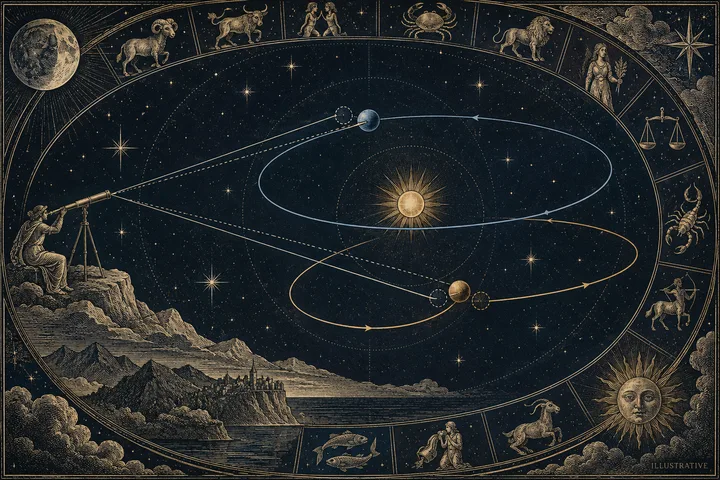
The plain idea is that light takes time to travel. When you see a distant planet, the light began its journey before it reached you. A geometric position describes the body at a specified instant in a reference frame. An apparent position asks where the body appears to be from an observer, and can include more than one correction. Swiss Ephemeris discusses light-time and aberration in the context of its apparent/true option. NASA/JPL's Horizons manual uses a broader astronomy vocabulary: it distinguishes geometric coordinates, astrometric coordinates that account for light travel time, and apparent coordinates that can also include deflection of light and stellar aberration. The shared word “apparent” does not make the software products interchangeable. Their definitions and output frames must be read in context.
A geocentric chart uses Earth's center as the reference origin for planetary positions. A topocentric chart refers positions to a location on Earth's surface, such as the birthplace. The apparent/true distinction in the headline is not the same as that observer-origin choice. Nor is it the same as heliocentric positions, which use the Sun as origin, or barycentric positions, which use the solar-system center of mass. The origin tells you where the coordinate measurement is referenced; apparent versus true describes a kind of position product. A report can vary on either axis.
The same caution applies to other uses of “true.” A true lunar node and a mean lunar node are alternative ways to calculate the Moon's nodes. They are not shorthand for the apparent and true position of every planet. A true equinox or a true-of-date reference frame is another concept. Tropical and sidereal zodiac settings determine how longitudes are mapped to sign names; they do not mean apparent and true positions. When a chart app offers several switches containing the word true, read the label and documentation rather than assuming they all change the same thing.
A practical vocabulary check has four parts: which body or point is being calculated; which observer origin is used; which position product is selected; and which reference frame and zodiac turn longitude into a chart label. JPL's Horizons documentation makes many of these choices explicit, including center, reference plane, time type and reference system. That manual is a technical coordinate reference, not a source of astrological meaning. Its value here is narrower: it shows why “the true position” is incomplete unless you say true according to which product and frame.
For the rest of this comparison, assume the same geocentric tropical ecliptic longitudes in a matched frame, with apparent and true positions defined as Swiss Ephemeris defines them. This gives the reader a clean question. It also keeps the answer from drifting into separate debates about zodiac systems, observer location, lunar nodes or chart-time corrections. Those subjects can matter in chart work. They simply are not the small switch measured by the sub-one-arcminute statement.
Sources: Swiss Ephemeris General Documentation; Horizons System Manual
Why do astrology charts usually use apparent positions?
Swiss Ephemeris says traditional astrology works with apparent positions and that most astrological ephemerides provide them. That is a useful statement about a common convention. It should not be enlarged into a claim that every lineage, astrologer or current chart service uses the same setting. A convention can be familiar without being universal, and a method can be coherent without being the only method.
There are two different questions hiding in the choice. One asks what a particular ephemeris or chart program has historically supplied. The other asks which kind of position best suits an astrologer's view of how celestial symbolism relates to earthly life. A practitioner who treats a chart as a symbolic correspondence rather than as an effect transmitted by physical forces may prefer a geometric position. In the Swiss Ephemeris manual, that synchronistic rationale appears beside the description of common apparent-position practice. It is a philosophical argument for a choice, not a measurement showing how often readings change.
That alternative deserves a fair hearing. If an astrologer believes the chart corresponds to a moment through a meaningful pattern, the apparent place seen from Earth may not seem more astrologically fitting than the body's geometric place. The practitioner may choose true positions to make the calculation align with that understanding. Consistency matters here: a method is easier to interpret when the astrologer knows which convention the chart uses and applies it throughout.
But the rationale does not answer the practical question in the headline. To decide whether a typical synastry comparison changes enough to matter, look at the amount of movement and the chart rules that movement would have to cross. The documentation's less-than-one-arcminute difference is small compared with a sign's 30-degree span and with an orb measured in degrees. Only a position near a threshold is a plausible exception. The true-position philosophy may still be meaningful to the astrologer, but it does not imply a broad shift in chart interpretation.
A reader can therefore make a calm choice. If a chart source uses apparent positions and the reader's school follows that convention, continue with it. If the reader's own method calls for true positions, use them consistently and note the choice. Neither selection turns a synastry chart into a verdict about the relationship. It defines how the positions are being represented. Where the setting changes no sign or aspect boundary, the astrologer has little reason to rebuild the interpretation around that switch alone.
There is a subtle point here: choosing a convention can matter to the integrity of a reading even when it rarely alters the practical output. A reader may care that the same method is applied to both charts, or may want a report to state its calculation policy. That is a legitimate preference. It is different from claiming that apparent positions routinely distort synastry or that true positions produce a more revealing relationship reading. The sources reviewed here support neither frequency claim. They support a precise technical distinction and preserve a philosophical alternative.
Which settings must stay fixed in a fair comparison?
To test apparent versus true positions, change that setting alone. If you change the time, location, zodiac and orb at the same time, the two outputs cannot tell you which choice caused a difference. This is the same discipline used in any careful chart comparison: keep the method stable while you inspect the variable in question.
Start by confirming that both charts use the same two birth moments and the same planetary bodies. Check that the time zone conversion and calendar entry are consistent. Then record the observer origin, zodiac, reference plane, reference frame or epoch, ephemeris and position product. For synastry, record the aspect set and orb rule too. The Swiss Ephemeris documentation gives apparent and true calculations as distinct options, while its programming documentation identifies a flag for the true geometrical position and a separate flag and location input for topocentric calculation. This is a concrete reminder that nearby-looking controls may do different jobs.
A controlled comparison can be done in five passes. First, save the chart inputs as entered, including any uncertainty the chart owner already knows. Second, use one calculation source and one frame to produce an apparent-position set and a true-position set. Third, write down raw ecliptic longitudes rather than relying only on sign names or colored aspect lines. Fourth, calculate the same inter-chart angular separations from each set. Fifth, apply one declared sign convention and orb policy to both. The only intentional difference should be apparent versus true.
NASA/JPL's Horizons API illustrates how detailed calculation requests can be. Its documentation lists a center, reference plane, time type and reference system, among other parameters. It also includes an APPARENT parameter, but that parameter switches atmospheric refraction for a particular Earth-topocentric apparent-coordinate product. It is not the same control as Swiss Ephemeris's apparent-versus-true choice. This distinction is worth stating because a reader searching for the same word in two interfaces might otherwise think the two settings are equivalent.
You do not need to make a technical project out of every chart disagreement. Often the source simply reports signs and aspects without exposing all the settings. In that case, ask for the exact degree positions or consult the provider's method notes. If the positions differ by much more than the narrow target correction, look for a different zodiac, origin, frame, time input or ephemeris before assigning the change to apparent versus true. A consistent report with limited visible detail can still be useful; it just cannot answer every calculation question.
This procedure also sets a boundary for what a supplied-placement reading can do. The Synastry Comparison Report interprets positions supplied by the reader and can use optional degrees. It does not take birth details and calculate a natal chart. The reader should therefore verify the chart positions at their source before asking the report to compare them. That is a product-scope fact, not a reason to distrust a chart. Good interpretation begins with knowing which positions and rules are being interpreted.
Sources: Swiss Ephemeris General Documentation; Horizons System Manual; Horizons API Documentation
Can a sign placement change?
Yes, but only if the position lies within the shift of a sign boundary. For a tropical zodiac, each sign occupies a 30-degree segment of the circle. The University of Texas-hosted presentation of Ptolemy's Almagest describes the sequence as equal segments, with Aries from zero to 30 degrees, Taurus from 30 to 60 degrees, and so on. Swiss Ephemeris places the apparent/true difference below one arcminute. Since one degree contains 60 arcminutes, one arcminute is one-sixtieth of a degree. The documented shift is therefore a very small sliver beside a 30-degree sign.
This comparison is an angular scale comparison, not a statistical claim. It does not tell us what share of people's planets sit near a sign boundary. It does not justify saying that sign changes never happen. It shows the condition required for a label to change: the apparent and true longitudes must fall on opposite sides of a boundary, which means the original longitude was already within the actual shift of that boundary.
A sign is a large interpretive field, while a degree gives the placement a more exact location within that field. If a planet sits just inside one sign under one calculation and just inside the next sign under another, the label may differ even though the coordinate barely moved. This is a threshold effect. The boundary can make a tiny continuous movement look like a crisp categorical switch. The printed label changes abruptly; the underlying longitude does not leap by 30 degrees.
Imagine a chart list that rounds degrees to whole numbers. A displayed position near zero degrees or near the last degree of a sign may conceal the minutes that determine which side of the boundary it occupies. Do not invent precision from a rounded chart, and do not assume that a label difference proves a large correction. Ask for the raw longitude at adequate precision, then compare the two products under the same zodiac. If the source does not provide that detail, say the boundary case cannot be resolved from the displayed labels alone.
If the label really does change, keep both readings in view. Note the planet, its role in the individual's chart, the sign framing in each output and the other contacts it makes. In synastry, a sign interpretation is not the whole contact. The receiving planet, angular relationship and wider chart context remain part of the judgment. A boundary crossing deserves attention, but it does not erase the chart's other testimony.
The same method applies whatever signs border the placement. Do not single out one sign pair as specially vulnerable; the condition is purely geometric. The test is proximity to an edge, not the planet's romantic importance or the emotional tone of its sign. A personal planet near a boundary may feel important to the reader, but the mathematics does not grant its apparent/true correction a larger size because the placement carries more interpretive weight.
Sources: Swiss Ephemeris General Documentation; Signs of the Zodiac
When can a cross-chart aspect label change?
A cross-chart aspect label can change only when the angular separation between two planets crosses the orb limit you have chosen. An aspect describes a relationship between positions, such as a conjunction near zero degrees, a sextile near 60, a square near 90, a trine near 120 or an opposition near 180. The orb is the allowance around exactness. For instance, a six-degree orb around a square includes separations within six degrees of 90 under that stated rule. Other astrologers may choose different limits or vary the allowance by aspect and planet pair.
The target movement is less than one arcminute per planet in the Swiss Ephemeris account. If both planets move in opposite directions relative to their apparent values, their separation can change by less than two arcminutes in the conservative combined case. That two-arcminute figure is a mathematical upper bound derived by adding two sub-one-arcminute movements. It is not a measurement of synastry charts, nor a claim that the two corrections always point in opposite directions. The actual shift may be smaller.
This gives a clean rule. A contact comfortably within the chosen orb remains inside. A contact comfortably outside remains outside. Only a separation already within the combined correction margin of the cutoff could switch its binary label. The same logic works for any orb policy. If the cutoff is three degrees, inspect contacts close to three degrees from exact; if it is six, inspect the six-degree edge. Apparent versus true does not create a new aspect out of a contact several degrees away from the boundary.
Astrological references show why the orb itself must be named. Nicholas Campion's accessible discussion of aspects describes exact angular relationships and permitted deviations, and presents different ways of setting orbs, including aspect-specific allowances and traditional approaches that consider planetary prominence. That discussion is a teaching reference, not a universal rule for every astrologer. The six-degree example here is a clear comparison policy, not an assertion of consensus.
Synastry guides also show that chart comparison is broader than a line in an aspect grid. The AstroTwins' relationship-chart introduction describes placing two charts together, examining inter-chart aspects and, when birth times are known, looking at house overlays. It is a popular interpretive guide rather than a technical standard. Its useful point is that aspects sit within a larger comparison. A contact that barely enters or leaves a chosen orb should be considered alongside signs, natal context and other inter-chart links, not treated as a standalone verdict.
A practical report might draw a line in one output and omit it in another. Before reading that as a dramatic difference, compare the raw separation and the rule that generated the line. Was the same aspect included in both? Was the same orb applied? Does the calculation use exact degrees or a sign-based relation? If the contact lies on the threshold, state that it is borderline under the chosen policy. You can then describe how the interpretation changes if included and how it reads if excluded.
The important distinction is between a boundary decision and a gradation of emphasis. Many astrologers already treat a tighter aspect as more exact than a wider one; an orb threshold sorts contacts into a displayed category, while interpretation can still recognize degrees of closeness. A minute-scale coordinate adjustment near a degree-scale orb boundary may flip the category without creating a strong new connection. Keep the classification precise and the meaning proportionate.
Sources: Swiss Ephemeris General Documentation; An Introduction to Aspects and Chart Shaping in Natal Astrology; Introduction to Relationship Astrology: Synastry
How does a tiny coordinate shift enter a synastry reading?
The shift enters a synastry reading through a short chain: a calculated longitude receives a sign and degree; two longitudes define an angular separation; the separation is compared with an aspect and orb rule; then the astrologer interprets the contact in context. Apparent versus true changes the first item. It usually leaves the later items unchanged because the coordinate difference is so small.
This chain matters because readers often move too quickly from a software label to an interpretive conclusion. A chart source might show a Venus-Saturn aspect in one output and leave it out in another. That is a classification difference, not automatically a different relationship meaning. First identify whether the raw positions changed, whether the pair crossed an orb threshold, or whether the astrologer simply weighted the contact differently. Each asks for a different kind of explanation.
Synastry compares two birth charts, often by considering the relationships between planets in one chart and planets in the other. A particular cross-chart contact brings two planetary functions into conversation. The signs describe how each planet expresses itself; the aspect describes the geometry between them; the natal charts show how each person carries those planetary themes; and the broader synastry picture helps the astrologer rank the contact. A tiny adjustment to longitude cannot replace those layers.
Consider this example as a method illustration, not a calculated couple's chart. Suppose an astrologer is comparing one person's Moon with another person's Venus and the contact is well inside a declared aspect orb under both settings. The apparent/true choice has not removed the contact. The reader can continue to explore how emotional response and affection meet, while still considering each placement's sign and natal context. If a different pair sits right on the cutoff, that one contact needs a conditional reading. The example shows why the important distinction is not “which chart is true,” but “which interpretive step changed?”
The layers can be stated separately. A coordinate-level change answers: did the planetary longitude move? A classification-level change answers: did the sign or aspect rule assign a different label? An interpretive change answers: does that label alter the astrologer's judgment of the chart pattern? The first may occur without the second. The second may occur without a large third-level change. Saying which level you mean keeps chart discussions clear.
This is especially useful when a reader is comparing known Moon, Venus and Mars placements. Sign-level comparison can offer a broad account of emotional needs, affection and desire. Optional degrees add information about exact contacts. If degrees are unavailable, a report should not pretend to know whether an aspect sits near an orb edge. A sign-only comparison can still interpret sign placements, but it cannot settle the minute-scale boundary question.
A careful reading also avoids turning a single contact into an outcome. A synastry aspect can describe a way two planetary themes meet; it does not establish whether a couple will date, stay together or experience a particular event. The purpose of this calculation check is narrower: determine whether a technical setting plausibly changed the chart material being interpreted. Once that is clear, return to the whole chart and to the couple's lived conversation.
Sources: Swiss Ephemeris General Documentation; Introduction to Relationship Astrology: Synastry
Which contacts deserve a closer boundary check?
Prioritize by proximity to a decision boundary. First, check a planet whose longitude is near the start or end of a sign. Second, check an inter-chart separation close to the orb limit you selected. Third, check whether the disputed contact carries enough weight in the reading that including or excluding it would change the synthesis. This is a practical ranking derived from the mathematics of thresholds, not a measured ranking of which planets change most often.
A compact audit can keep the comparison honest. For each disputed placement, record the body, apparent longitude, true longitude, zodiac sign under each setting and distance from the nearest sign edge. For an aspect, record the two bodies, each calculation's angular separation, the exact aspect angle, the chosen orb and the distance from the cutoff. If you do not have exact values, mark that field unknown rather than estimating it from a rounded display.
The first check is often easier to explain. If a planet is several degrees inside a sign, a sub-one-arcminute position shift cannot reasonably move it across the edge. If it appears at zero degrees or near the final degree, however, the display may hide whether it is within the tiny crossing window. Look up the exact longitude in both outputs. Keep in mind that a whole-degree display can round a position and conceal minutes; a rounded value is not enough to prove that a boundary was crossed.
The aspect audit asks a different question. The two planets each have their own correction, and their angular separation depends on both. Do not assume the shifts cancel, add in one direction or affect every pair equally. Compare the actual separations supplied by the calculation source. If one value falls just inside an orb and the other just outside, record the contact as a borderline classification. If both sit well on the same side, the setting did not change its inclusion under that orb.
Then rank interpretive importance without exaggeration. A contact may be central because it involves a personal planet, repeats a natal theme or resonates with several other contacts. That does not make the coordinate correction larger. It means the reader may want to understand the conditional reading more carefully. Describe the interpretation if the aspect is included, then describe the chart if it is omitted. Let the rest of the synastry show whether the disputed link is a major organizing feature or a minor note.
This order saves effort. It prevents a reader from rerunning every placement, comparing every line and rewriting every paragraph when only one borderline value could possibly change. It also avoids the opposite mistake: dismissing a real boundary case simply because the movement is small. Small movements can change a category at its edge. The right response is focused inspection, followed by an interpretation scaled to the significance of the contact.
Sources: Swiss Ephemeris General Documentation; An Introduction to Aspects and Chart Shaping in Natal Astrology
Which nearby calculation choices are easy to confuse with this one?
When two chart sources differ, the easiest mistake is to gather several distinct calculation choices under the phrase “true positions.” Start with observer origin. Swiss Ephemeris distinguishes geocentric and topocentric positions. It notes that the topocentric-geocentric difference can be several arcseconds for planets and more than a degree for the Moon. That is a different comparison from apparent versus true. The Moon's larger possible topocentric difference must not be cited as the size of the apparent/true effect.
Next check the zodiac. Tropical and sidereal systems can assign different sign names to the same general position because they use different zodiac reference conventions. This is not a tiny apparent/true adjustment. A sign mismatch across those systems may be expected even when both calculators are internally consistent. If your goal is to compare a tropical synastry reading, both charts need the same tropical frame and settings before you inspect the target switch.
Reference frame and epoch can matter too. A position may be referred to a particular equinox or frame, and software can transform it in different ways. JPL's manual and API documentation show that a requested output depends on items such as reference plane, reference system, time type and coordinate center. Their documentation concerns astronomy products, not a complete astrological chart method, but it helps clarify why two outputs should not be compared by a single display word. Match the underlying frame and time conventions where possible.
The lunar nodes create another naming trap. Many astrology programs offer mean and true nodes. Those terms describe different node calculations; they do not make the node another example of every planet's apparent-versus-true position. A comparison that changes node type has changed a point definition. It should be described that way, especially if the disputed reading concerns a node contact.
Birth information is not a calculation toggle either. A different time, time-zone conversion or location changes the chart inputs. Some chart features, especially angles and houses, are sensitive to birth time and location. The article's comparison is about planetary longitude products under matched inputs; it does not recalculate a birth chart or correct uncertain birth details. If a source used a different entered time, settle that first.
Finally, separate the ephemeris from the chart's interpretive policy. One source may include a wider set of aspects, use a different orb, or show sign-based relationships alongside degree-based aspects. Its chart can look different even when its planetary longitudes agree. A broad output mismatch is a clue to audit several layers, not evidence that apparent/true positions caused all of it.
A useful diagnosis asks one question at a time: did the raw longitude differ; did the observer origin differ; did the zodiac differ; did the time or frame differ; did the software select a different point such as a node; or did the astrologer use a different aspect convention? Answering that list in order protects the narrow conclusion. If a chart differs by a visible amount, a larger setting or input mismatch is more plausible than the sub-one-arcminute switch described here.
Sources: Swiss Ephemeris General Documentation; Horizons System Manual; Horizons API Documentation
What is the strongest case for preferring true positions?
The strongest case is methodological and philosophical consistency. An astrologer who understands planetary symbolism as synchronistic correspondence may prefer the body's geometric position to a position adjusted for how it appears to an earthly observer. That is a coherent choice within that interpretive outlook. It does not need to be mocked, and it does not need to be inflated into proof that conventional charts are wrong.
Swiss Ephemeris itself places the two perspectives next to each other. Its documentation describes apparent positions as traditional practice and says most astrological ephemerides provide them. It also records the argument that a synchronistic understanding may make true positions more convincing. This is unusually useful because it acknowledges both convention and dissent in the same technical reference. Still, it is the documentation's account, not a survey showing how all astrologers choose or a demonstration of which method produces better synastry interpretations.
There are three separate questions to keep clear. What does the software calculate? Which product does an astrologer choose for a particular school or philosophy? And does changing that product alter a specific chart judgment? The first is answered by the software documentation. The second belongs to an astrologer's method. The third is answered by comparing the actual longitudes and applying explicit sign and aspect boundaries. A reason to prefer one method does not by itself answer the other two questions.
For a reader who chooses true positions, the practical recommendation is to say so and use the setting consistently across both charts. If the method is personal or school-specific, state that plainly when sharing the reading. Then apply the same zodiac and aspect rules. Consistency lets a client understand why one chart report differs from another without suggesting that the couple itself has changed.
The supported default remains modest: under this documented Swiss Ephemeris distinction, the position change is usually too small to alter ordinary sign and aspect classifications. The strongest exception is a chart deliberately close to a sign boundary or orb cutoff. A second exception would be a service using “true” to mean a different, larger coordinate choice. In that case, the answer could differ because the setting is not the same one measured here. Check definitions before generalizing.
This leaves room for sincere methodological preference. An astrologer may select true positions because that approach fits the meaning they give the chart, even if the resulting reading is usually similar. Another may follow the familiar apparent-position convention. The reader does not need to settle the metaphysics in order to compare two reports. The practical question is whether the calculation choice changed a relevant boundary, and if it did, how much that one difference should matter within the whole chart.
What would change the practical conclusion? Exact data showing a boundary crossing would justify a conditional interpretation of that placement or contact. Documentation showing that a particular program's “true” option invokes a different frame or observer origin would require a broader comparison. A vague label alone would not. That is why source documentation and raw degrees matter more than the confidence with which an app names a setting.
Sources: Swiss Ephemeris General Documentation; Horizons System Manual
Why can two astrologers still describe the same pair differently?
Because apparent versus true positions is only one choice in a much larger reading method. Two astrologers can begin with the same longitudes and still differ over whether they read sign-based aspects, which degree aspects count, how wide an orb to allow, and how much weight to give each contact. Those are interpretive conventions, not necessarily calculation errors.
An aspect can be considered by its sign relationship or by the exact angular distance between two planets. A sign-based approach can preserve a broader relationship between signs even when the planets are not close in degree. A degree-based approach measures how near the pair is to an exact angle and commonly uses an orb to decide whether the aspect is active in the reading. These approaches answer related questions but do not always yield the same list of contacts.
Nicholas Campion's aspects discussion gives examples of orb selection and explains that practice can vary by aspect or by planetary prominence. The point is not to choose his table as a universal standard. It is to make the reader aware that an orb is a declared interpretive allowance. If one astrologer uses six degrees for a particular contact and another uses a tighter limit, they may disagree about inclusion with identical positions. The difference can be much greater than the minute-scale correction being investigated.
The AstroTwins' overview of relationship charts also illustrates that synastry may include more than inter-chart aspects. It describes comparing charts and, when birth times are available, using house overlays. Astrologers may then differ in what they emphasize: personal planets, luminaries, Saturn contacts, house placements, repeated themes or the natal condition of each planet. A disagreement about emphasis cannot be diagnosed by switching apparent to true positions unless the underlying coordinates show a relevant boundary crossing.
The fairest comparison names the layer. If raw longitudes disagree, compare calculation sources and settings. If longitudes match but sign labels differ, check zodiac convention or rounding. If signs match but an aspect line differs, check aspect set and orb. If the contact list matches but the meaning differs, the astrologers may be using different interpretive priorities. This sequence keeps one disagreement from being blamed on the wrong cause.
It also protects the reader from treating one report as a final authority over another. An astrologer can offer a reasoned reading while naming the convention behind it. When two approaches differ, ask what each one counts and how that choice changes the synthesis. A useful comparison is transparent about method and proportionate about conclusions. It can say, for example, that a contact is present under one orb and absent under another, then describe what each version contributes.
The evidence reviewed here supports no measured ranking of all possible sources of disagreement. It does support a useful diagnostic order: first match inputs and coordinate settings, then match zodiac and aspect rules, and only then compare interpretation. Apparent versus true positions is one setting in that sequence. It is not a catch-all explanation for every difference between astrologers.
Sources: Swiss Ephemeris General Documentation; An Introduction to Aspects and Chart Shaping in Natal Astrology; Introduction to Relationship Astrology: Synastry
What should you do when your two chart sources disagree?
Use this order. Confirm that both sources have the same birth date, time, time zone and place. Identify whether each chart uses apparent or true positions, and what the provider means by that term. Match the observer origin, zodiac, coordinate frame and ephemeris where the information is available. Then hold the aspect list and orb constant. Compare raw degrees, not just signs, colors or aspect icons.
Next, look only for an actual boundary crossing. Did a longitude pass a sign edge? Did an angular separation cross the orb you selected? If neither happened, keep the synastry interpretation stable. If one contact did cross, describe both readings of that contact and check how much it matters in the wider chart. A borderline contact is a reason for nuance, not for a relationship verdict.
If you have only sign placements, you can still compare sign-level themes, but you cannot settle a minute-scale degree question. If you have exact degrees from a trusted chart source, you can inspect the boundary. If a source rounds positions or hides its calculation settings, treat the unresolved detail as unknown rather than filling it in from assumption.
The Synastry Comparison Report may help when you already have placements to compare. It uses supplied Moon, Venus and Mars signs and optional degrees, and it does not calculate natal positions from birth details. Bring the verified positions you want interpreted. The report can then help organize the placement comparison under its stated rules; it does not need to decide which person to date or predict what the relationship will become.
The verdict is clear: the documented apparent/true switch usually does not change a typical synastry comparison enough to matter. Boundary cases deserve a precise check, and an astrologer's reason for preferring true positions can be meaningful as a method choice. For your own disagreement, write down the settings, compare the degrees, identify a crossed boundary, and decide whether that one contact changes the reading you care about.
Sources: Swiss Ephemeris General Documentation; Horizons API Documentation; An Introduction to Aspects and Chart Shaping in Natal Astrology
A little more clarity
Should I switch my synastry chart to true positions?
Choose the position convention that fits your astrological method, then use it consistently. Under the Swiss Ephemeris apparent/true distinction, the difference is below one arcminute, so most sign and aspect labels stay the same. Check exact degrees if a placement is near a sign edge or a contact is near your chosen orb cutoff. Confirm that the software's “true” option means this same calculation choice, rather than topocentric positions, a different zodiac or another setting.
Sources & further reading
- Swiss Ephemeris General Documentation
Defines the Swiss Ephemeris apparent and true position options, says their difference is below one arcminute, describes common astrological practice and distinguishes topocentric positions.
- Horizons System Manual
Defines geometric, astrometric and apparent coordinates and explains that apparent products depend on observer and reference frame.
- Horizons API Documentation
Lists configurable center, reference plane, time type and frame, and clarifies that its APPARENT switch concerns refraction in a specific product.
- Signs of the Zodiac
Provides the equal thirty-degree division of the zodiac signs used for the article's boundary-scale comparison.
- An Introduction to Aspects and Chart Shaping in Natal Astrology
Explains exact aspects and orbs and describes variation in orb conventions relevant to the threshold example.
- Introduction to Relationship Astrology: Synastry
Introduces comparison of two charts through inter-chart aspects and, where times are known, house overlays as wider context.
- Swiss Ephemeris Programming Documentation
Separates the true geometrical position flag from the separate topocentric calculation flag and birthplace coordinates.
Synastry Comparison Report
Enter known placements for two people. Get an input-by-input comparison, selected aspect calculations and a clear record of what remains uncertain.
Compare our placements