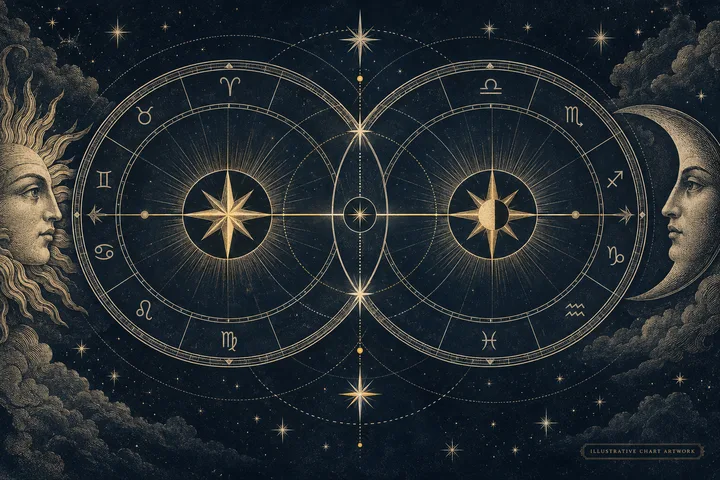
The assumption to test: the Anti-Vertex is just a weaker Vertex
If a synastry reading already includes the Vertex, it’s tempting to treat the Anti-Vertex as a spare label. The Vertex gets the vivid language. It marks the meeting that feels charged, timely, or hard to dismiss. The Anti-Vertex looks like the quiet point on the other side of the wheel, so many readings leave it there.
That shortcut misses the point. The Anti-Vertex doesn’t compete with the Vertex, and it doesn’t add a second promise that a relationship will last. It shows the other end of the same axis. In a useful reading, the Vertex describes what the relationship seems to bring toward you. The Anti-Vertex describes the inner material you carry toward the encounter: a need, instinct, value, or underused strength that helps explain why this particular meeting catches hold.
That distinction matters when a contact feels powerful but the story is unclear. One person may feel swept into a consequential bond, while the other seems to initiate, pursue, or embody a quality the first person hasn’t fully claimed. The Vertex tells you why the meeting lands with force. The Anti-Vertex helps you ask what each person is already participating in.
This also explains why the Anti-Vertex can feel less obvious at first. The Vertex story often has an event attached to it: the unexpected meeting, the sudden turn, the person who appears during a major change. The Anti-Vertex story may appear later, in the choices you make once the encounter is already real. You notice the need for calm after the rush. You hear yourself asking for a clearer promise. You discover that the relationship has made an old talent or desire impossible to ignore.
A good comparison therefore has two timelines. First comes the felt arrival. Then comes the work of recognizing what the arrival has activated. If you read only the first timeline, the relationship can seem to have all the power. If you include the second, you can see your own agency inside the experience.
So the supported position is simple. Read both points as one axis, but give them different jobs. The Vertex is the encounter’s magnetic or disruptive edge. The Anti-Vertex is the less visible personal contribution and the resource that can make the encounter conscious.
The Anti-Vertex adds the side of a Vertex contact that the usual reading can miss: what you bring, reach toward, or unconsciously need in order to meet the relationship’s deeper theme. Because it sits exactly opposite the Vertex, it doesn’t describe a separate event or a stronger version of fate. It completes the axis. Read the Vertex for the encounter’s compelling, other-person quality. Read the Anti-Vertex for the personal resources, desires, and habits that help create, receive, or work through that encounter. In synastry, start with exact conjunctions to either end of the axis, then check the planet involved, the person whose point is contacted, and the rest of the chart. Use a tight six-degree orb for this report, with the closest contacts carrying the most weight. If you only know the signs and not the degrees, compare themes without calling an aspect exact.
Sources: The Vertex in Astrology; Vertex in Synastry; The Vertex and Anti-Vertex
Why astrologers focus on the Vertex first
The Vertex is a calculated point, not a planet. It comes from the intersection of the ecliptic and the prime vertical in the western side of the chart. Cafe Astrology calls it an auxiliary Descendant and notes that astrologers use it most often in synastry. Brian Clark places the point within a third angle, alongside the Ascendant-Descendant and MC-IC axes. Those descriptions explain its reputation.
In relationship comparison, a partner’s planet or angle near your Vertex can describe a meeting that feels unusually consequential. The Vertex person may experience the contact as a pull from outside the usual plan. The planet person supplies the living function. Their Sun may illuminate the encounter, their Moon may stir attachment and memory, Venus may awaken attraction and value, and Mars may bring heat, action, or conflict. An angle contact can make the other person’s presence impossible to ignore.
But Vertex symbolism is not a relationship verdict. A powerful contact can belong to a romance, a friendship, a collaboration, or a meeting that changes your direction for a season. Cafe Astrology makes the same practical point: Vertex contacts in significant relationships don’t automatically describe a blissful outcome. They describe force and importance.
The word ‘fated’ can also confuse the reading if you let it do too much work. In this context, it describes the quality of an encounter, not a command about what you must do next. A bond can matter because it exposes a pattern. It can matter because it opens a new path. It can matter because it brings a person who reflects a part of you that had stayed out of view. None of those meanings requires you to surrender discernment.
That is where the Anti-Vertex becomes a useful corrective. It shifts the focus from ‘What has happened to me?’ toward ‘What is this relationship asking me to recognize in myself?’ The question is still astrological. It simply gives the point person a more active role.
This is why the Vertex often appears first in a reading. It answers the arrival question. Why did this person or situation feel different? Why did the timing matter? Once you have that answer, the Anti-Vertex asks the harder follow-up: what part of you was ready, hungry, or quietly equipped to meet it?
Sources: The Vertex in Astrology; Vertex in Synastry; The Vertex and Anti-Vertex
What the Anti-Vertex adds to the axis
The Anti-Vertex sits exactly 180 degrees from the Vertex, on the eastern side of the chart. Its position is mathematical, but its interpretive use is relational. Brian Clark describes it as a set of unseen resources and desires that can support the personality reflected by the Ascendant. That gives the Anti-Vertex a practical role: it points to what you may not lead with consciously, yet draw on when a relationship exposes a deeper task.
Think of the axis as a movement rather than a label. The Vertex is the point where an encounter breaks into your field. The Anti-Vertex is the inner capacity or longing that meets it. One end says, ‘This arrived and changed the temperature.’ The other says, ‘Here is what I was carrying into the room, even if I hadn’t named it.’
That hidden side can feel uncomfortable. If the Anti-Vertex is in a sign associated with steadiness, you may discover that a dramatic relationship is asking for patience, material reliability, or clearer values. If it’s in a sign associated with speech, you may need to name what the connection is doing instead of letting intensity speak for you. The sign doesn’t predict a person. It gives the style of the undeveloped or underused response.
You can read the sign through three questions. What quality does this sign trust? What quality does it avoid? What quality might it need to practice when a relationship becomes compelling? Taurus may trust what is tangible and avoid sudden surrender. Gemini may trust information and avoid emotional finality. Scorpio may trust depth and avoid casual vulnerability. These are prompts, not verdicts. They help you move from a sign keyword to a relational choice.
The house can add a setting when it is known and reliable, but don’t let it replace the point’s basic axis meaning. A fifth-house setting may bring the theme into romance, pleasure, children, or creative expression. A seventh-house setting can make partnership questions more direct. An eighth-house setting can deepen trust, merging, and shared vulnerability. The Anti-Vertex still asks what inner resource you bring to that setting.
The strongest use of the Anti-Vertex is therefore not to crown a connection as special. It’s to make the reading more complete. It shows what the Vertex experience activates in you, what you might seek without admitting it, and what resource can turn a compelling bond into a conscious exchange.
Sources: The Vertex and Anti-Vertex; The Anti-Vertex in Astrology: Meaning and How It Works
Vertex and Anti-Vertex in synastry: two directions of contact
In synastry, read the direction of contact carefully. If one person’s Venus conjuncts the other person’s Vertex, the Vertex person may experience the Venus person as a timely arrival who awakens affection, pleasure, beauty, or a question about value. If that same Venus conjuncts the other person’s Anti-Vertex, the Venus person may draw out a capacity for receiving, choosing, or expressing affection that the Anti-Vertex person doesn’t usually show first.
The contact can work both ways. Person A’s Sun may conjunct Person B’s Vertex, while Person B’s Mars may conjunct Person A’s Anti-Vertex. Now the exchange has two different currents. A’s presence may feel like an important arrival to B. B’s action, desire, or anger may call forward something in A that was present but not fully owned. The chart doesn’t tell you who is right or who must stay. It shows where the relationship gains charge and what it asks each person to embody.
An opposition across the axis can be just as revealing as a conjunction, because every Vertex contact has an opposite point built into it. When a planet touches the Vertex from the opposite side, don’t throw the contact away. Ask what the two poles are trying to integrate. A partner may activate the compelling encounter while also pressing on the instinct that helps you respond.
Keep the language directional. Say ‘the Vertex person may feel’ or ‘the planet person may activate.’ Don’t assign a fixed emotional experience to both people. Synastry is an exchange, and the same contact can be conscious for one person and barely named by the other.
There is another reason direction matters. The same planet can be experienced differently depending on whether it lands on the other person’s Vertex or Anti-Vertex. A Venus person may feel that she is simply expressing her taste and affection. The Vertex person may feel unexpectedly drawn into a new value system. On the Anti-Vertex, the Venus person may seem to give the point person permission to enjoy, receive, or choose more clearly. Neither side is passive, but the emphasis differs.
If both charts show contacts to both ends, read the pattern as reciprocal activation. That can be striking. It can also be confusing, because each person may believe the other is the one who started everything. Look for which point is contacted, which planet is involved, and when the contact becomes visible. The axis can describe mutual significance without describing identical experience.
Sources: The Vertex in Astrology; Vertex in Synastry; The Vertex and Anti-Vertex; The Anti-Vertex in Astrology: Meaning and How It Works
The planet changes the meaning more than the label does
The Anti-Vertex doesn’t speak by itself. The planet or angle making contact tells you what kind of material enters the story. Start there. Then add the axis. This keeps the interpretation specific.
You don’t need to force every planet into a dramatic story. If Mercury contacts the Anti-Vertex, the added layer may be simple and exacting: conversations become the route through which a hidden position is spoken. If Jupiter makes the contact, a partner may enlarge an underused faith or appetite for growth, but may also exaggerate it. If Saturn makes it, the relationship may reveal a skill for boundaries and endurance that feels heavy before it feels useful.
Use the planet’s natural function as a starting point, then let the sign, house, aspect, and wider chart modify it. Venus in Taurus won’t tell the same story as Venus in Aquarius. Mars in Cancer won’t act like Mars in Capricorn. The Anti-Vertex doesn’t erase those differences. It gives them a place in the axis between what arrives and what you must learn to carry.
With the Sun, the contact can draw attention to identity, visibility, confidence, and the right to take up space. A Sun on the Vertex may make the planet person feel like a significant figure in the other person’s unfolding story. A Sun on the Anti-Vertex can reveal an identity resource the point person has kept in the background. The relationship may ask, ‘Who are you when you stop adapting to the role others expect?’
With the Moon, the axis carries memory, safety, habit, and emotional timing. A Moon on the Vertex can make the encounter feel familiar or deeply affecting. A Moon on the Anti-Vertex can expose a need for care or belonging that the point person usually manages privately. Don’t reduce this to instant comfort. Sometimes the contact is powerful because it stirs what has been avoided.
With Venus, look at attraction, taste, reciprocity, and the values the relationship makes visible. With Mars, look at pursuit, heat, initiative, irritation, and the ability to act. With Saturn, ask what the bond requires, contains, or makes serious. With Uranus, Neptune, or Pluto, slow down before using grand language. Those planets can alter the relationship’s direction, but their meaning depends on the rest of the synastry and on how close the contact is.
Angles deserve attention too. An Ascendant contact can make the person’s manner and presence immediate. A Descendant contact can place the connection inside partnership symbolism. The Anti-Vertex adds the less obvious personal response beneath that visible exchange.
Sources: The Vertex in Astrology; The Vertex and Anti-Vertex; The Anti-Vertex in Astrology: Meaning and How It Works
A worked example: Venus on the Anti-Vertex
Imagine Maria has her Vertex at 18 degrees Scorpio and her Anti-Vertex at 18 degrees Taurus. Daniel’s Venus is at 17 degrees Taurus. These are illustrative placements, not a calculated chart. The contact is close enough to examine under a six-degree orb, and the conjunction to Maria’s Anti-Vertex is the first fact to name.
A thin reading says Daniel is attractive to Maria and the connection feels meaningful. That may be true, but it leaves the Anti-Vertex unused. A fuller reading starts with Taurus. Daniel’s Venus may draw Maria toward steadiness, touch, pleasure, dependable values, or a slower pace than the relationship’s initial intensity suggests. The Anti-Vertex person may not think of herself as seeking those things. She may discover the need through the bond.
Now bring in the opposite Vertex in Scorpio. The axis creates a contrast between security and depth, preservation and surrender, what can be held and what must be transformed. Maria may experience Daniel’s presence as a quiet invitation to build trust, while the relationship also stirs Scorpio questions about vulnerability, exclusivity, fear of loss, and emotional truth. The Venus contact doesn’t prove that Daniel will provide safety. It shows the kind of value and desire the connection activates.
What should Maria watch in real life? Does Daniel’s affection become consistent care, or does it remain a pleasant promise? Can she ask for clarity without turning the bond into a test? Does the relationship support both steadiness and honest depth? Those questions translate the axis into a decision guide. The astrology points to the work. Behavior shows whether the work is happening.
The example also shows why the point person and the planet person shouldn’t be assigned a simple winner-and-recipient role. Daniel’s Venus may feel natural to him. He may simply enjoy Maria, offer warmth, or prefer a slower rhythm. Maria may experience those choices as a revelation about what she values. At the same time, Maria’s Scorpio Vertex can draw Daniel into emotional depth that he didn’t expect. The exchange becomes richer when both people ask what they are learning, not when one person is labeled the catalyst and the other the student.
If Maria has other Taurus signatures, such as a strong Venus or a Moon in an earth sign, the Anti-Vertex theme may feel familiar and easy to recognize. If Taurus is otherwise quiet, Daniel’s Venus may make it feel new. Neither result is more meaningful. Familiarity can create skill, while novelty can create awareness. The chart tells you where to look. It doesn’t decide how consciously either person will respond.
If Daniel’s Venus were instead at 18 degrees Scorpio, it would conjunct Maria’s Vertex. The emphasis would shift. Maria might feel that Daniel arrived with unusual force, and Daniel’s Venus would activate her Vertex story through attraction and value. The two contacts are not interchangeable. Taurus on the Anti-Vertex describes the resource Maria must claim. Scorpio on the Vertex describes the charged relational field she enters.
One more variation makes the comparison clearer. Suppose Daniel’s Venus is at 24 degrees Taurus instead of 17 degrees. The sign symbolism still resonates with Maria’s Anti-Vertex, but the seven-degree distance falls outside this report’s working orb. You could mention a broad thematic echo if the rest of the chart supports it. You shouldn’t present it as a conjunction. That difference may seem technical, yet it changes the reader’s sense of emphasis.
Now suppose Daniel’s Venus is at 17 degrees Taurus, but Maria’s reported birth time is uncertain enough to move her Anti-Vertex from 18 Taurus to 22 Taurus. The contact becomes five degrees rather than one. It remains possible under the six-degree rule, but its priority drops. If another contact becomes exact under the alternate time, that one may deserve the main interpretation. A responsible report can show both possibilities and tell the reader what information would resolve them.
The worked example has one final lesson. Sign language should never replace relationship language. Taurus can suggest steadiness, touch, and value, while Scorpio can suggest depth, trust, and exposure. But the actual question is whether two people can build steadiness without avoiding depth. That sentence joins the astrological axis to a lived decision. It gives the reader somewhere to go.
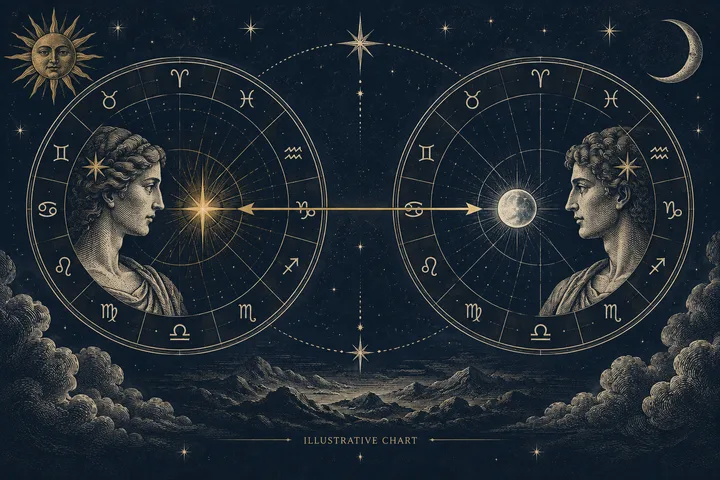
Degrees, aspects, and the six-degree working rule
You can’t judge a Vertex or Anti-Vertex contact from sign alone when degrees are available. The sign gives the language. The degree tells you whether the planet is actually speaking to the point. This is especially important because the Vertex depends on birth time and location, so a rough birth time can move the axis enough to change a close contact.
For this report, use a six-degree orb for selected major aspects, with exact and close contacts ranked first. A conjunction is measured around 0 degrees. An opposition is measured around 180 degrees. Astrologers use different orb rules, and Cafe Astrology describes its own Vertex practice as especially tight. Our six-degree ceiling gives this comparison a clear boundary without pretending every contact inside it has equal force.
Here’s a practical ranking. First, check a planet or angle within one degree of either point. That is the sharpest signal. Next, check contacts within two or three degrees. They remain strong and usually deserve a central paragraph. Contacts from four to six degrees can add context, especially when a personal planet or angle repeats the same theme elsewhere, but they shouldn’t overrule a closer contact. Beyond six degrees, leave the aspect out of this report unless another method explicitly calls for a wider orb.
Then check whether the aspect is in sign. A planet at 29 degrees Aries and a point at 2 degrees Scorpio are close by degree but don’t carry the ordinary sign-to-sign opposition. Treat that as a qualified contact, not a clean archetypal opposition. The degree may show pressure, while the signs tell a different story. Precision makes the interpretation quieter and better.
If you only have signs, say ‘Venus in Taurus resonates with the Taurus Anti-Vertex theme.’ Don’t say ‘Venus conjuncts the Anti-Vertex.’ That small distinction protects the whole reading.
A useful report can show this distinction in a small table or a plain list of facts: point, sign, degree, contacting planet, exact distance, and interpretive priority. For example, ‘Maria Anti-Vertex, 18 Taurus; Daniel Venus, 17 Taurus; conjunction, 1 degree; priority: high.’ The reader can then follow the reasoning. The interpretation doesn’t float free of the data.
If the birth time is rounded to the nearest hour, treat the degree as provisional. If the point changes by several degrees under plausible times, the contact may move from close to wide or disappear altogether. In that case, the honest astrological reading is conditional: the Anti-Vertex theme may be relevant, but the exact synastry contact needs better timing. Precision is not coldness. It is respect for the chart.
Sources: The Vertex in Astrology; Vertex in Synastry; The Vertex and Anti-Vertex; The Anti-Vertex in Astrology: Meaning and How It Works
The strongest exception: a clear Vertex contact can carry the reading
The Anti-Vertex deserves attention, but it doesn’t always deserve equal weight. The strongest exception is a very close Vertex conjunction from a personal planet or angle, especially when the contact repeats a theme already supported by the Moon, Venus, Mars, the Ascendant, Descendant, or a tight major aspect. In that case, the Vertex may carry the encounter’s main story. The Anti-Vertex can remain a supporting layer rather than the headline.
This matters because some astrologers describe the Anti-Vertex as less significant, while others read both ends as equally active. The useful middle position is to rank by evidence inside the chart. Don’t force symmetry because the axis is symmetrical in geometry. Interpretation is not a vote between two labels. It follows closeness, planet, angle, repetition, and lived relevance.
Consider a person whose partner’s Sun is within one degree of the Vertex, while the partner’s Anti-Vertex contact is six degrees from a minor point. The Sun-Vertex contact deserves the stronger claim: the partner’s identity and presence may feel unusually consequential. The Anti-Vertex contact may still describe a private response, but it shouldn’t compete with the exact personal-planet conjunction.
The reverse can happen. A close Venus or Moon on the Anti-Vertex may explain why the relationship becomes a mirror for receiving care, naming values, or building safety, while a wide Vertex contact adds only atmosphere. The point is not to make the Anti-Vertex win. It’s to stop the Vertex from taking every available meaning simply because it has the more dramatic name.
Rank the contacts. Then read the axis as a whole.
This ranking also protects you from a common reading error: counting contacts instead of weighing them. Three wide contacts don’t automatically defeat one exact conjunction. A chart isn’t a scoreboard. Repetition matters, but repetition must be close enough and relevant enough to support the same story. A tight Moon-Anti-Vertex conjunction may say more about emotional activation than several distant contacts from outer planets.
The exception can also involve the natal chart. If the Vertex person already has the Anti-Vertex tightly connected to a natal planet, the partner’s contact may awaken an established inner pattern rather than create an entirely new one. The synastry contact still matters, but it may feel familiar because the natal chart has been carrying the theme all along. Read natal and synastry layers together when the placements are available.
Sources: The Vertex in Astrology; The Vertex and Anti-Vertex; The Anti-Vertex in Astrology: Meaning and How It Works
How to use the Anti-Vertex without turning it into fate
Astrology gives you a way to name a pattern. It doesn’t remove your part in the pattern. The Anti-Vertex is most useful when it turns a charged reaction into a question you can answer through choice.
Start by writing down the point person’s Anti-Vertex sign and degree, if known. Then identify any of the other person’s planets or angles within six degrees. Note the closest contact first. Next, write one sentence about the activated resource. ‘This relationship may call me toward steadier values.’ ‘This person may draw out a voice I usually hide.’ Keep the sentence concrete.
After that, compare the Anti-Vertex theme with the Vertex theme. Where do they support each other? Where do they pull in different directions? A Taurus Anti-Vertex and Scorpio Vertex may ask for both reliability and emotional honesty. A Gemini Anti-Vertex and Sagittarius Vertex may ask for both careful listening and a larger truth. The signs don’t dictate the result. They show the tension to work with.
Finally, test the interpretation against observable choices. Are you making room for the resource, or only chasing the intensity? Can both people name what they want? Do actions match affection? Can the relationship hold a boundary without making the bond feel less meaningful? These questions keep the astrology alive. They also keep it useful.
A compelling contact can change you. It still needs consent, reciprocity, and ordinary care to become a relationship you can live inside.
This is especially important for readers who feel a strong pull before they have much evidence about the relationship itself. The Anti-Vertex can help name why you are drawn toward a quality, but it can’t tell you whether the other person can live that quality consistently. If the chart suggests a need for safety, ask whether the person keeps agreements. If it suggests a need for honest speech, ask whether difficult conversations remain possible. Let the symbol sharpen your questions.
You can also use the axis after conflict. What did the other person activate? What did you reach for? Did you move toward the Anti-Vertex resource, or abandon it to preserve the intensity of the Vertex story? A disagreement may reveal the point more clearly than the first attraction. That doesn’t make the conflict desirable. It makes it informative.
The best outcome of this reading is not certainty about the other person. It is a better understanding of your own response. You can feel the pull, honor the meaning, and still choose a pace that lets trust develop.
Sources: Vertex in Synastry; The Vertex and Anti-Vertex; The Anti-Vertex in Astrology: Meaning and How It Works
A clean reading order for your synastry report
When you compare the Vertex and Anti-Vertex, sequence matters. If you begin with a grand conclusion, every later detail will bend toward it. Begin with the chart facts instead.
First, confirm the inputs. You need each person’s Vertex and Anti-Vertex sign, and degrees if you want aspects. Because these points depend on birth time and location, record uncertainty instead of filling the gap with a guess. This report uses supplied placements and optional degrees. It doesn’t calculate a natal chart from birth details, assign houses, or produce a relationship score.
Second, list the contacts. Put the tightest conjunctions and oppositions first. Include personal planets and angles before distant planets or minor points. Third, assign the planet’s job. Is the contact about identity, feeling, attraction, action, commitment, disruption, imagination, or transformation? Fourth, separate the two people’s experience. Who owns the point? Who supplies the planet? What might each notice?
Fifth, compare the axis. Ask what arrives from the other person and what the point person is being asked to claim. Sixth, check repetition across the rest of the synastry. If Venus on the Anti-Vertex is echoed by a Venus-Moon trine and a strong second-house theme, the resource of value and steadiness has more support. If nothing repeats it, keep the interpretation modest.
Only then should you turn to the relationship question. Not ‘Are we destined?’ Ask, ‘What does this bond bring forward, and are we meeting that material with honesty?’ That is the decision the Anti-Vertex makes visible.
Here is the compact version you can carry into a comparison. Vertex tells you what feels brought to you. Anti-Vertex tells you what you may be reaching for or learning to use. The planet tells you the life function involved. The degree tells you how close the contact is. The rest of the synastry tells you whether the theme repeats, softens, or becomes more difficult.
If the points are known only by sign, stop at the symbolic layer. If the degrees are reliable, calculate the distance and name the aspect. If the birth times are uncertain, say what could change. If the contact is strong, ask what action would make the symbolism conscious. This sequence gives the reader a method instead of a mood.
Then make the report useful to the actual question in front of you. Are you trying to understand the first meeting? The Anti-Vertex may explain the personal readiness beneath it. Are you trying to understand why the bond keeps returning to one theme? Check the sign, planet, and repeated aspects. Are you deciding whether to deepen the relationship? Use the chart to frame a conversation, then judge the answer by what both people do.
A comparison can end with three short notes. First: the strongest contact and the feeling it may create. Second: the Anti-Vertex resource that the bond calls forward. Third: the conversation or behavior that would show whether the resource is being lived. For the example above, that might be ‘Venus close to Anti-Vertex: affection highlights steadiness; Scorpio-Taurus axis: trust needs both depth and reliability; next step: discuss consistency, exclusivity, and how each person handles vulnerability.’
That ending is stronger than a compatibility percentage because it preserves the chart’s actual information. It tells you what was compared, how the symbols were ranked, and what to observe next. It also leaves room for the relationship to surprise you. Astrology can reveal a pattern before you understand it, but your choices reveal what the pattern becomes.
When you’re ready, compare the placements you already know. Add degrees if you have them. Start with the closest contact, read the planet, then complete the axis with the Anti-Vertex. After that, ask one grounded question and listen to the answer. That is where the chart becomes a guide.
Sources: The Vertex in Astrology; Vertex in Synastry; The Vertex and Anti-Vertex
A little more clarity
Is the Anti-Vertex as important as the Vertex in synastry?
It can be, but don’t assign equal weight automatically. Rank contacts by closeness, planet or angle, and repetition elsewhere in the chart. A one-degree Sun conjunction to the Vertex may carry more of the encounter’s main story than a six-degree contact to the Anti-Vertex. A close Moon, Venus, or Mars conjunction to the Anti-Vertex can still reveal the personal need or resource the relationship activates.
What does a partner’s planet conjunct my Anti-Vertex mean?
It suggests that the partner’s planet activates a less conscious quality, desire, or resource in you. Venus may draw out values and receiving, the Moon may stir care and memory, Mars may call for action, and Saturn may make responsibility visible. The planet’s role matters more than a generic claim that the contact is fated.
Can I read the Anti-Vertex without exact birth times?
You can compare sign themes if the placements were supplied, but you shouldn’t claim an exact aspect without reliable degrees. The Vertex axis is sensitive to birth time and location. If degrees are missing or uncertain, describe a possible resonance and leave the conjunction or opposition unconfirmed.
Sources & further reading
- The Vertex in Astrology
Supports the Vertex definition, Anti-Vertex opposition, synastry use, tight-orb practice, and the distinction between powerful contact and a blissful outcome.
- Vertex in Synastry
Supports the interpretation of Vertex contacts as charged or consequential encounters and separates that felt quality from relationship permanence or safety.
- The Vertex and Anti-Vertex
Supports the axis reading, the Anti-Vertex as unseen resources and desires, house and sign contrasts, and its role in chart comparison.
- The Anti-Vertex in Astrology: Meaning and How It Works
Supports the Anti-Vertex as the exact opposite point, its eastern orientation, active reaching symbolism, and complementary role in a synastry interpretation.
Synastry Comparison Report
Enter known placements for two people. Get an input-by-input comparison, selected aspect calculations and a clear record of what remains uncertain.
Compare our placements