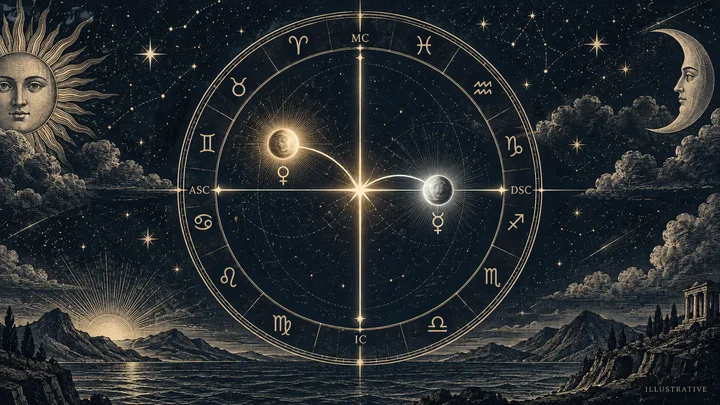
What does a planet-to-angle contact mean geometrically?
A planet-to-angle contact is a measured relationship between one chart owner’s planet and another chart owner’s angle point. Identify both people and both points before interpreting anything: for example, Person A’s Moon at its supplied zodiac position compared with Person B’s Descendant at its supplied degree. In this section, “personal planet” means the Moon, Venus, or Mars being compared; “angle point” means one of the four chart anchors Ascendant (ASC), Descendant (DC), Midheaven (MC), or Imum Coeli (IC). CHANI’s chart-angle article names the four angle points and their paired oppositions. The term “angle” can also refer colloquially to a geometric aspect, so use “angle point” for the chart anchor and “aspect” for the relation between two points. That vocabulary makes the claim checkable: it specifies an owner, a planet, an angle, and a geometry rather than saying only that a chart feels angular or prominent.
Synastry is the comparison of points belonging to two separate charts. Direction records which chart supplies which point: “A’s Venus to B’s ASC” and “B’s Venus to A’s ASC” are distinct comparisons, even if they use the same planet and angle names. The direction is a bookkeeping choice that preserves whose chart contributes the planet and whose contributes the angle. It does not claim that one person causes a particular response in the other. Write the owners beside the point names in notes or a comparison table, because a bare phrase such as “Venus conjunct the Ascendant” leaves unclear whose Venus and whose Ascendant are meant. This convention also helps keep a chart’s own internal aspects separate from interchart contacts: the former compare points within one person’s chart, while the latter compare a point from each person’s chart.
Before calculating separation, record the chart data used for both points. At minimum, note each owner, the point name, its zodiac sign and degree if supplied, the zodiac frame or reference used by the chart source, and the calculation source or chart settings when available. The Swiss Ephemeris manual, “SWISS EPHEMERIS,” documents that house and angle calculations depend on computational inputs and implementation choices; it is a technical reference for how chart points are calculated, not a source for their symbolic meaning. Stating the source makes two readers’ comparison reproducible and gives them a way to identify why outputs differ. If the source provides only a sign and no degree, a degree-based aspect cannot be confirmed from that information alone. If a display rounds degrees, preserve its stated precision rather than silently adding digits. The aim is not to create more data than the charts provide; it is to show exactly which supplied values support the comparison.
An aspect is the angular relationship between two chart points. To test one, place the planet and angle on the same zodiac circle, measure their shortest separation from 0° to 180°, then compare that separation with the exact angle of a named aspect. The major aspects used in many modern comparisons include conjunction (0°), sextile (60°), square (90°), trine (120°), and opposition (180°). For a planet-to-angle comparison, the angle point is the second point in that calculation, just as another planet could be. The Skyscript reference “Aspects” describes aspects as geometric relationships and discusses the role of orb in astrological practice. In this method, that source supports treating the aspect as a measured relation; it does not prescribe a universal eligibility rule for every astrologer or chart point.
Degree separation is the measured distance between the two supplied positions. The exact aspect is the target distance: for a conjunction the target is 0°, for a square it is 90°, and so on. The orb is the difference between the measured separation and that target. For clarity, calculate it as the absolute value of (measured separation minus exact aspect). Thus, if the distance is 88° and the aspect being checked is a square at 90°, the orb is 2°. This is an abstract arithmetic example, not a person’s chart. The signed difference shows whether the separation is below or above the target, but it does not reveal motion. In astrological usage, an aspect applies when its two points are moving toward exactness and separates when they are moving away. Assign either label only after checking their relative motion; the degree offset alone cannot establish direction. Whether an astrologer gives applying or separating status interpretive weight is a later judgment; recording the signed difference first prevents measured distance and interpretation from being conflated.
A reproducible entry can therefore read: “A’s Moon, sign and degree as supplied, to B’s MC, sign and degree as supplied; chart source/settings noted; measured separation __°; tested aspect __ at __°; orb __°; separation below or above exact.” Fill the blanks only from the chart data. If the article or reader uses an orb ceiling, state it separately from the calculation: the orb is the measured difference, while the ceiling is the chosen rule for whether to include the contact. Nicholas Campion’s “Aspects” and the Skyscript glossary “Orbs (or rays)” reflect that orb conventions vary; neither makes one ceiling binding on all chart work. A clear method can declare a six-degree maximum for its own comparison, but it should label that as the method adopted rather than a universal law. This section identifies the geometry; it does not rank a qualifying contact against other chart factors.
The four angle points form two conceptual axes: ASC–DC and MC–IC. CHANI’s chart-angle article identifies Ascendant opposite Descendant and MC opposite IC as paired points. The opposition is useful for orientation because it helps locate each point in relation to its counterpart. But the pair is not an automatic second contact. If A’s planet makes an aspect to B’s ASC, that calculation does not, by itself, establish that A’s planet aspects B’s DC. Check the second point’s actual degree and calculate its separation independently if that separate contact is relevant. The same applies to MC and IC. Naming the axis clarifies where the contacted point sits; only a second calculation can establish another planet-to-point geometry.
This distinction also prevents “angularity” from becoming a substitute for a specific contact. A statement that a planet is in an angular house describes its placement relative to a house division in a particular chart system. A statement that it aspects the MC or ASC by degree describes a measured relation to the named point. The Swiss Ephemeris manual documents house-system options and calculation differences, while CHANI’s chart-angle article explains that its Whole Sign convention can place MC or IC away from the tenth- or fourth-house cusp. Those sources support keeping house placement and angle-point geometry distinct. A planet may be interpreted as prominent by house in a given system without meeting a chosen orb to an angle; conversely, a close aspect to an angle point can be described even when the planet is not in a traditionally angular house. Each is a different chart statement, so label the one the supplied data actually show.
Use a compact record to make the distinction visible: “house placement” names the house system and house containing the planet; “planet-to-angle aspect” names the owners, points, aspect, separation, and orb. If the chart source offers both, record both as separate observations instead of allowing one to stand in for the other. This matters because labels such as “angular,” “on the angles,” or “strongly placed” can be used broadly in astrological writing, but they do not tell a reader whether the claim concerns a house, an angle point, or an aspect. A point-specific description is narrower and easier to compare across charts. For the current question, the minimum evidence for a contact is a planet’s supplied position, another chart’s supplied angle position, and a stated geometric rule. The interpretation of what that angle setting contributes comes next; it should not be folded into the arithmetic itself.
Sources: ✨ NEW: MC, IC, and DC are now in the CHANI app ✨; SWISS EPHEMERIS; Aspects
What scene does each end of the axis bring into view?
Once the geometry is identified, the angle contributes a symbolic setting for reading the contact. In CHANI’s educational vocabulary, the ASC–DC axis pairs presence and approach with encounter and close relationship; the MC–IC axis pairs public visibility and direction with private foundation and home. These are interpretive settings, not reports of events or fixed facts about either person. The same axis can be read from either end: ASC asks how a chart frames entry into experience, while DC gives the complementary setting of meeting and relating; MC points toward public role or direction, while IC turns attention to roots and what is held privately. The opposite point supplies context for the axis, but it is not independently contacted unless the planet’s degree also forms a stated aspect to it. CHANI’s “What is a birth chart?” supplies these broad symbolic descriptions and the planet functions used below; the matrix translates them into questions rather than predicted effects.
“Scene” is a useful word here because an angle is not a personality label for the person who owns it. It locates a symbolic domain in that chart. In a synastry reading, the person whose angle is contacted contributes the setting; the person whose planet is involved contributes a planetary function to consider within that setting. This is a reading convention, not proof that the angle owner experiences the contact in a particular way. CHANI’s “What is a birth chart?” associates the Ascendant with self-presentation and the Descendant with close relationships. Read together, these descriptions create a paired question: what is brought forward into the encounter, and what kind of meeting or relating does the chart symbolically foreground? Neither side cancels the other. The pairing helps a reader hold the axis as one organizing line while keeping the actual contact attached to the one point whose degree was measured.
The MC–IC axis works in a different symbolic register. CHANI’s “What is a birth chart?” describes the MC through visibility and the IC through private life. Read as a pair, they set public direction or recognition beside the foundation and private context from which life is organized. An angle contact to the MC therefore invites attention to the chart’s visibility-and-direction setting; a contact to the IC invites attention to its private-foundation setting. The axis comparison adds depth without implying that a partner changes someone’s career, home, family history, or public standing. A reader can ask what each symbolic setting brings into view, then distinguish the chart’s language from the actual circumstances the people describe. The practical use of the axis is to choose a better question about context, not to turn an angle into a forecast.
The planet column in the matrix uses the same restrained approach. CHANI’s “What is a birth chart?” describes the Moon through body and emotions, Venus through connection, and Mars through action. Those brief functions are starting points within CHANI’s interpretive tradition, not complete definitions and not claims that a person will behave in a fixed way. They help name what sort of symbolic material is being brought to an angle setting: a feeling or bodily rhythm, a way of relating or valuing, or an impulse toward action. Different practitioners may elaborate those functions through sign, house, aspect, dignity, or other chart context. The table deliberately holds those further layers aside so the reader can see the basic planet-and-scene pairing without mistaking a compact prompt for a total reading.
| Planet function in CHANI’s interpretive vocabulary | ASC: presence and approach | DC: encounter and relating | MC: visibility and direction | IC: private foundation | |---|---|---|---|---| | Moon: body and emotions | What emotional or bodily tone might be brought into how someone presents or begins? Consider comfort, sensitivity, or habit as alternatives. | What forms of emotional exchange or bodily ease might be noticed in the relationship setting? Consider care, familiarity, or changing needs. | What feeling, habit, or need might be visible in a public-facing or directional context? It may be supportive, private, or simply not central. | What needs, memories, or rhythms might be relevant to a private foundation? Consider nourishment, boundaries, or a preference for familiarity. | | Venus: connection | What style of connection, attraction, or appreciation might color presence? Consider warmth, taste, or social ease. | What forms of reciprocity, liking, or shared value might be relevant to meeting? Consider harmony, preference, or a difference in what feels pleasing. | What relational value or aesthetic preference might be visible in a public direction? It could support collaboration, express taste, or matter little to the situation. | What kinds of affection, pleasure, or valued comfort might enter a private setting? Consider shared enjoyment, different tastes, or a wish for solitude. | | Mars: action | What initiative, urgency, or way of pursuing a goal might mark an approach? Consider directness, energy, or a need to slow down. | What action or assertiveness might become salient in encounter? Consider taking initiative, negotiating pace, or making room for another approach. | What drive, effort, or ambition might appear around visibility or direction? It might encourage movement, create friction, or be unrelated to the people’s shared aims. | What actions around private life or foundations might be symbolically foregrounded? Consider protection, practical effort, or differing ways of restoring energy. |
Use a cell as a prompt, not as a description to assign to a person. For example, a Moon-to-DC reading might invite a conversation about what kinds of emotional exchange feel comfortable, while leaving room for care, familiarity, changing needs, or no special emphasis. A Venus-to-MC reading might lead someone to ask whether appreciation or shared values are relevant to a visible project or direction; it does not establish that the pair will collaborate or that either will gain recognition. A Mars-to-IC prompt could open a discussion about practical effort in private life, yet the people might experience that effort as protective, intrusive, useful, or irrelevant. Each alternative keeps the symbolic association alive without choosing the lived answer for the people involved. Their own accounts supply the context that a chart symbol alone cannot provide.
The matrix also shows why the angle matters to interpretation: the planet’s broad function stays the same across a row, while the angle changes the scene in which the reader considers it. Moon remains linked with body and emotions in each column, but the question shifts from entry and presence at the ASC to encounter at the DC, public direction at the MC, or private foundation at the IC. Venus remains connected with connection, yet its prompt changes with the setting. Mars remains action-oriented, but an approach, a meeting, a public aim, and a private foundation raise different questions. This is a way of organizing interpretation, not a measured claim that the same planet function produces four distinct effects. It lets a reader compare meanings consistently rather than importing a new planet definition every time an angle changes.
The two axes should remain paired in thought but separate in the contact record. If a planet contacts the ASC, the DC helps describe the other end of that axis; it does not follow that the planet also contacts the DC. The same is true of MC and IC. CHANI’s “What is a birth chart?” gives the symbolic pairings, while CHANI’s chart-angle article names the opposition relationships. Those roles are complementary as interpretive context, but measured contacts require their own geometry. This avoids a subtle slide from “the axis has two ends” to “both points receive a planet aspect.” Keep one angle in the heading of the contact, use its counterpart to understand the symbolic line, and make a separate degree comparison only if the second contact is actually being assessed.
A practical reading can therefore move from the row to the column: first name the planet’s broad function, then name the angle’s setting, then frame a question that allows multiple answers. For instance, “Venus brings connection into the MC’s visibility-and-direction scene” is a symbolic shorthand; a useful inquiry is whether shared values or appreciation matter in the context the people are considering. “Mars enters the IC’s private-foundation scene” can prompt a question about action or effort around private life, without deciding whether that effort feels supportive or disruptive. The prompt should be specific enough to discuss and open enough to be answered from lived experience. A chart reading becomes more precise when it says which symbols are being combined and what sort of scene they describe, while leaving the people’s actual experience for them to name.
Sources: What is a birth chart?
How is an angle contact different from a house overlay?
No. A planet occupying an angular house and a planet aspecting an angle point are different chart statements. The first depends on a house system’s division of the chart; the second depends on the supplied degrees of two points and a stated aspect rule. A third statement, that a chart contains an angle point at a given position, is an input to the comparison, not evidence that a planet contacts it. Keep these records separate, then interpret only the layer the available chart data support.
| Chart statement | Required input | What it permits | What it does not establish | |---|---|---|---| | Planet occupies a house | Planet position, house cusps or house boundaries, and named house system | A house-based interpretation within that system | A close degree aspect to ASC, DC, MC, or IC | | Chart has an angle point | Chart calculation inputs and the resulting point and degree | Naming the angle point as a candidate for comparison | That another chart’s planet forms an aspect to it | | Planet aspects another chart’s angle | Both supplied positions, owners, aspect tested, and orb rule | A specific interchart geometric contact under that rule | A house placement, mutual experience, or relationship outcome | The rows answer different questions. A chart can support the first and second rows while failing to support the third. A reader should not use “angular” as a shortcut that silently merges them.
House systems organize the circle into houses by different rules, so the same calculated point can sit against different house divisions. CHANI’s chart-angle article describes its Whole Sign convention, in which the MC and IC can fall outside the tenth and fourth houses. That example shows why “the MC is in the ninth house” and “the tenth-house cusp is the MC” need not be interchangeable claims in every system. Astrodienst’s “SWISS EPHEMERIS” documents house and angle calculations as related but distinct computations, with house-system choices and implementation differences. These sources support recording the system and chart source before interpreting house occupancy; they do not establish one universally required house system.
This distinction matters especially when someone assumes that a planet in the first, fourth, seventh, or tenth house must be close to an angle. A house label identifies a region under the chosen division. An aspect claim needs a measured distance from the planet to the relevant angle point. In CHANI’s stated Whole Sign convention, for example, the MC or IC may occupy a house other than the tenth or fourth; the house number alone therefore cannot tell you the exact distance to either point. Astrodienst’s “A Brief Introduction to Astrology: The House System” likewise distinguishes axes or points from house division, but its page was only partially accessible in the saved research, so it serves as narrow corroboration rather than the main basis for the distinction.
House occupancy is also chart-specific: it describes where a planet falls in the chart owner’s own division, whereas a synastry overlay places one person’s planet into the other person’s houses. Both can be useful layers, but neither substitutes for measuring the planet against a named angle degree. Astrodienst’s “SWISS EPHEMERIS” treats house divisions and angle calculations as distinct computational details, supporting the practice of recording the house system and the point calculation separately. A reader comparing overlays should keep that result beside, rather than inside, the interchart aspect record. If chart software displays an angular-house label and a planet-to-angle aspect list, treat them as outputs with separate inputs. This avoids inferring “conjunct the Descendant” from “in the seventh,” even when the terms appear together in a chart report.
Do not discard a valid house reading merely because no close angle aspect appears. A planet may still be interpreted as angularly prominent by house in the selected system. That is the counterpoint: house occupancy can carry symbolic weight within that framework even when the planet does not meet the comparison’s degree threshold. The disciplined wording preserves both findings: “The planet occupies the tenth house in this stated system” is supportable from the house data; “the planet closely aspects the MC” requires a separate calculation. If the latter cannot be made, keep the house interpretation and leave the degree-contact claim unconfirmed.
A practical record can use three columns: house placement and system; angle point and supplied degree; planet-to-angle aspect and orb. If two chart sources disagree, first check whether they used the same house system and calculation inputs before treating the disagreement as an interpretive difference. Astrodienst’s “SWISS EPHEMERIS” is a technical reference for how calculation inputs and house functions are handled, while CHANI’s page explains one provider’s Whole Sign presentation. Neither source turns a house placement into a degree contact. The comparison should name what is known, what method supplied it, and which claim remains open. That precision lets a symbolic house emphasis stand on its own without borrowing certainty from an aspect that has not been demonstrated. It also gives a reader a clean way to revisit the comparison if corrected birth data or a different house system becomes available later.
Sources: ✨ NEW: MC, IC, and DC are now in the CHANI app ✨; SWISS EPHEMERIS; A Brief Introduction to Astrology: The House System
How should exactness and aspect type change the ranking?
When multiple contacts are supplied, rank them in this order: first ask whether the geometry and angle data are reliable; next assess the aspect configuration and whether other supported contacts repeat or qualify the same theme; then consider sign resemblance as context. Under this article’s method, a planet-to-angle contact is eligible only when its orb is no greater than six degrees. This ceiling is a disclosed comparison rule, not a universal astrological standard. Nicholas Campion’s “Aspects” discusses geometric relationships and varying orb conventions; “Orbs (or rays) — Skyscript Glossary” contrasts modern aspect-based allowances with historical planet-specific practice. The latter was available only through its visible result in the saved research, so it supports variation, not a claim about consensus or prevalence.
Exactness is geometric closeness to the exact angle of the aspect being tested. For a conjunction the target is 0° separation, for a sextile 60°, square 90°, trine 120°, and opposition 180°. The orb is the absolute difference between measured separation and that target. Consider abstract geometry only: a point pair at the exact target has a 0° orb; a pair four degrees from that target has a 4° orb and remains eligible under this six-degree ceiling; a pair seven degrees away is outside it. These are arithmetic examples, not personal chart data. Eligibility does not make the contact automatically decisive; it only means the contact passes this method’s first inclusion rule.
Once eligibility is clear, aspect type describes a different relation to consider, not a score that mechanically predicts how a relationship will feel. A conjunction brings the two symbols to the same area of the zodiac circle, so this reading treats it as a concentrated meeting of the planet function and the angle setting. An opposition places them across the circle and emphasizes polarity or an axis tension in the interpretive frame. A square marks a quarter-turn relation that this method reads as friction, adjustment, or active engagement. A trine connects points through a 120° relation, often read as easier flow or reinforcement; a sextile forms a 60° relation, commonly treated as an opening that can require participation. These are interpretive distinctions, not measured outcomes. “Aspects” by Nicholas Campion supports treating aspect as geometry with a history of varied interpretation; it does not validate a fixed ranking for synastry angle contacts.
The labels should remain descriptions of relation, not shorthand for good or bad. A conjunction can make two symbols difficult to separate in the reading, but concentration does not mean ease. An opposition can call attention to two ends of a polarity without proving conflict between the people. A square can describe tension in an interpretive scheme, yet the people may use that tension constructively, ignore it, or experience it as a practical mismatch. A trine’s reputation for ease does not show that the relevant function is important to the question, and a sextile is not automatically weak merely because some accounts describe it as an opportunity. Nicholas Campion’s “Aspects” surveys interpretive treatments rather than reporting relationship outcomes; the distinction here is an editorial method for describing geometry while leaving expression open.
The angle point also shapes what the aspect is being related to. An opposition to an angle is not interchangeable with a conjunction simply because both pass the ceiling; nor does the same aspect name erase the difference between contacting one end of an axis and another. In this article’s comparison, aspect type helps describe the configuration after the measured contact is admitted. It should not be used to rescue weak inputs. If the chart source does not provide a dependable angle degree, a precise-looking orb cannot be inferred from the aspect label alone. If the degree is supplied but falls beyond the announced ceiling, the reader may note the wider symbolic association as part of a broader interpretive tradition, but should not label it an eligible contact under this particular method.
The ranking is deliberately procedural. First, check data quality: do both points belong to the named chart owners, are their positions supplied at usable precision, and is the angle calculation tied to stated inputs? Second, calculate the separation and orb against the aspect target, applying the same six-degree ceiling throughout. Third, describe the aspect type without assigning it an automatic positive or negative result. Fourth, inspect the rest of the supported pattern: does another contact repeat the same planet function, angle scene, or relational topic, or does it complicate that reading? Last, use sign similarity as texture. A shared element or compatible sign pattern may add interpretive context, but it should not outrank a verified degree contact merely because the signs sound alike.
Applied consistently, this order makes a comparison explainable. Imagine that one supplied angle contact is close but rests on an uncertain birth time, while a second angle contact has dependable inputs and a looser orb still inside the cap. The first may feel striking, but the uncertainty belongs at the top of the ranking because it affects whether the point itself is reliable. The second can lead provisionally under the declared method, with its larger orb disclosed. If both pass the input and orb checks, aspect type can then differentiate the symbolic relation; corroborating contacts can show whether the same subject recurs. This is a procedural illustration, not a claim about an actual chart or a universal rule for resolving every uncertainty.
Repeated corroboration matters because one striking contact can be a narrow lens. Suppose an illustrative reading is asking how emotional responsiveness and affection interact. A close Moon–Venus contact may address that question more directly than an otherwise eligible personal-planet-to-angle contact whose symbolic setting concerns public direction. Or a close Moon–Mars contact could be more relevant if the question is about emotional rhythm and action. This is not a universal hierarchy between planet-to-planet and planet-to-angle aspects. It is a relevance test: rank the contact that best speaks to the reader’s stated question, then use angularity to refine its scene if the angle is reliable. “Moon Contacting Venus and Mars in Synastry” is an available internal topic, but the present decision rule is this article’s synthesis, not a claim made by that page.
A close angle contact can still lead when the question is specifically about the setting it describes and the supporting inputs are dependable. The ranking here gives a contact prominence as an interpretive prompt, not authority over what either person feels. A vivid conjunction, for instance, does not settle whether the planet’s function is welcomed, difficult, or central in the lived relationship; those remain questions for broader chart context and the people’s own accounts. This is why the weight of a contact and the certainty of an outcome must remain separate judgments. Give it the lead when that setting directly sharpens the reader’s question and no better-supported contact answers it more closely. If the question concerns affection or emotional responsiveness, a planet-to-planet contact may be the more direct lens; the angle contact can remain a useful secondary setting rather than being discarded.
Orb choices can change the ranking. A practitioner who chooses a tighter threshold may exclude a contact that qualifies under six degrees; one who adopts a wider allowance may include more contacts. “Aspects” and “Orbs (or rays) — Skyscript Glossary” document that orb practice has varied, while the glossary’s limited access counsels against claims about which allowance most astrologers use. Therefore state the ceiling before comparing contacts and apply it consistently. Do not shift the threshold after seeing which contact produces the preferred interpretation. If a contact sits near the boundary, report the measured orb and the adopted rule together so another reader can see why it was included or left out.
A useful short-form ranking can be written as: reliable inputs, eligible geometry, aspect configuration, repeated corroboration, then sign context. This sequence is the article’s disclosed method, not a validated hierarchy or a claim that every tradition assigns identical weight. It lets readers explain why a contact leads: the degrees are usable, the orb passes the stated cap, the aspect is named, and other supported placements either reinforce or qualify its relevance. It also makes a secondary contact legible: perhaps the angle degree is uncertain, the contact is loose within the cap, or another Moon–Venus/Mars pattern better addresses the question at hand. The result is a reasoned order of attention, not a verdict about compatibility or an outcome. Write the reason beside each ranking so another reader can follow the choice and apply a different declared method if needed. consistently
Angularity can add a specific setting to a Moon, Venus, or Mars contact in synastry: the Ascendant–Descendant axis brings questions of presence and encounter, while the MC–IC axis brings public direction and private foundation. Give the contact weight only after checking whose planet meets whose angle, the aspect and degrees, and whether the birth-time information supports that angle. This article uses a six-degree ceiling as a declared working rule, not a universal standard. Compare the contact with relevant repeated planet-to-planet patterns; angularity can sharpen their meaning, but it does not automatically outrank them or prove mutual experience or relationship outcome. If the time is approximate, treat the contact as provisional unless it holds across the documented range. If the time is unknown, leave the angle contact unassessed and work with supported planetary information.
Sources: Aspects; Orbs (or rays) — Skyscript Glossary
How can the same contact describe two different chart roles?
A synastry contact has two chart owners and two interpretive positions. The planet person brings a planetary function into the comparison; the angle person supplies the chart scene being contacted. Naming both roles prevents the reading from turning one geometric relation into a single, assumed experience. CHANI’s “What is a birth chart?” describes Venus through attraction, values, and connection, while its Ascendant and Descendant language frames an axis of personal approach and encounter. Sasstrology’s “Angles & Midpoints in Synastry: When Someone Hits Your Most Sensitive Points” gives a contemporary, emphatic reading of angle contacts, including projection as one possible Descendant theme. Together these provide symbolic vocabularies, not evidence that either person will feel a particular way.
The direction matters because swapping chart owners changes which symbol is the planet and which is the angle. If A’s Venus contacts B’s Descendant, the interpretive shorthand is not simply “Venus–Descendant means partnership.” It is A’s Venus function considered in relation to B’s Descendant scene. Reverse the owners and the statement changes, even if the aspect geometry is otherwise similar. A’s angle does not become B’s angle, and the two people do not exchange planetary roles just because they share one comparison. This directional record is an editorial method for keeping the symbols legible; it is not a claim that astrology assigns a fixed behavioral effect to the planet person or a guaranteed sensation to the angle person.
Consider the saved illustration of two separate directions. In the first, Person A’s Venus contacts Person B’s Descendant. In the reverse direction, Person B’s Mars contacts Person A’s Ascendant. These are not one doubled contact and should not be blended into a general verdict about attraction. They join different planetary functions to different ends of an axis. The chart roles support distinct questions, conditional on the supplied angle degrees and the comparison’s stated aspect rule. The scenario is invented for method only: it does not describe actual people, birth data, feelings, or events.
| Contact direction | Symbolic role to consider | Question to test in conversation | |---|---|---| | A’s Venus to B’s Descendant | A’s Venus themes of relating, attraction, or values meet B’s encounter-oriented Descendant scene. This can invite reflection on what each person values in relating, while leaving open whether the contact feels easy, projected, or unremarkable. | “When we make a shared choice, what kinds of care or values do each of us want recognized?” | | B’s Mars to A’s Ascendant | B’s Mars themes of action, assertion, or initiative meet A’s approach-and-presence-oriented Ascendant scene. This may raise a different question about pace, initiative, and how action is received. | “In a new plan or activity, how does each of us prefer to initiate, and what pace feels comfortable?” | The table translates symbolism into questions, not predictions. Its questions are examples for a conversation, not a script that proves the contact is active. Each pair should replace them with a concrete situation they have actually encountered or expect to decide together.
CHANI’s “What is a birth chart?” is useful here because it supplies separate meanings for the planet and angle rather than treating a contact as a free-standing label. In its presentation, Venus concerns relating and values; Mars concerns action and assertion. The Descendant describes an encounter-oriented part of the chart, while the Ascendant describes the way a person approaches or meets the world. Combining those terms yields a symbolic sentence: one person’s Venus function is being considered in the other’s Descendant scene. The combination gives an astrologer a topic to investigate, but it does not state how either person actually behaves.
Sasstrology’s “Angles & Midpoints in Synastry: When Someone Hits Your Most Sensitive Points” demonstrates one contemporary school’s stronger language for angle contacts and also raises projection in its Descendant discussion. That qualification matters to the first row. A reader may experience the other person as embodying an ideal or desired quality, but the attribution may also describe the reader’s own expectations. The source offers an interpretive possibility, not a verified account of what happens in all such pairs. Therefore, the conversation question asks what each person values and wants recognized; it does not ask one partner to confirm that the other is an ideal match.
The second row should remain equally open. Mars symbolism can be framed as initiative, assertion, or action, but an Ascendant contact does not by itself tell us whether that initiative is welcomed, energizing, intrusive, or irrelevant. The person whose chart contains the Ascendant can describe how an interaction lands; the planet person can describe what they intended or experienced. Neither account cancels the other, and agreement is not required for the chart phrase to be useful. If they report different experiences, that difference is part of the conversation rather than a reason to force the symbolism into a single explanation.
This is why a directional reading should use verbs such as “brings,” “meets,” or “is considered in relation to,” then separate the interpretive prompt from claims about lived experience. “A’s Venus brings a relating function to B’s Descendant scene” identifies the symbolic combination. “B feels chosen by A” would claim an inner state not established by the chart. The first sentence can be followed by an open question; the second requires B’s own account and still should not be attributed to the aspect as fact. Similarly, “B’s Mars is read against A’s Ascendant” describes the contact’s structure, while “A experiences B as exciting” is a report only A can make.
A useful comparison note can preserve this distinction with four fields: planet owner, planet, angle owner, angle, followed by a separate question for each contact. That simple record prevents a common interpretive shortcut: treating “Venus to Descendant” as though the Descendant person and Venus person share one undifferentiated response. It also makes it possible to compare directions without claiming symmetry. In the illustration, A’s Venus-to-B’s Descendant and B’s Mars-to-A’s Ascendant are each read from the named planet owner toward the named angle owner. One cannot be used as proof of the other’s feelings or intentions.
The roles remain symbolic even when a contact is geometrically close. A close aspect may justify giving the combination attention under the announced method; it does not turn an interpretation into a report of what happened between the people. The planet person is not guaranteed to enact the function in a recognizable way, and the angle person need not find the contact pleasant or important. Context from other supported contacts can add or complicate themes, while the people’s descriptions can confirm, revise, or leave the symbolic prompt unused. This keeps the angle contact useful as a question generator without letting it speak over either person.
Use the two-direction illustration as a discipline in attribution. First state whose planet and whose angle are involved. Then name the planetary function and the angle scene separately. Finally, frame one question that the people can answer from their own experience. For A’s Venus to B’s Descendant, explore values or expectations in relating; for B’s Mars to A’s Ascendant, explore initiative and pace. If neither question clarifies anything the pair wants to understand, the symbols need not be given practical weight. The method preserves two distinct contacts and gives each a testable conversation prompt, without converting either into a relationship verdict.
Direction also clarifies where a question belongs. The Venus-to-Descendant prompt concerns how A’s relating symbols are interpreted in B’s encounter scene; it is not a claim that B alone must accommodate A’s values. The Mars-to-Ascendant prompt concerns how B’s initiative is considered against A’s approach; it does not assign A responsibility for managing B’s actions. A good conversation lets both people describe what they want, notice, and choose. The chart language can help identify a topic, but each person retains authority over their own account. If a prompt feels leading, translate it into a neutral description of the concrete choice or interaction under discussion.
Sources: What is a birth chart?; Angles & Midpoints in Synastry: When Someone Hits Your Most Sensitive Points
What is the strongest competing reading of a vivid contact?
A vivid angle contact can be important in an interpretive reading, but its intensity does not establish reciprocity, harmony, permanence, or relationship success. The strongest competing reading is that the contact marks a charged symbolic point while projection, mixed expression, or a more relevant repeated pattern changes what should lead. Sasstrology’s “Angles & Midpoints in Synastry: When Someone Hits Your Most Sensitive Points” presents a contemporary, emphatic view of angle contacts and explicitly includes projection as a possible Descendant interpretation. “Inner Planets to Angles: Electric Bolts from the Blue” likewise uses vivid language for inner-planet/angle links while allowing difficult expressions. These are interpretive positions, not findings about measured relationship outcomes.
The fair version of the emphatic reading is worth retaining: an angle contact may feel like a focal point in a chart comparison because it connects a personal planet’s function with a prominent angle scene. A practitioner may therefore give it attention, especially when its geometry is supported and the reader’s question concerns that scene. The caution is not to erase this emphasis. It is to separate “this contact is symbolically vivid” from “both people experience it the same way” and from “the relationship will last.” The first can be an interpretive judgment; the others require evidence that the chart contact alone does not supply.
| Reading element | Supported view and strongest exception | What would revise the reading | |---|---|---| | Vividness | Sasstrology’s “Angles & Midpoints in Synastry: When Someone Hits Your Most Sensitive Points” gives angle contacts emphatic symbolic weight. Its Descendant discussion also allows projection, so the felt significance may partly belong to the person interpreting or idealizing the contact. | If the people’s own accounts do not make the theme salient, or describe it differently, lower the practical weight while retaining the symbolic possibility. | | Ease | An inner-planet contact may be read as compelling without being uniformly harmonious; “Inner Planets to Angles: Electric Bolts from the Blue” allows difficult expression. A vivid link can accompany friction, ambiguity, or no notable shared effect. | Other reliable, supported contacts may contradict an easy-flow interpretation or point to a different recurring dynamic. | | Centrality | A contact can be a central symbolic emphasis in one contemporary school. Yet another repeated planetary pattern may answer the reader’s exact question more directly than this angle link. | Re-rank when the broader supported pattern repeats the relevant theme more clearly, or when the people’s own descriptions locate the issue elsewhere. | The table distinguishes what the named interpretations offer from this article’s practical ranking rule. The revision conditions are editorial synthesis, not reported findings from either source.
Projection is a particularly useful counter-reading because it preserves the contact’s interpretive value while asking whose meaning is being described. In “Angles & Midpoints in Synastry: When Someone Hits Your Most Sensitive Points,” Sasstrology includes projection in its discussion of the Descendant. In practice, that suggests a reader may see desired partner qualities in the other person, but the other person may not embody those qualities consistently or share the same understanding of the relationship. The source does not demonstrate how often this happens. The modest inference is simply that a symbolic description of attraction should be checked against each person’s account before it is treated as mutual.
The difference between salience and reciprocity is central. A contact can stand out to one reader because it offers a vivid way to name an attraction or encounter. The other person may notice a different feature, attach less significance to it, or disagree with the description altogether. None of these outcomes proves the chart reading false; they do limit what the reader can responsibly conclude from it. A chart can organize a reflection, but it cannot supply the second person’s testimony. A useful interpretation therefore permits asymmetry in experience rather than turning a shared geometric contact into a shared feeling.
Mixed expression is another reason not to equate vividness with harmony. “Inner Planets to Angles: Electric Bolts from the Blue” frames inner-planet-to-angle contacts as striking while allowing difficult forms of expression. That makes the competing reading more than a generic warning: the same symbolic prominence can be approached as energizing, uncomfortable, or complicated, depending on the contact and the people’s context. The source remains one contemporary astrological interpretation; it does not establish that every close contact produces mixed experience. The article’s synthesis is narrower: where a school itself allows more than one expression, a reader should not report only its most flattering possibility as though the alternatives had been ruled out.
A second supported pattern may also deserve the lead. Suppose the reader is trying to understand a recurring question about emotional responsiveness, affection, or action. A repeated Moon–Venus or Moon–Mars theme, if it is actually present in the supplied chart comparison, may speak more directly to that question than a vivid angle contact whose scene is less relevant. This is not a universal hierarchy, and it does not assert that such a pattern exists in any particular pair. It is a relevance test derived from the article’s method: ask which supported contact best addresses the question being asked, then decide whether angularity sharpens that interpretation or distracts from it.
The check should begin with what is genuinely supported in the comparison. A reader can list the verified contacts under the chosen orb method and note which symbolic themes recur. If a theme appears in several independent contacts, it may deserve more attention than a single dramatic phrase attached to one aspect. Repetition does not prove that the theme is experienced, either; it strengthens the case for treating it as a coherent interpretive thread. The distinction is between internal support in the chart reading and confirmation in lived experience. Both matter, but they are different kinds of support and should not be collapsed.
The people’s own accounts can change the emphasis too. If a proposed angle theme does not fit what they recognize, the reader can leave it as a possible symbolic lens rather than insisting it must be hidden or unconscious. If their accounts point to another repeated pattern, that information can move the other pattern forward as the more useful explanation of the question. These observations are practical editorial judgments, not findings attributed to Sasstrology. Their purpose is to keep the interpretation responsive to the people rather than make every experience conform to a vivid contact.
A disciplined conclusion can therefore say two things at once: this contact is a notable symbolic emphasis in the selected interpretive tradition, and its prominence does not prove mutuality or outcome. The strongest exception is not that the contact means nothing; it is that its meaning may be projected, mixed, or secondary to a better-supported pattern. If the other chart contacts contradict its proposed theme, or if the people’s own descriptions point elsewhere, revise its rank. If the contact remains relevant and the people recognize its scene, retain it as a useful prompt. Either way, keep the claim proportionate to what the chart and the conversation actually support.
This restraint does not flatten every contact into an interchangeable possibility. The source traditions still let the reader distinguish an angle link from an ordinary planet-to-planet theme and treat its symbolic scene as meaningful. The narrower claim concerns what follows from that emphasis: vividness can justify attention, but additional support is needed before claiming that the contact is mutual, easy, or decisive. Keeping that boundary allows a reader to take the symbolism seriously while remaining willing to change its rank.
Sources: Angles & Midpoints in Synastry: When Someone Hits Your Most Sensitive Points; Inner Planets to Angles: Electric Bolts from the Blue
How does uncertain birth time change what can be concluded?
Treat birth-time status separately for each chart and for each angle point. A documented time supports an angle comparison under the chart’s stated calculation inputs. An approximate time makes the angle provisional if a defensible range is available. With no usable time, leave the time-dependent angle unassessed. CHANI’s “What if I don't know my birth time? The problem with astrology — and how to work around it” distinguishes exact, approximate, and unknown times, and advises against relying on angles and houses when birth time is unknown. CHANI’s chart-angle article explains that angles depend on time and place and that the Ascendant degree can change over minutes. Swiss Ephemeris documents the computational inputs used for house and angle calculations. These sources establish why the input status matters; they do not supply a universal tolerance for an approximate time.
| Time status for this chart | What to compare | Wording the evidence permits | What can remain usable | |---|---|---|---| | Documented time and place | The calculated angle degree against the other chart’s supplied planet degree, using the declared aspect and orb rule. Record the calculation inputs and method. | “Under these stated inputs, the planet forms a [named aspect] to the angle within the selected orb.” | Other supplied planetary signs and supported planet-to-planet aspects remain available as separate layers. | | Approximate time, with a defensible interval | Calculate the angle at the interval’s documented endpoints using the same chart method, then check the contact at both ends. If its aspect and orb status stay the same, call the contact provisional across that interval; if status changes, report the uncertainty. | “This contact is provisional across the stated time range,” or “the contact’s orb eligibility changes across that range.” | Planetary placements or aspects that remain supported by the supplied data can still be discussed, with their own input limits. | | Unknown time or no defensible interval | Do not assign a degree-based angle contact. Do not substitute a guessed time or a generalized chart image for angle data. | “The angle contact is unavailable from the information supplied.” | Known supplied Moon, Venus, and Mars signs, and supported planetary aspects that do not require the missing angle, may still be compared. |
The approximate-time row is a cautious procedural inference for this article, not a validated method described by CHANI or Swiss Ephemeris. It asks for actual calculations at the endpoints of a range already provided or documented; it does not convert minutes into a guessed number of degrees. Use the same location, chart convention, aspect target, and orb ceiling at both endpoints. Otherwise a changed result could come from changing the method rather than from the time uncertainty. If the endpoints agree on whether the contact falls within the selected orb, the reader can state that it is stable across those tested bounds, not that every possible time or calculation convention has been ruled out.
Endpoint agreement is a useful screen, not a guarantee about every moment inside the interval. Angle movement and the tested aspect’s orb boundary may not be represented by a simple linear estimate, and the available sources do not establish an interpolation rule for this purpose. If the range is wide, if an endpoint sits close to the orb limit, or if an angle’s aspect classification changes, keep the conclusion provisional and ask for better documented inputs before ranking that contact. Do not report a fabricated degree, a minute-to-degree conversion, or false precision. Swiss Ephemeris supports the need to specify calculation inputs; the endpoint procedure itself is the article’s conservative way to show what those inputs can and cannot settle.
Run this check independently for each person. One chart may have a documented time while the other has only an approximate one; the first person’s angle can be assessed under its inputs even while the second person’s angle cannot. The two directions of a comparison can therefore have different confidence. For example, A’s documented Descendant could be compared with B’s supplied Venus degree, while B’s unknown Ascendant should remain unavailable when considering A’s Mars. This does not make the comparison unusable as a whole. It means the record should identify which specific contact is supported and which is not, rather than assigning one blanket confidence label to the couple’s entire synastry.
Apply the same independence to the four angle points. A birth-time uncertainty may affect an Ascendant or Midheaven contact differently from another point in the same chart; check each angle degree from the actual calculation instead of assuming all four contacts share one status. The article’s procedure is to retain a point only when its input and resulting degree can be stated. A chart record can therefore say “ASC contact provisional; MC contact unavailable” if those are the actual input conditions. Do not infer an angle degree from a house name, an axis description, or the apparent placement of a planet in a chart graphic. The geometry needs its own supplied or calculated point.
A broad sign description may still be meaningful within an astrologer’s symbolic practice when the birth time is uncertain, but it answers a different question. A sign-level reading can describe a general quality or theme; it cannot establish the degree separation required for a conjunction, square, trine, or another named contact under an orb rule. Label the sign interpretation as sign-level context and the angle contact as unavailable or provisional. This preserves interpretive material without letting it stand in for missing geometry. CHANI’s unknown-time guidance supports keeping time-dependent angles distinct from planetary information that remains usable; it does not require discarding every known placement.
A practical record needs only four items for each proposed angle contact: whose planet is involved, whose angle is involved, each point’s input status, and whether the calculated separation meets the declared aspect and orb rule. Add the range tested when a time is approximate. This makes the conclusion auditable and makes uncertainty local: it attaches to the angle contact that depends on the missing input, not automatically to known planetary signs or a separate planet-to-planet aspect. If better time information later becomes available, recalculate the affected angle and update that contact; retain the other supported comparison notes unless their own inputs change.
Sources: ✨ NEW: MC, IC, and DC are now in the CHANI app ✨; What if I don't know my birth time? The problem with astrology — and how to work around it; SWISS EPHEMERIS
What should we do with the strongest supported contact?
Choose one concrete situation related to the contact’s symbolic scene, then ask a question both people can answer from experience. For example, an illustrative Venus-to-Descendant prompt might be: “When we make a shared choice, what does each of us want the other to understand about our values?” Compare the answers as accounts, not as validation of the chart. If the angle is unavailable, leave the contact out; if the prompt adds no useful distinction, leave it out too. A chart phrase should earn its place by helping name a question the pair actually wants to discuss. The Synastry Comparison Report can compare supplied Moon, Venus, and Mars signs, with optional degrees. It does not calculate natal positions or angles from birth details, adjudicate an angle contact, or predict a relationship outcome. If supplied placements would help with that narrower comparison, use [Compare our placements](/compatibility-test); otherwise, the conversation itself may be the useful next step. Keep the note directional: name whose planet and whose angle prompted the question, then record each person’s own answer without scoring agreement. That keeps the next step specific and mutual.
Sources & further reading
- ✨ NEW: MC, IC, and DC are now in the CHANI app ✨
CHANI defines chart-angle points, their oppositions, dependence on exact time and place, and its Whole Sign convention under which MC/IC may fall outside houses 10/4; use for input conditions and separating point from house system.
- What is a birth chart?
CHANI’s educational page describes its symbolic settings for Ascendant, MC, Descendant, and IC and assigns Moon, Venus, and Mars broad planetary functions; use to introduce vocabulary within CHANI’s interpretive tradition.
- What if I don't know my birth time? The problem with astrology — and how to work around it
CHANI distinguishes exact, approximate, and unknown birth times; advises treating time-dependent angles/houses as unavailable without time while retaining planetary sign or aspect material that remains known.
- SWISS EPHEMERIS
Astrodienst’s technical documentation describes computational handling of house cusps and angles and documents house-system differences and edge cases; it supports distinguishing calculated points from house divisions and specifying calculation assumptions.
- Aspects
Astrological aspects are geometric relations between chart points and orb practice affects whether/ how contacts are considered; use to frame the six-degree threshold as an editorially declared method rather than a universal rule.
- Orbs (or rays) — Skyscript Glossary
The visible glossary result contrasts modern aspect-based orb conventions with historical planet-specific orbs/rays; it indicates variation in orb practice, so no universal six-degree standard should be asserted.
- Angles & Midpoints in Synastry: When Someone Hits Your Most Sensitive Points
This modern synastry interpretation presents angle contacts in emphatic terms and explicitly includes projection as a possible Descendant reading; use as a school-specific strong interpretation and its own qualification, not as evidence of guaranteed experience.
- Inner Planets to Angles: Electric Bolts from the Blue
A second modern interpretive article frames inner-planet/angle contacts as vivid while allowing difficult expressions; use as a contrasting reading against uniformly harmonious interpretations.
- A Brief Introduction to Astrology: The House System
Astrodienst’s introductory material distinguishes chart axes/points from house division; use narrowly to clarify why a house overlay and degree aspect to an angle are separate statements.
Synastry Comparison Report
Enter known placements for two people. Get an input-by-input comparison, selected aspect calculations and a clear record of what remains uncertain.
Compare our placements