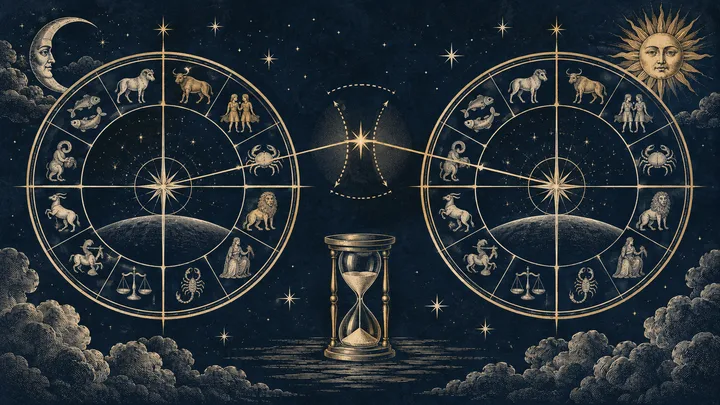
The first question is what the time record actually means
A displayed angle degree is only as strong as the time behind it. Before you interpret Venus on a Descendant or the Sun on an Ascendant, identify the record: exact to the minute, rounded to the nearest hour, remembered as approximate, or simply unknown.
Those descriptions are different inputs. If the record says 3:00 p.m., rounded to the nearest hour, this guide uses 2:30 to 3:30 p.m. as a clear working window. That is a declared convention for this reading. It isn’t a claim about every family record. If the note says “around 3,” “between 2 and 4,” or “sometime in the afternoon,” use the interval the note actually suggests.
The Ascendant and house cusps are among the most time-dependent parts of a chart. Cafe Astrology says the rising sign changes on average about every two hours, with a rate that varies by latitude, and stresses the need for the correct time-zone offset. [0] The real question is simple: does the planet-to-angle contact remain meaningful across the stated range?
Sources: What’s My Ascendant?, Cafe Astrology; Chart Rectification, Astrodienst Astrowiki
Know which angle receives the contact
The four angles are the Ascendant, Descendant, Midheaven, and Imum Coeli. They form two axes: the horizon axis runs from Ascendant to Descendant, and the meridian axis runs from MC to IC. Astrodienst describes these as the chart’s four cardinal points. [1]
The Ascendant is the eastern horizon point. It speaks to approach, presence, and the way someone meets life. The Descendant sits opposite it and brings one-to-one relating and partnership into focus. Astrology.com describes the Descendant as the point opposite the Ascendant and one of the four chart angles. [2]
The MC carries public direction, visibility, vocation, and reputation. The IC faces it and speaks to home, roots, family memory, and private foundations. Always name the angle owner. “Her Venus near his Descendant” is not the same sentence as “his Venus near her Descendant.”
Sources: Angle, Astrodienst Astrowiki; Descendant in Astrology: Meaning, Signs, and More, Astrology.com; Synastry, Cafe Astrology
Why a nearest-hour time can change the contact
The Ascendant moves quickly because it marks the zodiac on the eastern horizon at a particular moment and place. Astrodienst’s rectification reference gives an average movement for the Ascendant and MC of about one degree every four minutes, while treating that rate as an average rather than a fixed clock rule. [3]
That makes 30 minutes astrologically relevant. In a 2:30 to 3:30 window, the angle can move many degrees. The exact movement depends on the date, location, latitude, and chart method. The Descendant follows as the opposite point. The MC and IC are also opposites, but don’t assume they move at the same rate as the horizon axis.
A sign boundary raises the stakes. If the middle version shows late Libra rising and an edge version moves into Virgo or Scorpio, don’t blend the three into one invented personality. You have a fork in the angle story. State it. The same time issue affects house overlays while planet signs may remain secure.
Sources: What’s My Ascendant?, Cafe Astrology; Chart Rectification, Astrodienst Astrowiki
Use one window for one kind of evidence
Keep the time rule visible in your notes. Write the displayed time, the wording attached to it, and the tested range. For this article’s example: 3:00 p.m., rounded to the nearest hour, tested from 2:30 to 3:30 p.m.
Now separate it from a looser statement. “Around 3” does not automatically mean 2:30 to 3:30. It may mean a broad period remembered by someone who wasn’t watching the clock. Ask what the phrase meant, then record the answer. If nobody can narrow it, the angle language must become broader too.
An exact-looking number can still be rounded. Chart rectification is separate: it uses life events and timing techniques to propose a likely birth time. It doesn’t give you permission to silently turn an estimate into a verified angle. [3]
Describe the angle contact as provisional until it survives a stated time-range check. If a record says 3:00 p.m. and specifically means the nearest hour, test 2:30 to 3:30 p.m. If it says “around 3,” ask what range that phrase covers and use that wider range instead. Compare the planet’s degree with the angle at the middle, early, and late times. Keep the contact as a main theme only if the same angle relationship remains within this report’s six-degree orb throughout the tested window. Otherwise, call it conditional or set it aside, then lead with the supplied Moon, Venus, Mars, and secure planet-to-planet contacts. An angle can still speak clearly when its degree is approximate. Your wording should show what the chart supports.
Sources: What’s My Ascendant?, Cafe Astrology; Chart Rectification, Astrodienst Astrowiki
Run the middle, early, and late test
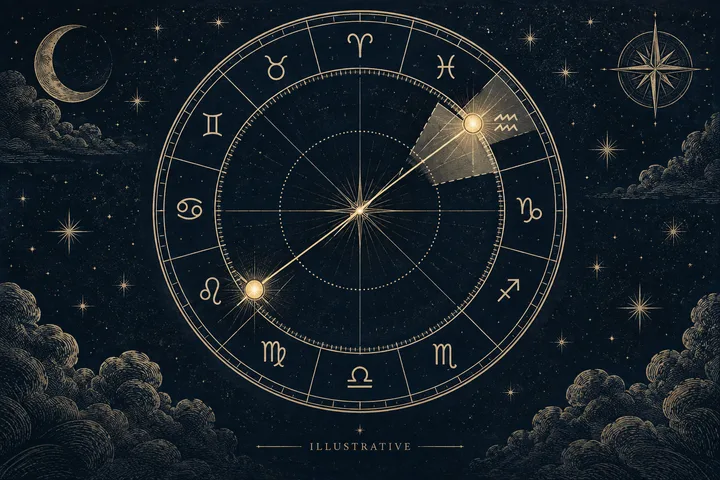
Here is the useful comparison. Imagine Maria’s record says 3:00 p.m., rounded to the nearest hour. Her partner’s Sun is supplied at 20° Libra. The middle version lists Maria’s Ascendant near 18° Libra, so the displayed contact is a two-degree conjunction. That number is a starting point, not the conclusion.
Test the same angle at 2:30 and 3:30. The exact degrees depend on a real birth date and place, so this remains an illustrative method rather than a calculated personal chart. Record the angle degree, the distance from the supplied Sun, the sign, and the status at each time.
If the Sun stays within six degrees of the Ascendant at all three points, the contact is stable within this declared window. If it falls within the orb at one or two points only, it is conditional. If it moves outside the orb or changes into a different angle story, set it aside. Do the same test in the other direction when both charts have uncertain times.
Let the six-degree orb answer only one question
An orb measures distance from an exact aspect. For a conjunction, it measures distance from 0°. This report uses a six-degree orb as a fixed editorial rule. It answers whether the contact falls within the chosen geometric reach.
It doesn’t answer whether the angle degree is secure. “The contact is within six degrees” describes the orb. “The angle moves across the tested time range” describes the input. You need both sentences when the birth time is rounded.
Don’t widen the orb to rescue an unstable contact. If a planet sits one degree from the angle in the middle version, three degrees away at one edge, and seven degrees away at the other, the contact is conditional under a six-degree rule. When possible, report a range instead of minute-level precision.
Sources: Chart Rectification, Astrodienst Astrowiki; Synastry, Cafe Astrology
Rank stable, conditional, and unsupported contacts
Use one ranking. A stable contact survives the full tested window with the same planet, the same angle, and the same six-degree rule. It can lead the angle portion of the reading, although its displayed degree remains approximate.
A conditional contact appears in only part of the window, changes sharply in strength, or depends on the edge. Keep it in a secondary note. An unsupported contact changes sign, leaves the orb, or produces two different angle meanings. Set it aside.
One exception matters. A close contact that stays close throughout the window can remain a major theme. The rounded time limits the exact degree, yet the planet-angle relationship remains strong enough to rank. Call it stable within the available range.
Sources: What’s My Ascendant?, Cafe Astrology; Chart Rectification, Astrodienst Astrowiki
Translate the surviving contact into a reading
Interpret a confirmed angle contact as a two-part sentence. The planet tells you what enters. The angle tells you where it lands.
Venus to the Descendant can describe liking, attraction, grace, and a wish to cooperate in one-to-one connection. Venus to the MC shifts the emphasis toward public support, shared taste, and encouragement around direction. Venus to the IC brings affection and preference into private space. Cafe Astrology places Venus among the central planets to compare in synastry and includes contacts to another person’s angles. [4]
The Sun to the Ascendant can make the angle person feel seen and energized. Mars can bring heat and movement. Saturn can steady or weigh down an angle. Jupiter can encourage and enlarge it. Keep the wording at the same confidence level as the contact.
Sources: Descendant in Astrology: Meaning, Signs, and More, Astrology.com; Synastry, Cafe Astrology
Use secure planetary layers to test the story
An angle contact is vivid. It isn’t complete. After the time check, compare the chart information you actually have: Moon, Venus, and Mars signs, supplied degrees, and selected major aspects within the report’s stated scope.
The Moon helps you ask whether the emotional texture supports the angle story. Venus describes attraction, values, and affection. Mars shows pursuit, heat, and friction. A conditional Venus-Descendant contact may explain a first impression, while a secure Venus-Mars aspect gives firmer evidence about attraction. Synastry sources treat planet-to-angle contacts as part of a wider comparison. [4]
Rank the layers. A tight, secure planet-to-planet aspect can outrank a broad conditional angle contact. A stable angle contact can outrank a loose sign comparison because it gives the interaction a specific axis. State which indication leads, which supports it, and what remains uncertain.
Sources: Descendant in Astrology: Meaning, Signs, and More, Astrology.com; Synastry, Cafe Astrology
End with the wording and conversation the range supports
The final choice is simple: confirm, soften, or set aside. Confirm a contact that survives the declared window. Soften one that appears only in part of it. Set aside one that changes into a different story or leaves the orb.
Then bring the symbolism into ordinary life. If Venus may sit on the Descendant, ask how affection is offered and returned. If Mars may touch the MC, ask whether shared ambition feels like fuel or competition. If an IC contact is stable, ask what creates comfort and belonging in private space.
The Synastry Comparison Report can organize supplied Moon, Venus, and Mars placements, optional degrees, and selected major aspects within its six-degree scope. It does not calculate a natal chart from birth details, houses, or angles. Keep the rounded-time angle in its own note, then [compare your placements](/compatibility-test). Start the conversation this way: “Our chart shows a possible angle theme, but the time is rounded. Let’s check the range before we make it central. What do we actually notice in the way this planet and angle meet?”
Sources: What’s My Ascendant?, Cafe Astrology; Descendant in Astrology: Meaning, Signs, and More, Astrology.com; Chart Rectification, Astrodienst Astrowiki
A little more clarity
Can you read an Ascendant contact when the birth time is rounded to the nearest hour?
Yes. State the working window, test the contact at its middle and edges, and call it stable only if the same relationship survives the full range. Otherwise, describe it as conditional and let secure planetary contacts lead.
Does rounded to the nearest hour mean 30 minutes on either side?
Use that as a declared working convention when the record explicitly says the displayed time was rounded to the nearest hour. Don’t apply it automatically to “around 3” or “sometime in the afternoon.” Those phrases need their own stated range.
Can a rounded time change the Ascendant sign or house overlay?
It can, especially near a sign boundary. The Ascendant and house cusps depend strongly on time, and the rate varies by latitude. Test the range before treating a sign, house, or angle degree as secure.
What if the angle contact is possible but not stable?
Keep it as a conditional note, explain the planet and angle symbolism, and rank it below secure Moon, Venus, Mars, and planet-to-planet evidence. Seek a more precise record if the angle matters to the reading.
Sources & further reading
- What’s My Ascendant?, Cafe Astrology
Supports the time dependence of the Ascendant and house cusps, the variable pace of rising signs, and the need to check the time-zone offset.
- Angle, Astrodienst Astrowiki
Defines the Ascendant-Descendant and MC-IC axes and identifies their four points as the chart angles.
- Descendant in Astrology: Meaning, Signs, and More, Astrology.com
Supports the Descendant as opposite the Ascendant, a chart point rather than a planet, and one of the four angles.
- Chart Rectification, Astrodienst Astrowiki
Supports the distinction between an uncertain recorded time, rectification as an estimated method, and the sensitivity of the Ascendant and MC to minutes.
- Synastry, Cafe Astrology
Supports comparing Venus and other relationship planets with a partner’s planets, luminaries, and angles as part of a wider synastry reading.
Synastry Comparison Report
Enter known placements for two people. Get an input-by-input comparison, selected aspect calculations and a clear record of what remains uncertain.
Compare our placements