The short answer: active is broader than aspected
A planet can matter in synastry without forming a selected major aspect. That’s the clean answer. The mistake is treating activated and aspected as synonyms.
An aspect is a measured relationship between two chart points. Activation is a wider interpretive word. A planet may stand out through a shared sign, a house overlay, a minor contact, rulership, or a pattern that repeats across the comparison. These layers can describe a real tone in the connection, but they don’t make the same claim.
Cafe Astrology’s synastry overview places sign, house, and aspect positions in the same larger study, while its technique summary keeps temperament, interchart aspects, and house overlays distinct. Name the layer before you name its meaning.
Write, ‘Your Venus is emphasized through a shared Taurus theme,’ when that’s what the placements show. Write, ‘Your Venus trines his Mars within four degrees,’ only after checking both degrees. One sentence describes resonance. The other describes geometry.
When a planet feels activated in synastry but has no major aspect, first check the degrees. If no conjunction, opposition, square, trine, or sextile falls within the chosen orb, read the other layers separately. A shared sign can create familiarity. A house overlay can focus the experience in a life area. A minor contact or repeated sign pattern can add texture. None of these should be renamed as a major aspect. In this guide, the working boundary is a six-degree orb for selected major aspects when degrees are supplied. If you only know the Moon, Venus, or Mars signs, you can read sign themes and compare relationship needs. You can’t confirm exactness or calculate houses. The useful question isn’t whether the planet is secretly aspected. It’s how the planet is active, what evidence supports that reading, and what the couple can observe in daily life.
Sources: Synastry: Relationship Astrology; Summary of Techniques in Synastry, Relationship Astrology
What a major aspect actually requires
The five major aspects used here are the conjunction, opposition, square, trine, and sextile. Their exact angles are 0, 180, 90, 120, and 60 degrees. Each gives the relationship a different motion: blending, polarity, friction, flow, or an opening that can be developed.
The signs alone don’t settle the matter. Two planets can occupy signs related by a square and still sit too far apart for the report’s orb. Two planets can sit near the same degree across a sign boundary and form a close conjunction by longitude while expressing through different signs.
For this report, use a six-degree orb for selected major aspects when degrees are supplied. A one-degree contact deserves more emphasis than a five-degree contact of the same kind. A contact at seven degrees may appear in a wider system, but it shouldn’t be promoted here because the label sounds useful.
Astrology.com’s introduction to synastry also ties activation to degree distance and treats a smaller orb as stronger. Measure first. Interpret second.
Sources: What’s Your Sign? An Intro to Synastry Charts and Astrological Compatibility; Birth Charts for Beginners: Four Things You Need to Know
The first alternative is sign resonance
Signs show style. Planets show the function using that style. Venus describes affection, pleasure, attraction, and values. Mars describes desire, initiative, heat, anger, and physical drive. The Moon describes comfort, habit, memory, and care. Mercury describes language, thought, and timing.
When two relevant planets share a sign, their functions use a similar vocabulary. That can feel immediate. It can make affection, conversation, or conflict look familiar even when the degrees don’t form a major aspect.
Imagine Maria has Venus at 2 degrees Gemini and her partner has Mercury at 25 degrees Gemini. The pair shares a Gemini tone around curiosity, words, and variety. The 23-degree gap does not make a Venus-Mercury conjunction within six degrees.
If his Mercury were at 6 degrees Gemini instead, the four-degree gap would qualify as a conjunction. The sign would describe the manner of the contact, while the aspect would describe a direct exchange between Venus and Mercury.
Sources: Synastry: Relationship Astrology; What’s Your Sign? An Intro to Synastry Charts and Astrological Compatibility
A worked comparison keeps the layers honest
Consider an example with Venus and Mercury in Virgo. The signs stay the same. Only the degrees change.
In version one, Venus is at 4 Virgo and Mercury is at 28 Virgo. The 24-degree separation gives you shared Virgo symbolism: careful attention, practical help, and a habit of noticing details. It doesn’t give you a major Venus-Mercury aspect. Rank this as sign resonance.
In version two, Venus is at 4 Virgo and Mercury is at 9 Virgo. The five-degree separation qualifies as a conjunction under the six-degree scope. Now affection and speech meet directly. The Virgo setting can make that exchange precise and useful.
In version three, Venus is at 4 Virgo and Mercury is at 4 Pisces. The planets oppose by degree. The signs add a Virgo-Pisces contrast between detail and impression, order and feeling. The opposition is the load-bearing fact. The signs tell you how that polarity may speak.
The reading changes because the chart layer changes. Don’t let a strong impression force three geometries into one label.
A house overlay answers a different question
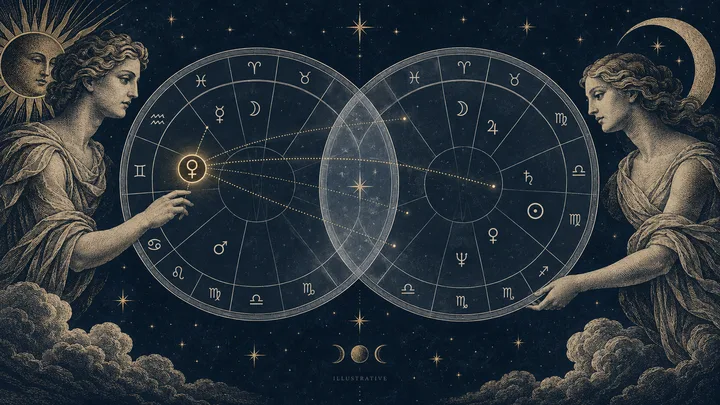
A house overlay shows where one person’s planet lands in the other person’s chart. It isn’t a planet-to-planet aspect. The aspect asks how two functions interact. The overlay asks which area of life becomes more noticeable around this person.
A partner’s Venus in your fifth house may draw attention to pleasure, romance, creativity, and play. Their Mercury in your sixth house may bring daily routines and practical details into conversation. Their Moon in your fourth house may stir belonging, family memory, privacy, and emotional shelter.
Cafe Astrology describes overlays as placing one chart over the other and compares the effect to a planet highlighting house matters. It also notes that the planet person and house person don’t occupy perfectly fixed roles. An overlay can be vivid without replacing an aspect.
You need a reliable Ascendant and house cusps to calculate this layer. Supplied Moon, Venus, and Mars signs aren’t enough. If birth time or house structure is missing, leave the overlay unranked. Don’t infer a seventh-house placement from attraction or a twelfth-house placement from confusion.
Sources: Summary of Techniques in Synastry, Relationship Astrology; Synastry: Planet Overlays in Houses
Minor contacts can add a quiet thread
The quincunx, semisextile, parallel, and contraparallel may appear in a fuller comparison. They belong to different geometries. The quincunx sits near 150 degrees. The semisextile sits near 30 degrees. Parallels use declination rather than zodiac longitude.
A minor contact can describe adjustment, echo, or a secondary link. It shouldn’t borrow the authority of a conjunction or square. Keep it in a second tier, especially when it stands alone.
An out-of-sign close contact needs care. A planet at 29 Aries and another at 2 Taurus are about three degrees apart, so their longitudes are close. The contact may be a conjunction by degree, but it isn’t a same-sign conjunction. Say both things.
Minor means lower in rank, not meaningless. If a minor contact repeats a theme already shown by a close personal-planet aspect, it can refine the picture. If it exists only to rescue a thin interpretation, let it stay quiet.
Sources: What’s Your Sign? An Intro to Synastry Charts and Astrological Compatibility; Birth Charts for Beginners: Four Things You Need to Know
Rank the evidence instead of collecting labels
When a planet feels active, use a hierarchy. Start with the closest valid major aspect between personal planets or luminaries. Then check reliable contacts to an angle. After that, consider sign resonance, confirmed house overlays, minor contacts, and repeated symbolism.
Exactness matters. Planetary relevance matters. Repetition matters. Lived expression matters. A close Venus-Mars contact normally carries more immediate weight than a wide shared-sign pattern. A house overlay can explain where the experience gathers, but it doesn’t change the aspect’s orb.
Imagine a woman’s Venus shares a sign with her partner’s Saturn but sits 18 degrees away, while his Saturn forms a close square to her Moon. The shared Venus-Saturn sign gives a background tone of restraint or duty. The Moon-Saturn square is the clearer contact. Lead with it.
Use language that matches the rank. A close aspect connects, blends, opposes, or presses. A sign pattern colors or echoes. An overlay focuses. A minor contact adds a thread. Good wording tells the reader how much weight to give each observation.
Sources: Synastry: Relationship Astrology; Summary of Techniques in Synastry, Relationship Astrology
Missing degrees change the verbs you can use
With signs only, you can compare elements, modalities, rulers, and broad planetary themes. You can say that both Venus signs favor steadiness, or that two Mars signs approach initiative in different ways. You can’t confirm exactness.
Without degrees, you can’t tell whether same-sign planets are conjunct, whether a square falls within six degrees, or whether a contact is applying or separating. Without reliable birth times, you also can’t calculate houses with confidence. The available placements still matter. They simply support a narrower reading.
This is where a sign comparison quietly turns into a false chart claim. A reader sees a sentence about a seventh-house overlay or a three-degree trine and assumes the report calculated it. If those inputs weren’t supplied, the sentence has gone beyond the evidence.
Use a clean note: ‘Based on the supplied signs, this is a shared-sign theme. Degrees weren’t provided, so the comparison doesn’t classify it as a major aspect.’ That’s precise, and it leaves the astrology intact.
Sources: Summary of Techniques in Synastry, Relationship Astrology; What’s Your Sign? An Intro to Synastry Charts and Astrological Compatibility
The strongest exception is convergence
Here’s the meaningful exception. A planet can organize the synastry story through several independent layers even when no single major cross-chart aspect explains it.
Imagine Maria has Venus in Libra, her partner has Mars in Libra, and their supplied placements repeat an air-sign emphasis. If Venus and Mars sit too far apart for a major aspect, don’t call them conjunct. You can still describe a converging Libra-air theme around balance, conversation, attraction, and the need to keep choosing each other in a social world.
That synthesis earns weight when the layers are genuinely separate: a sign pattern, a calculated overlay, a ruler connection, or another contact that points to the same planet. Three sentences repeating ‘air feels social’ don’t create three facts.
Convergence changes the headline, not the geometry. It can make a planet central. It can’t turn a wide placement into a close aspect, and it can’t fill in a missing house calculation.
Sources: Synastry: Relationship Astrology; Summary of Techniques in Synastry, Relationship Astrology
A simple reading sequence brings you to a decision
Write down the suspected planet pair, their signs, and their degrees if you have them. Check the selected major aspects first and apply the six-degree orb consistently. Name the closest valid contact, or say that none qualifies.
Then read the signs. Ask what each planet does, how its sign modifies that function, and whether the sign relationship creates a shared style or a contrast. Check houses only when the Ascendant and cusps are reliable. Review minor contacts and repeated patterns last.
Translate the result into one ordinary relationship question. For Venus, ask how affection and reassurance are exchanged. For Mars, ask how desire, initiative, anger, or repair moves between you. For the Moon, ask whether comfort needs meet. For Mercury, ask how you speak, decide, and handle timing.
The Synastry Comparison Report can compare supplied Moon, Venus, and Mars signs, use optional degrees to identify selected major aspects within a six-degree orb, and mark which interpretations remain at sign level. It doesn’t calculate natal positions from birth details or houses, and it doesn’t issue a relationship verdict.
Return to the opening question. Yes, the planet may be activated. But the useful conclusion names why: a verified major aspect, a sign connection, a supported overlay, a minor contact, or converging symbolism. Compare that claim with one repeated exchange in daily life. That’s where the chart layer becomes clear.
Sources: Synastry: Relationship Astrology; Summary of Techniques in Synastry, Relationship Astrology; What’s Your Sign? An Intro to Synastry Charts and Astrological Compatibility; Synastry: Planet Overlays in Houses
Sources & further reading
- Synastry: Relationship Astrology
Supports the distinct roles of planets, signs, aspects, and relationship themes in synastry.
- Summary of Techniques in Synastry, Relationship Astrology
Supports separating temperament comparison, interchart aspects, house overlays, and other chart techniques.
- What’s Your Sign? An Intro to Synastry Charts and Astrological Compatibility
Supports degree-based activation, orb strength, and the use of personal planets in synastry.
- Birth Charts for Beginners: Four Things You Need to Know
Supports introductory definitions of planets, signs, houses, aspects, degrees, and orb.
- Synastry: Planet Overlays in Houses
Supports reading house overlays as a separate layer that highlights life areas in synastry.
Synastry Comparison Report
Enter known placements for two people. Get an input-by-input comparison, selected aspect calculations and a clear record of what remains uncertain.
Compare our placements