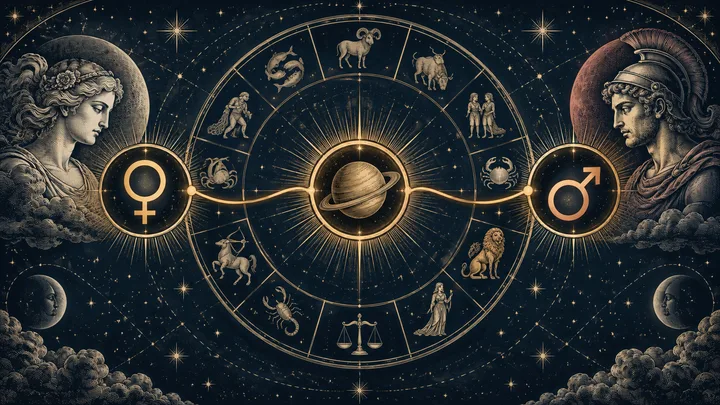
The assumption to test: Venus or Mars tells the whole story
When a Venus or Mars placement feels difficult to read, the tempting answer is to search for a better sign description. Venus in Gemini must be this. Mars in Libra must be that. The description gets longer, but the person stays blurry. A dispositor gives you a sharper next question. Which planet rules the sign, and what condition does that planet have?
That question matters because a planet does not express in a vacuum. In traditional astrology, the sign gives a planet its field of action, while the sign's ruler acts as a manager or host for the planet living there. Skyscript describes the dispositor as the planet that rules the sign a planet occupies, then asks you to consider the general condition of that ruler. This is why a Venus placement can look charming in one chart and restless in another, even when the sign is the same. The dispositor changes the route Venus takes.
The strong position is simple. Read the dispositor after you read the planet and sign, not instead of them. Venus remains Venus. Mars remains Mars. The dispositor tells you what carries their expression forward. It may show the language Venus uses to seek closeness, or the method Mars uses to pursue a goal. It may also show why the planet struggles to deliver what its sign promises.
This keeps the technique useful. You don't need a grand claim about a final chart ruler. You need a concrete layer that helps you compare known placements without turning one symbol into a verdict about a relationship.
The everyday decision behind this method is usually small. You may be trying to understand why one person sounds affectionate but stays hard to read, or why desire appears strong until a practical question arrives. The dispositor helps you ask where that expression goes next. Does Venus hand its needs to Mercury, so words become essential? Does Mars hand its urgency to Venus, so pursuit depends on agreement? Those questions produce better observations than a sign stereotype.
The method also gives you a clean stopping point. Once you know the planet, sign, ruler, and the ruler's condition, you have enough to form a working interpretation. You don't have to keep adding minor techniques until the original question disappears. Start with the layer that can change the decision in front of you. If a full chart gives you the dispositor's sign and condition, use that information. If you have only selected placements, stop at the sign-based link and ask how the pattern appears in plans, conflict, affection, or physical closeness.
A dispositor is the planet that rules the sign occupied by another planet. If Venus is in Gemini, Mercury is Venus's dispositor. If Mars is in Libra, Venus is Mars's dispositor. That extra planet can explain how affection, desire, pursuit, or conflict gets expressed when the Venus or Mars sign alone feels too broad. Start with the planet and sign. Then find the sign ruler and judge the condition you actually know. A dispositor refines a reading. It doesn't replace Venus or Mars, or turn a relationship into a verdict. For this report, use the supplied Moon, Venus, and Mars signs, plus degrees when available. Compare the sign-based dispositor story with the direct contacts the supplied placements support.
Sources: Dispositor - Skyscript Glossary; Understanding Planetary Dignity and Debility - Part 1
What a dispositor is, in plain language
A dispositor is the ruler of the sign occupied by a planet. The relationship is based on sign rulership. It isn't an aspect, and it isn't the same thing as a house ruler or chart ruler. If Venus is in Cancer, the Moon disposits Venus because the Moon rules Cancer. If Mars is in Capricorn, Saturn disposits Mars because Saturn rules Capricorn in the traditional scheme.
You can picture the planet as a visitor in another planet's home. The visitor still has its own nature, but the host controls the setting. Venus in Aries is still Venus, yet Mars describes the conditions Venus has to work through. Mars in Taurus is still Mars, yet Venus describes the ground on which Mars must act. The host doesn't erase the visitor. It shapes the resources, tone, and response available to it.
This is why the word can sound stronger than it is. A dispositor doesn't own a person's choices. It doesn't reveal another person's private intention. It supplies a second interpretive link. Astrodienst's definition gives the same basic sequence: identify the planet in a sign, then look to the planet ruling that sign. In a full chart reading, the dispositor's house, sign, and general condition can add further detail.
For a placement-only comparison, you can do this with sign data. You don't need birth times to identify the sign ruler. You do need more information to judge houses, angles, and some degree-based contacts. Keep that boundary visible. A useful reading says exactly what it is using.
The distinction between a dispositor and a chart ruler is worth keeping sharp. A chart ruler comes from the ruler of the Ascendant, so it depends on a known Ascendant and therefore a reliable birth time. A Venus dispositor comes from Venus's sign. One answers a question about the chart's approach and direction. The other answers a question about how Venus is hosted. They can be the same planet, but they don't have the same job.
The same care applies to house rulership. If Venus is in the sixth house, the ruler of the sign on the sixth-house cusp may describe that house's affairs. It isn't automatically Venus's dispositor unless Venus occupies that sign. Similar words can hide different relationships. Name the relationship before interpreting it. In a couple's comparison, this simple naming step prevents a common muddle. A person's Venus dispositor belongs to that person's chart. The planet ruling the sign on a partner's house cusp belongs to a different layer. Keep the chart owner and the relationship role visible.
Sources: Dispositor - Skyscript Glossary; Understanding Planetary Dignity and Debility - Part 6: Reception
The first pass: find Venus or Mars, then find its ruler
Use a fixed order. First, name the planet. Second, name its sign. Third, name the traditional ruler of that sign. Fourth, inspect the ruler. Only then move to the next layer. This prevents the dispositor from becoming a free association exercise.
For the traditional seven-planet rulership scheme, the Sun rules Leo, the Moon rules Cancer, Mercury rules Gemini and Virgo, Venus rules Taurus and Libra, Mars rules Aries and Scorpio, Jupiter rules Sagittarius and Pisces, and Saturn rules Capricorn and Aquarius. Modern astrologers may add Uranus, Neptune, or Pluto as co-rulers. If you use modern rulers, say so and apply the choice consistently. For a clean sign comparison, the traditional ruler is often the easier first pass because it gives every sign one clear dispositor.
Now try the method. Venus in Gemini goes to Mercury. Ask where Mercury is by sign. If Mercury is in Taurus, Venus's chain goes from Venus in Gemini to Mercury in Taurus, then to Venus again because Venus rules Taurus. That loop is not a mistake. It tells you that Venus and Mercury keep referring back to one another. Affection, language, taste, and exchange are tied together in the way the chart works.
Mars in Libra goes to Venus. If Venus is in Scorpio, the chain goes from Mars in Libra to Venus in Scorpio, then to Mars because traditional Mars rules Scorpio. Here desire and relating form a loop. The person may pursue through attraction, negotiate through intensity, or turn a question about closeness into a question about control. Those are possibilities to test against the rest of the chart, not labels to paste onto a person.
Write the chain down. Seeing it on the page is often enough to stop a vague interpretation from drifting.
Use the traditional ruler consistently within one reading. If you begin with Mars as the ruler of Scorpio, don't switch to Pluto halfway through because Pluto gives a more dramatic sentence. You can mention a modern co-ruler as a second layer, but label it and let the traditional chain remain intact. Otherwise the chain stops being a method and becomes a collection of associations.
A short written chain also helps in synastry. Put each person's route on its own line. Person A: Venus in Gemini to Mercury in Taurus. Person B: Mars in Libra to Venus in Cancer. Now you can see which planets are being asked to carry the relationship story. That is more useful than saying the pair has complicated energy. You can then ask a grounded question. Does Person A need words and steady proof, while Person B needs emotional safety before desire can move? If the chart layers suggest that contrast, the couple can discuss it directly.
Sources: Dispositor - Skyscript Glossary; Dispositor - Astrodienst Astrowiki
The worked Venus example: from a broad sign to a usable reading
Consider an example. Venus is in Gemini. On its own, you might read a need for conversation, variety, wit, and mental movement in affection. That's a reasonable first layer. But what kind of Mercury carries this Venus? Mercury in Taurus will speak and bond differently from Mercury in Scorpio, even though both are dispositors of Venus in Gemini.
If Mercury is in Taurus, Venus's social and romantic expression may look quick on the surface but rely on steady sensory preferences underneath. Conversation matters, yet it needs to lead somewhere tangible. A person may flirt through words and choose through consistency. If Mercury is in Scorpio, the same Venus in Gemini may ask sharper questions, notice subtext, and use conversation to test trust. Curiosity becomes more private and probing.
The dispositor doesn't turn Venus in Gemini into Taurus Venus or Scorpio Venus. That would be the wrong conclusion. It tells you what planet is hosting Venus and what style of processing Venus must pass through. The sign of Venus still describes the immediate way affection seeks contact. Mercury's sign describes the manager of that process.
In a full chart reading, you can then inspect the dispositor's own aspects. A close contact may make Venus's expression more measured, expansive, or heated, depending on the planets involved. The dispositor gives you a reason to inspect that planet. Its condition and contacts tell you how the management works. When you have only selected Moon, Venus, and Mars placements, don't imply that an unprovided dispositor or its aspects have been examined.
This is the useful distinction. The dispositor opens the door. The condition of the dispositor tells you what you find inside.
Notice what changed in the two examples. The planet's sign supplied the visible style, while the dispositor supplied the operating language. Venus in Gemini needed Mercury's way of thinking. Mars in Libra needed Venus's way of relating. That is why the technique can rescue a reading that feels generic. It adds a mechanism, not another pile of keywords.
But mechanism doesn't mean destiny. A Mars dispositor in a fixed sign may describe a slower route to action, yet the person can still act quickly in one situation and slowly in another. Look for repeated chart testimony and actual behavior. The dispositor gives you a question to test. It doesn't answer the human question by itself.

Sources: Dispositor - Skyscript Glossary; Understanding Planetary Dignity and Debility - Part 1
The worked Mars example: desire needs a method
Mars often gets reduced to pursuit, sex, anger, or action. Those meanings belong in the reading, but they don't tell you how Mars acts. Mars in Libra, for example, may pursue through charm, timing, negotiation, or a contest over fairness. Venus, as Libra's traditional ruler, becomes the dispositor. The condition of Venus shows what kind of social and relational method Mars has available.
Imagine Maria has Mars in Libra and Venus in Virgo. Her Mars still wants balance and response, but its dispositor is more exacting. She may act by refining the arrangement, noticing what is unequal, or asking whether the exchange is practical enough to continue. That can support skilled negotiation. It can also turn desire into critique if Venus is under strain. The chart gives you both the gift and the pressure point.
Now change only the dispositor. Mars stays in Libra, but Venus moves to Leo. The pursuit becomes warmer, more visible, and more willing to lead from the heart. It may need appreciation. The same Mars sign now travels through a different host. You aren't changing Mars's core symbolism. You're changing the channel through which it reaches another person.
If Venus and Mars are in a close aspect, rank that aspect before the dispositor's sign description. A tight Mars-Venus conjunction or opposition speaks directly between desire and attraction. The dispositor then helps explain the style of that exchange. If there is no close aspect, the dispositor can still describe the planet's internal chain, but don't pretend it has the force of a measured inter-chart contact.
Mars needs a method. The dispositor helps you see it.
The same method works when Mars seems contradictory. Mars can want direct action while its dispositor prefers patience. It can seek peace while its dispositor wants proof. It can act boldly but choose its target carefully. These aren't errors to smooth away. They show the difference between impulse and management, between what starts the action and what decides how the action continues.
In synastry, compare the methods rather than asking which person is more passionate. One person's Mars may move through Venus and need signs of mutual choice. Another person's Mars may move through a slower or more structured ruler in a complete chart, while the first person's pace stays quick. Attraction can exist in both charts while the pace differs. That difference deserves a conversation before either person turns it into a judgment. If Mars in Libra is disposed by Venus in Virgo, desire may begin through rapport but continue only when the details feel right. If Mars in Libra is disposed by Venus in Leo, desire may need warmth and visible appreciation. The sign of Mars stays fixed. Its route changes.
Sources: Dispositor - Skyscript Glossary; Understanding Planetary Dignity and Debility - Part 6: Reception
How dignity changes the answer
Finding the dispositor is only half the job. You must judge its condition. In traditional astrology, essential dignity describes how at home a planet is in a sign. Domicile, or rulership, is the clearest form. Exaltation, triplicity, term, and face add other layers of relationship. Accidental dignity describes strength gained from other chart factors, such as angular placement or motion.
This matters because a planet can manage another planet with ease, strain, or mixed results. Venus in Taurus has a strong connection to its own sign, so it can provide Venusian resources to a planet it disposits. Venus in a sign where it has less essential support may still act effectively, but its tools may be less comfortable or less steady. Skyscript's dignity guide stresses that strength and dignity aren't identical. A planet can be powerful without being pleasant, or well placed by sign without dominating the whole chart.
Return to Venus in Gemini. If Mercury, its dispositor, is in Virgo, Mercury is in its own sign and can give Venus a precise, discerning, articulate manager. If Mercury is in Pisces, traditional Mercury is in detriment and fall. The Venus placement may still be curious and social, but its processing can become more porous, indirect, or difficult to organize. That doesn't make the placement bad. It changes the work required to express it cleanly.
Return to Mars in Libra. If Venus, its dispositor, is in Taurus or Libra, Venus has strong sign resources. Mars may pursue through a clearer sense of value, attraction, or agreement. If Venus is in Aries or Scorpio, traditional Venus is in detriment. Mars may still be socially skilled, yet the manager is more concerned with direct desire, competition, or intensity than with easy balance.
Use dignity to rank ease and strain. Don't use it to hand down a moral verdict.
This is also where the word hard needs care. A dispositor in detriment or fall doesn't mean the planet is worthless. It may mean that the planet has to work outside its favorite habits, or that its resources come with a cost. Mercury in Pisces may receive impressions richly while struggling to sort them. Venus in Aries may desire directly while finding compromise less natural. The interpretive task is to name the tradeoff.
Accidental condition adds another check in a complete chart. If the house is known, ask whether the dispositor is angular, cadent, or otherwise emphasized. For a placement-only comparison, leave that layer aside and judge only the supplied signs, degrees, and contacts that fall within the report's scope.
Sources: Dispositor - Skyscript Glossary; Understanding Planetary Dignity and Debility - Part 1
Reception and mutual reception: when the planets can answer each other
A dispositor becomes especially important when the planet and its ruler connect by aspect. Traditional astrologers call this reception when a planet aspects the ruler of the sign it occupies, or another relevant dignity ruler. Skyscript describes reception as a form of acceptance or attention. The host receives the visitor and can offer some of its own resources.
If Venus is in Aries and aspects Mars, Mars receives Venus by sign because Mars rules Aries. That does not erase a difficult square or opposition. It gives the contact a channel through which the planets may respond to each other. A hard aspect with reception can still be tense, but it may contain more willingness, involvement, or practical support than the same aspect without reception.
Mutual reception goes one step further. Venus and Mars each occupy a sign ruled by the other. Venus in Aries and Mars in Libra form a mutual reception by sign. Each planet is in the other's territory. This can make the attraction vivid because Venus and Mars are already linked through rulership, even before you count an aspect. But vivid doesn't mean effortless. The same exchange can produce fascination, negotiation, competition, or a constant need to answer the other planet.
The strongest exception matters here. Mutual reception is not automatically harmony. Skyscript's discussion of dignity points out that the condition of both planets still decides how much benefit they can offer. Two planets may receive each other while both are strained, making the bond real but not easy. Read the reception as connection and potential response. Then inspect the dignity and aspect type you can actually establish, along with the wider chart when it is available.
In a synastry comparison, reception can also show why a difficult contact keeps pulling attention. It doesn't promise repair. It shows that the planets have a route to one another.
Separate three ideas that often get folded into one. Dispositorship is the rulership link. Reception is the condition in which a planet is received by a ruler, usually with aspectual involvement in traditional practice. Mutual reception is reciprocal reception. They can overlap, but they are not interchangeable labels. This distinction matters when one person feels strongly engaged while the other appears less available.
For example, Venus in Aries with Mars in Libra has mutual sign reception, but the actual aspect still matters. A trine may give the exchange an easier path. An opposition may make the bond vivid and polarizing. A square may keep the planets active through friction. No aspect may leave the reception as a background connection rather than a direct conversation between the planets. When degrees are missing, describe the mutual reception as a sign-based link and stop there. When degrees are supplied, check the aspect rather than guessing from the sign pair. The technical distinction is small on paper, but it changes the strength of the conclusion.

Sources: Understanding Planetary Dignity and Debility - Part 6: Reception; Understanding Planetary Dignity and Debility - Part 1
Dispositor chains, loops, and the final dispositor
Sometimes Venus or Mars leads to another planet, which leads to another, and so on. Venus in Gemini goes to Mercury. Mercury in Capricorn goes to Saturn. Saturn in Taurus goes to Venus. The chain returns to its starting point and forms a loop. Other chains end at a planet in its own sign. That planet is often called a final dispositor.
A final dispositor can be a useful organizing point. Astrodienst describes it as a planet in the sign it rules, such as the Moon in Cancer or Venus in Taurus, where a chain can end. But don't inflate the technique. A final dispositor is not automatically the chart ruler. It doesn't become the sole explanation for every planet, and not every chart produces one single endpoint.
Loops deserve the same restraint. A Venus-Mercury loop can make communication and affection inseparable. A Venus-Mars loop can tie attraction to pursuit and response. Yet the loop doesn't tell you whether the relationship is kind, stable, or wise. It tells you where the chart keeps circulating energy. To interpret it, you still need the planets' signs, condition, aspects, and the lived decisions that bring the symbolism into form.
With supplied placement data, you can trace a sign chain without calculating houses. Mark each step until you reach a planet in its own sign or return to a planet already named. Add degree-based contacts only for placements whose degrees are actually supplied and whose aspect calculation belongs to the declared scope. If a chain leads to an unprovided planet, label that step as unknown and stop there. Don't invent a final result from missing data.
The chain is a map. It isn't the destination.
A loop can be more revealing than a single endpoint because it shows a closed exchange. Venus sends the matter to Mercury, Mercury sends it back to Venus. The chart keeps asking affection to speak and speech to become affection. Mars sends the matter to Venus, Venus sends it back to Mars. Desire and attraction keep negotiating their terms. The loop may feel lively, repetitive, or both.
When a chain ends at a planet in domicile, ask what that planet can actually provide. Venus in Taurus may offer steadiness, pleasure, and value-based judgment to the planets that depend on it. Saturn in Capricorn may offer structure, boundaries, and endurance. Final means where the chain stops, not that the planet wins every interpretive argument.
Sources: Dispositor - Skyscript Glossary; Dispositor - Astrodienst Astrowiki
How to use dispositors in a synastry comparison
A synastry reading compares two charts. The dispositor technique works inside each chart first, then between the charts. Start with Person A's supplied Venus and Mars. Find their sign rulers when the needed placements are known. Repeat for Person B. Then compare the supplied personal planets directly. Treat any dispositor link as a sign-based interpretive layer unless the relevant planets and degrees are present in the stated scope.
Suppose Person A has Venus in Gemini, disposed by Mercury in Taurus. Person B has Mars in Libra, disposed by Venus in Cancer. The first layer compares Venus and Mars directly: how does A's affection meet B's desire? The second layer asks how A's Venus operates through Mercury and how B's Mars operates through Venus. Communication, security, and emotional belonging become part of the attraction story, but only as interpretive themes. They aren't proof of a fixed outcome.
Then check the available degrees. A six-degree orb is the stated scope for selected major-aspect calculations in the Synastry Comparison Report. With supplied degrees, you can test contacts among the supplied Moon, Venus, and Mars placements. You can't treat an unprovided Mercury, Saturn, house cusp, or other dispositor as though the report calculated it. Without degrees, compare signs and describe sign-based relationships, but don't call an aspect calculated.
Keep the order of the charts stable. Person A's Venus to Person B's Mars is not the same statement as Person B's Venus to Person A's Mars, even when both contacts exist. Planet roles change with the person. This is one reason a clean input sheet matters. Record the zodiac system, planet signs, available degrees, orb policy, and whether you're using traditional or modern rulerships before interpreting.
A good dispositor reading makes the comparison more precise. It doesn't make the chart more certain than the inputs allow.
The order also protects both people from being flattened into roles. Person A isn't simply the Venus person, and Person B isn't simply the Mars person. Each chart contains both planets, and each planet has its own dispositor. One person may initiate while needing reassurance. The other may appear receptive while requiring a great deal of mental trust. The comparison becomes humane when you keep those layers attached to the correct person.
The Synastry Comparison Report uses supplied Moon, Venus, and Mars placements, with optional degrees. It compares those known inputs; it doesn't calculate natal positions from birth details or determine houses. If a dispositor is not among the supplied placements, its sign-based rulership link can still be named, but its own condition can't be judged as though it were provided. Precision about the method makes the astrological reading stronger because the reader can follow every step.
Sources: Dispositor - Skyscript Glossary; Understanding Planetary Dignity and Debility - Part 6: Reception
The decision guide: what to inspect next
If Venus or Mars seems hard to interpret, don't collect more adjectives. Run a short diagnostic. First, write the planet and sign. Second, identify the traditional sign ruler. Third, write the dispositor's sign only if that placement is known. Fourth, inspect an aspect only when both planets, degrees, and the orb policy support it. Fifth, trace one more step only if the chain adds a real distinction.
If you have sign placements but no degrees, stop at sign rulership, elemental tone, modality, and the broad chain. You can say that Venus in Gemini disposits to Mercury, or that Mars in Libra disposits to Venus. You can compare the two chains. You can't claim that a conjunction, square, trine, or opposition was calculated. The difference protects the usefulness of the report.
If you have degrees, calculate only within the declared scope. Use the same zodiac system and the same six-degree orb for selected major aspects among the supplied Moon, Venus, and Mars placements. Rank a close aspect over a loose one. A dispositor relationship without an aspect still matters as a sign-based management link, but don't promote it to a calculated contact when the dispositor's placement wasn't supplied.
If the two charts seem contradictory, keep both statements. One person's Venus may be received by the other person's Mars, while the dispositor condition shows different needs underneath. Attraction can be strong and pacing can still differ. Conversation can be easy while values remain unsettled. The reading improves when it names the exact layer that agrees and the layer that needs negotiation.
For a comparison report, bring your known Moon, Venus, and Mars signs, plus optional degrees. Use the result to identify the next conversation, not to hand over the decision. Before you begin, write down which person owns each placement. Then record the zodiac system, the available degrees, and the orb policy. A clean record prevents a familiar sign label from quietly changing meaning halfway through the reading. It also lets you separate what the supplied chart inputs show from what you are inferring.
Here is the final check. Can you state the direct placement, the dispositor, the strongest condition affecting that dispositor, and the exception that could change your first impression? If you can't, the reading is not finished. If you can, turn it into an observable question. How do you each handle a change of plan? What kind of explanation feels reassuring? Who starts the repair after tension? The best astrological interpretation reaches a conversation you can actually have.
Start that conversation with one specific sentence. 'When we disagree, do you want time to think, or do you want us to solve it before the day ends?' The chart may explain why that question matters. The answer comes from the people involved.
You can make the question even more specific when the dispositor points to a recurring need. If Venus runs through Mercury, ask what kind of words create trust and what kind create distance. If Mars runs through Venus, ask whether pursuit feels mutual or whether one person is carrying the whole exchange. If a slower, more structured ruler manages the chain in a complete chart, ask what pace feels responsible rather than merely slow. These questions honor the symbolism because they bring it into lived choices.
That is the best use of a difficult Venus or Mars placement. Don't force it into a prettier label. Find the planet that receives it, judge the condition of that planet, then ask what the two people can do with the pattern. A dispositor gives the placement a route. The conversation gives that route a direction.
Keep the conclusion modest and clear. You may discover that a person's Venus is easier to understand once you follow it to its ruler, or that Mars becomes less confusing once its managing planet enters the picture. You may find reception, a loop, or a final dispositor. Each discovery improves the map. None of them removes the need to watch consistency, speak plainly, and decide what kind of closeness works for both people. When the dispositor story and a direct supplied-planet aspect agree, give that repeated theme priority. When they disagree, preserve the tension and ask which part appears in daily life. The chart is most helpful when it makes a real observation more precise. That precision can be simple: one person needs a clear answer, another needs time; one person reads effort as affection, another reads words as affection. The placement does not decide which need wins. It helps you name the need before resentment does.
Sources: Dispositor - Skyscript Glossary; Understanding Planetary Dignity and Debility - Part 6: Reception
A little more clarity
Is a dispositor more important than Venus or Mars itself?
No. Read Venus or Mars first, then use the dispositor as a refining layer. The planet and sign describe the immediate role and style. The dispositor shows the planet that manages that expression. A close aspect among supplied placements may outrank a sign-based chain, while an unprovided dispositor can't be judged in detail. If you only know signs, use sign rulership and don't present a degree-based aspect as calculated. The technique is strongest when it answers a precise question about expression, pace, attraction, or conflict. It should make the reading easier to follow, not turn every placement into a hidden master key.
Sources & further reading
- Dispositor - Skyscript Glossary
Defines a dispositor as the ruler of the sign occupied by another planet and explains how its condition can affect interpretation.
- Understanding Planetary Dignity and Debility - Part 6: Reception
Explains reception, mutual reception, dignity, and why a dispositor's condition changes the planet's available expression.
- Understanding Planetary Dignity and Debility - Part 1
Distinguishes essential and accidental dignity and cautions that strength and dignity must be judged together.
- Dispositor - Astrodienst Astrowiki
Provides the sign-ruler definition and describes mutual reception, dispositor chains, and final dispositors.
Synastry Comparison Report
Enter known placements for two people. Get an input-by-input comparison, selected aspect calculations and a clear record of what remains uncertain.
Compare our placements