
Venus in Taurus or Libra usually gives the Venus person a steadier, clearer way to express affection, pleasure, taste, and value. In synastry, that condition strengthens the planet doing the contacting, but it doesn't automatically make every contact easy. Start with three questions: which person owns Venus, what aspect connects the planets, and how close is the degree? A Venus-Moon trine from Venus in Libra may offer graceful reassurance and social ease. A Venus-Saturn square from Venus in Taurus can still feel restrained, but the Venus person may know what they want and keep showing up. Read the domicile as the quality of Venus's contribution. Read the aspect as the meeting itself. Then check the Moon, Mars, Saturn, and the lived pattern before you decide what the contact means for your relationship.
What does Venus in its own sign change in synastry?
You see a Venus contact in a synastry chart and want to know how much weight it deserves. Then you notice that one person's Venus is in Taurus or Libra. The reading changes, but not in the way a quick compatibility label suggests. Venus in its own sign is not a promise that the person loves perfectly, gives endlessly, or avoids conflict. It describes a planet with a familiar language. Venus can speak through its own sign with less translation.
In traditional astrology, a planet in the sign it rules is in domicile. Skyscript defines domicile as a planet's place of residence and gives Taurus and Libra as Venus's two homes. That gives us a clean starting point. The planet's essential condition belongs to the natal chart. The synastry aspect belongs to the relationship between two charts. One describes how Venus operates in its owner. The other describes what happens when that Venus meets your Moon, Sun, Mars, Saturn, or another planet.
That distinction matters because readers often let a strong natal placement swallow the whole comparison. They see Venus in Libra and write, ‘This person knows how to love.’ They see Venus in Taurus and write, ‘This person is loyal.’ Both statements reach too far. Venus in domicile can make affection, attraction, pleasure, diplomacy, sensuality, and value easier for the planet to carry. It does not decide which of those Venus subjects will dominate. The sign, house, aspects within the natal chart, sect, and condition of the dispositor still shape the expression.
In a relationship chart, think of Venus in domicile as a well-equipped participant. That participant still has to meet another person's needs. A well-equipped musician can play beautifully, but the song depends on the other instruments, the tempo, and whether anyone is listening. This is why dignity modifies a synastry contact rather than replacing it. A strong Venus can offer a more coherent response. It can't turn a square into a trine or manufacture a Moon connection that isn't there.
The useful question is not, ‘Is this a good Venus?’ Ask instead, ‘What can this Venus reliably bring into the contact?’ Venus in Taurus may bring patience, physical warmth, consistency, and a desire for tangible proof. Venus in Libra may bring tact, reciprocity, beauty, and an instinct to negotiate. Those are working hypotheses, not fixed personality labels. You test them against the planet receiving Venus, the aspect's geometry, and what the two people actually repeat together.
This gives you the article's central rule. Domicile strengthens the Venus person's side of the exchange. The aspect tells you the shape of the exchange. The receiving planet tells you what part of the partner's life gets touched. Keep those three layers separate, and the chart becomes more precise at once.
Venus rules both Taurus and Libra, but it doesn't become identical in both signs. Taurus is a fixed earth sign. Libra is a cardinal air sign. The same planet has two homes, and each home gives it a different room in which to work. Taurus emphasizes holding, sensing, preserving, and valuing what can be touched. Libra emphasizes meeting, comparing, balancing, and making room for another viewpoint.
Venus in Taurus often makes the Venus person's affection legible through continuity. They may show care by remembering preferences, making a comfortable place, sharing food, offering practical help, or returning to what feels good and trustworthy. The gift is steadiness. The pressure point is inertia. A Taurus Venus may protect peace by staying with a familiar pattern long after a direct conversation would help. In synastry, the contact may feel warm because Venus knows how to remain present, but the partner may need to ask whether presence also includes movement.
Venus in Libra often makes the Venus person's affection legible through exchange. They may notice the tone of a conversation, adjust their approach, choose words with care, or look for a fair arrangement. The gift is social intelligence. The pressure point is indecision or over-accommodation. A Libra Venus may keep the atmosphere pleasant while postponing a hard preference. In synastry, the contact may feel elegant and mutual, but the partner still needs to see whether agreement survives an actual difference.
Neither sign is the ‘better’ domicile. They answer different relationship questions. Taurus Venus asks, ‘Can we create something comfortable enough to last?’ Libra Venus asks, ‘Can we treat each other fairly while we build it?’ When either one contacts a partner's planet, watch which question becomes active. Venus in Taurus contacting a partner's Moon may soothe the body and daily rhythm. Venus in Libra contacting a partner's Mercury may make difficult subjects easier to frame. These are sign-based readings. The aspect and degrees decide how strongly they connect.
The sign also colors what the Venus person values in the partner. Taurus may prioritize reliability, sensual ease, and the feeling that resources are handled sensibly. Libra may prioritize manners, responsiveness, shared taste, and the feeling that the relationship has two equal voices. If the receiving planet wants something else, the domicile doesn't erase the mismatch. Venus in Taurus meeting a restless Mars may offer grounding that Mars experiences as slow. Venus in Libra meeting a private Moon may offer diplomacy that the Moon experiences as polished rather than intimate.
A good reading therefore names the two versions before it names the outcome. Say, ‘This Venus brings a Taurus style of affection into your Moon,’ or, ‘This Venus approaches your Mars through Libra's language of invitation and response.’ Then ask what the other planet needs. That last step keeps the interpretation relational. Venus does not perform in a vacuum, even when it is strong by sign.
You can also ask who is doing the perceiving. The Venus person may feel natural and generous, while the partner mainly notices the contact through a Moon, Mars, or Saturn reaction. That difference isn't a contradiction. It is the exchange. One person offers in a Venus language. The other person receives through a different planetary need.
Sources: Domicile - Skyscript Glossary; The Astrological Attributes and Rulerships of Venus - Skyscript; Synastry - Skyscript Glossary
Which part of the synastry contact gets the boost?
Once you know that Venus is dignified, locate the role Venus plays in the aspect. If your Venus contacts your partner's Moon, you are the Venus person and your way of giving affection meets their emotional body. If your Venus contacts their Mars, your attraction and values meet their desire and pursuit. If their Saturn contacts your Venus, their Saturn is the contacting planet and your Venus is the receiving planet. The dignity belongs to the planet in its own sign, not to the aspect as a whole.
This is the first ranking rule. A dignified Venus improves the Venus person's contribution. It does not automatically improve the partner's planet or the entire relationship. Venus in Libra conjunct another person's Moon can make the Moon person feel seen through kindness, attention, and social grace. The Moon person still brings their own sign, house, natal condition, and aspects. They may welcome the contact, feel exposed by it, or need more private reassurance than Libra Venus naturally offers.
With Venus-Mars contacts, the domicile can clarify pursuit and response. Venus in Taurus may respond to Mars through touch, patience, and repeated proof. Venus in Libra may respond through flirtation, eye contact, banter, and a sense of mutual invitation. A square can still produce frustration. The dignified Venus may simply have a stronger and more recognizable preference inside that frustration. It knows what feels pleasurable or fair, which can help the couple negotiate. It can also make the Venus person less willing to accept a pattern that violates those values.
With Venus-Saturn contacts, avoid the fast verdict that Saturn means rejection. Synastry compares planetary positions, and the quality of the exchange depends on both aspect and planetary condition. Venus in Taurus square a partner's Saturn may feel slowed down, but Taurus Venus can also understand the value of patience, material responsibility, and a bond built through repeated acts. Venus in Libra opposite Saturn may feel the weight of judgment, yet Libra Venus may know how to name the terms of an agreement. The hard aspect remains hard. The domicile gives Venus more resources for meeting it.
With Venus-Neptune or Venus-Pluto contacts, a strong Venus can make the experience more compelling without making perception infallible. Venus in its own sign may know its tastes and desires, but intensity can still invite projection. With a dignified Venus, ask whether the person is expressing a clear value or defending an idealized picture of the relationship. This is where the Moon and Saturn become useful checks. Emotional safety, consistency, and boundaries tell you how the contact lives beyond the first glow.
The boost is practical, then. Domicile can increase Venus's ability to offer its own goods: affection, pleasure, charm, social ease, attraction, and value. It can't decide how the partner receives those goods. Put the Venus person on one side of the reading and the contacted planet on the other. The difference between those sides is often the most revealing sentence in the interpretation.
One more distinction helps. Strength is not volume. A dignified Venus doesn't have to be loud, constantly romantic, or visibly charming. It may work quietly through a clean promise, a thoughtful invitation, a steady hand, or a refusal to bargain away a core value. In synastry, quiet strength can be easy to miss because the chart reader is looking for drama. Look instead for what the Venus person can repeat without losing the thread of who they are.
That repeatability is the key difference between a pleasant impression and a usable reading. A Venus in domicile may make the person's preferences easier to recognize, but recognition becomes trust only when it survives an ordinary week. Watch the small acts. Does the person make room, keep a promise, repair a slight, and name a limit without punishment? Those acts give the astrological symbolism a living form.
Sources: The Astrological Attributes and Rulerships of Venus - Skyscript; Synastry - Skyscript Glossary; Orbs (or rays) - Skyscript Glossary
How should you rank sign, aspect, and degree?
A synastry reading becomes noisy when every sign similarity gets treated like an aspect. Start with the actual inputs. You need each person's Venus sign and, if available, its degree. You need the other planet's sign and degree. You need a declared zodiac system, a list of aspects, and an orb policy. This report's comparison scope uses supplied Moon, Venus, and Mars placements, optional degrees, selected major aspects, and a six-degree orb. It doesn't calculate natal positions, houses, or a birth chart from birth details.
Read the layers in this order. First, confirm the planet pair. Venus to Moon is not Venus to Mars. Venus to Saturn is not Venus to Venus. Second, confirm the aspect. A conjunction joins functions. An opposition places them across an axis. A square creates friction that demands handling. A trine lets the functions flow with less effort. A sextile offers an opening that grows when someone uses it. Third, measure the orb. A close aspect usually deserves more weight than a wide one of the same type, especially when the signs and planetary roles agree.
Astrological sources don't use one universal orb rule. Skyscript notes that many modern astrologers allow eight degrees for major aspects and four degrees for a sextile, while traditional practice assigns orbs to planets and gives Venus an attributed orb of seven degrees in one common scheme. Astrodienst's partner-chart guidance says its synastry drawings use half the natal orb because two charts create twice as many possible contacts. Our six-degree policy is an editorial choice for this comparison tool. State it before you interpret it.
Fourth, read the sign condition. Venus in Taurus or Libra supplies domicile. Venus in Pisces supplies exaltation in the traditional scheme, which is a different kind of strength. Venus in Aries or Scorpio is in detriment, and Venus in Virgo is in fall. These terms don't cancel the aspect. They describe how comfortably Venus can carry its own functions. Fifth, check the natal chart around Venus if the supplied data allows it. A conjunction to Saturn, a square from Mars, a retrograde motion, or a strong dispositor can change the way the domicile is available.
Consider the difference between these two examples. Venus at 14 degrees Libra trine a partner's Moon at 15 degrees Aquarius is a close trine with Venus in domicile. Venus at 28 degrees Libra square a partner's Moon at 26 degrees Cancer is a two-degree square, so it qualifies comfortably under a six-degree policy. Libra and Cancer already form a square by sign, and the degree distance confirms that this is a close contact rather than a loose sign-only theme. Say what is exact, what is wide, and what is interpretive.
Degrees help you rank. They don't give you a verdict. A close Venus contact can describe a powerful channel while the rest of the chart shows different needs. A dignified Venus with no close interaspect may describe a person who loves clearly, but not necessarily a strong Venus exchange between you. This is the technical discipline that protects the reading from both exaggeration and dismissal.
Keep applying the same order when two contacts compete for attention. A close Venus-Moon conjunction usually deserves the first look for affection and emotional response. A wider Venus-Mars trine may still matter, but it has less claim on the immediate reading. A Venus placement in domicile adds quality to either contact; it doesn't rearrange the aspect hierarchy by itself. Write the strongest contact first, then use dignity to explain why that contact may feel more available or more definite.
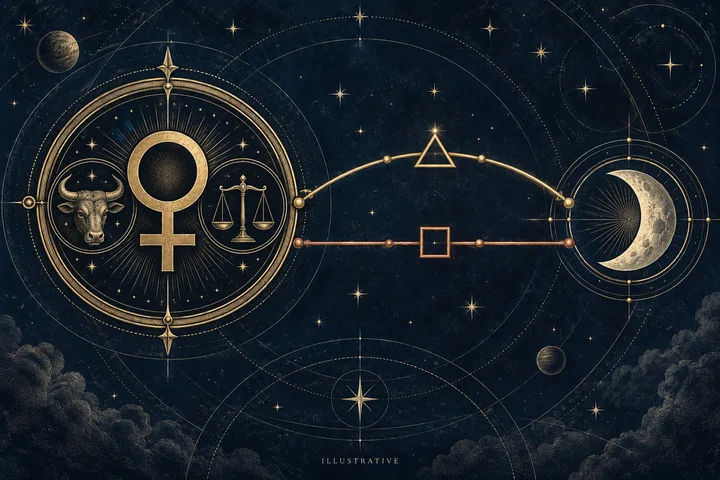
Sources: Orbs (or rays) - Skyscript Glossary; Partner horoscopes - Astrodienst FAQ; Domicile - Skyscript Glossary
What does the receiving planet tell you about the experience?
The Venus person may bring the stronger resource, but the receiving planet tells you where the partner feels it. This is the part many short readings skip. They describe Venus as attractive and stop there. You need to ask what Venus is touching. The answer changes the lived scene.
When domicile Venus contacts the Moon, affection can reach the partner's habits, moods, private needs, and sense of safety. Venus in Taurus may calm through food, touch, reliable timing, or a peaceful room. Venus in Libra may calm through considerate words, a balanced conversation, or the feeling that no one is being forced to choose alone. But the Moon person may have a Cancer Moon that wants closeness at home, a Capricorn Moon that trusts competence, or an Aquarius Moon that needs room to breathe. The Venus sign gives the offering. The Moon sign describes how it lands.
When domicile Venus contacts Mars, Venus reaches desire, initiative, anger, and the way the partner moves toward what they want. The contact can feel erotic because attraction and pursuit have a direct bridge. Venus in Taurus may invite Mars to slow down and enjoy the body. Venus in Libra may invite Mars into a dance of mutual response. A hard aspect can make timing, tempo, or consent conversations necessary. A strong Venus doesn't remove those conversations. It can make the Venus person's boundary and preference clearer.
When domicile Venus contacts Mercury, the relationship may find pleasure in speech, humor, ideas, or shared taste. Libra Venus often works well through tact and dialogue, while Taurus Venus may prefer simple, honest language and a steady rhythm of contact. Again, don't turn the sign into a script. Mercury's sign and condition matter. A Mercury that moves quickly may find Taurus Venus too deliberate. A Mercury that analyzes every feeling may find Libra Venus too ready to smooth things over.
When domicile Venus contacts Saturn, the receiving Saturn person may experience Venus as a softening influence, while Venus may experience Saturn as a test of value, timing, or commitment. Astrology's aspect tradition often treats Venus as able to make Saturn more agreeable, but the aspect still needs work. A trine may support a practical bond. A square may reveal different standards around money, availability, affection, or public commitment. Venus in its own sign can state what it needs. Saturn decides whether structure will meet it.
When another person's planet contacts domicile Venus, reverse the lens. Their planet may activate Venus strongly, but Venus remains the place where the experience is interpreted through taste and value. Their Mars may pursue. Their Pluto may intensify. Their Neptune may enchant. Ask whether Venus can keep its own standards while receiving that force. This is the most useful protection a strong Venus gives: not immunity, but a better chance of recognizing what feels good, what feels fair, and what costs too much.
The receiving planet also shows the question the partner may keep asking. A Moon contact asks, ‘Can I relax with you?’ Mars asks, ‘Can desire move between us?’ Mercury asks, ‘Can we enjoy the way we think together?’ Saturn asks, ‘What can we rely on?’ A domicile Venus may answer each question in its own style. Taurus answers with steadiness and substance. Libra answers with responsiveness and balance. The answer works only if the partner recognizes the language.
Sources: The Astrological Attributes and Rulerships of Venus - Skyscript; Synastry - Skyscript Glossary
Worked comparison: Venus in Taurus with Venus in Libra
Imagine Maria has Venus at 12 degrees Taurus and Alex has Venus at 15 degrees Leo. Their Venuses do not form a close major aspect by the six-degree policy, so don't invent a Venus-Venus contact. Maria's Venus is still in domicile. Alex's Venus sign still tells you what Alex values. The first conclusion is about Maria's style of affection, not about a shared Venus channel. If the couple feels close, look for the Moon, Mars, Sun, or another real contact that explains how the exchange works.
Now change the example. Maria has Venus at 12 degrees Taurus. Alex has Venus at 15 degrees Libra. The signs form a quincunx by zodiacal distance, not one of the selected major aspects in this report. A casual reading might call both Venuses ‘strong’ and stop there. A better reading says that both people have Venus in a sign ruled by Venus, but their values don't automatically move together. Maria may trust repetition, loyalty, touch, and a sensible use of resources. Alex may trust conversation, equality, social grace, and an openly negotiated partnership.
That can become a real attraction. Maria may find Alex refined, responsive, and willing to consider her point of view. Alex may find Maria warm, grounded, and hard to shake. The same difference can become a daily irritation. Maria may ask, ‘Why are we still discussing this?’ Alex may ask, ‘Why did you decide without me?’ Neither question proves a lack of love. They reveal two Venus homes asking for different evidence.
Suppose their Moons form a close trine and Maria's Venus also sextiles Alex's Mars within four degrees. The Moon contact supports emotional ease. The Venus-Mars sextile gives attraction an opening. Maria's domicile Venus can bring a settled, sensuous quality to the exchange, while Alex's Libra Venus can make pursuit feel mutual and graceful. The Venus sign difference becomes something to work with rather than the whole story. Their decision is practical: make room for both comfort and consultation.
Now suppose instead that Maria's Venus squares Alex's Saturn at a close degree, while Alex's Venus has no close contact to Maria's personal planets. The strong Taurus Venus may know that it wants consistency, but Saturn may delay, judge, or ration affection. The contact deserves weight because it is close and structurally demanding. The domicile helps Maria bring patience and a clear standard. It doesn't mean she should wait without an agreement. The chart describes the tension. The couple still has to name the terms.
Notice what the example does not say. It does not say Maria is the stable one and Alex is the inconsistent one. It does not say a quincunx condemns the bond, or that two Venus domiciles guarantee shared taste. The signs describe different value languages. The actual choices tell you whether those languages can be translated. Maria might ask for a dependable weekly plan. Alex might ask for a say in how that plan is made. Both requests belong in the reading because both arise from the Venus layer.
Here is the decision guide hidden in the example. If domicile Venus has a supportive close aspect to the partner's Moon or Mercury, look for ease in care and conversation. If it has a hard close aspect to Mars or Saturn, look for a clear pattern of friction and repair. If Venus is dignified but barely connected, don't use the placement as proof of mutual attraction. Ask what other contacts carry the bond. The strongest Venus is still one planet in one chart. Read the relationship that actually exists.
The example also shows why symmetry can mislead. Maria's Venus and Alex's Venus may both be dignified, yet each person can feel the relationship through a different planet and a different need. One may feel loved when plans hold. The other may feel loved when choices are discussed. A fair reading gives both experiences a place, then asks which agreement would join them. ‘We will keep Friday for us, and we will decide the plan together by Wednesday’ is more useful than calling the pair naturally compatible.

What is the strongest exception to the domicile reading?
The strongest exception is simple: a dignified Venus can still be under pressure from the rest of its chart. Domicile is a real strength, but it is not a free pass. A planet can be at home and still be having a difficult day. The natal aspects, house placement, sect, motion, and dispositor show how available the Venus function is in practice.
Start with natal aspects. Venus in Taurus square Saturn may value loyalty yet fear that affection will be withdrawn. Venus in Libra opposite Mars may know the art of partnership yet become pulled between pleasing and asserting. Venus in domicile conjunct Neptune may have exquisite sensitivity and a strong romantic imagination, but it may also read longing into ambiguity. These possibilities don't erase the domicile. They tell you which Venus resources need conscious use.
Then check whether the synastry contact repeats a natal pattern. If someone's natal Venus-Saturn square is activated by a partner's Saturn, the relationship may feel familiar because it presses an old Venus question. The partner didn't create the whole pattern. They may help the person work with it, or they may make the old fear louder. A dignified Venus can recognize value, but recognition takes practice when the chart has learned to expect delay or criticism.
A second exception concerns the receiving planet. Your Venus may be in Libra, but your partner's Moon may be in Scorpio and receive the contact by a hard aspect. Your grace may feel too public for their private intensity. Your willingness to discuss may feel like pressure to disclose. This doesn't make either person wrong. It tells you that a Venus gift must be translated. Ask the receiving planet what kind of care it can actually take in.
A third exception concerns proximity. Sign dignity cannot replace an aspect. If Venus in Taurus and your partner's Moon are separated by 20 degrees, they don't form a Moon-Venus conjunction simply because Taurus is comforting and the Moon is emotional. If a report lists signs without degrees, report the possible sign relationship as a theme, not a calculated aspect. The missing degree is a real limit on precision. It isn't an invitation to fill the gap with confidence.
So rank the domicile beneath the whole chart, but above a generic sign adjective. It is more useful than saying ‘Venus is romantic.’ It is less decisive than a close, repeated pattern involving Venus, the Moon, Mars, or Saturn. The exception doesn't weaken the method. It tells you how to use it honestly. Strong Venus means strong Venus resources. The relationship still depends on how those resources meet the other chart.
This is also why a hard contact can become a place of skill. Venus in domicile has something to defend and something to offer. If Saturn asks for proof, Taurus Venus can define what proof looks like instead of waiting forever. If Mars pushes too fast, Libra Venus can insist on mutuality instead of smiling through discomfort. The chart doesn't promise that the person will make that choice. It shows the resource available when they do.
Sources: Domicile - Skyscript Glossary; The Astrological Attributes and Rulerships of Venus - Skyscript; Synastry - Skyscript Glossary; Orbs (or rays) - Skyscript Glossary
What should you ask before you call the contact supportive?
Before you call a Venus contact supportive, move from the chart to the repeated scene. What happens when one person wants closeness and the other wants space? Who starts the repair after an argument? Does affection show up in the form the other person can receive? Can the couple talk about money, time, exclusivity, sex, and public recognition without one person carrying the whole conversation? These questions don't replace astrology. They give Venus somewhere real to land.
Use the chart as a ranking tool. Put a close major Venus contact first. Put Venus's sign condition beside it. Then check whether Moon, Mars, and Saturn contacts repeat the same theme. A Venus in domicile contacting the Moon and Saturn may describe affection that wants both tenderness and reliability. A Venus in domicile contacting Mars and Uranus may describe pleasure that needs freedom and surprise. One contact offers a clue. Repetition gives the clue weight.
If the aspect is harmonious, don't confuse ease with completion. A trine may make affection natural, but natural affection can still leave practical needs unspoken. Ask what the contact makes easy and what it leaves unattended. If the aspect is tense, don't confuse friction with failure. A square may show different methods of loving. Ask whether both people can name the difference and make a workable adjustment. Astrology gives you the language. Choice gives it direction.
For missing data, stay with what the chart actually supplies. If you know only the signs, compare sign meanings and say that degrees are needed for a precise aspect check. If you have degrees but no birth times, you can still compare the supplied planets, but don't add houses or angles. If the couple uses tropical placements, keep the same zodiac system throughout. Switching systems halfway through changes the sign labels and can change the interpretation.
The Synastry Comparison Report fits at this point because it organizes the information you already have. You can compare supplied Moon, Venus, and Mars signs, add optional degrees, and review selected major aspects under the stated six-degree orb. It doesn't calculate a natal chart from birth details or issue a relationship verdict. The useful action is to bring a clear question to the comparison: ‘What does my Venus offer your Moon?’ or ‘Where do our Venus values need a spoken agreement?’
Begin with the exact contact. Name the Venus domicile. Name the receiving planet. State the orb. Then bring the reading to one repeatable choice. If Venus in its own sign is truly helping, you should be able to see the help in a behavior: a softer conversation, a more reliable repair, a fairer arrangement, or a pleasure both people can share.
You can make the final conversation brief. ‘My Venus needs love to feel steady and shared. What makes it feel real to you?’ Let the answer become specific. Ask about one night, one expense, one boundary, or one repair habit. Then notice what happens after the chart language is gone. A useful synastry reading should leave you with a clearer way to meet, not a label you carry around while the same problem repeats.
Sources: Synastry - Skyscript Glossary; Orbs (or rays) - Skyscript Glossary; Partner horoscopes - Astrodienst FAQ
A little more clarity
Does Venus in Taurus or Libra make a synastry contact automatically positive?
No. Venus in Taurus or Libra is in domicile, so Venus can express its own themes with strength and familiarity. The aspect still decides whether the connection flows, presses, or pulls in opposite directions. A close square from domicile Venus can be powerful and useful, but it needs a clear way to handle the friction. Read the sign condition as a resource, not a guarantee.
Is Venus in Taurus stronger than Venus in Libra for compatibility?
Neither domicile is automatically stronger for a relationship. Venus in Taurus often seeks continuity, sensual ease, and tangible value. Venus in Libra often seeks reciprocity, dialogue, and fairness. The better fit depends on the receiving planet, the aspect, the degree, and the rest of both charts. Taurus and Libra give Venus different ways to work.
What if I know the Venus signs but not the degrees?
You can read the sign condition and describe possible sign-based themes, but you can't confirm a precise synastry aspect without degrees. Don't call a conjunction, square, trine, or sextile calculated unless the supplied degrees support it under your chosen orb. Use the missing information as a reason to keep the reading at the sign layer, then add degrees when you want to rank the contact.
What should I talk about after reading a domicile Venus contact?
Ask where affection feels easiest and where it needs translation. Try this: ‘When you show love, what response tells you it reached me?’ Then add a practical follow-up about time, money, touch, conflict, or reassurance. A domicile Venus can make its values clearer. The conversation shows whether both people can act on those values together.
Sources & further reading
- Domicile - Skyscript Glossary
Defines domicile as a planet's own sign of rulership and identifies Taurus and Libra as Venus's homes.
- The Astrological Attributes and Rulerships of Venus - Skyscript
Supports Venus's traditional rulerships, exaltation, detriments, and core relationship and value significations.
- Synastry - Skyscript Glossary
Defines synastry as chart comparison and explains that aspects show interaction while planetary condition shapes its quality.
- Orbs (or rays) - Skyscript Glossary
Explains that an orb measures distance from exactness and distinguishes modern aspect orbs from traditional planetary rays.
- Partner horoscopes - Astrodienst FAQ
Documents Astrodienst's partner-chart practice of using half the natal orb when drawing synastry aspects.
Synastry Comparison Report
Enter known placements for two people. Get an input-by-input comparison, selected aspect calculations and a clear record of what remains uncertain.
Compare our placements