The useful answer is smaller than the myth
People often ask whether a morning-star or evening-star planet changes the meaning of a Venus synastry contact. It does. But it changes the texture more than the verdict. That distinction keeps the technique useful.
The tempting shortcut says morning is bold, evening is soft, and one must be better for love. That shortcut is too blunt. Traditional astrology gives the phases different modes of expression. A morning planet rises before the Sun. An evening planet follows it into visibility after sunset. The symbolism is about sequence. One moves first. The other responds, receives, or works with what has already appeared.
In synastry, that sequence can describe how a person carries a relationship planet into contact with someone else. A morning-star Venus may show affection by making the first move, naming a preference, or creating a pleasant experience before anyone asks. An evening-star Venus may show affection by noticing what the other person needs, answering an invitation, or shaping intimacy through shared experience. Neither description guarantees kindness, desire, loyalty, or a lasting bond. The sign, house, aspects, dignity, speed, and condition still matter.
This is the governing rule for the whole reading: use phase as a modifier of the planet that has it. Don’t turn phase into a secret aspect between two charts. If one person’s Venus is an evening star, that fact doesn’t create a Venus-Mars conjunction with the other person. It tells you how that Venus may enter the contact. The actual connection still comes from the degrees and signs of the two charts.
That smaller claim is also the stronger one. It gives you something you can observe. Does the Venus person initiate pleasure, or do they become more expressive after the other person opens the door? Does the Mars person pursue immediately, or does desire gather in response to a clear invitation? The phase can help you ask those questions. It can’t answer them by itself.
This is why phase can feel striking in one chart and quiet in another. Several close contacts may give it a useful role in the pattern. No close Venus contact may leave it as a minor natal detail.
A planet’s morning or evening phase adds style and timing to Venus synastry. It tells you whether that planet tends to lead from its own impulse or respond after experience has already begun. Venus as a morning star often approaches affection, pleasure, and attraction with more initiative. Venus as an evening star tends to read the room, receive, and refine its response. That difference can color a Venus contact, but it doesn’t replace the contact itself. Read the sign, the planet’s condition, the exact interaspect, and the lived pattern in that order. If you only know Venus by sign, you don’t yet know its phase. You need the Sun and Venus longitudes, and you should keep the interpretation modest when degrees are missing.
Sources: Evening Star - Astrodienst Astrowiki; Heliacal Rising - Astrodienst Astrowiki; Oriental - Astrodienst Astrowiki
What morning and evening actually mean
Start with the sky, not the personality label. In the phase language used by traditional astrologers, a planet is oriental, or a morning star, when it rises before the Sun. It is occidental, or an evening star, when it sets after the Sun. With Venus and Mercury, those names match the familiar morning and evening appearances because both planets travel close to the Sun from Earth’s point of view.
The words can confuse you because oriental and occidental also describe chart hemispheres in some astrological writing. Here the question is narrower. Where is the planet in its solar cycle? Is it visible before sunrise, after sunset, or hidden in the Sun’s light? The phase is relative to the Sun. It isn’t the same thing as a planet sitting in the eastern or western half of the wheel.
For Venus, the cycle moves through an inferior conjunction, a morning-star phase, a superior conjunction, and an evening-star phase. Around the conjunctions, Venus can be lost in the Sun’s rays. After it reappears before dawn, it belongs to the morning phase. After it reappears after sunset, it belongs to the evening phase. The exact visibility threshold varies by tradition and by the observer’s sky, so don’t pretend a single degree rule is universal.
This is why phase is not the same as phasis. Phase describes the wider stretch in which Venus is a morning or evening star. Phasis marks the threshold when a planet first becomes visible or disappears from view near the Sun. A planet can be oriental without being in the brief moment of heliacal rising. If your data only says Venus in Libra, it gives you a sign. It does not tell you whether Venus rises before the Sun.
For a practical chart comparison, compare the Sun’s zodiacal longitude with the planet’s longitude and verify the planet’s motion and solar relationship in a reliable ephemeris or chart record. For Venus, the physical cycle matters because it can be direct or retrograde at different transitions. Don’t infer the phase from a rising sign, a day chart alone, or the planet’s element.
The simplest paper check uses the zodiacal order. If Venus lies behind the Sun in the zodiac, it precedes the Sun in the sky and belongs to the morning-star side of the cycle. If Venus lies ahead of the Sun, it follows the Sun and belongs to the evening-star side. The wording can feel backward until you picture the planets moving through the zodiac: behind and ahead describe their relation to the Sun’s place, not the left and right sides of a wheel printed on a page. A chart program may label the condition oriental or occidental, morning star or evening star. Record the label and the underlying solar relationship together.
Then check the edge cases. A planet can sit on the correct side of the Sun and still be too close to show plainly in the sky. It can also be near a transition in which the visible appearance changes around a conjunction. That’s why a phase label from a chart record is useful, but a bare sign label isn’t enough. If two sources disagree, compare their zodiac system, longitude, retrograde notation, and definition of visibility before choosing an interpretation.
Phase belongs to the individual chart before it belongs to the relationship. Identify what Venus is doing on its own. Then ask what happens when the other person’s Moon, Venus, or Mars touches it.
Sources: Evening Star - Astrodienst Astrowiki; Heliacal Rising - Astrodienst Astrowiki; Oriental - Astrodienst Astrowiki
Why Venus needs a different phase reading
Astrologers sometimes carry a simple rule from Mars, Jupiter, or Saturn into Venus: oriental is stronger and more active, occidental is weaker or later. That transfer is too blunt. Venus is an inferior planet. It never reaches opposition to the Sun, so it doesn’t trace the same conjunction-to-opposition rhythm as a superior planet.
There is also a traditional distinction you shouldn’t skip. In some dignity systems, Venus is helped when occidental and weakened when oriental, while the wider morning-star and evening-star symbolism describes how the planet emerges into expression. Those are related judgments, but they aren’t identical. A careful reading names the doctrine it uses instead of turning every phase into a modern personality label.
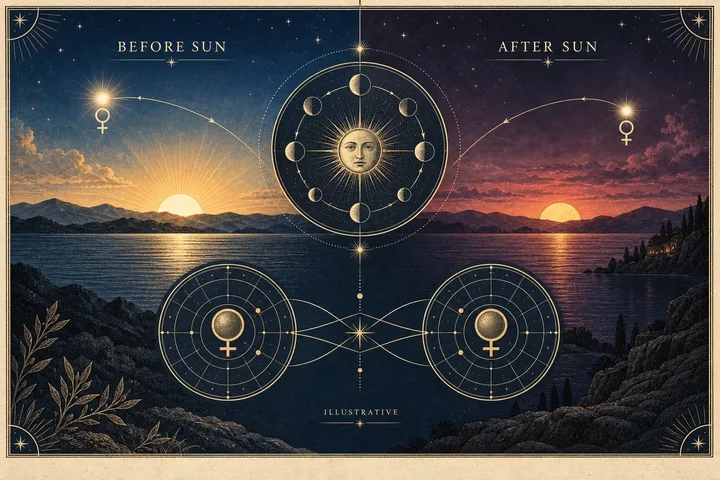
Morning-star Venus is the Venus that appears before dawn. In a chart, it can describe a person who reaches toward what they value. They may name the pleasure, make the invitation, or choose the style of affection before the other person has fully shown their hand. In a Venus synastry contact, this person may activate the connection by giving it form. They choose the restaurant. They send the first warm message. They decide that a moment should become romantic.
Evening-star Venus appears after the Sun has gone down. This Venus can describe a person who receives experience and then answers it with taste, warmth, or discernment. They may learn what they want through contact. In a Venus synastry aspect, they can make the other person feel seen because they respond to what is actually present rather than forcing the moment into a plan.
Those are tendencies, not costumes. A morning Venus can act from fear, pride, or impatience. An evening Venus can withdraw, delay, or wait for the other person to carry every emotional risk. A dignified Venus under pressure may behave differently from a Venus with a close hard aspect to Saturn or Pluto. Phase never cancels the rest of the chart.
The better question is not Which phase is more romantic? Ask, What does this Venus do first when attraction becomes real? As an interpretive shorthand, morning phase points toward initiative, while evening phase points toward response and refinement. Then the sign tells you the manner, the house tells you where the matter lives, and the synastry aspect tells you how the other person’s planet enters the exchange.
The distinction can also describe how values become conscious. Morning-star Venus may know what it wants by moving toward it. Evening-star Venus may know what it wants after tasting an experience, watching a response, or comparing what feels beautiful with what actually feels right. In synastry, that difference can matter when one partner wants an immediate declaration and the other needs a little lived evidence before naming the bond.
That distinction matters in synastry because a planet’s phase can explain a style while its sign explains a preference. A morning Venus in Cancer may initiate through care, familiarity, and emotional shelter. A morning Venus in Aquarius may initiate through friendship, unusual ideas, or a refusal to follow a script. An evening Venus in Virgo may respond by noticing details and making a practical adjustment. An evening Venus in Sagittarius may answer through candor, humor, or shared movement. The same phase produces different acts in different signs. Read the phase as the verb’s timing, and the sign as the verb’s accent.
Sources: Evening Star - Astrodienst Astrowiki; Heliacal Rising - Astrodienst Astrowiki; Oriental - Astrodienst Astrowiki; Accidental Dignities - Astrodienst Astrowiki
How phase changes a Venus synastry contact
Now bring the two charts together. A synastry aspect is an angular relationship between planets or chart points across two horoscopes. The aspect describes the contact. The planets describe the subjects involved. Phase adds a condition to one of those subjects. It answers a quieter question: does this planet lead into the contact, or does it develop its response through what the other person brings?
Start with the planet being touched. If Person A’s Moon aspects Person B’s Venus, begin with Person B’s Venus. That is the Venus person whose style of pleasure, attraction, and affection is being called forward. Person A’s Moon shows the emotional material arriving at the door. If Person B’s Venus is morning star, the Venus person may take that lunar feeling and turn it into an action, invitation, or visible expression. If Venus is evening star, the Venus person may first absorb the mood, then shape a response that fits it.
The same order works with Mars. A Venus-Mars contact can describe desire, pursuit, receptivity, and the spark between attraction and action. A morning-star Venus may make the attraction easier to name or enact. An evening-star Venus may respond more strongly once Mars has shown intent. But don’t confuse response with passivity. An evening Venus can be highly selective and powerful. It may decide what is welcome by the quality of its answer.
With another Venus, phase can show two different styles of affection meeting. Two morning Venuses may both initiate, choose, and set the tone. That can feel lively, but it can also create a quiet contest over whose preference leads. Two evening Venuses may be attentive and responsive, but they might wait too long for the other person to make the first move. A morning and evening pair can create a useful rhythm: one opens the scene, the other gives it shape.
The Moon needs a doctrinal note. In the five-visible-planet framework used here, the Sun and Moon are lights, so this morning-star and evening-star terminology belongs to the planets. Some astrologers apply related oriental and occidental language to the Moon or use its waxing and waning cycle instead. Name that choice if you use it. Don’t transfer Venus’s solar-phase vocabulary to the Moon without naming the doctrine.
This lead-and-response language is an interpretive synthesis of the traditional oriental and occidental distinction, not a universal rule stated in those exact words by every source. Write one sentence for Venus, then one for the contact. A Venus may initiate or refine; a partner’s Mars may press for action, while a Moon seeks welcome. Keep both roles visible.
Sources: Synastry - Astrodienst Astrowiki; Aspect - Astrodienst Astrowiki; Synastry: The Astrology of Relationships - The Astrology Podcast
A worked comparison without a fake chart
Consider an example using supplied placements rather than a claimed personal horoscope. Person A has Venus in Leo as a morning star. Person B has Mars in Taurus, and the two placements form a close square within the six-degree working orb. The sign pair tells you there is a fixed-style tension between expressive warmth and steady, embodied desire. The square gives the contact friction and insistence. The morning phase adds a possible sequence: Person A’s Venus may show preference first, dramatize attraction, or want the romantic tone established clearly.
That doesn’t mean Person A always pursues. Venus is still Venus, not Mars. The phase modifies Venus’s mode; it doesn’t change Venus into a planet of conquest. Person B’s Mars may answer with patience, physical consistency, or a refusal to be hurried. The square can become a pattern of show me and keep up with me. It can also become a strong exchange when both people respect the different pace.
Now keep the same signs and aspect, but make Person A’s Venus an evening star. The attraction doesn’t disappear. The square doesn’t become a trine. What changes is the likely entry point. Person A may become more expressive after Person B demonstrates desire in a way that feels grounded. They may respond to reliability rather than perform interest in advance. Person B’s Mars could experience that as reassurance, or as delay, depending on the rest of the charts and the actual behavior between them.
The phase gives you a testable question: does Person A’s affection become clearer after Person B acts, or does Person A act without waiting? Watch the pattern. Don’t force the answer from a label. If the lived exchange shows the opposite, keep the phase as a secondary possibility and let the stronger chart testimony lead.
Consider another example. Person A’s evening-star Venus receives a close conjunction from Person B’s Moon. The Moon person may bring feeling, familiarity, and changing needs. The Venus person may answer by making the emotional atmosphere pleasant, beautiful, or safe. Because Venus is evening star, the affection may appear most clearly as a response to the Moon person’s mood. But if Person A’s Venus is in Aries and strongly supported by other conditions, the same evening phase may still produce a direct, decisive style once the emotional cue arrives.
This is why examples should show layers, not replace them. Phase ranks below the actual aspect and the condition of the planets. It becomes valuable when two interpretations are otherwise plausible. An evening-star Venus receiving both a Moon and Mars contact offers a clear test: if the Moon aspect is exact, tenderness may appear first; if the Mars aspect is exact, desire may carry the first movement. The phase refines the order. The degrees and planet roles choose the stronger testimony.
The morning-star person isn’t automatically the pursuer, and the evening-star person doesn’t wait helplessly. Saturn can slow an eager Venus. Fire or Mars emphasis can make a receptive Venus act with force. If behavior contradicts the first reading, revise it.
How to rank phase beside signs, aspects, and degrees
A clean synastry reading needs an order of operations. Otherwise one vivid detail takes over the whole story. Use this ranking when a Venus phase seems important.
First, confirm the data. You need the Sun and Venus placements, and you need enough degree information to know whether the phase can be identified. A Venus sign by itself cannot tell you morning or evening status. If the degree is unknown, say that the phase is unconfirmed and move on. Missing data is part of the reading’s scope.
Second, read the natal Venus. Look at sign, house if supplied, rulership or dignity in the chosen tradition, motion, solar proximity, and major aspects. Phase belongs here. It describes the planet’s condition before the partner enters the picture. A morning Venus in a chart full of water and Saturn contacts won’t act like a simple bold lover. An evening Venus with strong fire emphasis won’t become vague or timid.
Third, identify the synastry aspect. Conjunction, opposition, square, trine, and sextile create different kinds of exchange, and the orb matters. This brief uses a six-degree orb for selected major-aspect calculations when degrees are supplied. A one-degree Venus-Mars conjunction deserves more weight than a wide, uncertain contact. Don’t use phase to rescue a weak aspect or to erase a strong one.
Fourth, compare the planet roles. Venus describes attraction, pleasure, values, and the style of relating. Mars describes pursuit, heat, assertion, and how desire moves. The Moon describes feeling, comfort, and habit. If Venus touches Mars, read the Venus phase as one side of a Venus-Mars exchange. If Venus touches the Moon, read how affection meets emotional need. Keep each planet’s job visible.
Fifth, check repetition. Does the same lead-and-response pattern appear in the Moon, Mars, and Venus contacts? Do both charts repeat the theme? A single phase label is a light accent. Several close contacts that tell the same story make the accent worth foregrounding. This is not a numerical score. It is a synthesis rule.
Finally, return to behavior. The chart can show a style of approach. It can’t tell you whether someone keeps promises, respects consent, or shares relationship work. If you have many contacts, rank exactness before novelty. A close Venus-Moon conjunction may describe daily tenderness more directly than a loosely inferred phase.
Sources: Oriental - Astrodienst Astrowiki; Synastry - Astrodienst Astrowiki; Aspect - Astrodienst Astrowiki; Synastry: The Astrology of Relationships - The Astrology Podcast
The strongest exception is a planet too close to the Sun
The morning-versus-evening distinction becomes less useful when the planet’s visibility is already compromised by its closeness to the Sun. This is the strongest exception because it changes the question from How does Venus lead or respond? to Can Venus show its preferences clearly at all?
Traditional astrology distinguishes several solar-proximity conditions. A planet under the beams is hidden by the Sun’s light. Combustion is a closer and more intense form of that obscuration in many Western conventions. Cazimi, in the heart of the Sun, is treated differently and can fortify rather than weaken a planet. The exact boundaries vary by tradition. Don’t collapse all three into one rule.
For synastry, the practical meaning is straightforward. If Venus is very close to the Sun, the person may experience Venus matters through the Sun’s agenda. Pleasure can become tied to identity, pride, visibility, purpose, or the need to be recognized. The Venus phase may still add a lead-or-response flavor, but it won’t carry the interpretation by itself. A morning Venus close to the Sun may act quickly because it identifies with its desire. An evening Venus close to the Sun may still need the partner’s response, but the solar emphasis can make the response highly personal.
Cazimi is the important counterexample to the lazy claim that every planet near the Sun is weakened. If your tradition and chart data support a cazimi condition, read it as a special concentration of the planet’s power rather than as ordinary combustion. This is exactly why degrees matter. The words Venus near the Sun are not precise enough.
A second exception concerns phasis. A planet at the threshold of heliacal rising or setting is not simply an ordinary morning or evening star. It is making a visible entrance or exit, and classical astrologers treated that moment as prominent. If a supplied chart record identifies a genuine phasis, give it its own sentence. Don’t bury it under a generic phase keyword.
These conditions also show why a six-degree synastry orb and a solar-phase judgment answer different questions. The orb tells you whether two chart placements form a selected major aspect. Solar proximity tells you how a natal planet relates to the Sun. Keep those measurements separate. Precision is not pedantry here. It prevents one layer from pretending to be another.
Retrograde motion is a separate condition. It can accompany a transition between appearances, but it doesn’t mean the same thing as morning-star status. If Venus is at a genuine heliacal threshold, describe that emergence or disappearance before translating it into relationship language. Don’t call every close Venus-Sun conjunction a phasis.
Sources: Evening Star - Astrodienst Astrowiki; Heliacal Rising - Astrodienst Astrowiki; Accidental Dignities - Astrodienst Astrowiki
What you can safely do with the phase in a report
A useful report turns the phase into a decision aid. It doesn’t hand you a romantic verdict. Start by writing the technical observation in plain language: Venus is identified as morning star, so this Venus tends to enter attraction through initiative, or Venus is identified as evening star, so this Venus tends to develop attraction through response and refinement. Name the tradition and scope if your method differs.
Then connect the observation to the actual synastry. This morning-star Venus squares the partner’s Mars, so the Venus person may set the romantic pace while the Mars person pushes for a steadier physical rhythm. Or: this evening-star Venus conjuncts the partner’s Moon, so the Venus person may show affection most clearly by answering the Moon person’s emotional cues. Keep the aspect in the sentence. Without it, the report floats free of the chart.
Next, name the strongest alternative. The sign, dignity, a tighter aspect, or the partner’s own planet may describe the initiative more clearly. If the degrees are missing, the phase may be unconfirmed. Say so. The close contact and repeated behavior carry more weight than an interesting label.
Turn the reading into an observation. Who usually makes the first invitation? Does affection become clearer after one person feels chosen? Does one person wait for proof while the other assumes interest is obvious? These questions test the symbolism without asking it to decide the relationship.
The report can compare supplied Moon, Venus, and Mars signs and optional degrees. With degrees, it can identify selected major aspects using the stated six-degree working orb. It doesn’t calculate a natal chart from birth details, houses, soulmate status, or relationship success.
For a clean comparison, write three notes: the phase, the closest relevant aspect, and the behavior that supports or challenges the reading. With signs only, stay at sign level. With degrees, rank the closer contact first. Keep phase when it clarifies a real pattern. Otherwise, let stronger testimony lead.
A report can end with a small, useful question rather than a grand conclusion. For a morning-star Venus, ask, “What do you want to make visible before the other person has to guess?” For an evening-star Venus, ask, “What response helps you know that affection is welcome and real?” For the couple, ask who usually opens the exchange, what makes the answer feel safe, and where the two people want a different pace. Those questions honor the chart and return the reading to choice.
The useful order is plain: establish the phase, read natal Venus, interpret the interaspect, then compare the symbolism with repeated behavior. That gives you a focused question instead of a romantic verdict.
Sources: Evening Star - Astrodienst Astrowiki; Synastry - Astrodienst Astrowiki; Aspect - Astrodienst Astrowiki; Synastry: The Astrology of Relationships - The Astrology Podcast
A little more clarity
Can I know whether Venus is a morning or evening star from its sign alone?
No. You need Venus and the Sun’s positions, ideally with degrees, because the phase describes Venus in relation to the Sun. A Venus sign can show style, but it can’t tell you whether Venus rises before the Sun or appears after sunset. If the degrees are missing, mark the phase as unconfirmed rather than guessing.
Does an evening-star Venus mean someone is less passionate?
No. Evening-star Venus describes a responsive or refining mode, not a lack of desire. Passion can be strong, direct, and selective in an evening phase. Read the Venus sign, condition, aspects, and the synastry contact first. The phase tells you how affection may enter the exchange. It doesn’t rate the amount of love or predict the relationship’s future.
Sources & further reading
- Evening Star - Astrodienst Astrowiki
Defines Venus as the evening star when it appears after sunset and places the morning-evening terms in their solar relationship.
- Heliacal Rising - Astrodienst Astrowiki
Distinguishes the wider morning or evening appearance from the heliacal threshold and explains why visibility depends on solar proximity.
- Oriental - Astrodienst Astrowiki
Defines oriental as a planet east of the Sun that rises and sets before it, while distinguishing it from chart hemispheres.
- Accidental Dignities - Astrodienst Astrowiki
Records the traditional dignity distinction that favors occidental Venus and treats oriental Venus as a debility in that system.
- Synastry - Astrodienst Astrowiki
Defines synastry as chart comparison and supports reading interaspects alongside each individual chart.
- Aspect - Astrodienst Astrowiki
Defines an aspect as an angular relationship and explains how an accepted orb keeps the contact valid.
- Synastry: The Astrology of Relationships - The Astrology Podcast
Explains synastry as chart comparison and stresses reading natal condition, interaspects, and relationship dynamics together.
Synastry Comparison Report
Enter known placements for two people. Get an input-by-input comparison, selected aspect calculations and a clear record of what remains uncertain.
Compare our placements