Start with the two different contacts
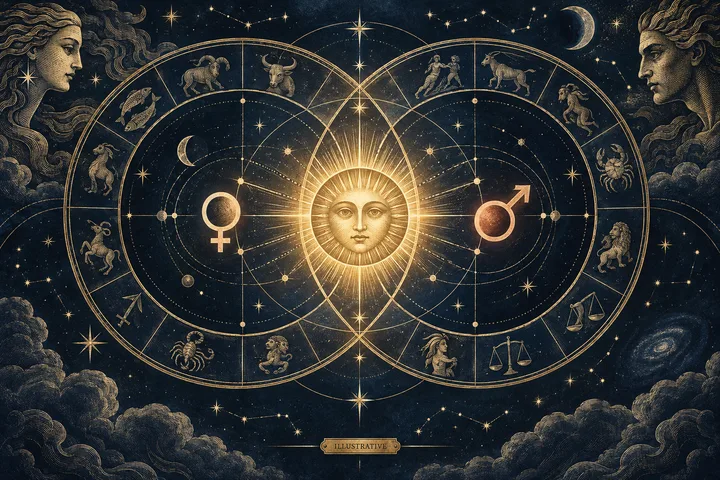
Consider an example. Maria has been told that her Venus is combust. Daniel's Mars sits close to her Venus by degree. The scene is illustrative, not a calculated report about a real couple.
These are two contacts, not one. Maria's natal Sun-to-Venus condition belongs to her own chart. Daniel's Mars-to-Maria's Venus contact belongs to the comparison between their charts. Daniel's Mars didn't make her Venus combust. It activates a condition already attached to her Venus, and it may make that condition easier to feel.
Keep the roles clear: the person who owns the Venus or Mars, the Sun-to-planet label supplied for that person, and the partner's planet making contact. A Venus-Mars conjunction is not automatically a conjunction to the Sun. That difference keeps a vivid attraction from becoming a dramatic verdict.
Sources: Synastry - Astrodienst Astrowiki; Interaspect - Astrodienst Astrowiki
Verify the solar label before reading its meaning
Combustion is a degree relationship with the Sun. Skyscript records William Lilly's roughly 8 degrees 30 minutes for combustion, a wider under-the-beams zone, and a cazimi condition within about 17 minutes. The same source also records older limits, so a careful reader names the convention instead of pretending every school draws the borders in exactly the same place.
Use this sequence. Take the supplied Sun and Venus or Mars degrees. Find their smallest zodiacal distance. Then label the planet outside the beams, under the beams, combust, or cazimi under the chosen convention. A cross-sign conjunction needs the same care, because astrologers don't all treat it alike.
If you have only a sign, you don't have a degree-based combustion judgment. Keep the label provisional. This site's Synastry Comparison Report accepts supplied Moon, Venus, and Mars signs, plus optional degrees. It doesn't calculate a birth chart or derive the Sun-to-planet distance from birth details.
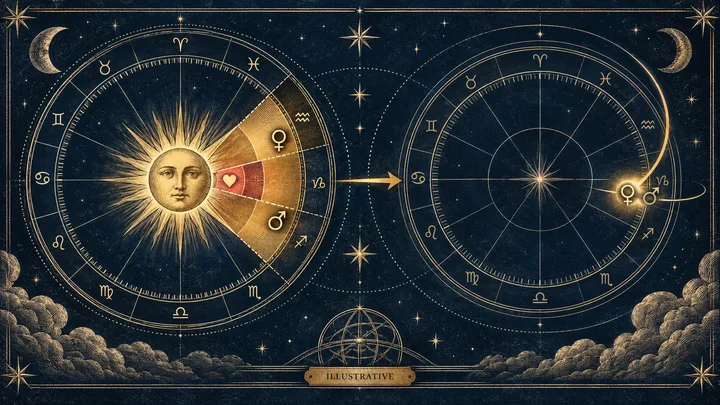
Read the contact in two layers. First, establish whether the natal Venus or Mars is actually under the beams, combust, or cazimi by using the Sun-to-planet degrees supplied for that person. Then read the other person's Venus or Mars as an activator of that natal condition. Mars on combust Venus can sharpen desire and visibility. Venus on combust Mars can make action feel inviting, intimate, or more personal. The contact matters, but it doesn't prove compatibility. Rank the exact inter-chart aspect and orb, then the signs and any supplied supporting placements. This site's Synastry Comparison Report compares supplied Moon, Venus, and Mars signs, with optional degrees and selected major aspects within a six-degree orb. It doesn't calculate birth charts, the Sun's distance from Venus or Mars, or houses. Without those Sun-to-planet degrees, keep combustion as a label to verify. Then ask which behavior the contact describes: attraction, pressure, or a clearer way to give and receive affection.
Read combust Venus as affection tied to identity
Venus speaks to affection, pleasure, attraction, and values. When Venus sits very close to the Sun, those needs can feel personal and exposed. Being loved may touch the question of being seen. A preference may feel like a statement of self. That doesn't erase Venus. It changes what the Venus person has to separate and name.
A partner's Mars can bring heat, pursuit, and movement to that Venus. In a generous expression, Mars helps Venus act on desire, while Venus gives Mars a warm response to move toward. The Venus person may feel more visible. The Mars person may feel encouraged to be direct.
The difficult expression is just as specific. Attention can become proof of worth, and chemistry can be mistaken for permission. Read the sign for style, then ask what happens when pursuit slows. Does Maria still know what she wants when nobody is watching? If yes, the contact is helping her express Venus. If not, it is exposing pressure around visibility.
Sources: Combust/Combustion - Skyscript Glossary; Dignities and Debilities - Skyscript Glossary
Read combust Mars through action and consent
Mars speaks to desire, action, courage, anger, and boundaries. Close to the Sun, its actions can feel bound up with identity. A changed plan may feel like a personal challenge. A clear desire may feel impossible to soften. That can produce courage and focus, or make restraint harder to practice.
A partner's Venus can give combust Mars a welcoming path. Affection may make desire more graceful, sensual, and relational. The Mars person can say what they want, while the Venus person answers freely. That is the clean expression of the contact.
The line is firm. Venus doesn't promise access, and combustion doesn't excuse anger. Ask whether the Mars person can hear yes, no, slower, and not today without turning the answer into a contest. This question belongs beside the chart, because it shows how the symbolism is being carried.
Sources: Combust/Combustion - Skyscript Glossary; Dignities and Debilities - Skyscript Glossary
Let aspect and orb set the volume
Once the natal label is verified, read the inter-chart contact. A conjunction joins the functions directly. A square brings friction. An opposition makes the two sides harder to ignore. A trine tends to flow, while a sextile asks for participation. These are different ways of meeting. None can decide the whole relationship.
Orb sets the volume. A one-degree Venus-Mars contact deserves more attention than a six-degree contact. This report uses a six-degree orb for selected major aspects, but that threshold only says the contact is included. It doesn't make every included contact equally loud. Astrodienst likewise advises smaller orbs in synastry because two charts can otherwise produce too many competing contacts.
Direction matters, too. Daniel's Mars to Maria's Venus describes one exchange. Maria's Mars to Daniel's Venus would describe another. If degrees are missing, remove claims that depend on exact aspect or orb. The honest reading gets narrower, and therefore more useful.
Sources: Synastry - Astrodienst Astrowiki; Interaspect - Astrodienst Astrowiki
Use sign and dignity as modifiers
The sign describes how Venus or Mars reaches for its purpose. Leo can make recognition and visible warmth important. Taurus can seek touch, steadiness, and comfort. Scorpio can bring privacy, trust, and intensity forward. These are interpretive directions. They don't replace the degrees or the inter-chart aspect.
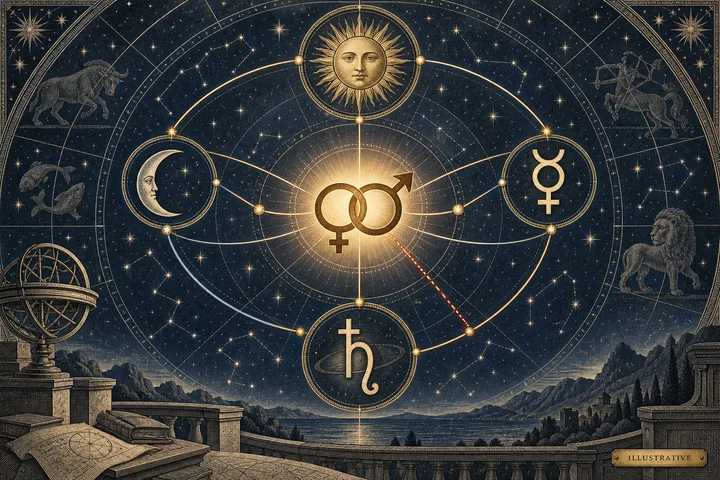
Essential dignity adds another layer. Skyscript distinguishes strength that comes from zodiacal placement from accidental conditions such as combustion. A Venus or Mars can have useful resources in its sign and still be close to the Sun. The label doesn't cancel the planet's tools.
Cazimi is the strongest exception in this method. If supplied Sun and planet degrees place Venus or Mars within the chosen cazimi limit, read that as a distinct, focused union rather than repeating an ordinary combustion judgment. In this report, however, dignity and cazimi are inputs to bring with you or labels to verify. The report itself compares the supplied Moon, Venus, and Mars information; it doesn't calculate them from birth data.
Sources: Combust/Combustion - Skyscript Glossary; Dignities and Debilities - Skyscript Glossary
End with a question the chart can sharpen
A useful synastry reading should leave you with a question, not a sentence stamped on a person. For Mars on combust Venus, ask, "How can pursuit make room for my answer?" For Venus on combust Mars, ask, "How can affection support desire without taking control of it?"
Use the contact in three moments: when one person says no, when a plan changes, and when the attraction is quiet. Those moments show whether the energy creates warmth, pressure, or both. The chart won't choose for you. It can help you name the pattern before you choose how to meet it.
If you use the Synastry Comparison Report, enter only the Moon, Venus, and Mars placements you actually know, with degrees when available. Keep any combust or cazimi label separate unless the relevant Sun-to-planet degrees are supplied. Read selected major aspects within six degrees, then start the conversation: "When we feel this much pull, what helps each of us stay clear, willing, and free to slow down?"
Sources: Synastry - Astrodienst Astrowiki; Interaspect - Astrodienst Astrowiki
A little more clarity
Is combust Venus always weak in synastry?
No. Combustion describes Venus's close relation to the Sun. It doesn't erase Venus's ability to value, attract, or receive affection. Check the chosen degree convention, sign, dignity, and cazimi possibility. Then read the partner's contact by aspect and orb. A strong Venus may still need room to separate personal desire from the wish to be recognized.
What does a partner's Mars on my combust Venus mean?
It can make desire and affection vivid. The Mars person may pursue or energize the Venus person, while the Venus person may feel more visible and wanted. Because Venus is close to the Sun, the contact can also touch pride and identity. Check whether pursuit feels inviting, whether a pause is respected, and whether the degree-based aspect is actually confirmed.
Can combust Mars still show strong attraction?
Yes. Combust Mars can show concentrated, proud, private, or highly personal desire. A partner's Venus may give that Mars an appealing channel, but it can also make delay feel personal. Read the supplied sign and aspect details, then watch what happens after a limit is spoken. Strong desire needs direction and restraint.
What if I know the signs but not the degrees?
Compare the signs and describe the possible planet-to-planet theme, but don't claim a precise combustion category, cazimi condition, or orb. This report can state the supplied signs and mark degree-based conclusions as unknown. A narrower reading is better than invented precision. Update the interpretation when exact degrees become available.
Sources & further reading
- Combust/Combustion - Skyscript Glossary
Supports the traditional distinctions among combustion, under the beams, cazimi, and their degree conventions.
- Synastry - Astrodienst Astrowiki
Supports defining synastry as a comparison of two horoscopes and their inter-chart aspects.
- Interaspect - Astrodienst Astrowiki
Supports using smaller orbs in synastry because inter-chart contacts can otherwise overwhelm the reading.
- Dignities and Debilities - Skyscript Glossary
Supports distinguishing essential dignity from accidental conditions such as combustion and cazimi.
Synastry Comparison Report
Enter known placements for two people. Get an input-by-input comparison, selected aspect calculations and a clear record of what remains uncertain.
Compare our placements