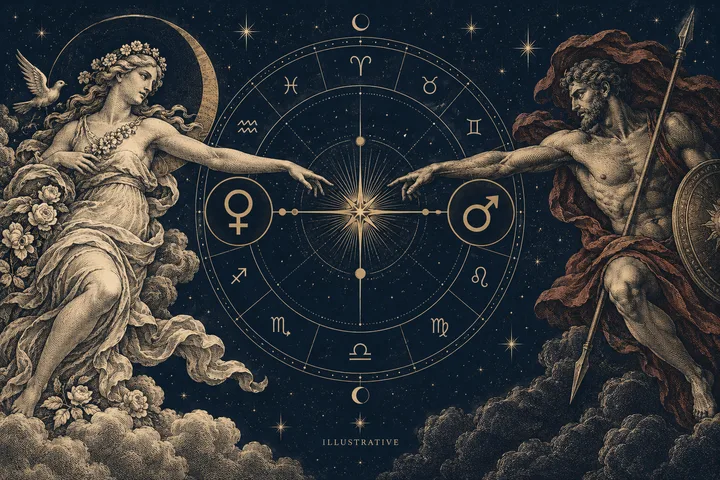
Venus opposite Mars in synastry describes one person’s Venus meeting the other person’s Mars across a 180-degree angle. Astrologically, Venus speaks to attraction, values, pleasure, and the way affection is offered; Mars speaks to desire, initiative, and pursuit. Their opposition places those functions face to face. That can feel compelling because each person encounters a style that differs from their own, but the same difference can create friction around timing, directness, and how interest is shown. The strongest reading begins with the actual degree contact, then considers the signs, the direction of the aspect, and the wider chart. Even a close opposition names a theme, not mutual desire or a relationship outcome. Ask whether the pattern describes something you both recognize, and whether the difference invites a conversation about what feels welcome.
What does Venus opposite Mars mean between two charts?
The short reading is attraction across difference, with friction possible where those differences meet. In synastry, one person’s Venus forms an opposition to the other person’s Mars. This is not a promise that two people will feel instant chemistry, nor a prediction that their connection will be stormy. It is a symbolic description of one person’s way of relating, attracting, and receiving meeting the other person’s way of acting, pursuing, and asserting. Cafe Astrology treats the Venus–Mars opposition separately from the conjunction and square, and describes attraction alongside tension. Synthesis Astrology likewise frames Venus–Mars contacts as a charged dynamic whose meaning depends on the wider pattern. Those are interpretive accounts, not measured claims about every couple.
The useful question is not simply whether the aspect is good. Ask what each person does when interest arises. Does one offer warmth and wait for a response, while the other communicates interest by taking initiative? Does one person’s directness feel refreshing, or does it arrive faster than the other wants? Does a pause feel inviting, or does it feel like rejection? These are examples of possible expressions, not predictions attached to the aspect. The chart gives a vocabulary for the difference; the people involved supply the lived meaning.
This article gives the opposition a clear but limited place in the reading. First verify the degree relationship. Next identify whose Venus contacts whose Mars and consider both planets’ signs. Then look for a second Venus–Mars contact or other close placements that change the emphasis. Finally compare the symbolic reading with the actual exchange. A close contact that describes a real pattern may be useful. A loose contact or a pattern that does not fit should carry less weight. This order protects the central insight without asking one aspect to explain an entire bond.
Some contemporary pages describe the opposition as magnetic or mutually compelling. Such language captures a familiar astrological interpretation: opposition puts two functions in direct relation, and Venus–Mars symbolism often concerns attraction and desire. But ‘mutual’ is a stronger claim than the geometry alone can support. Each person has both Venus and Mars, and their experience cannot be read from one contact as if a chart were a statement of consent or intention. The more careful reading is that the contact may make a contrast in relating and initiating especially noticeable. Whether that contrast becomes attraction, irritation, curiosity, or no important theme depends on the people and the rest of the charts.
So begin with a modest but meaningful proposition: the opposition can describe a live polarity between affection and action. Hold attraction and friction in view at once. Then ask what the aspect helps you notice that a vague label such as ‘strong chemistry’ would miss.
The phrase “attraction and friction” therefore works best as a starting hypothesis. It keeps both poles visible, but it does not tell you which one leads in a particular exchange. A couple may notice the attraction most at first and the difference later, or may find the difference useful from the start. Read the aspect as a pattern to investigate, then let the chart details and the people’s own descriptions sharpen it.
Sources: Synastry: Venus-Mars Aspects Between Charts; Venus-Mars Synastry: Attraction Aspects Explained
What exactly are we comparing?
Synastry compares the positions in two separate birth charts. To name this contact precisely, label the charts A and B. The first possible contact is A’s Venus opposite B’s Mars. The second is B’s Venus opposite A’s Mars. Those are separate cross-chart comparisons, even though both involve the same pair of planetary symbols. When a reader says ‘our Venus opposite Mars,’ the phrase can conceal which planet belongs to whom. Writing the direction down removes that ambiguity.
This is different from a natal Venus–Mars opposition, where one person’s Venus and Mars oppose each other within that person’s own chart. A natal aspect describes a symbolic relationship among functions in one chart. A synastry contact describes the relationship between a planet in one chart and a planet in another. It is also different from a composite chart, which uses a separate method to describe a relationship chart. Interpretations that move casually between these layers can sound convincing while answering a different question. Keep the comparison on the two supplied longitudes and the cross-chart contact they form.
A practical notation helps. Write ‘A Venus opposite B Mars’ and record the signs and degrees beside the labels. Then check the reverse direction on its own line. If there is no reverse contact within the selected orb, do not call the aspect mutual or a double contact. If there is a reverse contact, it adds another layer: each person’s Venus has a relationship to the other’s Mars. The two contacts may have different signs and different degrees of exactness, so they should not be collapsed into one undifferentiated claim.
The planets also have natal contexts. A person’s own Venus sign describes part of their individual style of attraction, values, and pleasure; their own Mars sign describes part of their way of acting and asserting. Those placements can help explain how a cross-chart contact is expressed. Still, they do not turn the interchart aspect into a fixed role. The Venus person is not only receptive, and the Mars person is not only initiating. Both people have both planets, and both can make choices that shift the interaction.
The distinction matters when you use a chart report. A report should make clear which supplied placement is being compared with which. If it only lists the word ‘opposition,’ ask whether the contact is cross-chart or natal, which direction it runs, and whether the displayed degree confirms it. The Synastry Comparison Report on this publication’s compatibility page works from placements you supply, with optional degrees. It organizes those inputs; it does not calculate birth charts from birth details. Knowing that scope helps you bring the right information and read the result at the right level.
This is also why direction belongs in the record even when a chart wheel looks symmetrical. The geometry may show the same two positions whichever way a line is read, but interpretation assigns one planet as Venus and the other as Mars. Without naming whose planet is whose, a description can slide between perspectives. Keep the labels fixed while you interpret, then separately ask whether the reverse contact exists.
Sources: Synastry: Venus-Mars Aspects Between Charts; Venus-Mars Synastry: Attraction Aspects Explained; Venus Opposition Mars: Meaning in Astrology
How do Venus and Mars contribute different parts of the pattern?
Venus and Mars carry distinct meanings in astrological interpretation. Venus is associated with attraction, pleasure, values, harmony, and the way a person gives or receives affection. Mars is associated with desire, action, initiative, assertion, and the way a person moves toward what they want. In a synastry contact, those functions meet across two charts. The reading concerns the encounter between them, not a simple division between love and sex or between two fixed kinds of people.
Venus can show what feels beautiful, appealing, or worth choosing. It can describe preferences in how one gives attention, makes space, shares pleasure, or seeks balance. Mars can show how desire becomes action: how one starts, pursues, competes, asks, or presses ahead. These are broad symbolic meanings. They do not tell us that a particular person will use one behavior or another. A Venus placement may be expressed through clear initiative, while a Mars placement can act with patience and care. Planetary language is a way to organize themes, not a script that removes individual agency.
Older astrology writing sometimes genders Venus and Mars, assigning Venus to women and Mars to men. That shorthand narrows the chart and does not serve this reading. Every chart contains Venus and Mars. A contact can matter across any genders, orientations, or relationship forms, and it need not be read as heterosexual pursuit. The relevant distinction is between planetary functions: what attracts or welcomes, and what acts or asserts. That language keeps the interpretation available to the people whose charts are being compared.
When these functions meet in synastry, try translating them into neutral questions. What does each person find appealing? How does each signal interest? What counts as an invitation? What pace feels good? How does each respond when the other takes initiative? The answers might align, or they might differ. A person may enjoy bold invitations but need time before responding. Another may be comfortable showing interest directly yet want reassurance that the invitation is welcome. The chart can suggest which contrast to examine, but only conversation and behavior can tell you whether that description fits.
This distinction also prevents an easy mistake: treating Venus as passive and Mars as active in every interaction. In one moment, the Venus symbolism may describe the person who initiates through charm or invitation. In another, Mars may describe someone who acts decisively but still waits for consent and response. The contact’s direction names which planets form the aspect; it does not assign permanent jobs to the people. Ask about the behavior, not the label. A useful reading makes each person more legible to themselves, rather than reducing one to the pursuer and the other to the pursued.
These meanings are traditionally broad rather than behavioral checklists. One Venus placement does not prove a person prefers gifts, physical touch, or any other single love language. One Mars placement does not prove someone pursues aggressively. Start with the traditional planet meanings, then ask for an example that supports the application. The chart becomes more useful when its language invites curiosity rather than supplying assumptions about a partner.
Sources: Synastry: Venus-Mars Aspects Between Charts; Venus-Mars Synastry: Attraction Aspects Explained
What does an opposition add to the Venus–Mars story?
An opposition is an aspect of 180 degrees. Its image is two planetary functions placed across an axis, facing one another from opposite ends. Nicholas Campion’s overview of aspects at Skyscript describes the opposition as a powerful relation that can bring conflict while widening the range of possibilities. It also notes that aspect closeness and the planets involved affect how astrologers weigh a contact. This is general aspect teaching, not a dedicated study of couples, but it gives a useful interpretive frame: opposition makes a difference visible and asks how the two ends will relate.
Applied to Venus and Mars, the image becomes a meeting between attraction or receptivity and desire or action. Some astrologers describe the encounter as compelling because the other person embodies a quality that feels distinct. The Venus person may notice the Mars person’s directness; the Mars person may notice the Venus person’s warmth or taste. That is a possible interpretation of polarity, not a universal experience. The same difference could also feel foreign or poorly timed. The aspect does not make either person the missing half of the other.
It helps to distinguish complementarity from polarization. Complementarity means difference adds range: one person’s initiative is met by the other’s interest, or a more receptive style gives an active style a clear response. Polarization means difference hardens into opposite camps: one always presses, the other always retreats; one decides what counts as interest, the other is expected to accommodate. The aspect’s opposition symbolism can name this face-to-face tension. It cannot tell us which branch is happening. Look for exchange, adjustment, and room for both people to act.
The opposition also invites a reading of projection. In the astrological tradition, a person may notice another’s quality intensely when that quality contrasts with their own style. That can produce admiration, irritation, or both. If someone sees all initiative as belonging to the other, they may miss their own ability to make a direct request. If someone casts the other as endlessly receptive, they may overlook the other person’s preferences and limits. Treat projection as a question to explore, not a diagnosis. Ask what each person owns in the dynamic and what they have assigned to the other.
A practical test is to watch what happens after an invitation. Is there an answer? Can either person slow the pace without punishment? Does a difference prompt curiosity, or does it become evidence in a case against the other? Those observations turn a broad symbol into a useful reading. If the opposition helps the couple name a contrast with warmth and precision, its polarity can be a resource. If the label obscures pressure or disinterest, set the label aside and attend to what is happening. The best interpretation holds both possibilities until the actual pattern earns one.
An opposition can also ask each person to hold both sides in view. That does not mean they must compromise every difference or meet halfway on every choice. It means neither pole should erase the other. A person can value closeness and personal space, and a couple can name when each matters. In this reading, integration is a possible response to polarity, not a promised result.
Sources: An Introduction to Aspects and Chart Shaping in Natal Astrology; Venus-Mars Synastry: Attraction Aspects Explained; Synastry: Venus-Mars Aspects Between Charts
Who experiences Venus, and who experiences Mars?
In a one-way contact, one person’s Venus occupies the Venus position and the other person’s Mars occupies the Mars position. Astrologers sometimes call them the Venus person and Mars person for convenience. Those labels refer only to the planets in that particular contact. They do not describe each person’s whole personality, tell us who feels more, or establish who has more influence. Synthesis Astrology’s discussion of Venus–Mars synastry distinguishes the two perspectives and cautions that a one-channel reading can become a fixed pursuer-and-pursued story. That warning is useful because a chart label can quietly become a rule imposed on the couple.
The Venus-side interpretation may focus on what feels appealing, welcome, valued, or worth responding to. The Mars-side interpretation may focus on the impulse to act, initiate, or express desire. These are questions to take into a reading. They are not reports of what either person actually feels. A Venus person may not welcome a Mars person’s approach; a Mars person may not experience strong desire. Neither conclusion follows from the aspect alone. The chart supplies a symbolic comparison, while each person’s words and choices supply the answer to whether there is a shared interest.
Do not let the shorthand turn into a permanent division of labor. Both people have Venus and Mars. Each can initiate, receive, choose, pause, and set a boundary. If the relationship repeatedly places one person in the role of asking and the other in the role of deciding, the chart should not be used to naturalize that imbalance. Instead, ask whether the arrangement suits both people. Does the person who initiates feel met? Can the other person say no or ask for a different pace? Can either person initiate without being told they have stepped outside their role?
A good reading compares viewpoints without pretending to speak for either partner. Each person can answer privately first: What signals attraction to me? What kind of invitation feels clear? What makes pursuit feel welcome? What makes it feel like pressure? What do I do when I want closeness? Where do I wait for the other person to guess? These questions give the Venus–Mars symbolism practical shape, and the difference between answers may be more useful than a generic description of chemistry.
Then check the reverse-direction contact. If B’s Venus also opposes A’s Mars, the chart has a second Venus–Mars relation. It can make the exchange more reciprocal in astrological structure, but it still does not establish mutual attraction or equal behavior. Each contact should be measured separately and interpreted through its own signs. If only one direction is present, the other person’s Venus and Mars still matter elsewhere in the comparison. Either way, the reader’s task is to describe the pattern accurately, not to decide that one person is destined to pursue.
Use role language lightly and check it against each person’s account. One may recognize the Venus description in a particular moment and the Mars description in another. The same person can welcome an invitation one day and decline it the next. If the roles switch, the interpretation need not break; it may show that the aspect is only one lens among several, or that the exchange is more reciprocal than the shorthand suggests.
Sources: Venus-Mars Synastry: Attraction Aspects Explained; Synastry: Venus-Mars Aspects Between Charts
How do the signs change the way attraction and friction show up?
The aspect describes the angle between the planets; the signs describe the styles through which the planets operate. A Venus–Mars opposition can connect planets in opposite signs, but sign polarity and exact degree geometry are not identical. In ordinary sign-based language, opposite signs form an axis: Aries–Libra, Taurus–Scorpio, Gemini–Sagittarius, Cancer–Capricorn, Leo–Aquarius, and Virgo–Pisces. The pair shares a polarity while expressing it differently. This can refine the interpretation, but it should not replace the longitude check.
Consider an illustrative example, not a real couple or a calculated chart. Imagine a supplied placement comparison in which Venus in a more security-seeking sign opposes Mars in a more exploratory sign. A reader might explore whether one person values steadiness and familiar signals while the other values movement, direct experience, or variety. The productive branch is not that one person changes to match the other. It is that they name which forms of invitation and reassurance help them meet across the difference. The difficult branch is assuming that a preference for steadiness means lack of desire, or that a preference for exploration means lack of care. Those conclusions require evidence from behavior, not sign names.
Now imagine the same opposition geometry expressed through signs whose traditional meanings emphasize visibility and partnership, or analysis and intuition. The details of the conversation might shift: one pair may need to talk about who takes the first step in public, while another may need clearer language when one person hints and the other expects directness. These are broad astrological possibilities, not sign-by-sign verdicts. The comparison shows why an aspect’s geometry alone cannot supply every detail. Signs give texture; they do not tell us exactly what two individuals do.
The zodiac system must also be consistent. If the placements were calculated in different zodiacs, comparing their signs as if they belonged to the same framework can create confusion. The report uses positions supplied by the reader, so the reader should know whether those positions are tropical or another zodiac and use the same basis for both charts. If the zodiac is unknown, state that the sign interpretation is provisional. The angular relationship can be assessed from longitudes when those are supplied, but the sign language depends on the system behind those longitudes.
When you have signs but not degrees, you can talk about the symbolic contrast of the signs. You cannot confirm that the planets form a close opposition. This is especially important near sign boundaries, where planets in signs that are conventionally opposite may be far apart in exact angular terms, or planets in adjacent signs may still form an opposition by degree. Sign language offers a first layer. It is not a substitute for the aspect calculation. Read the style only after you have labeled what kind of information you actually possess.
Avoid reading every trait of a sign into the contact. A sign is a context for interpretation, not a complete description of the person. Use one or two relevant qualities to form a question, then look for a concrete example. This keeps an aspect-focused article from becoming a broad sign-pair catalogue and lets readers see exactly how sign symbolism changes the interpretation under discussion.
Sources: Venus-Mars Synastry: Attraction Aspects Explained; Synastry: Venus-Mars Aspects Between Charts
How can we tell whether the opposition is exact enough to weigh?
To check the contact, compare the planets’ supplied longitudes and measure their separation around the zodiac. An exact opposition is 180 degrees apart. The orb is how far the actual separation differs from that exact angle. If two positions are 176 degrees apart, for example, the distance from exact opposition is 4 degrees. This is an arithmetic illustration only, not a pair of personal placements. A contact at 179 degrees is closer to exact than one at 174 degrees, and many astrologers give closer aspects more weight.
For this article, use a maximum orb of 6 degrees as a focused working convention. That means the separation must be between 174 and 186 degrees, measured by the shorter distance around the circle, to qualify under this rule. The six-degree limit is not a universal doctrine. Skyscript’s overview gives a broader 8-degree opposition allowance in its table and explains that astrologers may adjust orbs according to the planets involved. Contemporary practitioners also use narrower limits for synastry than for some natal work. The honest method is to state the rule and apply it consistently, rather than present one cutoff as settled for every astrologer.
Closeness is a weighting tool, not a volume knob that predicts how strongly two people feel. Within the chosen range, a tighter contact gives a stronger reason to foreground the opposition symbolically. A contact near the edge of the range can remain a background note or may be better treated as a secondary possibility, especially if other chart details do not echo it. A contact outside six degrees falls beyond this article’s working rule. Another astrologer might use a broader allowance; that difference should be described as a difference in method, not a hidden fact about the couple.
Sign labels alone cannot establish exactness. ‘Venus in Aries opposite Mars in Libra’ suggests the expected polarity, but without degrees we do not know how closely the positions face each other. Conversely, a degree opposition can cross sign boundaries and still be geometrically close. If either placement lies near the start or end of a sign, be especially careful not to infer angle from sign names. Ask for the actual degrees and the zodiac basis. If the birth date itself is uncertain, or if the supplied placement came from inconsistent systems, say that the calculation is uncertain and reduce the weight of the conclusion.
Birth times are not required to compare supplied Venus and Mars longitudes, though accurate birth data may be needed to calculate a full natal chart and other chart factors. This particular report uses placements readers provide and can include optional degrees. It does not derive planetary positions from birth details or calculate houses. The useful decision is simple: with degrees, apply a clearly stated orb; with signs only, discuss a possible sign-axis theme and leave the exact aspect unconfirmed. Precision about the inputs makes the interpretation easier to trust and easier to revise.
To compare longitudes carefully, express each position as a number from 0 to 360 degrees, find the smaller angular distance, and compare it with 180 degrees. The orb is the absolute difference between that distance and 180. A calculator or chart program may do this arithmetic, but readers should still know which positions and zodiac it used. The interpretation begins with transparent inputs.
Sources: An Introduction to Aspects and Chart Shaping in Natal Astrology
How is an opposition different from a conjunction or square?
A conjunction places two planets at or near the same zodiac longitude. A square places them about 90 degrees apart. An opposition places them about 180 degrees apart. Those geometries give astrologers different images for the relation. Skyscript describes the conjunction as combining two planets, the square as friction, and the opposition as conflict that can widen possibilities. Cafe Astrology’s Venus–Mars synastry reference likewise separates the conjunction, opposition, square, trine, and sextile rather than treating all Venus–Mars contacts as the same experience.
For Venus and Mars, the conjunction is often read as immediate blending: attraction and action meet at one point. The opposition is read as face-to-face polarity: attraction or receptivity encounters desire or initiative across a difference. A square is often described as cross-pressure, where the two styles may get in each other’s way or produce friction through competing approaches. These are symbolic distinctions, not a ranking of chemistry or relationship quality. A conjunction is not automatically easier, and a square is not automatically worse. The angle helps name the kind of interaction to examine.
This comparison corrects a common drift in online summaries. Advice written for ‘Venus opposite Mars’ may actually describe a conjunction, or it may use the word ‘hard aspect’ to merge opposition and square. That loses the geometry that gives the aspect its particular interpretive picture. If a report lists an opposition, use the opposition’s image of encounter across a polarity. If it lists a square, ask what cross-pressure is present. If it lists a conjunction, examine what feels fused or immediate. Then consider sign and orb within each case.
Trines and sextiles can serve as brief contrasts. In many astrological frameworks, they are associated with easier flow or opportunity, while opposition highlights a balancing of distinct ends. ‘Easier’ does not mean more meaningful, just as ‘challenging’ does not mean more passionate. A couple may find ease in a flowing contact and still need to talk about the same practical choices as anyone else. The point of the comparison is not to rank the aspects by desirability. It is to avoid importing a reading that belongs to a different relationship between the planets.
Before you accept a description, check the exact angle. Is the claim about two planets in the same region, a right-angle relation, or a face-to-face axis? Is the source talking about one person’s natal chart or two people’s synastry? The geometry and chart layer should match the question. That small check often matters more than a colorful adjective. It keeps a specific aspect from dissolving into the general statement that ‘Venus and Mars mean attraction.’
The contrast does not mean astrologers must read every trine as pleasant or every square as difficult. The geometry supplies a traditional starting image, and planets and signs modify it. For this question, the key is narrower: a reading of face-to-face polarity is distinct from a reading of fusion or cross-pressure. Keep that distinction clear before adding any judgement about how the relationship feels.
Sources: An Introduction to Aspects and Chart Shaping in Natal Astrology; Synastry: Venus-Mars Aspects Between Charts; Synastry Mars-Venus Aspects - Learn Astrology
What might the same opposition look like in everyday interaction?
Imagine a couple who feel drawn to one another but differ in how they begin closeness. One shows interest by responding warmly, sharing time, and making room for the other. The other tends to show interest through direct invitations and clear initiative. This imagined scene is not a case study and does not represent chart calculations. It gives a concrete way to test the symbolism: does the first person experience the invitation as welcome, and does the second experience the response as clear? The same contrast can be reciprocal, or it can create uncertainty.
In the complementary branch, the person who prefers a warm response answers an invitation with genuine enthusiasm and adds an idea of their own. The person who initiated notices that their effort has landed, and asks what pace feels good. Both understand the difference without turning it into a test. One does not need to become more forceful, and the other does not need to become less receptive. They exchange information, then adjust. The Venus–Mars reading may help name the pattern as a meeting of distinct styles, but the useful work comes from their choices.
In the frictional branch, the same invitation arrives with an assumption that a quick yes is the only meaningful answer. The other person needs time, but the pause gets read as disinterest. The first person presses harder to resolve the uncertainty; the second pulls back to regain space. Each person then uses the other’s reaction as proof of an earlier fear. In symbolic terms, initiative and receptivity have become polarized. In ordinary terms, one person feels pressured and the other feels unanswered. Naming the cycle is helpful only if it opens a better exchange.
A practical conversation can interrupt the cycle. The initiator might ask, ‘Would you like me to suggest plans directly, or do you prefer to choose together?’ The other might say, ‘I enjoy your invitations, and I need time to answer some of them. A pause means I’m thinking, not that you should keep asking.’ These are illustrative lines, not quotes from real people. They model the kind of specific information that a general chart reading cannot provide. A boundary or a preference is clearer than a symbolic label.
The scene also shows why the word ‘chemistry’ can hide too much. Two people can feel a spark and still have different preferences about timing, initiation, and closeness. Two people can also feel little attraction even when their charts show the aspect. Compare the interpretation with one recent, observable moment. What happened? What did each person understand? What response would have felt welcome? If the aspect helps you ask those questions without presuming the answers, it is doing useful work.
The point of an illustration is to test an idea, not to prove it. These imagined branches do not show that Venus–Mars contacts create a particular behavior. They show how a reader might compare one symbolic description with observable events. If the example feels too neat for a real relationship, that is a reminder to ask open questions instead of fitting the couple into a template.
Sources: Venus-Mars Synastry: Attraction Aspects Explained; Synastry: Venus-Mars Aspects Between Charts; Synastry
What can the rest of the synastry change?
A Venus–Mars opposition belongs inside a wider comparison. The first question is whether the contact is geometrically present under the chosen orb. Then look at how each planet’s sign modifies its expression. Next note close aspects to Venus or Mars and other personal planets, if the necessary positions are supplied. Finally compare each person’s natal Venus and Mars styles. This order keeps a striking contact visible without letting it stand in for the whole chart. Both Synthesis Astrology and Cafe Astrology place Venus–Mars contacts among wider synastry patterns rather than treating one aspect as a full relationship account.
A close contact to Venus may add another theme around affection, values, or what feels pleasurable. A close contact to Mars may add a theme around action, anger, energy, or initiative. Moon contacts can bring emotional habits into the picture; Sun contacts can make identity and attention more salient. These are broad interpretive categories, not guaranteed effects. Do not announce that a Moon contact ‘rescues’ the opposition or that Saturn ‘blocks’ it. A nearby aspect adds context. Its meaning depends on which planets form it, how close it is, the signs involved, and what else the chart shows.
The reverse Venus–Mars direction deserves its own check. If the second person’s Venus also contacts the first person’s Mars, the chart contains another relationship between the same planetary functions. If both contacts are close, an astrologer may read a more layered exchange of Venus and Mars themes. But the structure still does not prove equal interest, identical experience, or mutual desire. One person may recognize a pattern that the other does not. The chart comparison can suggest reciprocity as a question; the people’s actual responses answer it.
The wider chart may also keep the opposition from becoming the dominant story. Several close supportive contacts can describe ease in communication or emotional responsiveness, while other close tensions can give the couple a different challenge to address first. Do not count aspects as votes. Three easy aspects do not mathematically cancel one difficult one, and one difficult aspect does not outweigh every other connection. Instead, ask which contacts repeat the same theme and which point to separate parts of relating. Repetition can make a topic more relevant to examine, but it still does not assign an outcome.
Houses and angles can add another layer in a full synastry reading, but only when reliable birth times and a defined chart method are available. The supplied-placement Synastry Comparison Report does not calculate houses or derive charts from birth details. Readers who have already calculated positions can compare the supplied Venus, Mars, and other placements within the report’s stated scope. If they lack the necessary information, the right move is to keep the interpretation at the planetary and sign level. Missing data limits which chart questions can be answered; it does not require filling the gap with guesswork.
No amount of chart context makes consent something to infer. If an invitation is declined, the response is clear even if an astrologer can describe a symbolic polarity. If the interaction feels unsafe or coercive, focus on the behavior and the boundary. Astrological language can support reflection, but it should never be used to excuse pressure or argue someone out of their own account.
Sources: Synastry: Venus-Mars Aspects Between Charts; Venus-Mars Synastry: Attraction Aspects Explained; Venus Opposition Mars: Meaning in Astrology; Venus Opposition Mars Synastry: Meaning & Chart
What is the strongest exception to the magnetic reading?
The strongest exception is simple: the chart may show a Venus–Mars opposition while the people do not experience mutual interest, welcome, or reciprocal initiative. An aspect is not an agreement. No placement can establish consent or tell us that another person secretly wants something. If one person says no, avoids contact, or feels pressured, that lived information has priority over any symbolic account of attraction. Astrology can help describe a pattern when it fits. It cannot make an unwanted approach welcome.
There is also a technical exception. The contact may be only a sign-based resemblance, or its orb may fall outside the stated working range. If the degrees are missing, the exact aspect remains unconfirmed. If the supplied degrees are uncertain or calculated in inconsistent zodiacs, confidence in the geometric comparison should fall accordingly. Even within six degrees, a wider chart may give the Venus–Mars contact less prominence than another close pattern. The article’s working rule makes the reasoning explicit, but it does not turn an interpretive convention into a universal boundary.
Some pages present this aspect in absolute terms: irresistible attraction, an inevitable push–pull, or a bond that repeatedly returns. Those descriptions make a vivid story, but the sources do not establish that every couple with the contact experiences those outcomes. Leymora’s contemporary overview says the aspect guarantees neither harmony nor instability and encourages comparing both people’s placements and asking how each feels wanted without feeling managed. That is a more careful use of the symbol. Cafe Astrology’s emphatic attraction language is best understood as one common interpretive position, not a finding about all relationships.
A strong counter-reading may also come from the lived situation. Suppose the chart contact is close, but both people consistently experience the same pace and show interest in similar ways. Then the aspect may be technically present but not especially useful as a description of their current relationship. Or suppose the chart suggests polarity, but the people have no mutual romantic interest. The symbolic possibility should not be forced onto them. A reading earns its place by illuminating something recognizable, not by insisting that experience must match the chart language.
What could change the conclusion? More precise degrees could confirm or weaken the contact. A reverse-direction aspect could add a second layer. Sign context or other close aspects could change which theme deserves attention. Most of all, a candid conversation could show that the supposed attraction-and-friction pattern fits, needs revision, or does not fit at all. The strongest reading stays open to correction. That is not a retreat from astrology; it is a disciplined way to interpret a chart in partnership with the people whose lives it is meant to illuminate.
This review order is a hierarchy of interpretation, not a scoring formula. It tells you which questions to answer first and what additional information could matter. It does not say that every chart needs a catalogue of dozens of contacts. Select only the factors that clarify the specific Venus–Mars question. More placements can add context, but they can also distract if no clear interpretive reason connects them.
Sources: Synastry: Venus-Mars Aspects Between Charts; Venus-Mars Synastry: Attraction Aspects Explained; Venus Opposition Mars: Meaning in Astrology; An Introduction to Aspects and Chart Shaping in Natal Astrology
What should we do with the comparison next?
Start with the placements. Confirm whose Venus is being compared with whose Mars, check that both longitudes use the same zodiac, and record the degrees. Apply the chosen orb consistently. If the positions are close to exact opposition, read the signs for style and consider whether a reverse-direction contact adds another layer. Then compare the interpretation with one actual moment when one person initiated and the other responded. Ask what each intended, what felt welcome, and what could be clearer next time.
If the pattern fits, use it as a conversation prompt: ‘I think we may show interest differently. What kind of invitation feels good to you?’ If it does not fit, set it aside. If the degrees are missing, describe a possible sign-axis theme without calling it a confirmed opposition. If you want help organizing placements you already have, the Synastry Comparison Report can compare supplied Moon, Venus, and Mars signs, with optional degrees and selected major aspects using its stated six-degree orb. It does not calculate natal positions from birth details, houses, or relationship outcomes.
The verdict is practical. A verified Venus–Mars opposition can give a name to attraction across difference and to friction around how interest is expressed. Its degree closeness ranks before sign interpretation; the direction and wider chart refine the reading; the people’s actual reciprocity decides whether the symbolism is useful. Look for a mutual pattern, ask one clear question, and observe what changes. If both people can name a preference and respond to it, the chart has helped. If it obscures a boundary or creates a story one person does not share, trust the boundary and revise the interpretation.
Make the next step small enough to observe. Instead of asking whether the whole chart proves compatibility, ask whether a particular way of initiating feels welcome and whether both people can say so plainly. A single conversation cannot settle every question about a relationship, but it can test whether this symbolic description gives the couple a shared language for one real difference.
Sources: Synastry: Venus-Mars Aspects Between Charts; Venus Opposition Mars: Meaning in Astrology; An Introduction to Aspects and Chart Shaping in Natal Astrology
A little more clarity
Does Venus opposite Mars in synastry always mean strong attraction?
No. Astrologers often read the contact as attraction across difference, but the aspect does not establish what either person feels. Confirm the degree contact, read the signs and wider chart, then compare the interpretation with mutual interest and actual behavior.
Can we confirm Venus opposite Mars from signs alone?
Signs can suggest an opposite-sign polarity, but they do not confirm a close 180-degree contact. Compare the supplied planetary longitudes and state the orb convention. This article uses six degrees as a focused editorial rule, not a universal standard.
Sources & further reading
- An Introduction to Aspects and Chart Shaping in Natal Astrology
Supports the 180-degree opposition definition, orb as distance from exactness, greater weight for closer aspects, and the fact that orb practices vary.
- Synastry: Venus-Mars Aspects Between Charts
Supports that astrologers interpret Venus–Mars synastry through attraction and distinguish the opposition from conjunction and square.
- Venus-Mars Synastry: Attraction Aspects Explained
Supports reading Venus–Mars contacts as one charged theme in the broader chart and attending to the two planetary perspectives.
- Venus Opposition Mars: Meaning in Astrology
Supports the interpretive view that synastry requires comparing both people’s Venus and Mars and that an opposition guarantees neither harmony nor instability.
- Synastry Mars-Venus Aspects - Learn Astrology
Supports the distinction between conjunction, opposition, square, trine, and sextile in Venus–Mars synastry interpretation.
- Synastry
Supports treating individual interchart contacts within the broader context of synastry rather than as a complete relationship reading.
- Venus Opposition Mars Synastry: Meaning & Chart
Records a current categorical ‘magnetic attraction’ interpretation that this article qualifies rather than adopts as a universal outcome.
- Venus opposite Mars - natal, synastry, transit
Supports the existence of differing orb conventions, including narrower synastry use, and shows why claims of inevitable outcomes need qualification.
Synastry Comparison Report
Enter known placements for two people. Get an input-by-input comparison, selected aspect calculations and a clear record of what remains uncertain.
Compare our placements