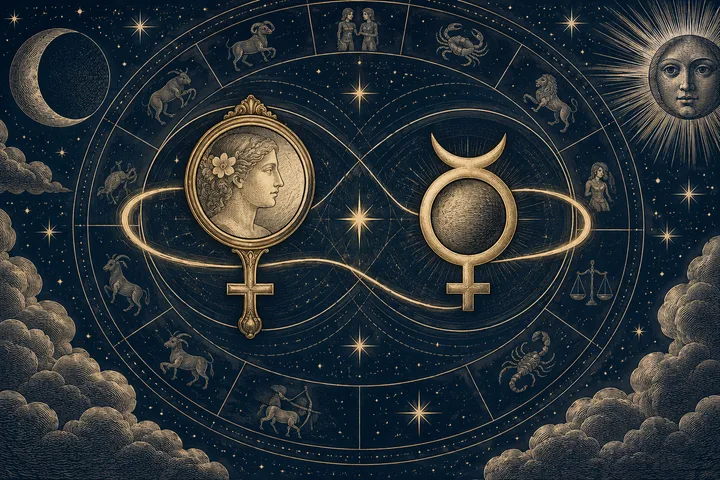
How can you use the report without asking it to calculate an unconfirmed contact?
Start with the report’s accepted fields. The product brief confirms supplied Moon, Venus, and Mars placements, optional degrees, and selected major-aspect calculations using a six-degree orb. It doesn’t confirm Mercury as an input. Unless Mercury is explicitly accepted, don’t treat a Venus-Mercury contact as something this report calculated. A Venus comparison can describe how two people’s relational styles meet, but it cannot stand in for a calculation involving one person’s Mercury and the other’s Venus. The report also doesn’t calculate natal positions from birth details.
You can still explore the question. Use the report for the Venus information it supports, then bring in Mercury only if you know that placement from another source. Keep the inputs distinct as you read: which Venus signs came from the report, where Mercury came from, and whether either placement includes a degree. You can consider the symbolic meeting of Venus and Mercury without attributing an unconfirmed calculation to the report. That is an interpretation of known placements, not a result the report established.
Before interpreting, ask what the result actually compares. If the report gives Venus signs but doesn’t accept Mercury, it may help you reflect on each person’s style of affection or appreciation. It hasn’t shown that those placements form a cross-chart aspect. If you have both Mercury and Venus degrees from chart information, you can investigate their angular relationship separately. The report’s six-degree setting applies only to calculations it supports. Sign names alone don’t establish a precise degree-based contact.
A check keeps the tool within its scope: confirm the accepted fields, identify the source of each placement, and label the comparison accordingly. If Mercury isn’t an accepted field, use the report for its confirmed Venus context and treat any Venus-Mercury reading as a separate exploration. A placement comparison, an aspect reading, and a full birth-chart calculation are different kinds of information. State what you know, what came from elsewhere, and what the report supports. Then you can ask how warmth meets speech without confusing the chart inputs, the report’s scope, and your interpretation.
What data can establish an aspect instead of a sign-only resemblance?
A sign comparison can describe broad style, but it cannot by itself confirm the exact angle between two cross-chart planets. To identify a conjunction, sextile, square, trine, or opposition, you need both placements' degrees, their angular separation, and a stated orb. The report's six-degree orb applies only to calculations it actually supports. If you have signs but not degrees, describe a possible stylistic resonance, not a verified aspect or its closeness. In synastry, an aspect is the angular relationship between a planet in one person's chart and a planet in another person's chart. The five major aspects have target angles: conjunction, 0 degrees; sextile, 60; square, 90; trine, 120; and opposition, 180. As Astrology Aspects Explained puts it, “Aspects measure the angular distance between planets.” The angle gives astrologers a pattern to interpret; it doesn't tell the whole story by itself. The orb is the distance between the measured separation and the aspect's exact target angle. If two placements are 93 degrees apart, for example, the separation is three degrees from an exact square, so the square has a three-degree orb. This is a hypothetical geometry example, not a couple's chart. Astrology Aspects Explained describes exactness as a measure of a contact's strength, while the Orb glossary defines the term as distance from an exact angle. An orb rule decides which contacts a method counts. It isn't universal. Astrology Aspects Explained publishes its own limits for each major aspect, while the Orb glossary notes that conventions differ. The Synastry Comparison Report brief specifies a six-degree orb for selected major-aspect calculations. Apply that setting only when the report accepts both placements and calculates that contact. Don't borrow another site's limits. When comparing readings, ask which orb rule each one used. Signs offer a different kind of information. They describe the style through which a planet expresses itself; degrees let you measure the relationship between two placements. A sign-pair shorthand can suggest a familiar harmony or tension, but planets in signs commonly associated with an easy relationship may still sit far from an exact aspect. Conversely, two planets in signs not usually grouped as harmonious may lie close to a major angle near a sign boundary. Sign names alone don't establish the geometry. Imagine a hypothetical comparison in which a Venus sign and a Mercury sign seem compatible by element. Without degrees, you can explore that broad stylistic resemblance: perhaps one person's way of showing appreciation seems to fit the other's conversational manner. You cannot call it a close trine, sextile, or any other degree-based contact from that resemblance alone. If their degrees later show a measured separation near a target angle, you can name the aspect and its orb under a stated method. The added precision changes the technical description; it doesn't turn the interpretation into a guarantee of easy conversation. Use a three-part check: confirm both cross-chart placements, calculate their shortest angular separation, then compare it with the target angle and the selected orb. If any input is missing, stop at the level the information supports. With signs only, discuss sign style. With verified degrees, discuss the aspect geometry. With a stated calculation method, explain whether the contact falls within that method's orb. This keeps sign reading distinct from measured aspect.
Sources: Astrology Aspects Explained; Orb
Why must you keep track of whose planet is whose?
A Venus-Mercury contact joins two people’s planetary roles. One person’s Mercury brings speech, thought, and exchange; the other person’s Venus brings appreciation, values, and relational tone. Reverse the direction and the roles reverse. Name the people and planets before interpreting. Then consider each sign as a modifier of style, not a substitute for the contact itself. “A’s Mercury to B’s Venus” asks how A’s way of phrasing ideas meets B’s way of valuing, receiving, and expressing warmth. It doesn’t mean A alone speaks or B alone listens. It gives you a lens for noticing what each contributes. Cafe Astrology’s “Aspects Between Charts” describes this role-based approach: each person takes on the part of the planet in their own chart when it meets the other person’s placement. The page also advises considering each planet’s sign when interpreting the contact. Imagine A tends to offer concise answers and quickly name the practical point. B may place more weight on warmth or a considerate tone. In this illustrative scene, A’s Mercury meets B’s Venus. Ask what A’s words are doing, what B values in how they arrive, and whether each recognizes the other’s contribution. This is a prompt for interpretation, not a chart-derived fact. Now reverse the roles. “B’s Mercury to A’s Venus” is a separate contact: B’s way of speaking meets A’s way of valuing and receiving warmth. A may now be attuned to tone, while B brings the Mercury side of this interaction. If both directions are present, read each on its own before describing a mutual theme. One may feel easy while the other calls for more care; they need not tell identical stories. Signs can refine those stories. Cafe Astrology notes that planetary signs affect how an inter-chart contact plays out. A sign can help describe style: someone may favor direct, measured, playful, or soothing phrasing. Keep that description attached to the person whose planet carries the sign. Don’t let a sign stereotype replace what each partner recognizes in themselves. The contact shows the relationship between roles; signs add color to each role. Before drawing a conclusion, write the contact in one line with both owners named. Then ask each person what they recognize: How do you tend to phrase an idea? What makes an appreciative tone feel clear to you? If both can name the exchange without being assigned a script, the symbolism may help describe a real pattern. If it fits only one person’s account, keep it as that person’s perspective. A Venus-Mercury contact is useful when it opens a conversation about how warmth and words meet, rather than declaring that you already communicate well.
Sources: Aspects Between Charts
What can Venus and Mercury suggest about the exchange?
In contemporary Western synastry, Mercury-Venus contacts are read through the meeting of language and relational values. Sextiles and trines are often interpreted as companionable or easy in tone. Squares and oppositions can make differences in expression more visible and engaging. A conjunction brings the two themes close together, which may feel familiar and fluent, or make tone especially important. These are symbolic readings, not scores for communication quality. The reason this pairing speaks to conversation is that the planets describe different parts of an exchange. Mercury signifies how a person thinks, phrases ideas, asks questions, and moves information. Venus signifies what that person appreciates, values, and finds pleasing in relating. When one person's Mercury contacts another person's Venus, speech meets a style of appreciation. It can describe how words are offered and received, and whether a difference in tone catches attention. That is a specific theme, not a verdict on whether two people understand each other in every circumstance. Aspect type gives the first contour. In “Synastry: Mercury-Venus Aspects,” Cafe Astrology describes sextiles and trines as supporting an easy flow of communication, mutual encouragement, and shared enjoyment of cultural or artistic interests. Its account of a square, opposition, or quincunx keeps the exchange stimulating but raises the possibility of competing to speak, interrupting, or hearing the other's style as shallow or illogical. Neither description means that one pair will always listen well or another cannot. Treat them as options, then ask what each helps you notice. The square, in particular, can be read as a meeting between directness and tact, or between factual phrasing and a wish for relational warmth. The friction can make each person notice what the other brings to conversation: one may value a clear answer, while the other pays close attention to how that answer lands. Naming the difference can help translate between styles; assuming one style is self-evidently considerate can make the other feel slighted. This is an interpretive possibility, not a claim about any particular couple. An opposition can similarly bring contrasting registers into view. Each may draw attention to a quality the other tends to leave out. Read this as a prompt to notice what each person contributes and what gets missed, rather than as a prediction of argument. The practical question remains: does the exchange make room for both clear thought and relational consideration? A conjunction concentrates the symbolism. Cafe Astrology says it can bring common ground and complementarity, while Kerykeion's “Synastry Venus-Mercury Aspects” describes natural conversational ease and pleasurable dialogue. Kerykeion also points to a possible growth edge: partners may preserve smoothness by softening a difficult truth or staying with attractive language instead of its substance. The conjunction may make pleasant conversation feel central, and that very ease can become something to examine when a harder subject arrives. A warm tone is a resource; it doesn't answer the whole question of what was understood. Taken together, the aspect symbols offer a vocabulary, not a ranking from good to bad. A sextile or trine suggests ease as a leading theme. A square or opposition suggests visible difference and the need to notice how styles meet. A conjunction emphasizes the blend, with both rapport and smoothness worth watching. Stay close to conversation: what feels welcoming, how ideas move, and whether difference invites curiosity or defensiveness. The strongest reading is the one that fits the contact's symbolism while leaving room for the actual exchange to show what happens.
Use the report only for placements and calculations it supports. Its brief confirms supplied Moon, Venus, and Mars placements, optional degrees, and selected major-aspect calculations with a six-degree orb; it doesn’t confirm Mercury as an input or calculate natal positions from birth details. You can explore Venus-Mercury symbolism with placements known from another source, but keep that reading separate from the report. Degrees and a stated orb establish an aspect; a conversation helps you see whether its symbolism fits.
Sources: Synastry: Mercury-Venus Aspects; Synastry Venus-Mercury Aspects
When does pleasant conversation fail to mean understanding?
Pleasant conversation is one kind of ease. Understanding asks for more: did each person hear the point beneath the words, respond to it, and stay with it when the subject became uncomfortable? A Venus-Mercury contact can offer a symbolic language for affection meeting speech, but it cannot answer those questions on its own. Tone and exchange are the closest fit; accurate understanding and repair depend on what happens between the people. That distinction matters because smooth talk can keep a conversation comfortable by steering around its substance. The guide “Synastry Venus-Mercury Aspects” raises this possibility in its readings of conjunctions and harmonious contacts: agreeable dialogue may leave harder truths unspoken or favor intellectual ease over emotional disclosure. Treat that as a question to bring to the chart, not a diagnosis of either person. A flowing contact may describe an inviting way of speaking, yet the same ease could make it tempting to keep the mood pleasant when one person needs a direct answer. The interpretation becomes more useful when you ask what the conversation actually made possible. Consider this illustration: two partners trade jokes easily, and each feels welcomed in ordinary conversation. When one raises a recurring hurt, the other makes another joke and the topic shifts. The warmth is real, but it hasn't shown whether the concern was understood or addressed. Now consider a different illustration. Two people have noticeably different ways of speaking; one is brisk and literal, the other takes time to find a gentle approach. They pause, ask what the other meant, and restate the concern before answering. Their exchange may feel less effortless, yet it gives both people room to be heard. Neither scene proves a chart interpretation. Each helps separate conversational charm from the work of understanding. A useful reading keeps four outcomes apart. Pleasant tone concerns whether words feel warm, tactful, or enjoyable. Reciprocal turn-taking asks whether both people have space to speak and respond. Understanding asks whether they can describe the other person's meaning without replacing it with their own assumption. Repair asks what happens after a miss: can they return to the point, acknowledge its effect, and make a clearer response? Venus and Mercury symbolism most directly invites reflection on tone and the exchange of ideas. The other questions are practical observations, not extra properties that an aspect can guarantee. The article “Synastry: Mercury Aspects” makes a related boundary: easy Mercury contact does not settle deeper emotional understanding, and difficult Mercury contacts can coexist with meaningful attachment. Read that as a reason to keep chart layers distinct, not as a command to add more contacts until a preferred answer appears. One Venus-Mercury contact may help name a style of exchange. It cannot tell you what either person intends, whether a concern was sincerely received, or how the relationship will unfold. So let repeated conversation refine the symbolism. If hard topics are routinely heard, clarified, and addressed, that lived pattern is stronger grounds for calling the communication supportive than the label “easy aspect” alone. If pleasant exchanges repeatedly turn away from what matters, the chart's promise of graceful dialogue may describe the surface rather than the whole exchange. Ask what each person needed, what they heard, and whether the conversation returned to the original point. That is how you test whether the contact illuminates a real pattern, while leaving room for a warm but incomplete exchange to become clearer with attention.
Sources: Synastry Venus-Mercury Aspects; Love, Relationship Astrology: Mercury in Synastry
What can one contact tell you—and what remains separate?
One Venus-Mercury contact can suggest a theme about how appreciation meets words; it cannot summarize every kind of understanding between two people. In synastry, each contact has its own subject. This one brings Mercury's way of thinking and speaking into relation with Venus's values, affection, and sense of what feels pleasing. That gives you a focused question: does the way one person communicates meet the way the other person gives and receives warmth? It doesn't answer whether both people feel emotionally secure, handle conflict well, share desire, or will build a lasting relationship. Keep the interpretation at the scale of the contact.
The article “Love, Relationship Astrology: Mercury in Synastry” makes a helpful distinction: strong Mercury links may make conversation feel comfortable, yet comfort in verbal exchange doesn't necessarily reach a person's hopes, feelings, or deeper understanding. Still, it points to a sound limit for this reading. A lively conversation or pleasing tone can show that words move easily. Whether each person understood what mattered is another question. You can ask what was actually said, what response followed, and whether the important point stayed in view. The contact may give you language for the exchange; it can't stand in for the exchange itself.
The general guide “Synastry” also treats planetary contacts as distinct parts of a larger interpretation. It describes Venus in relation to several different planets, with each pairing carrying its own emphasis. Don't make Venus-Mercury carry themes assigned to other chart factors. Moon, Mars, houses, and other contacts may belong to a broader reading, but naming them doesn't make them part of this one. The Synastry Comparison Report's confirmed scope includes supplied Moon, Venus, and Mars placements, optional degrees, and selected major-aspect calculations using a six-degree orb. Its brief doesn't confirm Mercury as an accepted input, and it doesn't calculate houses or derive natal positions from birth details. So don't describe the report as producing a complete chart or a Venus-Mercury result unless Mercury input is confirmed.
Keep three questions separate as you interpret: Does the exchange feel pleasant? Does each person get room to speak and respond? Does each person grasp the other's meaning when the subject matters? Venus-Mercury symbolism most directly invites reflection on the first two, especially the tone and movement of conversation. The third calls for attention to what happens in an actual exchange. A harmonious reading may fit easy banter and kind phrasing, while a tense one may describe different habits that need translation. Neither settles whether someone feels heard. And a challenging contact needn't cancel care: the same Mercury-in-synastry guide notes that deep attachments can occur even alongside difficult communication contacts. Let what they say and do refine the interpretation. If warm conversation repeatedly leaves a concern untouched, that is a meaningful exception to a simple “easy contact, easy understanding” reading. If different styles lead to honest clarification, the tension may describe a point of learning rather than a barrier. Read the contact as one thread in the conversation, then listen to the conversation itself.
Sources: Love, Relationship Astrology: Mercury in Synastry; Synastry
How can you test the interpretation against one exchange?
Choose one recent conversation that mattered to both of you. A broad feeling like “we talk easily” is too vague to test. Pick an exchange with a clear subject, a response, and some consequence, even if the consequence was simply feeling closer or less understood. Ask each other what was said, what response you hoped for, and what you heard. Then notice the tone: welcoming, hurried, carefully softened, or sharply direct. You’re looking at a particular exchange, not trying to prove that an aspect has a fixed effect.
Separate the words from the way they landed. What was the main point? Did each person have room to finish? Did either person check what the other meant, or did the conversation move on before that became clear? If the subject was difficult, notice whether you could name the concern plainly. These questions help distinguish pleasant talk from reciprocal attention. They don’t turn a chart symbol into a measure of anyone’s character. They give you something specific to compare with the Venus-Mercury theme: how one person’s way of speaking meets the other’s sense of appreciation and tone.
Consider this illustrative example. One partner shares a problem and receives practical advice. They had hoped first to feel appreciated or understood, so the advice lands as dismissal. The other partner meant to help. Those two accounts can both be true. In a Venus-Mercury reading, you might ask whether Mercury’s quick move toward explanation met Venus’s wish for warmth or affirmation. That is a symbolic way to describe the mismatch, not proof of what either person intended. Cafe Astrology’s “Synastry: Mercury-Venus Aspects” describes the contact through communication and appreciation; it gives you language for the exchange, not a verdict about this imagined pair.
Now ask what happened after the mismatch surfaced. Could the first person say, “I wanted you to hear why this mattered before we solve it”? Could the second reflect that meaning back, then ask whether advice would help? If they did, the conversation may show more than an appealing tone: both people made room for the other’s meaning. If they joked, changed the subject, or repeated their positions, the exchange may have felt lively without resolving the point. Kerykeion’s “Synastry Venus-Mercury Aspects” raises a related possibility: agreeable dialogue can keep harder material out of view. Treat that as a question to bring to the conversation, not a pattern to assign in advance.
Compare the actual exchange with the aspect interpretation in both directions. Maybe the symbolism fits the warmth of your everyday talk, but a tense subject reveals a different pace or preference. Maybe a challenging contact offers a useful description of how you have to translate tone, while the conversation itself shows patient listening. Either observation can refine the reading. If the chart language fits only after you ignore what was said or how each person responded, loosen the interpretation. A symbol should help you notice the exchange; it shouldn’t make you explain away the exchange.
End with one clear question: did each person understand what the other meant, or did you mainly enjoy the way you talked? You can ask, “When I bring you an idea or concern, what helps you hear both what I mean and the care behind it?” Listen for the answer, then see whether the next conversation changes. This isn’t a psychological test, and no single exchange settles a relationship. It’s a practical way to decide whether a Venus-Mercury interpretation illuminates a real conversational pattern or merely sounds attractive. Let the chart offer a prompt. Let the two of you clarify what happened.
Sources: Synastry: Mercury-Venus Aspects; Synastry Venus-Mercury Aspects
What should you do next with the report and the contact?
Begin with the report’s accepted fields. The brief confirms supplied Moon, Venus, and Mars placements, optional degrees, and major-aspect calculations using a six-degree orb; it doesn’t confirm Mercury as an input. Use Compare our placements only for fields the report accepts, and keep any Mercury placement from another source separate. The report works from supplied placements; it doesn’t derive natal positions from birth details. Next, label what you know. With signs alone, describe a broad style comparison. With both degrees, compare their angular separation and name a Venus-Mercury aspect only under a stated orb. Then keep the direction clear: whose Mercury is meeting whose Venus? “Aspects Between Charts” explains that each planet belongs to the person whose chart contains it. That gives you a more useful question than a claim that you communicate well. Finally, choose one exchange and ask: “When I bring you an idea or concern, what helps you hear both what I mean and the care behind it?” Listen for what each of you meant, what the other heard, and whether the conversation felt welcoming or strained. “Synastry: Mercury-Venus Aspects” offers symbolic possibilities; the exchange shows whether that reading illuminates this moment. If Mercury isn’t an accepted report field, compare supported Venus placements and reflect on a separately known contact. Let that conversation be your next step.
A little more clarity
Can the Synastry Comparison Report calculate a Venus-Mercury contact?
The product brief confirms supplied Moon, Venus, and Mars placements, optional degrees, and selected major-aspect calculations using a six-degree orb. It doesn’t confirm Mercury as an input. Check the report’s accepted fields; unless Mercury is explicitly accepted, use a separately known Mercury placement for this exploration.
Sources & further reading
- Synastry: Mercury-Venus Aspects
Supports the interpretive comparison of flowing, challenging, and conjunction Venus-Mercury contacts.
- Synastry Venus-Mercury Aspects
Supports the interpretation that agreeable dialogue can leave harder truths or emotional substance unspoken.
- Aspects Between Charts
Supports reading each planet through the role of the person whose chart contains it and considering its sign.
- Love, Relationship Astrology: Mercury in Synastry
Supports the distinction between verbal ease and deeper understanding in a broader synastry reading.
- Synastry
Supports treating planetary interactions as distinct parts of a larger synastry interpretation.
- Astrology Aspects Explained
Defines aspects as angular distances and orbs as distance from exact target angles; its orb method is not universal.
- Orb
Defines orb as the allowable distance from an exact aspect and notes that practitioners use different conventions.
Synastry Comparison Report
Enter known placements for two people. Get an input-by-input comparison, selected aspect calculations and a clear record of what remains uncertain.
Compare our placements