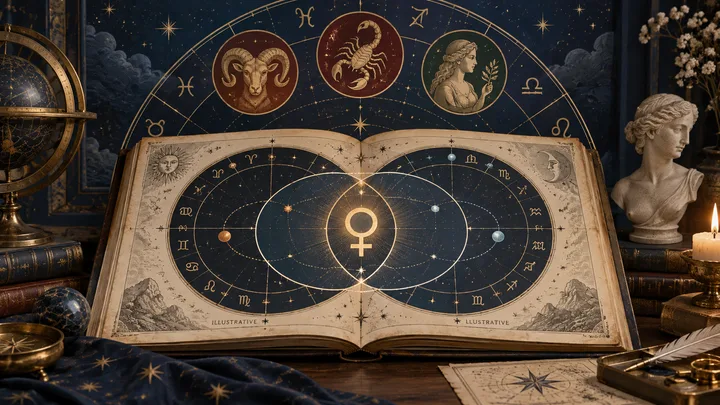
Imagine a Venus placement that looks worse than it feels
Imagine Maria and Leo have been seeing each other for three months. Maria's Venus is in Virgo. Leo's Venus is in Pisces. Maria notices every detail. She remembers Leo's coffee order, edits the message before sending it, and asks whether his week has left room for dinner. Leo calls her careful. On a tense evening, he calls her critical. Both descriptions contain a piece of the picture, but neither is the whole picture.
The traditional label gives you a reason to look closer. Venus in Virgo is in fall because Virgo stands opposite Pisces, the sign of Venus's exaltation. Venus in Aries and Scorpio is in detriment because those signs oppose Venus's domiciles, Taurus and Libra. The old vocabulary describes a planet operating away from its easiest territory. It doesn't stamp a person with a permanent flaw. It describes the conditions around one function of the chart.
That difference matters in synastry. You're not asking, 'Is Maria good at relationships?' You're asking, 'How does Maria's Venus seek harmony, and what happens when Leo's planet touches that style?' Venus still signifies affection, attraction, pleasure, taste, agreement, and values. The sign shows the manner. The condition shows how naturally that manner may come forward. The aspects show what activates it.
Maria's Venus may express love through useful attention. She might want proof that care works in daily life. Leo's Pisces Venus may want softness, trust, and room for feeling. Their difference can become a complaint about fussiness versus vagueness. It can also become a gift: Maria gives shape to Leo's wishes, while Leo reminds Maria that affection doesn't have to pass an inspection before it can be enjoyed.
The first reading is therefore neither 'easy' nor 'bad.' It's specific. A Venus in a traditional debility can make the Venus story more conscious. It may show a person learning how to receive pleasure, state preferences, or make peace without abandoning self-respect. In a relationship, that learning becomes visible when the other person's planets ask Venus to respond.
This article uses the sign placement as supplied, with optional degrees for major synastry aspects. It doesn't calculate a natal chart from birth details. That boundary keeps the question clean. If you know only that Venus is in Virgo, you can discuss the Venus condition. If you also know both Venus degrees, you can test whether the two Venuses form a close conjunction, opposition, trine, square, or sextile. If you don't know the degrees, keep the aspect claim open.
Sources: Understanding Ptolemy's Table of Essential Dignities; Understanding Planetary Dignity and Debility: Essential Debilities
What detriment and fall mean before you compare two charts
Essential dignity asks whether a planet is at home in the sign it occupies. Venus rules Taurus and Libra. She is exalted in Pisces. The signs opposite those positions are Aries and Scorpio for detriment, and Virgo for fall. That is the traditional map. It is not a ranking of people's worth, and it is not a promise that one sign loves more than another.
Detriment describes a planet in the sign opposite one of its domiciles. In Aries, Venus is opposite Libra. In Scorpio, Venus is opposite Taurus. Aries moves by direct assertion, while Venus seeks agreement and reciprocity. Scorpio presses toward depth, loyalty, and emotional truth, while Venus's Taurus side prefers steady pleasure and its Libra side prefers balance and exchange. The planet can still act. It simply has to negotiate with a sign whose priorities don't naturally give Venus the room it wants.
Fall describes a planet in the sign opposite its exaltation. Venus in Virgo sits opposite Pisces. Pisces gives Venus breadth, surrender, imagination, and compassion. Virgo sorts, measures, edits, and improves. Venus in Virgo may show love through discernment and service, yet it can doubt whether pleasure is deserved or whether affection is being done correctly. That doubt is a possible expression, not a compulsory one.
A dignity is also only one layer. Traditional astrology distinguishes essential condition from other factors, including the planet's house, sect, phase, rulers, and aspects. In this report's narrower comparison, you may have only Moon, Venus, and Mars signs, plus some degrees. So you can make a useful reading, but you shouldn't pretend the supplied placements answer every natal question.
The practical translation is simple. Detriment or fall changes the starting weight you give Venus. It asks you to expect a more particular route to affection. It doesn't erase Venus's ability to bond. A person with Venus in Aries may love boldly and dislike indirect courtship. Venus in Scorpio may offer fierce loyalty and need emotional honesty. Venus in Virgo may be attentive, exacting, and generous with practical help. The condition describes friction around Venus's natural job. It does not cancel the job.
This is why the word 'weak' can mislead. A Venus in fall may be less comfortable with effortless charm, but discomfort can produce skill. A Venus in detriment may not default to compromise, but it may know exactly when a compromise would betray desire. Read the placement as a style under pressure. Then look for the rest of the chart to tell you whether that pressure becomes craft, defensiveness, or both.
Imagine Maria has Venus in Virgo and Leo has Venus in Pisces. The first placement doesn't prove that Maria is cold, difficult, or unable to love. It tells you to read Venus with care. In traditional astrology, Venus in Aries and Scorpio is in detriment, while Venus in Virgo is in fall. Those conditions describe a Venus that may need to work harder to express affection, pleasure, agreement, and values in its usual manner. In synastry, the condition adds a natal layer. It can show where a person's way of loving feels less settled, more defended, more selective, or more dependent on context. Then you test that layer against the two charts' actual Venus, Moon, and Mars contacts. A close aspect can make the theme vivid. A supportive dispositor or strong Venus can change its tone. What this placement cannot prove is just as important: it cannot certify rejection, incompatibility, bad character, or a doomed relationship. Use it to ask better questions, then compare behavior with the chart pattern.
Sources: Understanding Ptolemy's Table of Essential Dignities; Understanding Planetary Dignity and Debility: Essential Debilities
What this condition adds to a synastry reading
Synastry compares the relationship between two charts. It doesn't replace either natal chart. When one person's Venus is in detriment or fall, the placement adds a question about how that person gives and receives Venusian experiences. Does affection feel safest when it is direct? Does desire need privacy and depth? Does love become easier to trust when it takes a practical form? Those questions are more useful than a label such as 'bad Venus.'
The condition can add three kinds of information. First, it can describe the person's preferred route into closeness. Venus in Aries may move first and ask questions later. Venus in Scorpio may test the bond for honesty before relaxing into it. Venus in Virgo may notice what needs care and offer help before offering a grand declaration. These are sign-based tendencies. The condition tells you that Venus may not express its values through the smoothest version of its usual social script.
Second, it can explain why a partner's Venus, Moon, or Mars contact feels loaded. Suppose one person has Venus in Virgo and the other has Mars in Pisces at a close opposition. The contact can create attraction and irritation at once. Mars in Pisces may pursue through mood, imagination, or indirect signals. Venus in Virgo may want clear evidence and a workable plan. The Venus condition adds sensitivity around uncertainty. It doesn't decide whether the pair can meet each other.
Third, it can show where a partner's planet supplies a missing language. A partner with Venus in Taurus may steady Venus in Scorpio through loyalty and consistency. A partner's Mercury in Virgo may understand Venus in Virgo's detailed care instead of treating it as criticism. A partner's Mars in Aries may energize Venus in Aries, while also making the relationship too fast if neither person pauses. The same contact can support or strain the placement depending on how the planets function in their own charts.
The most honest synthesis ranks the layers. Start with each person's Venus sign and condition. Check whether the other person's Moon, Venus, or Mars makes a close major aspect to it. Then compare the contact with the rest of the available pattern. A Venus condition is a modifier. A tight Venus-Moon conjunction may speak more loudly about felt affection than the bare sign condition. A loose sign-based resemblance may be pleasant, but it isn't the same as a calculated aspect.
This approach also protects both people from caricature. It lets you say, 'This Venus may need clarity before it can relax,' rather than, 'This person is impossible.' It lets you say, 'This contact may awaken a guarded form of desire,' rather than, 'The relationship is toxic.' Astrology becomes more precise when it describes a mechanism and the choice that follows from it.
Sources: Understanding Planetary Dignity and Debility: Essential Debilities; Venus in Astrology: Meaning and Significations
How Venus in Aries can behave when another chart touches it
Venus in Aries is in detriment because Aries opposes Libra, one of Venus's homes. The contrast is clear. Libra weighs the other person's position and seeks a shared rhythm. Aries acts from a direct, individual impulse. Venus in Aries may therefore show affection through initiative, candor, pursuit, and a strong sense of personal taste. It may not enjoy waiting for a perfect mutual mood.
In synastry, a partner's Venus can either appreciate that frankness or experience it as impatience. A close Venus-Moon contact may help the Aries Venus feel welcomed, because the other person's Moon responds to its warmth. A Venus-Saturn contact may add steadiness, but it can also make the Venus person feel judged if the relationship turns every act of desire into a test. A Venus-Mars contact can be lively and physical. It can also turn attraction into a contest when neither person yields the lead.
Consider an example. Maria has Venus at 14 degrees Aries. Leo has Mars at 10 degrees Cancer. Their planets form a square within four degrees. Maria wants clean movement. She'd rather say, 'I like you. Let's meet Friday,' than decode a week of hints. Leo's Mars in Cancer may act protectively, cautiously, or through changing moods. His hesitation can make Maria push harder. Her pressure can make him retreat into his shell. The aspect describes the heat and the mismatch. It doesn't tell you which person is right.
Now change one piece. Leo also has Moon at 16 degrees Sagittarius, trine Maria's Venus by two degrees. The Venus-Moon contact gives the bond a friendly emotional welcome. Maria's directness may feel exciting rather than aggressive. The Mars square still needs handling, but it no longer carries the whole interpretation. This is why the condition must stay in proportion to the pattern.
The useful question for Venus in Aries is, 'Can direct desire remain considerate?' Ask whether each person can name a want without turning it into a demand, and whether a pause feels like rejection or simply timing. If the answer is workable, the detriment may describe a relationship style that is brave, clear, and refreshing. If the answer is no, the same style may keep creating collisions.
Don't read Venus in Aries as a failed Libra. Read it as Venus learning to love without losing the self. A synastry contact can show who encourages that lesson, who resists it, and where both partners need a better rhythm.
Sources: Understanding Ptolemy's Table of Essential Dignities; Venus in Astrology: Meaning and Significations
How Venus in Scorpio can deepen the bond and raise the stakes
Venus in Scorpio is in detriment because Scorpio opposes Taurus, Venus's other domicile. Taurus seeks continuity through touch, trust, resources, and repeated pleasures. Scorpio seeks emotional depth, intensity, privacy, and transformation. Venus in Scorpio may not be satisfied by a pleasant connection that stays on the surface. It wants to know what the bond means when the easy mood disappears.
That desire can bring remarkable loyalty. It can also make uncertainty feel unbearable. In synastry, the partner's Moon may soothe Venus in Scorpio when it responds with emotional honesty. The partner's Mars may create strong desire, but it can also provoke territorial behavior or a struggle over control. A supportive Venus-Jupiter contact can give the relationship generosity and pleasure. A hard Venus-Pluto contact may intensify the bond, but intensity isn't the same as safety.
Imagine Maria has Venus at 22 degrees Scorpio and Leo has Moon at 25 degrees Taurus. Their opposition falls within three degrees. Maria wants emotional truth. Leo's Moon wants calm, reliability, and familiar comfort. At first, Leo's steadiness may help Maria trust the relationship. Maria's depth may help Leo speak about feelings he usually leaves unnamed. Under stress, though, Maria may read Leo's silence as concealment, while Leo may read her questions as an attempt to disturb peace.
The aspect doesn't prove manipulation or infidelity. It shows a strong pull across two Venus-Taurus and Venus-Scorpio needs: security and depth. The decision is behavioral. Can Leo answer directly? Can Maria ask without setting a trap? Can both people agree on what privacy means? If they can, the opposition becomes a live exchange. If they can't, the same contact can keep turning reassurance into interrogation.
A second chart factor can shift the tone. If Maria's Venus also receives a close trine from Leo's Jupiter, affection may have more room to forgive and grow. If her Venus receives a close square from his Saturn, the bond may feel consequential but heavy. No single aspect wipes out the others. Rank the tightest and most relevant contacts, then ask what the pair actually does with them.
Venus in Scorpio adds a valuable instruction to synastry: don't confuse emotional volume with emotional proof. Look for consistency. Look for repair after conflict. Look for the freedom to say what is true without punishment. When those qualities exist, Scorpio's Venus can love with courage and staying power.
Sources: Understanding Ptolemy's Table of Essential Dignities; Understanding Planetary Dignity and Debility: Essential Debilities; Venus in Astrology: Meaning and Significations
How Venus in Virgo can turn care into both craft and criticism
Venus in Virgo is in fall because Virgo opposes Pisces, Venus's exaltation. Pisces gives Venus an expansive, receptive, imaginative field. Virgo breaks experience into useful parts. It checks the detail. It asks what can be repaired. Venus in Virgo may therefore express affection through reliability, skill, modesty, and attention to the small things that let a relationship function.
That is not lovelessness. It is a different love language. The trouble begins when discernment loses its warmth. A Venus in Virgo person may notice the missed call, the uneven chore, or the careless word before noticing the effort that came with it. They may offer an improvement when the partner wanted appreciation. The condition can describe a Venus that needs to learn that a relationship isn't a project whose flaws must be removed before pleasure can begin.
Consider an example. Maria has Venus at 8 degrees Virgo. Leo has Mars at 12 degrees Gemini. Their square is four degrees wide. Maria shows interest by making plans that account for both schedules. Leo pursues through messages, jokes, and quick changes of direction. Maria calls him inconsistent. Leo calls her hard to please. The Venus-Mars square gives the contact friction and attraction, while Venus in fall helps explain why Maria may treat practical inconsistency as a threat to affection itself.
Now give Maria a close trine from Leo's Moon at 6 degrees Capricorn. The earth-sign link can make her care legible to him. He may understand that her questions are attempts to build trust, not evidence that she wants control. The Mars square still asks for a different pace, but the Moon contact gives the Venus layer a place to land.
The strongest exception is a Venus in Virgo that has substantial support elsewhere. A well-placed dispositor, a close benefic contact, or a Venus-Moon connection can help this Venus use its eye for detail as a form of devotion. Conversely, a chart with repeated hard contacts can make the same placement more guarded. The sign condition starts the inquiry. The full pattern gives it texture.
For Venus in Virgo, ask one clean question: 'When I point out what needs attention, does my partner feel more cared for or less loved?' Then ask the partner what kind of care actually reaches them. The fall doesn't prove criticism. It points to a place where love may become more skillful when the person stops demanding perfection from it.
Sources: Understanding Ptolemy's Table of Essential Dignities; Understanding Planetary Dignity and Debility: Essential Debilities; Venus in Astrology: Meaning and Significations
How to rank the condition against degrees and major aspects
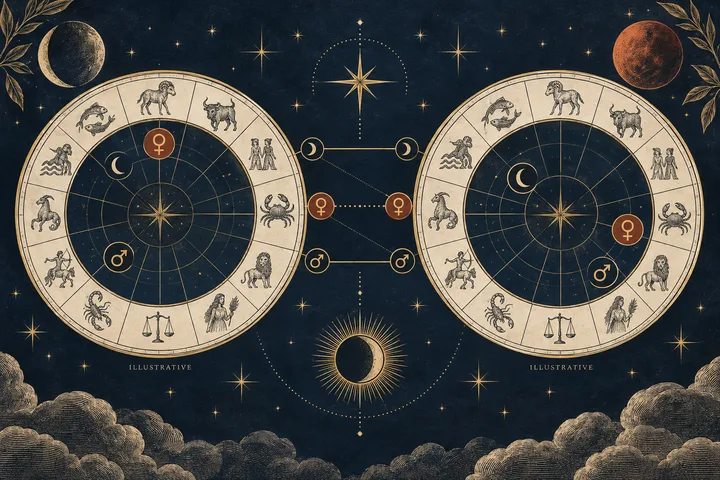
A sign condition is broad. An aspect is a measured relationship between two chart positions. If you have degrees, calculate the angular distance between the planets and name the aspect only when it falls within the stated orb. This report uses a six-degree orb for selected major aspects. That policy gives the reading a repeatable boundary. It also keeps a sign resemblance from masquerading as a degree-based contact.
Start with exactness. A Venus contact within one or two degrees usually deserves more attention than the same aspect at six degrees. Then consider the planets. A Venus-Moon contact speaks to affection and emotional reception. Venus-Mars speaks to desire, pursuit, and response. Venus-Saturn can describe durability, restraint, duty, or fear. Venus-Jupiter can enlarge pleasure and goodwill. The aspect's nature and the planets' jobs matter together.
Next, ask whether the contact repeats a natal theme. If Venus in Virgo already struggles with feeling appreciated, a partner's Saturn square may make that issue more visible. If Venus in Scorpio already needs emotional honesty, a partner's Moon opposition may bring the need into daily conversation. Repetition raises priority. It still doesn't turn a symbol into a sentence about inevitable behavior.
Then check mutuality. Synastry has two planet-person roles. One person's Venus may respond to the other's Mars, while the other's Venus responds to the first person's Moon. Don't reduce the relationship to one person carrying the whole meaning. Describe who brings which function and how the exchange might feel from each side.
Finally, separate calculated and inferred statements. If the supplied data says Venus is in Virgo but gives no degree, you can interpret the sign condition. You cannot claim a Venus-Saturn square. If the degree is listed but the other planet's degree is missing, you can describe the known placement and state that the aspect remains unconfirmed. Precision increases trust.
A useful ranking looks like this: first, close and relevant major contacts; second, repeated themes across Moon, Venus, and Mars; third, the natal condition of the planet; fourth, sign-element or modality echoes; fifth, broad symbolism that has no degree support. This isn't a mechanical score. It's a reading order. It tells you what deserves the strongest language and what should remain a possibility.
The Venus condition never wins by default. A close aspect can activate it. A supportive pattern can refine it. Missing degrees can limit what you say. The chart becomes clearer when your confidence matches the input.
Use the ranking as a decision guide, not a scoring contest. If the strongest contact is Venus-Moon, ask how affection is received: does practical care land as warmth, or does it feel like management? If it is Venus-Mars, ask how desire handles pace and refusal: can initiative stay mutual? If it is Venus-Saturn or Venus-Pluto, ask what happens after pressure rises: do both people become more honest and responsible, or does one person start controlling the terms?
Then compare the answer with the natal condition. Venus in Virgo may need care to be visible in daily life. Venus in Scorpio may need emotional truth before it trusts. Venus in Aries may need direct movement rather than prolonged ambiguity. Those needs aren't instructions for the partner to obey. They're clues about where each person may feel exposed.
A partner's planet can make a Venus function easier to express, but it can't do the work for the Venus person. The Moon may receive affection. Mars may awaken desire. Saturn may give form. None of them rescues a placement or guarantees a result. The useful question is, 'What contact opens the door, and what behavior proves that the door stays open?'
Sources: Understanding Planetary Dignity and Debility: Essential Debilities; Venus in Astrology: Meaning and Significations; Aspects, Astrodienst
What the placement cannot prove about attraction or commitment
Venus in detriment or fall cannot prove that someone is unattractive, unfaithful, selfish, emotionally unavailable, or doomed in love. It cannot prove that a partner will leave. It cannot certify a soulmate bond either. Those claims ask the placement to carry more than it can carry.
It also cannot prove a compatibility verdict. The word 'compatible' hides several questions. Do you enjoy one another? Can you repair conflict? Do your values fit around money, exclusivity, family, and time? Can desire stay respectful? A Venus condition may illuminate one part of those questions, especially affection and value exchange. It doesn't answer the whole relationship by itself.
Nor can it prove intention. If a person with Venus in Scorpio goes quiet, the chart can't tell you whether they need privacy, feel hurt, are overwhelmed, or have chosen not to continue. You need the person's words and consistent actions. Astrology can help you frame the conversation. It can't replace the conversation.
It can't prove that a close aspect will manifest in one fixed way. A Venus-Saturn contact may feel serious, protective, restrained, or burdensome. A Venus-Pluto contact may bring depth, magnetism, fear, or renewal. The natal charts, the exact degrees, the wider pattern, and the stage of the relationship all matter. The aspect gives a range of expression. It doesn't remove choice.
Be especially careful with missing information. A sign-only comparison doesn't calculate houses. It doesn't establish an Ascendant. It doesn't confirm an exact Moon position when the degree is unknown. It doesn't justify a precise aspect claim. State what you have. State what you can infer. Leave the rest unclaimed.
This limit makes the reading stronger, not smaller. A precise answer can say, 'Venus in Virgo may seek proof through care, and a close Moon contact may help that care feel received.' It should stop there until the chart or the relationship supplies more. Strong astrology names the symbol. Wise astrology knows where the symbol ends.
If you're trying to decide whether to invest, watch the practical evidence. Does the person make room for you? Do they answer direct questions? Do they respect your no? Do they repair what they damage? Let the chart show you which conversations may matter. Let the person's choices show you what the relationship can hold.
Sources: Understanding Planetary Dignity and Debility: Essential Debilities; Venus in Astrology: Meaning and Significations; Aspects, Astrodienst
A comparison guide for Aries, Scorpio, and Virgo Venus
The three placements share a traditional condition, but they don't share the same problem. Venus in Aries strains against Libra's emphasis on mutual adjustment. Venus in Scorpio strains against Taurus's steady, uncomplicated pleasure. Venus in Virgo strains against Pisces's expansive, receptive affection. Read the sign-specific tension before you apply the general label.
Venus in Aries often asks for directness. It may need a partner who can say yes, no, or not yet without hiding behind mixed signals. Its growth edge is consideration without self-erasure. In synastry, prioritize whether the other person's Moon or Mercury can receive candor, and whether Mars contacts create play or constant contest.
Venus in Scorpio often asks for honesty. It may need emotional depth and a clear sense of loyalty before it can fully relax. Its growth edge is trust without surveillance. In synastry, prioritize whether Moon contacts create safety, whether Saturn adds commitment or fear, and whether the relationship has room for privacy that isn't secrecy.
Venus in Virgo often asks for reliability. It may need care that appears in schedules, details, and follow-through. Its growth edge is discernment without contempt. In synastry, prioritize whether Moon or Mercury contacts make practical care understandable, and whether Mars contacts turn effort into attraction or into a running evaluation.
Here is the comparison in plain language. Aries Venus may say, 'Show me by being clear.' Scorpio Venus may say, 'Show me by being honest when it's hard.' Virgo Venus may say, 'Show me by doing what you said you'd do.' Each request can be reasonable. Each can also become a defense if it is used to avoid receiving love in a different form.
For the partner, this guide offers a better response than a diagnosis. With Venus in Aries, answer the question directly. With Venus in Scorpio, don't use vagueness as reassurance. With Venus in Virgo, name the care you see before discussing what needs changing. These aren't rules for every person. They're practical experiments suggested by the Venus symbolism.
The comparison also shows why the label alone is too blunt. Three Venuses can be in detriment or fall and still create very different bonds. Their aspects, rulers, degrees, Moon needs, Mars rhythm, and lived choices decide the texture.
Use the placement as a question generator. Begin with the person's Venus sign. Name the traditional condition and the Venus function it makes more deliberate. Then bring in the other chart. Which personal planet touches Venus? How close is the aspect? Does another contact support, repeat, or complicate the same theme? This sequence keeps the reading moving from symbol to exchange to choice.
A compact report might say: 'Your Venus in Virgo suggests that you show affection through careful attention and practical follow-through. Because Venus is in fall here, you may be especially alert to whether love is working in daily life. Your partner's Moon at 6 degrees Capricorn forms a close trine to your Venus at 8 degrees Virgo, so their emotional style may recognize and steady that care. Their Mars at 12 degrees Gemini forms a wider square within the six-degree policy, adding attraction and friction around pace. Ask for appreciation before offering another correction.'
Notice what the report does not say. It doesn't call the Venus person cold. It doesn't assign a compatibility percentage. It doesn't claim the Moon contact guarantees security. It gives a supported interpretation, names the strongest tension, and offers a conversation that can test the reading.
If you have only signs, stay at the sign layer. You can compare element and modality, discuss Venus's condition, and identify likely differences in affection and values. You should not present an aspect as calculated. If you have degrees for Venus and the relevant partner planet, the six-degree orb allows a more precise comparison. If a degree is missing, label the contact unknown rather than filling the gap with confidence.
This is where a synastry report earns its place. It can organize supplied Moon, Venus, and Mars signs, test selected major aspects from optional degrees, and keep the interpretation's scope visible. It doesn't calculate natal positions from birth details, houses, or a whole chart the reader hasn't supplied. The tool helps you compare what you know. It doesn't invent what you don't.
The goal isn't to make the chart pronounce a sentence. The goal is to make the relationship easier to read.
Sources: Understanding Ptolemy's Table of Essential Dignities; Understanding Planetary Dignity and Debility: Essential Debilities; Venus in Astrology: Meaning and Significations
The decision point: what should you look for next?
Return to Maria and Leo. Maria's Venus in Virgo helped explain why follow-through mattered so much to her. Leo's Venus in Pisces helped explain why rigid proof made him retreat. Their chart comparison became useful when it stopped asking which person was defective and started asking what each person needed to recognize as love.
That is the governing judgment for Venus in detriment or fall in synastry: the condition is a meaningful modifier, not a relationship verdict. It adds a likely pressure point around how Venus gives, receives, values, and relaxes. Close aspects show where the pressure becomes relational. Supportive contacts show possible ease. Hard contacts show work. None of them removes agency.
Take three steps. First, write down each person's Venus sign and, if known, degree. Second, list close major contacts to Moon, Venus, and Mars using one consistent six-degree orb. Rank the tightest contacts before the sign condition. Third, turn the leading pattern into one observable question. 'What does reassurance look like for you?' 'How should we handle directness?' 'When does helpful feedback stop feeling loving?'
Then watch the answer in action. A chart may suggest that Venus in Scorpio needs honesty, but the decision turns on whether honesty is practiced. Venus in Virgo may value follow-through, but the decision turns on whether both people can give and receive care without constant correction. Venus in Aries may need clarity, but the decision turns on whether directness leaves room for consent and timing.
If the pattern feels warm and workable, let the chart describe what you're already building. If it feels difficult, use it to name the work without dramatizing it. If the relationship keeps violating your needs, don't let an attractive aspect talk you out of what you can see. Astrology can give language to a bond. It shouldn't ask you to ignore its lived terms.
You don't need Venus to be in a so-called easy sign for love to be real. You need a way for love to become legible, mutual, and chosen. Compare the placements. Ask the question. Look at the answer.
Sources: Understanding Planetary Dignity and Debility: Essential Debilities; Venus in Astrology: Meaning and Significations
A little more clarity
Is Venus in detriment or fall automatically bad in synastry?
No. It describes a Venus that may express affection, pleasure, or values less effortlessly in its sign. Venus in Aries, Scorpio, or Virgo can still love with courage, depth, care, and skill. In synastry, read the condition with the actual Moon, Venus, and Mars contacts, their degrees, and the relationship's observable behavior.
Which signs put Venus in detriment or fall?
Venus is traditionally in detriment in Aries and Scorpio, the signs opposite Venus's domiciles in Libra and Taurus. Venus is in fall in Virgo, opposite its exaltation in Pisces. These are essential dignity terms. They describe the planet's relationship with its sign, not a fixed judgment about the person.
Can Venus in Virgo prove that someone is critical or difficult to love?
It can't. Venus in Virgo may notice details and show care through practical help, but that expression can become thoughtful craft rather than criticism. Other chart factors and lived habits matter. In synastry, ask whether the partner recognizes that care and whether both people can discuss improvements without turning affection into an inspection.
Do I need degrees to interpret Venus in detriment or fall in synastry?
No for the sign-based layer, yes for a precise degree-based aspect claim. With Venus signs alone, you can discuss the condition and compare styles of affection. With optional degrees, a report can test selected major aspects using a stated six-degree orb. Missing degrees mean the contact should remain unconfirmed.
Sources & further reading
- Understanding Ptolemy's Table of Essential Dignities
Supports the traditional table and definitions placing Venus in detriment in Aries and Scorpio and describing fall as opposition to exaltation.
- Understanding Planetary Dignity and Debility: Essential Debilities
Supports the distinction between detriment and fall, and the way other chart factors can modify a planet's condition.
- Venus in Astrology: Meaning and Significations
Supports Venus as a significator of love, pleasure, relationship, harmony, and the traditional Venus-Mars contrast.
- Aspects, Astrodienst
Records the consulted Astrodienst reference for aspect terminology and the need to state an aspect method clearly.
Synastry Comparison Report
Enter known placements for two people. Get an input-by-input comparison, selected aspect calculations and a clear record of what remains uncertain.
Compare our placements