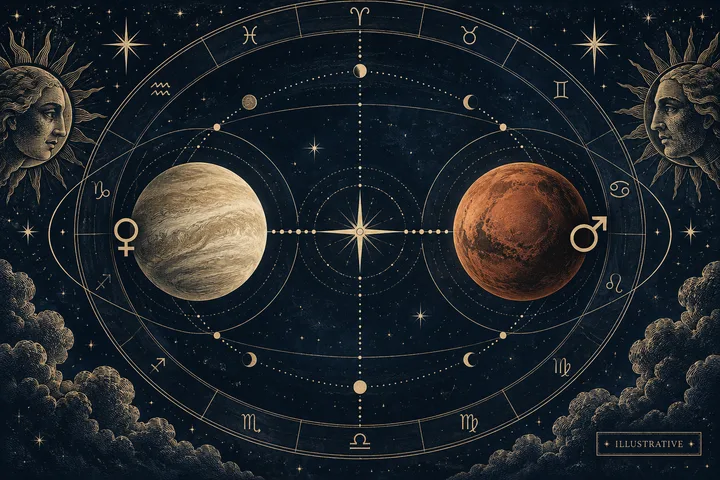
Can the report test both Venus–Mars directions?
Yes. If you supply comparable Venus and Mars positions, including degrees, for both charts, the Synastry Comparison Report can test each cross-chart direction for an opposition within its six-degree orb. It can compare person A’s Venus with person B’s Mars, then person B’s Venus with person A’s Mars. Those are two separate geometric checks: a passing result in one row does not establish that the other row passes too. The report uses the placements you provide; it does not calculate natal positions from birth details. A result classifies the entered positions under this stated rule. It does not tell you what either person feels or decide what the relationship means. If a degree is unverified or the positions use mismatched conventions, the report can still compare the entries as given, but the arithmetic cannot repair those inputs. To make the comparison interpretable, keep the owner attached to every entry: A Venus, B Mars, B Venus, A Mars. Each row pairs one Venus with the other chart’s Mars; it is not a comparison between the two Venuses or between the two Mars positions. The answer therefore depends on four supplied positions, and each direction can have its own separation and orb. A degree value without its sign is not enough to locate a position on the zodiac, just as a sign label without its degree cannot settle whether the separation is close enough under this rule.
Yes. With comparable sign-and-degree positions for both charts, the Synastry Comparison Report can check A’s Venus against B’s Mars and B’s Venus against A’s Mars separately. Each check converts the positions to a shared zodiac circle, measures the shorter angular separation, and compares its distance from 180° with the report’s six-degree orb. Opposite-sign labels alone don’t establish that the degree-based check passes. The report compares the values supplied; it doesn’t calculate natal positions from birth details or verify their source. A qualifying contact is a geometric result under this method. Its astrological meaning calls for interpretation and doesn’t establish mutual attraction or relationship success.
Sources: Synastry Comparison Report
How do sign degrees become a circular separation?
A sign-relative degree tells you how far a position lies into one 30-degree sign segment. To compare two positions, first express each on the same 360-degree circle: add the sign’s starting longitude to its degree within that sign. The University of Texas at Austin’s “Signs of the Zodiac” describes Aries as the segment beginning at 0° and Libra as the segment beginning at 180°, with each sign occupying 30°. Thus Aries 2° becomes 2° of longitude, while Libra 28° becomes 208°. This shared coordinate is useful because subtracting the printed degrees alone ignores where each sign sits on the circle.
Find the smaller angle between the longitudes: take their absolute difference, and if it exceeds 180°, subtract it from 360°. The Swiss Ephemeris Programmer’s Manual documents longitude normalization to 0°–360° and normalized angular differences; it is a reference for this geometry, not evidence that the report uses that software. An opposition is exact at 180°, so the orb is the separation’s distance from 180°; this report allows up to 6°. In compact form: longitude = sign start + within-sign degree; separation = the smaller of the absolute longitude difference and 360° minus that difference; opposition orb = |separation − 180°|. Normalizing matters across the 0°/360° boundary, where the direct numerical difference is large although the points are close by the shorter route.
For the first constructed illustration, Aries 2° and Libra 28° become longitudes 2° and 208°. Their difference is 206°, so the shorter separation is 360° − 206° = 154° and the opposition orb is |180° − 154°| = 26°, outside the report’s six-degree rule. Opposite-sign labels identify an opposition axis at sign level, but these degrees are not close to exact opposition. Using 206° as the aspect distance would take the longer route and give the wrong orb; the shorter arc yields a separation 26° short of 180°. Showing the conversion makes the result checkable without relying on sign names alone.
The second constructed illustration uses Aries 20° and Libra 10°, or longitudes 20° and 190°. Their 170° separation gives an orb of |180° − 170°| = 10°, also outside six degrees. These are arithmetic examples, not real charts. They show that opposite signs can describe a sign-level relationship without proving a degree-qualified opposition. Here 170° is already the shorter separation, so no 360° adjustment is needed. Both Aries–Libra examples fail the threshold, at different orb sizes. The calculation keeps three ideas distinct: signs give a broad relationship, longitudes locate positions on the circle, and the orb measures distance from the exact aspect. A sign-pair description remains useful, but these results should not be called degree-confirmed oppositions.
Sources: Signs of the Zodiac; Swiss Ephemeris Programmer's Manual
Why check Venus-to-Mars and Mars-to-Venus separately?
Yes. A passing Venus–Mars comparison in one direction does not establish a passing contact in the reverse direction. Keep the chart owner attached to each planet, then make one row for A’s Venus against B’s Mars and another for B’s Venus against A’s Mars. The ICRS paper, “Introduction to Relationship Astrology 2: Synastry,” instructs readers to keep each person’s chart factors distinct in a synastry grid and record the positions before comparing them. That owner-sensitive layout makes the two questions visible instead of hiding them inside the broad phrase “Venus–Mars contact.”
Use the same fields in both rows: Venus owner and supplied position; Mars owner and supplied position; calculated separation; opposition orb; and whether that row meets the chosen allowance. The rows are structurally parallel, but their values are not interchangeable. A’s Venus has its own sign and degree, as does B’s Venus; the same is true of each Mars. So the A-Venus/B-Mars separation can differ from the B-Venus/A-Mars separation. This is a consequence of comparing four independently supplied positions, not a claim that people experience a contact in a particular way.
An abstract worksheet can look like this, with the entries left blank until positions are supplied: | Direction | Venus position | Mars position | Separation | Orb from 180° | Result under rule | | --- | --- | --- | --- | --- | --- | | A Venus → B Mars | A Venus: ___ | B Mars: ___ | ___ | ___ | pass / no pass | | B Venus → A Mars | B Venus: ___ | A Mars: ___ | ___ | ___ | pass / no pass | If only the first row passes, report one qualifying direction. If both pass, report two qualifying directions, each with its own separation and orb. If neither passes, neither direction qualifies under that rule. These are distinct reporting outcomes; “mutual” should be reserved for two passing rows, not used as a casual synonym for finding either cross-chart contact. Some astrologers use “Venus–Mars contact” generically for either pairing. That shorthand can describe the topic, but it does not add a second calculated result. Labeling the owner and direction prevents a reader from mistaking a single row for a pair of results.
The practical convention is simple: preserve the owner, planet, supplied value, separation and orb in every record. The report or a reader can then see exactly which pairing was checked and reproduce the classification from the entered values. A result in one row answers only that row’s question. It says nothing about whether the reverse row also meets the threshold, and it does not turn the geometric comparison into a conclusion about either person’s feelings.
Why can a six-degree report differ from another astrologer's result?
Six degrees is the Synastry Comparison Report’s stated allowance for this opposition check, not a universal opposition orb. “Introduction to Relationship Astrology 2: Synastry,” the ICRS paper named in the plan, recommends a five-degree allowance for synastry oppositions. These are two declared methods. They set different boundaries for classifying the same measured distance from exact opposition; neither boundary, by itself, measures how compelling, difficult or important a relationship is.
An orb is the allowed distance between an aspect’s measured separation and its exact angle. For an opposition, exactness is 180°, and the orb is the gap from that point. Under the report rule, a gap of six degrees or less passes. Under the ICRS recommendation, a gap of five degrees or less passes. The value is therefore a cutoff used by a method, not an intensity score: a smaller orb is closer to exact by arithmetic, but this comparison alone does not establish that the contact feels stronger or matters more in a relationship.
The boundary difference is easiest to see near the cutoff. A hypothetical opposition 5°30′ from exact passes the report’s six-degree rule, while it falls outside the ICRS paper’s five-degree recommendation. At 5° from exact, it passes both stated rules; beyond 6°, it passes neither. These examples compare classifications only. They do not describe actual charts or rank the relationship evidence. The same entered positions can therefore receive different labels when readers apply different orb conventions, even though their underlying separation has not changed.
A reader who prefers a narrower allowance can reasonably use one, provided the convention is named and applied consistently. Astrologers vary their orb choices by aspect and chart context, so the ICRS recommendation is a specific alternative, not a universal correction to the report. A useful comparison records the method beside the result: “passes the report’s six-degree rule” or “falls outside the ICRS paper’s five-degree recommendation.” That wording tells the reader what was tested without implying that one label is inherently more favorable or more meaningful.
For a result near a boundary, retain the measured orb and the rule used instead of reducing the finding to a bare yes or no. The threshold comparison can explain why another astrologer reaches a different classification; it cannot settle which interpretive convention the reader should prefer. The report’s answer is conditional on its own published rule, while a narrower practice will classify some near-boundary contacts differently. That difference concerns method. It is not evidence that one person feels more, that the contact is stronger in lived experience, or that the relationship has a particular outcome.
When comparing two written readings, check that both readers are discussing the same cross-chart direction and the same supplied positions before attributing the difference to orb choice. A different row or a changed input can change the measured geometry; a different cutoff can change only whether that geometry is classified as within the stated allowance. If the positions and direction match, noting the exact orb alongside each convention isolates the methodological difference cleanly. This also makes later discussion more useful: the reader can revisit the calculation or choose a narrower rule without mistaking a change in classification for a change in the chart itself. The ICRS paper’s five-degree recommendation gives one documented comparison point, while the report applies its own six-degree boundary. Neither choice supplies an additional fact about the people represented by the placements.
Sources: Synastry Comparison Report; Introduction to Relationship Astrology 2: Synastry
What input mismatch or rounding can change the degree check?
A correct calculation can still be uncertain when the positions going into it are not comparable or precise enough. Before treating a near-threshold result as settled, trace each value to its source chart and record the planet owner, sign, degree, coordinate convention if stated, displayed precision, and whether the source rounded the value. This is an editorial provenance check: the arithmetic can be repeated exactly from supplied values, but it cannot establish that those values describe comparable chart positions.
The Swiss Ephemeris Programmer’s Manual documents sign-degree formatting and options that affect rounding in displayed degree values. That establishes a technical point about representation: a displayed position may reflect a formatting choice. It does not show that the Synastry Comparison Report uses Swiss Ephemeris, nor that any particular entry is wrong. The practical concern follows from the report’s six-degree boundary. When the calculated orb is comfortably away from that boundary, modest display precision may not alter the pass/fail classification; when it is close, rounding or truncation could matter, so the displayed number alone may not settle the underlying position. No correction should be guessed without the source’s unrounded value or stated method.
Check consistency across the two chart sources as well. Confirm that both values identify the same kind of zodiac coordinate and that each value is attached to the intended planet and chart owner. If a source does not state its convention, or if the provenance of a displayed degree is unclear, mark the degree check unresolved as a verified chart fact. This does not mean the supplied entries cannot be compared: the report can still calculate from the values as entered. It means the result should be described as conditional on those entries, rather than as confirmation that the underlying charts were represented consistently.
A compact record keeps those two conclusions separate: source chart; owner and planet; sign and degree; stated coordinate convention; displayed precision; rounding or truncation status; then the calculated result under the named orb. If the record is incomplete, retain the entered-value comparison and identify what is unknown. Seek a more precise, compatible source before resolving a borderline classification. This preserves a reproducible calculation without converting uncertain inputs into false certainty.
The distinction is useful when comparing exported charts, typed notes, or values copied from different references. Preserve the original notation before converting or reformatting it, and do not silently harmonize values whose conventions are unknown. If one source supplies a rounded sign-degree display and another gives greater precision, retain both the displayed entry and its provenance so a later reader can see what was actually compared. Where the source can provide more detail, update the input and repeat the same calculation; where it cannot, report the arithmetic as an entered-value result and leave verification open. This makes uncertainty specific: the operation may be reproducible even when the source positions are not independently confirmed.
Sources: Swiss Ephemeris Programmer's Manual
What does a qualifying Venus–Mars opposition mean within astrology?
Once the geometry qualifies, the next claim belongs to interpretation. In the astrological sources used here, Venus concerns attraction and relating, while Mars concerns desire and initiative. Reading an opposition between one person’s Venus and the other’s Mars as a polarity between these themes is an astrologer’s symbolic interpretation. It is not a calculation of either person’s feelings, and a passing orb does not turn symbolism into an observed event.
Synthesis Astrology’s “Venus-Mars Synastry: Attraction Aspects Explained” presents Venus–Mars contact as a possible attraction theme and places it within a wider synastry reading. Its attraction-forward emphasis supports one plausible reading: an astrologer might explore how differing ways of relating and initiating could create interest or energy between the chart factors. The words “might” and “could” matter. This is a lens for reflection on supplied placements, not a report that two particular people are attracted or that either will act on that attraction.
Cafe Astrology’s “Synastry” complicates that emphasis by describing possible friction in hard Venus–Mars aspects, including the opposition. In this reading, the same polarity can signify tension between how affection is expressed and how desire or action is pursued. Attraction and friction do not cancel each other as interpretations; they show why the aspect’s geometry cannot choose a single lived meaning. A symbolic contact may invite consideration of both ease and mismatch, while the actual relationship context determines which, if either, is recognizable to the people involved.
Consider a plainly hypothetical illustration, not a chart or a report about real people: an astrologer reviewing a qualifying opposition could ask whether one person’s way of showing interest meets the other’s way of taking initiative smoothly, or whether those styles pull in different directions. The question opens an interpretive possibility. It does not supply an answer about a couple, and it should not become a psychological diagnosis. Even a familiar description of attraction cannot establish that both people experience it equally; the ICRS paper, “Introduction to Relationship Astrology 2: Synastry,” explicitly cautions that a synastry contact need not be experienced equally by both people.
The strongest exception to an attraction-led reading is therefore built into the interpretive range: the opposition can be read through friction, and the symbolic pattern may not describe either person’s experience in a way they recognize. Neither Synthesis Astrology nor Cafe Astrology establishes outcomes or measures couples. Their accounts offer astrological interpretations with different emphasis. A careful reading names the geometry first, then identifies attraction or tension as a possible symbolic meaning, and leaves the personal claim open until it can be considered alongside the people’s actual experience. The contact can enrich a comparison; it cannot certify mutual desire, compatibility, or success.
The opposition contributes a particular symbolic shape to that reading: astrologers commonly examine the two ends of an axis as related themes that may need recognition or adjustment. Applied here, the Venus and Mars meanings can be considered in relation across the two charts, rather than collapsed into a single trait assigned to either person. That is an interpretive framework, not a claim that the pair is necessarily polarized in daily life. The sources provide descriptions of possible themes; they do not establish a fixed sequence in which attraction appears first and conflict follows, or show that every qualifying opposition expresses both poles.
This is also why a technically qualifying contact should be described with its direction attached. Saying whose Venus is being compared with whose Mars keeps the symbolic reading tied to the actual chart factors and avoids turning a general Venus–Mars description into a statement about both partners at once. If only one direction qualifies, the interpretation belongs to that one pairing; it does not imply a reciprocal experience. If both qualify, each can be considered on its own terms. In either case, the symbolic vocabulary helps frame questions for reflection, while the chart comparison itself does not answer those questions on behalf of the people involved.
Sources: Venus-Mars Synastry: Attraction Aspects Explained; Synastry
How much weight should this one contact receive in a comparison?
A qualifying opposition deserves a clear place in the comparison, but its pass under the report’s rule does not make it the dominant fact about a relationship. Treat the result as one defined chart contact. The first ranking is procedural: record which cross-chart direction passes and the exact orb attached to that direction. The ICRS paper, “Introduction to Relationship Astrology 2: Synastry,” recommends keeping each person’s chart factors distinct in a comparison grid. That practice keeps the result attached to the placements actually compared, rather than letting a broad label stand in for the specific contact.
Next, set that row beside the reverse direction and the other supplied placements. If only one direction passes, the comparison contains one qualifying Venus–Mars contact; if both pass, each row has its own result. If neither passes, the entered positions do not meet this report’s threshold. This ordering matters because a single contact can be easy to overstate when it is discussed apart from the rest of the supplied chart factors. The ICRS method’s grid gives a practical discipline: preserve who owns each factor, then read each contact in the context of the other recorded factors instead of multiplying one symbol into a complete relationship judgment.
An orb can rank geometric exactness within a stated method. A smaller distance from exact opposition is closer by arithmetic, so a reader can accurately say that one qualifying contact is tighter than another. That statement describes the measurement and nothing more. The ICRS paper’s advice to distinguish chart factors supports an organized comparison, but neither it nor the report’s cutoff establishes that a tighter contact has greater lived importance. That next step is interpretation, not a second mathematical result. Keep those claims separate in notes: “closer to exact” belongs beside the orb; “more important between these people” requires context the orb alone does not provide.
The interpretive sources already allow more than one way to consider a Venus–Mars opposition. Synthesis Astrology’s “Venus-Mars Synastry: Attraction Aspects Explained” places the contact among possible attraction themes within wider synastry, while Cafe Astrology’s “Synastry” includes possible friction in hard Venus–Mars aspects. Neither account supplies a scale for deciding how much this contact matters in a particular couple’s life. Its useful role is to suggest a symbolic question to consider alongside the other chart factors and what the people themselves recognize in their shared experience. A chart comparison can organize that reflection; it cannot replace the wider reading or lived context.
A reader may reasonably give greater weight to the wider chart, or prefer a different orb convention, when forming an astrological interpretation. The report answers the narrower question of whether supplied positions pass its declared rule. It does not settle the total synastry judgment, and the presence of one qualifying row should not be made to carry that larger decision. A balanced record therefore preserves the direction and exact orb, places the row among the other supplied factors, and leaves its personal significance open to interpretation in context. The strongest supported conclusion is bounded: this contact qualifies under this comparison method, while its relative importance remains a question for the fuller chart reading and the people’s experience.
That boundary also helps when the chart information is incomplete. If there are enough comparable degrees to classify a row, report its geometric result and retain its measured orb. If a necessary value is missing, the reader cannot rank the contact’s exactness against another degree-based result with confidence. A known sign pairing may still contribute to a sign-level comparison, but it cannot fill in an absent degree or establish a degree-qualified contact. Keeping those outputs distinct protects the wider reading from treating unknown information as a negative result or as hidden support for a preferred interpretation. The right weight depends first on what the supplied placements actually establish, then on how that defined contribution fits the wider comparison.
The report’s result is therefore best used as an input to interpretation, not a verdict that ends it. A tight orb can make the geometric match more exact under the chosen rule, and a broader chart view can give that match its proper setting. Readers who use another convention can name it and reach a different classification near a boundary without changing what the supplied positions are. What should remain stable is the distinction between a classified contact, its symbolic possibilities, and the judgment formed from the chart as a whole. Only the first of those is answered by whether this one row passes.
Sources: Introduction to Relationship Astrology 2: Synastry; Venus-Mars Synastry: Attraction Aspects Explained; Synastry
What can the report establish when degrees are missing?
When one or both degrees are unavailable, the answer divides into three outcomes: the degree check passes under the entered values; it fails under those values; or it remains unresolved because a necessary value is missing or cannot be compared on a compatible basis. “Unresolved” is not another way to say “fails.” It means the information does not support a degree-based classification yet. The report’s assigned method compares supplied placements and optional degrees, while its scope excludes calculating natal positions from birth details. It cannot supply an absent degree by inference from a sign label or a birth date.
If both degrees are available and comparable, the entered positions can be assessed under the report’s six-degree opposition rule. A pass means the measured opposition orb falls within that allowance; a failure means it falls outside it. Both labels describe the supplied values under this particular rule. They do not say whether the sign pairing remains meaningful in an astrological reading, and they do not turn the contact into a relationship verdict. This section’s practical distinction is narrower: a degree-based result is available only when the values needed for that comparison are present and suitable to compare.
If a degree is missing, retain what is known at sign level. The University of Texas at Austin astronomy text, “Signs of the Zodiac,” describes the signs as consecutive 30-degree segments, which supports locating a sign on the zodiac circle. In astrological interpretation, knowing two placements occupy opposite signs can support discussion of their sign-level relationship. But sign names alone do not determine the precise separation between two points inside those signs. They therefore cannot establish whether the positions fall within six degrees of exact opposition. Preserve the sign-level observation without upgrading it to a degree-confirmed aspect.
The same distinction applies when a value is present but its comparability is uncertain. If the entries do not clearly refer to compatible chart positions, the degree outcome should stay unresolved until the necessary information can be checked. Do not choose a likely degree, assume a missing value sits at a sign boundary, or treat a sign pairing as a substitute for the unprovided measurement. The question to ask is simple: are both required degrees available in a form that can be compared? If yes, classify the entered values under the stated rule. If no, keep the degree result open and describe only the supported sign-level information.
This pause preserves useful information without overstating it. A known sign pairing has not disappeared merely because a degree is absent; it can still support a broad placement comparison. What remains unavailable is the exact, degree-based answer to whether the opposition falls inside the report’s orb. Once compatible degrees are obtained from a chart source, the check can be made from those supplied values. Until then, the honest result is unresolved, and the reader can continue with sign-level interpretation while leaving the more precise classification unclaimed.
What should you do next with your placements?
Start with the chart information you already trust. For each person, locate Venus and Mars, keeping the chart owner attached to every position. If you want a degree-based comparison, make sure the sign and degree are both available and expressed in a comparable zodiac convention. A chart source that shows only signs can still support a sign-level discussion; it simply leaves the precise degree question open. There is no need to guess or fill in a value to keep moving.
When the positions are ready, compare them through the Synastry Comparison Report. Read the two cross-chart directions as separate entries: your Venus with the other person’s Mars, then their Venus with your Mars. Keep whichever result you have for each direction distinct, including a direction that remains unresolved because its information is incomplete. The report is useful here as a way to compare supplied placements, not as a substitute for retrieving them.
If a degree or convention is uncertain, pause that part of the comparison and return to the source chart when you can. You can still consider the signs you know while leaving the degree result undecided. If your positions are ready, [compare your placements](/compatibility-test) and use the result as one clearly bounded part of your chart reading.
A little more clarity
Why might another synastry reading classify the same contact differently?
Orb conventions vary. This report uses a six-degree opposition orb, while Philip Graves’s ICRS synastry method recommends five degrees. A contact near the boundary may pass one rule and not the other, so record the method and measured orb rather than treating either cutoff as universal.
Sources & further reading
- Synastry Comparison Report
The assigned offering compares supplied placements and optionally degrees; it does not calculate a natal chart from birth details. The saved report specification uses a six-degree aspect allowance.
- Signs of the Zodiac
The zodiac signs are modeled as consecutive 30-degree ecliptic-longitude segments; Aries begins at 0° and Libra at 180° in this coordinate description, enabling conversion of sign-relative degrees to a circle-wide value.
- Swiss Ephemeris Programmer's Manual
The software documentation treats ecliptic longitude as a degree value, documents normalization to 0–360 degrees, sign-degree formatting, and normalized angular difference functions; these are technical analogues for explaining circular rather than naïve linear subtraction.
- Introduction to Relationship Astrology 2: Synastry
Philip Graves's instructional method recommends keeping each person's chart factors distinct, recording sign and degree, calculating angular separations, and uses a five-degree allowance for synastry oppositions; it also cautions that synastry is not necessarily experienced equally by both people.
- Venus-Mars Synastry: Attraction Aspects Explained
This contemporary astrology interpretation presents Venus–Mars contact as a possible attraction theme while treating it as one component of a larger synastry reading, rather than proof of relationship success.
- Synastry
The guide describes Venus–Mars contacts as potentially involving attraction and notes friction as a possible reading of hard aspects, including opposition; this supplies an alternate interpretive emphasis to attraction-forward accounts.
Synastry Comparison Report
Enter known placements for two people. Get an input-by-input comparison, selected aspect calculations and a clear record of what remains uncertain.
Compare our placements