What is the contact actually connecting?
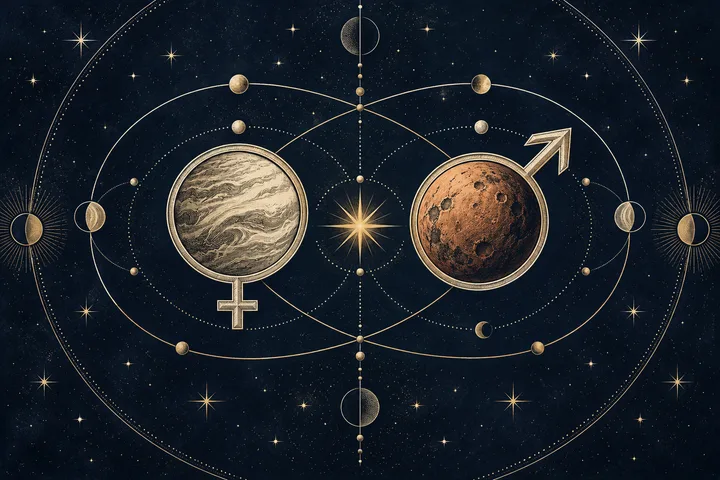
Synastry compares two natal charts by looking at how one person's planets contact the other person's. In a Venus-Mars contact, one person's Venus meets the other person's Mars across those charts. The phrase names two symbolic functions in dialogue. It doesn't describe the whole relationship, and it can't tell you what either person privately feels. Venus describes what draws us toward pleasure, affection, harmony, and what we value. Mars describes desire, initiative, and the impulse to act. These meanings give the contact its subject: how one person's way of valuing or receiving affection meets the other's way of wanting or moving toward something. Sira Nur Uysal's “What Is Synastry? Classical Relationship Astrology” presents Venus and Mars as relationship signifiers, while “Venus-Mars Synastry: Attraction Aspects Explained” describes the contact through value, affection, desire, and initiative. Name the direction before you interpret. A's Venus contacting B's Mars is one cross-chart statement; B's Venus contacting A's Mars is another. The first asks how A's Venus symbolism meets B's Mars symbolism. The second reverses the planets and the people. If both contacts appear in a comparison, keep them separate. Their presence doesn't establish equal interest, mutual attraction, or matching experience. Nor does one direction prove that only one person feels drawn in. The chart gives you a way to frame the exchange, not access to anyone's inner life. The planet names don't assign people fixed roles. “Venus person” and “Mars person” are shorthand for whose planet is under discussion in that particular contact. They don't mean that one person must be passive and the other must pursue, or that either role belongs to a particular gender. The Synthesis Astrology guide describes a possible asymmetry between receiving affection and taking initiative, but that is a lens for the symbolism, not a rule for how two people behave. Actual approaches can be more varied than the labels suggest. Consider an example with no chart data: one person appreciates warm, thoughtful gestures, while the other tends to show interest by making a direct invitation. Venus-Mars language can help describe the meeting between a preference and an approach. It cannot tell you whether the invitation felt welcome, whether the gesture was understood, or whether either person wants more. Those answers come from what the people say and do. So begin with a modest, precise sentence: “A's Venus contacts B's Mars, bringing affection or values into dialogue with desire or initiative.” If the reverse contact is also present, name it separately. This lets the contact carry real astrological meaning without asking it to prove reciprocity or speak for the relationship as a whole.
A Venus-Mars synastry contact links one person’s Venus themes, such as affection and pleasure, with the other person’s Mars themes, such as desire and initiative. Its direction, signs, aspect, and orb refine that interpretation. Even a close contact describes an attraction theme, not proof of mutual feeling, emotional fit, or a lasting relationship. Read the placements you have, name what remains unknown, and use other chart factors or a direct conversation for questions this contact can’t answer.
Sources: What Is Synastry? Classical Relationship Astrology; Venus-Mars Synastry: Attraction Aspects Explained
Why does chemistry feel like proof, and where does that inference fail?
A vivid attraction symbol can feel like a complete explanation because it names an experience that already has force. Venus and Mars speak to affection, pleasure, desire, and initiative, so their contact can matter deeply in a synastry reading. But naming the spark doesn't explain everything it touches. It doesn't tell you whether affection feels welcome, whether two people want the same kind of closeness, whether tension can be repaired, or whether they will choose to build a lasting bond. The leap usually happens in stages. First, attraction feels unusually strong. Then an astrological description seems to explain it. Finally, the explanation expands into a verdict: because the contact is intense, the relationship must be compatible, mutual, or enduring. That last step asks one symbol to carry several questions. Venus-Mars gives language for the attraction theme; the larger conclusion needs more. Some popular interpretations encourage the leap. In “Synastry: Venus-Mars Aspects Between Two Charts,” Cafe Astrology describes a Venus-Mars conjunction as almost irresistible and says its feelings are unlikely to fade. Its trine description reaches further, calling the bond fulfilling and long-lasting. Those are strong statements about outcomes. The same guide gives a more useful account of the square: attraction may be strong while the two people are out of tune, and timing or approach can become a source of friction. That detail shows why a charged contact can describe both appeal and a point that needs care. The symbolism needn't be discarded; the promised outcome needs to be held more lightly. “Venus and Mars in Synastry: The Aspects That Create Attraction” makes a similar tension visible. It calls a conjunction intense, but says intensity doesn't ensure durability; it describes a square as friction that can persist, then says Venus-Mars alone isn't enough to build a lasting relationship. Read these claims as interpretations, not guarantees about a couple. “Venus & Mars in Synastry” also calls attraction the spark and points to other chart factors when discussing lasting bonds. Its categorical language about what decides whether people stay goes beyond what this contact can establish, but its distinction between chemistry and the wider relationship is useful. The strongest case for giving Venus-Mars real weight is simple: when close and personally recognizable, it may become one of the clearest symbols for how attraction moves between two charts. That matters. A close, flowing contact may describe welcome ease; a close, tense one may describe potent chemistry with a sharper edge. Neither texture tells you how each person experiences it in daily life. An aspect guide can outline a possibility, but it cannot establish another person's feelings or choices. Keep the symbol and narrow the claim. Ask what the contact suggests about affection meeting desire. Then ask which other chart layer, or which honest conversation about pace, welcome, and needs, would address the question that remains.
Sources: Synastry: Venus-Mars Aspects Between Two Charts; Venus and Mars in Synastry: The Aspects That Create Attraction; Venus & Mars in Synastry
What can signs tell you before you have degrees?
Signs can describe the style associated with each person's Venus and Mars and support a sign-level comparison. They cannot tell you the exact angular separation, confirm a degree-based aspect, or show whether it falls within a selected orb. Keep sign interpretation and measured aspect interpretation as separate claims. That distinction preserves what the signs can say without asking them to supply information they don't contain.
In a birth chart, a planet's sign is the 30-degree section of the zodiac in which that planet is placed. A degree gives its more exact position within that section. To compare two people's planets, an astrologer measures the angular distance between their zodiac positions. An aspect names a meaningful angle, such as a conjunction near 0 degrees, a sextile near 60, a square near 90, a trine near 120, or an opposition near 180. The orb is how far the measured angle sits from the exact angle associated with that aspect.
Signs still offer a real first reading. Compare A's Venus sign with B's Mars sign, then reverse the direction and compare B's Venus with A's Mars. In astrological interpretation, the signs can suggest how each person's way of valuing or enjoying things meets the other's way of acting or pursuing. Their elements and modes can help describe whether those styles seem to support, challenge, or move at different paces. That's a reading of the signs' symbolism. It isn't a measurement of the distance between the planets, and the two directions need not tell the same story.
The distinction matters because a sign pairing invites a shortcut: if the signs seem harmonious, assume an exact trine; if tense, a square. But an aspect depends on actual planetary degrees, not broad sign labels. Even signs associated with a familiar aspect pattern don't confirm that the planets sit close enough to the exact angle under a chosen orb rule. Without degrees, discuss sign-level style, but don't claim a measured contact.
The guide “Venus conjunction Mars in Synastry: Meaning, Orb, and Context” defines a conjunction by proximity in zodiac longitude, gives 0 degrees as the exact angle, and states a three-degree default for its calculator. It also says no cutoff is universal. “Synastry Aspects Explained” publishes different orb ranges by aspect. These guides show why readers should ask which convention an interpretation uses; they don't establish a shared rule. A report's stated orb is a working convention, not something inferred from signs.
So begin with the information you have. If you know only the signs, describe the sign-level comparison and name the unknown: the exact angular separation and whether a major aspect falls within a selected orb. If both degrees are available, compare the positions, identify any aspect, and state the orb convention before interpreting its closeness. A sign pairing remains useful at its own level. It simply can't confirm what only measured positions can show.
Sources: Venus conjunction Mars in Synastry: Meaning, Orb, and Context; Synastry Aspects Explained
How should you read degrees and orb without turning them into a score?
An aspect names an angular relationship between two planets; the orb tells you how far that relationship sits from its exact angle. In synastry, that measurement helps you describe the Venus-Mars contact with care. It does not measure how much two people desire each other, and it cannot be turned into a compatibility score. For a conjunction, the exact angle is 0 degrees. If the planets sit at slightly different longitudes, the distance between them is the conjunction's orb. For other aspects, the same principle applies around their own exact angle: measure the separation, then compare it with the aspect's target. A smaller orb is closer to exact. Astrologers often give closer contacts more interpretive weight, but that is a reading convention, not a measured scale of attraction or relationship quality. The conventions vary. “Venus conjunction Mars in Synastry: Meaning, Orb, and Context” uses a three-degree default for its conjunction comparison and explicitly says there is no universal cutoff. “Synastry Aspects Explained” gives different ranges by aspect, listing six to eight degrees for conjunctions and oppositions, five to seven for squares, and four to six for sextiles. These are the policies of two guides, not evidence that one range is objectively correct. Their difference is precisely why an interpretation should tell you which rule it uses. The Synastry Comparison Report follows its own disclosed rule: it checks selected major aspects within a six-degree orb when you supply degrees. That setting lets you know what the report counts. It is not a universal astrological boundary, and it does not say that attraction begins or ends at six degrees. A contact beyond the report's limit simply falls outside that report's selected major-aspect calculation. The symbolic relationship between the placements may still invite a sign-level reading, but that is a different claim. Keep three ideas distinct: the angle identifies the aspect, the orb records its distance from exactness, and interpretation gives that contact a place in the reading. The first two are chart measurements. The third depends on the astrological framework and the rest of the information available. Even a close contact still needs its planet direction and signs read in context; closeness alone cannot tell you whether the attraction is mutual, welcome, emotionally easy, or likely to last. So when comparing readings, ask what orb convention each one uses and whether both degrees were supplied. Then read the contact's closeness as a reason to give this particular theme more or less attention within that framework. Don't read it as a higher or lower score for the relationship. A cutoff helps define what a tool includes. It does not decide what two people feel.
Sources: Venus conjunction Mars in Synastry: Meaning, Orb, and Context; Synastry Aspects Explained
What do easy and tense aspects each add?
Within common synastry language, conjunctions concentrate the two themes, trines and sextiles are often read as easier channels, and squares or oppositions bring contrast, friction, or polarity. These are different textures, not a ranking from compatible to incompatible. Ease can feel welcome without answering every need. Tension can hold attention without proving a durable fit. A conjunction brings Venus and Mars into the same area of the zodiac, so astrologers often describe its symbolism as concentrated: affection or pleasure meets desire and initiative with little distance between them. A trine or sextile is commonly read as a smoother route between those functions. The Venus-Mars discussion in “Synthesis Astrology: Venus-Mars Synastry: Attraction Aspects Explained” calls trines and sextiles flowing, while noting that ease can also feel mild or require someone to act on it. That distinction is useful. A smooth channel describes how the symbolism may move; it does not tell us what either person will choose to do with it. Squares and oppositions are often described through friction or polarity. In “Synastry: Venus-Mars Aspects Between Two Charts,” Cafe Astrology links the square with attraction alongside differences in timing and approach. Its trine description, by contrast, presents warmth and ease. But the same guide moves beyond texture into confident claims that feelings will endure or that a relationship will be fulfilling. Those are interpretations, not consequences established by the aspect itself. The symbolism can suggest a theme to notice; it cannot settle what two people feel, how they handle conflict, or whether they stay together. Other astrologers make stronger claims in the opposite direction. “Venus-Mars Synastry: Attraction Aspects Explained” describes a square as an engine of engagement and says many long relationships have this contact. That preserves a meaningful counterpoint: a hard aspect need not be a flaw, and friction may be part of a compelling attraction pattern. Yet the source offers an interpretive account, not evidence that squares cause lasting relationships. Its value here is to show that astrologers can read the same tension as lively engagement rather than simple incompatibility. Neither reading should be promoted into a forecast. A classical approach also gives Venus and Mars importance without making them the whole judgment. “What Is Synastry? Classical Relationship Astrology” describes relationship reading as comparison across two charts and places Venus and Mars among other considerations, including the lights and partnership indicators. The broader point helps rank the claims: an aspect contributes testimony about attraction, while a whole relationship reading asks more than one question. A close, harmonious Venus-Mars contact may count as supportive testimony. Support matters, but it is not a guarantee about every condition shaping a bond. When comparing an easy aspect with a tense one, ask what experience each interpretation names. Does the first suggest that affection and initiative find a natural rhythm? Does the second suggest that desire and preferred timing may pull against each other? Check whether either description fits what both people notice. Let the label frame a question, not decide compatibility or tell you to leave.
Sources: Synastry: Venus-Mars Aspects Between Two Charts; Venus-Mars Synastry: Attraction Aspects Explained; What Is Synastry? Classical Relationship Astrology
How does direction change the reading without assigning fixed roles?
Direction gives a Venus-Mars contact its proper owner. In synastry, A's Venus meeting B's Mars is a different cross-chart statement from B's Venus meeting A's Mars. The first asks how A's themes of attraction, pleasure, or affection meet B's desire and initiative; the second reverses those planetary roles. Name both people and both planets before you interpret. This keeps the reading specific without assigning either person a permanent role in the relationship.
That distinction matters because the shorthand “Venus person” and “Mars person” can sound like a description of character. It isn't. In “Venus-Mars Synastry: Attraction Aspects Explained,” Synthesis Astrology describes Venus through value, pleasure, and affection, and Mars through initiative. Its useful caution is that a one-channel reading can cast one person as pursuer and the other as pursued. Treat those as symbolic positions in a contact, not fixed identities or a report of what either person actually does.
Now compare the two directions separately. A Venus can form a measured aspect to the other person's Mars, while the other Venus-Mars pair may form a different aspect, fall outside the chosen orb, or have no measured major aspect under that convention. One contact might be close and the other wider. Or only one direction may qualify. The chart therefore offers a more detailed map when you record each pair, aspect, and degree relationship on its own. It doesn't give stronger evidence about who feels more.
Some guides make a larger claim. “Venus and Mars in Synastry: The Aspects That Create Attraction” from Horoscope Logic says reciprocal contacts share desire more evenly and tend to age better than a one-sided pull. That is an interpretation of reciprocity, not something the contact can establish about two people's feelings or future. AstroLuma's “Venus and Mars in Synastry: The Aspects That Create Attraction” likewise says an aspect reads both ways, while stressing that the two sides need not feel the same. The useful point is that astrologers can examine both perspectives. The limit is that a chart pattern cannot confirm consent, welcome, or equal interest.
So record what each direction symbolizes, then check it against the relationship as it is lived. Does an invitation feel welcome? Does the pace suit both people? Can each person express desire and affection in ways the other understands? These questions don't erase the astrology; they show which part of its symbolism fits the exchange. One qualifying contact isn't a verdict of unrequited feeling. Two directions aren't proof of equal desire. Ask, listen, and let the answer refine the reading.
Sources: Venus-Mars Synastry: Attraction Aspects Explained; Venus & Mars in Synastry; Venus and Mars in Synastry: The Aspects That Create Attraction
What does Venus-Mars leave for the rest of the chart?
A Venus-Mars contact can be meaningful without carrying the whole relationship reading. In “What Is Synastry? Classical Relationship Astrology,” Venus and Mars are important relationship signifiers, but they sit alongside the Sun and Moon, each chart’s seventh house and its ruler, and the condition of the planets involved. The sequence matters: establish wider signifiers, then examine how the charts connect. This gives Venus-Mars weight while keeping its meaning in proportion. Venus-Mars speaks most directly to attraction, preference, desire, and initiative. It doesn’t directly tell you whether two people feel emotionally at ease, communicate clearly, share values, or understand partnership alike. Those concerns call for other chart factors and sometimes different information. A contact may color the relationship’s chemistry; it can’t stand in for every part of the bond. Contemporary guides often use a broader collection of inter-chart contacts. “Venus & Mars in Synastry,” for example, distinguishes Venus-Mars chemistry from Venus-Venus themes of taste and affection, Mars-Mars themes of drive and pace, and other contacts associated with warmth, emotional safety, or commitment. Its sweeping claims about what makes bonds last go beyond what this article can establish. The distinction remains useful: different placements raise different questions. If your question is “Is there an attraction theme here?”, Venus-Mars is relevant. If you’re asking whether you feel understood, can talk through differences, or want the same kind of partnership, name that separately. The classical framework offers an example of a wider hierarchy, while the contemporary guide shows how astrologers group additional contacts around distinct themes. These are interpretive approaches, not one required checklist. A focused reading should say which layer it has considered. A wider factor can change the context of a Venus-Mars contact, but it doesn’t erase or certify it. The Moon may be relevant to an emotional question when both people’s Moon placements are included. Communication needs its own chart inquiry. Partnership structure may lead an astrologer to examine the seventh house and its ruler, as the classical source does. Each addition needs relevant information and its own interpretation. Otherwise, the question remains open; Venus-Mars hasn’t answered it by default. The comparison report organizes the Moon, Venus, and Mars signs you supply. Optional degrees allow it to assess selected major aspects under its stated six-degree orb. It doesn’t calculate natal positions from birth details or calculate houses. It can compare known placements within that scope, but it can’t fill missing chart factors or turn an attraction contact into a full partnership reading. Keep the layers distinct. Write down what Venus-Mars suggests about attraction and initiative. Then name the unanswered question: emotional ease, communication, shared values, or partnership expectations. If you have the relevant placements, compare them as their own layer; if you don’t, leave that part unresolved. A focused chart reading becomes clearer when each contact answers only the question it can address.
Sources: What Is Synastry? Classical Relationship Astrology; Venus & Mars in Synastry
How can you test the interpretation against lived experience?
A chart reading becomes useful when its symbolism meets a question the people can answer for themselves. For a Venus-Mars contact, ask what kind of affection feels welcome, how each person shows initiative, and what pace lets both participate. Compare their answers and actions with the contact's theme. The symbolism should give language to the exchange, not require real life to confirm the chart. Imagine one person enjoys a clear invitation and quick plans, while the other prefers more conversation and time to warm up. Venus-Mars language can frame this as one person's style of affection or pleasure meeting the other's way of expressing desire or initiative. It doesn't tell us why either person acts as they do or whether their preferences can meet. If their contact is a trine, an astrologer might read the interaction as flowing; if it's a square, the approach may bring friction or different timing. Cafe Astrology's “Venus-Mars Aspects in Synastry” uses this kind of contrast, describing ease in some contacts and mismatched approaches in others. Aspect words name a possible texture. They can't tell the pair whether an invitation feels welcome, whether a slower pace feels caring or frustrating, or whether both want the same connection. A smooth aspect isn't a substitute for asking. A tense aspect doesn't cancel what the people show through their choices. Make the question concrete. “What helps you feel wanted?” may reveal more than a broad question about chemistry. “Would you rather make plans directly, or talk first and decide later?” turns initiative and pace into something both people can answer. Listen for the difference, then ask what adjustment would feel good to each of them. This gives the symbolism a real setting without turning either person into a fixed Venus or Mars role. The observations matter. A direct invitation that is welcomed and met with a clear response differs from repeated pressure after someone has asked for space. A slower approach with honest communication differs from silence that leaves the other person guessing. If a mismatch appears, notice whether both people can name it, make room for each other's preference, and follow through on an agreed pace. If a boundary is crossed, the chart doesn't soften that fact. What matters is how the people respond and whether behavior changes. This is where the interpretation can be revised. If a supposed “easy” contact accompanies very different preferences, don't insist that harmony must be present. If a “tense” contact accompanies a conversation in which both feel heard and find a workable rhythm, don't turn the square into a prediction of conflict. Astrology offers a symbolic lens; lived interaction shows which possible expression deserves attention. “What Is Synastry?” places Venus and Mars among wider chart considerations, supporting a reading of this contact as one theme rather than a complete account of the bond. Leave the conversation with one observable next step: agree on a way to show interest or set a pace, then see whether both people can honor it. If the chart language helps describe what happened, keep it. If it doesn't fit, let the lived pattern refine the reading. The people decide what they welcome, communicate, and build.
Sources: Synastry: Venus-Mars Aspects Between Two Charts; What Is Synastry? Classical Relationship Astrology
What is the fairest verdict on a Venus-Mars contact?
Give Venus-Mars real weight as an attraction signature, especially when a measured contact is close. Stop at that claim. Aspect type and direction refine the reading; they don't prove compatibility, mutuality, or staying power. The strongest exception is that this contact may be central to a couple's lived chemistry. That makes it worth discussing, but it still can't settle every other question.
Popular aspect descriptions preserve useful symbolic texture. A conjunction can suggest concentrated exchange, easier aspects flow, and a square or opposition friction or polarity. But descriptions overreach when they promise lasting passion or fulfillment. “Venus and Mars in Synastry: The Aspects That Create Attraction” uses strong language about irresistible attraction and enduring passion, then says Venus-Mars alone doesn't build a lasting relationship. Keep the symbolic reading separate from the outcome claim. “What Is Synastry” also gives Venus and Mars importance while placing them among other relationship indicators. Together, these sources support a focused reading, not a total verdict.
What could change the interpretation? Degrees can confirm whether an aspect falls within a stated orb convention; signs alone support a sign-level comparison. Other supplied placements add distinct themes, while the couple's experience shows how this attraction language is expressed. Neither extra precision nor a wider chart proves what someone feels. A close contact may be central to the chemistry and still leave emotional fit, reciprocity, and durability open.
Describe the contact plainly: whose Venus meets whose Mars, what aspect is being read, and what its symbolism may illuminate. Then name the question it leaves unresolved. That's stronger than turning chemistry into a compatibility score or relationship verdict.
Sources: What Is Synastry? Classical Relationship Astrology; Venus-Mars Synastry: Attraction Aspects Explained; Venus and Mars in Synastry: The Aspects That Create Attraction
What should you do next with the comparison?
Start with the information you actually have. Write whose Venus meets whose Mars, and keep the direction clear: A’s Venus to B’s Mars is a different statement from B’s Venus to A’s Mars. Then mark whether you know only the signs or both planets’ degrees. Signs support a sign-level reading. Degrees let you check an aspect and its orb under a stated convention. The Synastry Comparison Report uses supplied placements and, when degrees are included, selected major aspects within its six-degree orb; it doesn’t calculate natal positions from birth details or houses. A classical overview such as “What Is Synastry? Classical Relationship Astrology” also places Venus and Mars within a wider comparison, rather than treating one contact as the whole bond.
Next, describe the contact’s texture in plain words: ease, concentration, friction, or polarity. Then ask one question that matters outside the chart. Does this way of showing affection feel welcome? Is the pace of initiative comfortable for both of you? If your question concerns emotional response, communication, or shared values, identify the placement that could speak to it instead of stretching Venus-Mars. Compare supplied placements if that’s useful, or talk directly. Keep the chart’s suggestion distinct from what you’ve observed. The comparison can focus your conversation; the people involved decide what feels welcome and what remains to ask.
A little more clarity
Does a Venus-Mars contact prove two people are compatible?
No. In synastry, Venus-Mars describes an attraction theme between affection or pleasure and desire or initiative. Its aspect and direction can refine that reading, but the contact alone doesn’t establish mutual feelings, emotional fit, or staying power.
Sources & further reading
- What Is Synastry? Classical Relationship Astrology
Supports the framing of Venus and Mars as relationship signifiers within a wider comparison of two charts.
- Venus-Mars Synastry: Attraction Aspects Explained
Supports the symbolic distinction between Venus themes of value, pleasure, and affection and Mars themes of initiative and pursuit.
- Synastry: Venus-Mars Aspects Between Two Charts
Provides aspect-by-aspect interpretations that contrast smoother contacts with friction in squares and stronger claims about outcomes.
- Venus and Mars in Synastry: The Aspects That Create Attraction
Shows contemporary interpretations of Venus-Mars aspects and why attraction language should be separated from claims about relationship outcomes.
- Venus & Mars in Synastry
Supports comparison of aspect types and the distinction between attraction and other relationship questions.
- Venus conjunction Mars in Synastry: Meaning, Orb, and Context
Defines conjunction and orb, gives one guide’s three-degree default, and notes that no cutoff is universal.
- Synastry Aspects Explained
Provides one guide’s differing orb ranges by aspect as an example of variation in published conventions.
Synastry Comparison Report
Enter known placements for two people. Get an input-by-input comparison, selected aspect calculations and a clear record of what remains uncertain.
Compare our placements