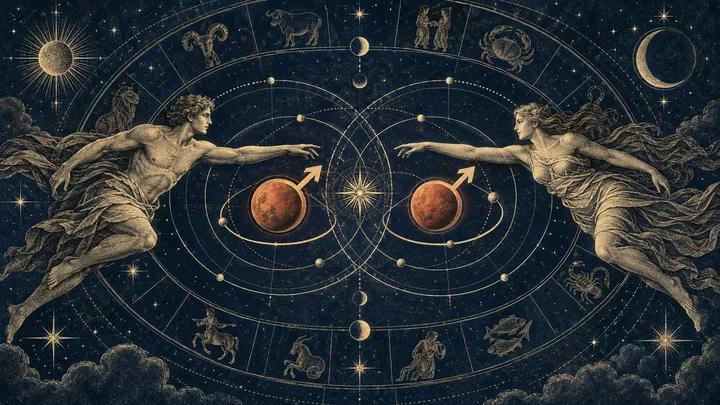
Mars synastry becomes a question about shared initiative when you stop asking only whether two people feel desire and start asking how they move together. Mars describes the first push: what each person wants, how each person pursues it, and what happens when the path is blocked. Compare the two Mars signs first. Then rank close major aspects, especially Mars-Mars, Mars-Sun, Mars-Venus, and Mars-Saturn. A flowing contact may make action feel natural. A hard contact may create friction that becomes either productive challenge or constant irritation. The strongest reading still needs a real-life test. Who starts the plan? Who follows through? Who makes room for the other person’s pace? Use the chart to name that conversation. Do not use one Mars contact as a verdict about the relationship.
Mars synastry asks who moves, and how
Chemistry gets your attention. Initiative tells you what happens next. A couple can feel an instant physical pull and still struggle to decide who will make the booking, raise the hard subject, begin the move, or keep a shared plan alive. Mars synastry belongs in that gap. It gives you a language for the couple’s active life.
In astrology, Mars is linked with energy, action, desire, assertion, anger, competition, and the instinct to act. It is the part of the chart that says, in effect, I want this, and I’m going to do something about it. In a comparison between charts, Mars shows how one person’s drive meets the other person’s drive. That meeting can feel erotic. It can also feel like teamwork, rivalry, interruption, courage, or pressure. [Mars, God of War, in Astrology/Zodiac](https://cafeastrology.com/mars.html) describes Mars as the planet of energy, action, and desire, and connects its sign with the first instinct to act.
That wider meaning changes the question. Instead of asking, Is our Mars connection hot?, ask, What does our energy make easier? A good Mars contact may help you start a project, protect each other’s independence, take a trip, repair a room, or speak plainly when a problem has been avoided. A difficult contact may still be magnetic, but it can turn every small delay into a contest. The issue is not whether energy exists. The issue is where it goes.
This is why Mars synastry shouldn’t stand alone. Venus can describe attraction, taste, pleasure, and the way affection is offered. The Moon can show emotional timing and bodily comfort. Mercury can describe the words used when plans change. Saturn can show whether desire meets patience, limits, and sustained effort. Mars supplies the spark and the push. Other planets tell you whether the couple knows how to hold that force.
A chart comparison also gives roles. If your Mars aspects my Moon, my feelings may become the field where your action lands, while your Mars becomes the pressure or protection I experience. If my Mars aspects your Sun, my directness may energize your identity or irritate your sense of authority. The planet person and the Mars person don’t experience one identical story. Name both sides before you draw a conclusion.
The most useful Mars reading ends in an observable question. When this pair has a shared goal, do they move as a team, take turns, divide the work, or compete for control? That is the living expression of the synastry. The symbols help you see it. The couple’s habits show you how it behaves.
Sources: Mars, God of War, in Astrology/Zodiac; Synastry: Sun-Mars Aspects Between Two Charts
Start with the two Mars signs
Before you count aspects, compare the signs. The sign tells you the style Mars uses. It doesn’t tell you everything about a person’s initiative, but it gives you the verb: rush, sustain, explain, protect, perform, refine, negotiate, transform, or dissolve. When two Mars signs meet, the first question isn’t which one is better. It’s whether their methods can share a task.
Consider an example. One person has Mars in Aries. The other has Mars in Taurus. Mars in Aries tends to move quickly, speak directly, and enjoy the clean beginning of a challenge. Mars in Taurus tends to build slowly, hold a course, and value strength, stability, and staying power. These people may admire what the other has. Aries can wake Taurus up. Taurus can help Aries finish. But Aries may call Taurus slow, while Taurus may experience Aries as wasteful or impatient.
That is a difference in pace, not a sentence about compatibility. Put the pair in a real decision. They want to plan a weekend away. Aries wants to choose a place tonight and solve details on the road. Taurus wants to compare costs, check the room, and know that the plan will be comfortable. If they treat the difference as a character flaw, initiative becomes accusation. If they name it as a division of labor, Aries can open possibilities while Taurus secures the plan.
Elements add another layer. Fire Mars often seeks movement, challenge, and a vivid sense of being alive. Earth Mars tends to prefer tangible results, reliability, and a pace that can be maintained. Air Mars may act through ideas, words, options, and quick changes. Water Mars may act from feeling, protection, memory, or an atmosphere that must be right. These are interpretive tendencies, not fixed boxes. A person can act differently in different parts of life.
Modalities sharpen the pace. Cardinal Mars starts. Fixed Mars persists. Mutable Mars adapts, redirects, and responds to changing conditions. Two cardinal Mars placements may begin everything and finish little. Two fixed placements may build something durable but resist changing the method. Two mutable placements may keep a shared life flexible while postponing the one decision that needs a firm answer. The sign comparison tells you where to look for the couple’s natural rhythm.
Read the sign pair as a translation problem. What does action mean to each person? What counts as progress? How much preparation feels responsible, and how much feels like avoidance? What kind of pressure creates courage, and what creates shutdown? Those questions turn a sign-pair overview into a useful guide. They also keep you from mistaking a Mars stereotype for a complete reading.
Sources: Mars, God of War, in Astrology/Zodiac; Mars in the Signs: Astrology
Then rank the Mars contacts by closeness
A Mars sign comparison gives the background. An aspect shows the angle of contact. In astrology, an aspect is an angular relationship between chart factors. The orb is the distance from the exact angle that determines whether the aspect is treated as active. Astrodienst’s Astrowiki defines an aspect through this angular relationship and explains that the allowed deviation is called an orb. Its synastry guidance also recommends tighter orbs because comparing two charts creates many possible contacts.
For this report’s working method, use a six-degree orb for selected major aspects. That is a stated editorial rule, not a claim that every astrologer uses one universal allowance. A contact at one degree deserves more weight than the same aspect at five degrees. A contact at six degrees may belong in the background, especially if the planets are personal and the rest of the chart repeats the theme. A wide aspect shouldn’t outrank a close one just because its symbolism sounds dramatic.
Start with conjunctions, oppositions, squares, trines, and sextiles. The conjunction fuses the two functions. The opposition makes the functions face each other and can create awareness through contrast. The square creates friction and demands a new way to use energy. The trine can bring instinctive flow. The sextile offers a usable opening that becomes stronger when the pair chooses to act on it.
Now rank the contacts. First, ask whether Mars directly touches the other person’s Mars, Sun, Moon, Venus, or Saturn. Next, consider the orb. Then ask whether the same pattern appears in the sign elements or in another contact. One close Mars-Mars square tells a different story from a loose Mars-Mars square supported by a close Mars-Saturn trine and an easy Venus-Mars contact. The chart isn’t a bag of isolated meanings.
Direction matters, too. Your Mars conjunct my Sun isn’t quite the same lived experience as my Mars conjunct your Sun, even though the geometric contact works both ways. The Mars person may feel active, provocative, or motivated around the Sun person. The Sun person may feel energized, challenged, noticed, or pushed. Both descriptions can be true. A good reading names the interaction and the role each person may feel they occupy.
If you don’t have degrees, keep the interpretation at the sign and aspect level supplied to you. Don’t invent precision. A report based on known placements can still compare the symbolism and offer questions. It simply shouldn’t pretend that an unknown degree is exact, or that an unconfirmed aspect carries the same weight as a close one. Precision begins with admitting what the chart data actually contains.
The strongest Mars-Mars story is shared rhythm
Mars-Mars synastry is the cleanest place to study shared initiative because the same planetary function meets itself. Both people bring action, desire, defense, and anger into the room. The aspect shows whether their inner rhythms cooperate, collide, alternate, or keep missing one another.
A close Mars-Mars conjunction can feel like recognition at the level of instinct. You may want to move at the same time, pursue the same challenge, or aim your energy at a common target. The risk is excess heat. If neither person has room for a separate interest, competition can replace closeness. The couple needs outlets, not constant contact.
A Mars-Mars trine often makes cooperation feel easy. You understand how the other person starts and pushes. You can work side by side without explaining every move. A sextile can be just as useful, though it may ask for a conscious choice. You have a door. You still have to walk through it. In both cases, the practical question is what the pair does with the natural flow.
A Mars-Mars square can produce impatience, provocation, and different methods of handling anger. That doesn’t make it empty. Friction can sharpen effort. Two people may challenge each other to become braver or more disciplined. But the square needs rules for the contest. If every task becomes a test of whose method wins, the same energy that could build a life together will drain it.
An opposition can make the difference visible. One person’s way of acting becomes the mirror that shows the other what they don’t want to admit about their own drive. This can create rivalry. It can also create a strong division of roles, especially when each person learns to respect the other’s half of the task. The pair needs give and take, not a permanent winner.
Cafe Astrology’s Mars-Mars reference describes flowing contacts as an instinctive understanding of impulses and methods, while its discussion of hard contacts emphasizes misunderstanding, impatience, and the value of separate interests. That gives you a sound interpretive sequence: name the contact, name the energy, then ask whether the couple channels it into a common goal or turns it against the other person.
Mars-Mars becomes useful when you can finish this sentence: We work best when we ____. The blank might be compete kindly, divide the steps, move after we talk, leave room for solo projects, or agree on who has the final call. If you can’t fill it from the couple’s behavior, the chart hasn’t yet become a reading.
Sun-Mars shows whether action feeds identity
Mars-Mars compares two engines. Sun-Mars asks what happens when one person’s drive meets the other person’s sense of self. The Sun says, This is who I am and what I stand for. Mars says, This is what I want to do now. Together, they can create movement. They can also create a struggle over whose way of acting feels legitimate.
With a flowing Sun-Mars aspect, the Mars person may help the Sun person act on a purpose, while the Sun person gives Mars a direction worth pursuing. The pair can feel as if they’re going somewhere. One person brings confidence or vision. The other brings heat, courage, and follow-through. This is shared initiative with a center.
With a conjunction, physical presence can be unmistakable. The Mars person may energize the Sun person simply by showing up. The attraction can be strong, but the same closeness can make arguments personal. If the Sun person hears every suggestion as criticism, or the Mars person treats every boundary as resistance, the couple loses the benefit of the contact.
A square or opposition can make the Sun person feel pushed and the Mars person feel judged. The Sun may insist on the right way. Mars may react defensively or press harder. This isn’t a call to suppress either planet. It’s a call to separate identity from method. You can say, I don’t like that approach, without saying, You’re wrong to want this.
Imagine Maria has Sun in Capricorn and her partner has Mars in Libra. She wants a clear outcome and a plan that serves the long term. He wants to open a fair discussion before taking action and may spend time weighing the other person’s position. She may experience his diplomacy as delay. He may experience her efficiency as a decision already made. Their shared initiative improves when she asks for a deadline and he agrees to choose by it.
The chart doesn’t tell Maria whether her partner will keep that agreement. It does show why their active styles can rub. A Sun-Mars reading becomes honest when it moves from type to behavior: who feels seen, who feels interrupted, who is allowed to lead, and how quickly the couple repairs a bruised ego. Chemistry may start the exchange. Respect keeps it from becoming a fight about personhood.
Venus-Mars adds attraction, but not the whole bond
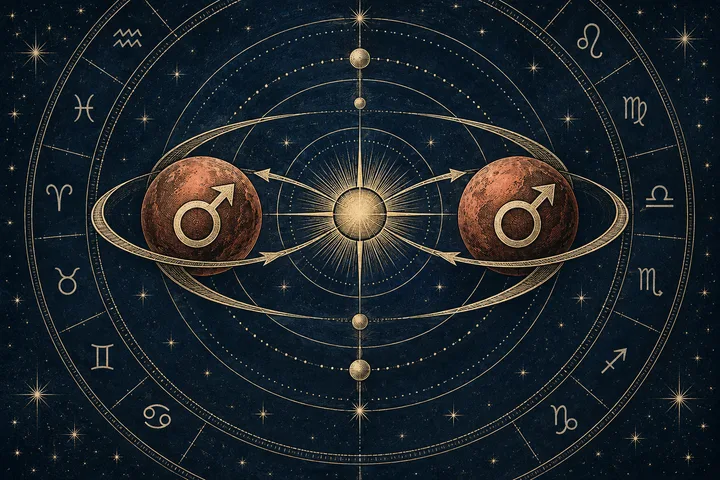
Venus-Mars is the contact most people mean when they say chemistry. It can describe the pull between one person’s way of loving, enjoying, and appreciating and the other person’s desire, pursuit, and physical directness. It matters. It just doesn’t answer every question Mars synastry raises.
A conjunction can make the roles feel immediate. The Venus person may find the Mars person’s physicality compelling. The Mars person may feel wanted by Venus’s warmth and taste. A trine or sextile can blend tenderness and pursuit more easily. In a square or opposition, attraction may remain strong while timing, approach, or sensitivity keeps missing the mark.
That difference between attraction and coordination is the heart of this article. A couple can want each other and still fail to act together. One person reaches for closeness when the other needs space. One starts a conversation through touch while the other needs words first. One pushes for a plan because desire feels urgent. The other slows down because pleasure disappears under pressure.
Use Venus-Mars to ask what each person finds inviting. What approach feels exciting rather than intrusive? What kind of pursuit feels like appreciation rather than demand? How does each person signal yes, not now, or try again later? Those questions protect the living meaning of the aspect. They also keep the reading rooted in mutuality rather than assigning a permanent pursuer and a permanent responder.
The sign can change the expression. Mars in Gemini may pursue through conversation, novelty, and quick exchange. Venus in Cancer may need emotional warmth and a sense of safety before desire can open. Mars in Virgo may show interest by helping, fixing, or paying attention to details. Venus in Sagittarius may want room, humor, and a shared horizon. None of these styles is automatically more passionate. They speak different dialects of desire.
Cafe Astrology’s Venus-Mars synastry guide treats the contact as a strong romantic and physical link, while also describing the friction that can appear when affection and approach are out of tune. That is the ranking to keep: Venus-Mars can explain the pull and the mismatch in how the pull is handled. It can’t certify emotional security, shared values, or long-term capacity.
For a deeper comparison, place Venus-Mars beside the couple’s Moon contacts. If Venus and Mars attract while the Moons struggle to settle, the couple may need more care around timing and repair. If the Moon supports the contact, desire may feel safer to express. Read the layers together. A single spark isn’t the whole sky.
Sources: Synastry: Venus-Mars Aspects Between Two Charts; Mars, God of War, in Astrology/Zodiac
Saturn tells you whether initiative can last
Mars starts. Saturn measures, contains, commits, and asks what a choice will require over time. When Mars meets Saturn in synastry, the question becomes sharper: can one person’s drive work with the other’s timing and sense of responsibility? This is where shared initiative stops being a mood and becomes a practice.
A flowing Mars-Saturn contact can help the couple turn energy into structure. Mars brings the first move. Saturn brings the schedule, boundary, or patience that keeps the move from fading. One person may say, Let’s begin. The other says, Here’s how we’ll make it real. The dynamic can feel dependable when neither person treats the other’s function as an insult.
A hard contact can feel like a brake. The Saturn person may see Mars as reckless, childish, or badly timed. The Mars person may see Saturn as cold, controlling, or determined to find fault. The same pair may begin with fascination and later repeat a critic-and-rebel pattern. The problem isn’t that Saturn has limits or Mars has urgency. The problem is contempt.
The sign tells you what kind of initiative meets the limit. Mars in Aries may resent a long approval process. Saturn in Libra may insist that a decision account for both people. Mars in Cancer may need reassurance before taking a risk. Saturn in Capricorn may expect proof through sustained work. The symbols can show the pressure point, but the couple must decide whether the pressure produces skill or shame.
Cafe Astrology’s Mars-Saturn material gives a useful exception to the usual hard-aspect fear. Harmonious contacts can bring stability and dependability, qualities that are less glamorous than immediate passion but often matter greatly in a shared life. It also stresses that the natal condition of both planets changes the expression. A synastry contact doesn’t erase each person’s own Mars or Saturn story.
Ask three practical questions. Can Mars make a request without attacking Saturn’s caution? Can Saturn set a limit without belittling Mars’s desire? Can both people revisit the agreement after reality changes? If the answer is yes, the contact may become a training ground for mature initiative. If the answer is no, the chart may be naming a pattern the couple needs to interrupt quickly.
This is also the strongest exception to a simple pro-chemistry reading. A vivid Venus-Mars contact may pull two people together, while a difficult Mars-Saturn pattern repeatedly blocks action and pleasure. The attraction remains real. So does the block. Rank both. Shared initiative requires more than wanting the same thing. It requires a way to make room for time, limits, and repair.
Sources: Mars-Saturn Aspects in Synastry
A worked example turns symbols into a decision guide
Let’s return to Mars in Aries and Mars in Taurus. Imagine Maria has Mars in Aries and Daniel has Mars in Taurus. We aren’t calculating their charts or claiming these are real people. We’re using a sign-pair example to show how a reader can move from symbolism to a shared decision.
At the first layer, Maria starts quickly. Daniel builds slowly. Maria may enjoy the chase, the new plan, and the moment when a vague wish becomes a bold move. Daniel may conserve energy, choose one goal, and keep going after the first rush has passed. The pair has a possible strength: initiation plus endurance. It also has a clear fault line: speed versus readiness.
At the second layer, suppose their supplied data includes a close Mars-Mars sextile. The aspect softens the sign difference by giving the two Mars functions a cooperative opening. Maria can invite movement without forcing Daniel to copy her pace. Daniel can add continuity without treating Maria’s first impulse as foolish. The sextile still asks for action. They might use it to divide the trip plan, the home project, or the next career step.
Now change the aspect to a close square. The same sign difference becomes more combustible. Maria’s push can feel like pressure. Daniel’s delay can feel like refusal. Their shared initiative may work best when they separate the stages. Maria gets to propose three options by Tuesday. Daniel gets to choose the durable one by Friday. The agreement turns a repeating argument into a process both Mars signs can enter.
At the third layer, add Venus-Mars attraction. The couple may feel a strong physical pull, which makes the contrast exciting at first. Maria may love Daniel’s steadiness. Daniel may love Maria’s direct heat. Later, the same qualities can become the language of complaint. She says he never acts. He says she never waits. The attraction hasn’t vanished. It has become entangled with the initiative problem.
At the fourth layer, add Saturn. If Daniel’s Saturn makes a supportive contact to Maria’s Mars, he may provide a steady container for her energy. If his Saturn squares her Mars, the dynamic may become permission and rebellion. Neither result is automatic. The question is whether Daniel can name a real limit and whether Maria can hear it without experiencing a personal rejection.
The decision guide is simple. First, name each Mars sign’s preferred pace. Second, identify the closest relevant aspect. Third, state the likely strength in one sentence. Fourth, state the likely friction in one sentence. Fifth, choose one real shared task that can test the pattern without turning the relationship into an experiment. The goal isn’t to score the couple. It’s to give the symbols somewhere honest to land.
For Maria and Daniel, the useful sentence might be: We have enough drive to build something if we stop using speed as proof of care and patience as proof of commitment. That is a stronger conclusion than hot or not. It names the shared resource, the mistaken test, and the next behavior.
The strongest exception is a chart that repeats another story
A Mars contact can look promising and still fail to describe the couple’s main struggle. It can look difficult and still become one of the relationship’s most productive bonds. The exception is not a loophole. It’s a reminder that a synastry reading ranks patterns across the chart instead of crowning one aspect.
Start with the natal charts as far as the supplied data allows. Is Mars comfortable or heavily challenged in each person’s own chart? Does one person’s natal Saturn already describe caution, delay, or disciplined effort? Does the other person’s natal Mars already move through anger quickly? Synastry activates personal material. It doesn’t manufacture a personality from one contact.
Then look for repetition. Mars-Mars square plus Mars-Sun square may repeat the theme of competing methods and bruised pride. Mars-Mars trine plus Venus-Mars sextile may repeat ease between desire and action. A hard Mars-Saturn contact alongside supportive Moon or Venus contacts may show a couple that feels the block but also has emotional resources for repair. Repetition raises importance. It doesn’t guarantee an outcome.
Watch for a stronger planet or aspect taking the lead. A close Saturn contact may matter more than a loose Mars-Venus contact. A Moon-Mars contact may explain why initiative becomes emotionally charged. A Mercury-Mars contact may show that the real fight is in the words used to push, correct, or defend. The article [When a Synastry Aspect Fits the Chart but Not the Relationship](/journal/synastry-aspect-fits-chart-not-current-relationship) can help you compare a symbolic fit with the pattern you actually observe.
The lived relationship remains the final translator. If a supposedly harmonious Mars contact coincides with fear, coercion, or a person changing ordinary plans to avoid another person’s anger, don’t dress that behavior in attractive astrology. Mars includes assertion and conflict. A responsible reading can name the need for boundaries and safety while still honoring the chart’s symbolic language.
The reverse matters as much. If a square describes frequent challenge but both people argue fairly, repair quickly, and use the tension to make better decisions, don’t reduce the relationship to conflict. A hard aspect can demand skill. It can make the couple more awake to the places where their methods differ. The question is what they do with the heat.
Your strongest exception, then, is the repeated chart story that changes the rank. Don’t let a glamorous contact outrank a close block. Don’t let one difficult aspect erase a wider pattern of support. State the main reading, name what could modify it, and say what observation would tell you which version is active. That is how astrology stays precise without becoming rigid.
Sources: Mars, God of War, in Astrology/Zodiac; Synastry: Sun-Mars Aspects Between Two Charts; Mars-Saturn Aspects in Synastry
Use the reading to choose one conversation
A Mars synastry reading should leave you with a better question, not a verdict. If you’ve compared the signs, ranked the closest contacts, and tested the interpretation against a real pattern, you’re ready to choose one conversation. Keep it small enough to have. Make it specific enough to answer.
Try this opening: When we want the same thing, I notice that we don’t move toward it in the same way. I tend to ____. You tend to ____. What would make this feel like shared effort instead of one person pushing and the other resisting? That sentence keeps the chart in the background and the relationship in the room.
If the pattern is Mars-Mars, ask about pace and division of labor. Who starts? Who finishes? How will each person have independent time? If the pattern is Sun-Mars, ask how challenge can remain separate from disrespect. If it’s Venus-Mars, ask what pursuit feels welcome and how either person can slow down without creating shame. If it’s Mars-Saturn, ask how limits can be stated without criticism and how urgency can be expressed without force.
Choose one shared task for the next week. Plan the meal. Book the visit. Set a budget. Repair the shelf. Have the conversation you’ve postponed. Give each person one clear responsibility and one clear choice. Then notice what happens. Does the plan create energy? Does one person take over? Does the other disappear? Does the couple adjust without turning the adjustment into a character judgment?
You can record the observation in plain language. We work well when one of us opens the path and the other checks the details. We lose momentum when waiting becomes silent punishment. We enjoy desire more when we name timing before we push. That sentence is a living interpretation. It tells you what to repeat and what to change.
If you want a focused comparison, the Synastry Comparison Report can organize supplied Moon, Venus, and Mars placements, optional degrees, and selected major aspects using the stated six-degree orb. It doesn’t calculate a natal chart from birth details or provide houses. You can [compare your placements](/compatibility-test) when you have the chart information you want to examine.
Keep the conversation close to one pattern. Don’t arrive with a list of every aspect and ask your partner to defend the whole chart. Choose the contact that best explains the decision in front of you. If Mars-Mars is the clearest contact, talk about pace. If Venus-Mars leads, talk about approach and consent. If Mars-Saturn leads, talk about timing, responsibility, and the difference between a useful limit and a wall.
Listen for the words beneath the complaint. I wish you would hurry may mean I want proof that this matters to you. I wish you would stop pushing may mean I need room to choose freely. You never follow through may mean I am carrying too much of the practical work. Astrology gives these hidden needs a shape, but the conversation gives them a chance to be answered.
A shared initiative agreement can be brief. We’ll decide the destination tonight, check the cost tomorrow, and revisit the plan Sunday. Or: I’ll bring the first idea, you’ll tell me what makes it workable, and neither of us will treat a revision as rejection. Small agreements suit Mars. They convert heat into movement, and movement gives the couple new evidence about its own rhythm.
You don’t need to settle the entire relationship in this talk. You need one honest answer about how the two of you act together. If the answer feels encouraging, repeat the kind of task that brought out your best rhythm. If it feels strained, change the agreement before you blame the person. If one person refuses every shared process, take that behavior seriously. A chart can describe tension, but it can’t make unwillingness into cooperation.
Let the result stay specific. We chose a pace we could both keep. We found a way to disagree without making the task personal. We discovered that one of us needs a clear invitation before taking the lead. Or we learned that the same conflict returns because neither person wants to share the work. Each result gives the Mars story more truth than a dramatic label ever could. That is the point of a field guide: clearer choices, better questions, and less guessing.
Start the conversation with this: What would shared initiative look like between us this week, and what is one thing each of us will do to create it? Then listen to the answer. Mars is clearest when it has a direction, a boundary, and a next step for both people in ordinary life together.
A little more clarity
Does strong Mars synastry mean a couple will last?
No. Strong Mars synastry can show desire, activation, courage, competition, and a powerful effect on each other’s initiative. It doesn’t decide whether the relationship lasts. Read Mars with the Moon, Venus, Mercury, Saturn, the natal condition of each planet, and the couple’s actual habits. The useful question is whether the energy becomes shared effort, respectful challenge, or repeated conflict. If you know only the signs and one aspect, keep the conclusion at that level. If you have degrees, rank the closer contact more strongly. Then test the reading through one concrete conversation and one shared task.
Sources & further reading
- Mars, God of War, in Astrology/Zodiac
Supports Mars as energy, action, desire, assertion, anger, instinct, and the sign-based style of acting.
- Synastry: Sun-Mars Aspects Between Two Charts
Supports the reading of Sun-Mars as coordinated or conflicting energy, goals, physical presence, and competition.
- Mars in the Signs: Astrology
Supports sign-based differences in Mars pace, initiative, persistence, anger, and methods of pursuing desire.
- Aspect, Astrowiki
Supports the definition of aspects as angular relationships and the use of an orb for allowed deviation.
- Mars-Saturn Aspects in Synastry
Supports Mars-Saturn interpretations involving initiative, restraint, criticism, dependability, stability, and natal context.
- Synastry: Venus-Mars Aspects Between Two Charts
Supports Venus-Mars as romantic and physical attraction with possible mismatch in approach, timing, and affection.
Synastry Comparison Report
Enter known placements for two people. Get an input-by-input comparison, selected aspect calculations and a clear record of what remains uncertain.
Compare our placements