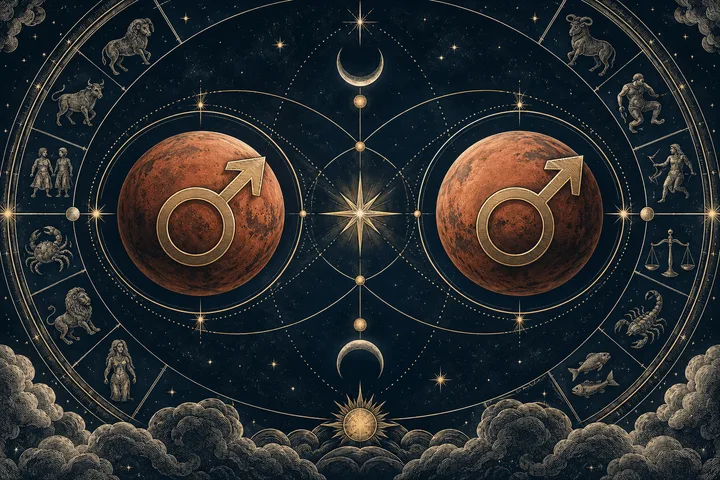
Does Mars opposite Mars point first to competition or coordination?
When two people’s Mars placements oppose each other, read the polarity first: one person’s initiative meets a contrasting response. Competing action styles are the safer starting point. Coordination remains possible, but it describes how the pair uses the difference, not a result guaranteed by the aspect. In modern Western astrology, Mars speaks to action, pursuit, assertion, and desire. In synastry, the question is how one person’s Mars meets the other’s. The chart offers a symbolic lens for that exchange; it does not settle what either person intends or whether the relationship will succeed.
Synastry describes interplay between two natal charts, and an inter-chart aspect is one part of that reading. In “Synastry,” Cafe Astrology describes opposition as polarity with room for complement and attraction, but also competition, insecurity, and a see-saw pattern: one person expresses a planet’s energy and the other counters. That countering possibility deserves first place here because it follows the opposition’s central image of two sides meeting across an axis. Yet countering needn’t mean hostility. A response can challenge an approach, check it, or supply what it lacks. The lived meaning depends on what that response does next.
Mars makes the question vivid. “Mars in the Elements: Synastry” describes Mars contacts as capable of stimulating desire and activity, while difficult contacts can bring arguments and competitiveness. Those are interpretive possibilities, not fixed outcomes for every pair. Imagine two people planning a small community event. One proposes a quick plan; the other immediately asks what could go wrong. If the second person keeps vetoing each move, the exchange looks like counteraction. If the question catches a missing detail and lets them proceed with a sounder plan, the same contrast may serve a shared aim. This imagined example illustrates a distinction; it is not evidence about couples.
So ask what happens in the next turn. Does a response repeatedly cancel the first move, or does it contribute a useful counterweight? Check the supplied Mars signs for style, and compare degrees before calling the placements an opposition. Other known chart contacts may add context, but this one contact cannot speak for the whole chart. Start with the pattern you can observe, then refine the astrological reading with the data you actually have.
Sources: Synastry; Mars in the Elements: Synastry
What does the opposition describe before you call it a clash?
An opposition links two placements across a polarity. In synastry, that means one person’s planet is read in relation to the other person’s placement. With Mars opposite Mars, both sides bring Mars into the comparison: the question concerns two ways of acting, asserting, pursuing, and expressing desire. The aspect describes a relationship between those styles. It doesn’t decide in advance whether they will collide or work together. In chart language, an opposition is an aspect near 180 degrees. Picture the two placements facing across an axis. Neither is simply absorbed into the other; each stands at a distinct end of the relationship. This geometry gives the aspect its sense of polarity. To confirm that two Mars placements form an opposition, compare their degrees as well as their signs. Sign labels alone can suggest a contrast, but they don’t tell you how close the angle is. The degree and orb question belongs to the next step in the reading. An inter-chart aspect relates a placement in one person’s chart to one in another’s. “Aspects Between Charts” organizes these contacts, while “Synastry” describes the interplay of the two people’s planetary positions. One contact is part of the comparison, not the whole relationship. Why might an opposition describe either complement or countering? In “Synastry,” Cafe Astrology presents both possibilities. The aspect can bring attraction and a feeling of complement, yet it can also bring competition, insecurity, or a see-saw exchange. One person expresses a planetary energy and the other answers from the opposite side, sometimes countering or thwarting the first expression. Those readings aren’t contradictory. The opposition makes the difference between two poles part of the contact; it doesn’t prescribe how the people will use that difference. With Mars on both sides, the two poles concern the same broad planetary territory. Cafe Astrology describes Mars in relationship astrology through desire and assertion, and notes that difficult Mars contacts can bring argument as well as invigorating exchange. That gives a Mars-Mars opposition a charged vocabulary: both placements speak to action and pursuit, while the opposition describes their polarity. It’s not one person’s Mars playing against, say, the other person’s Venus, where the comparison would involve unlike planetary roles. Here, each person brings Mars themes to the contact. “Both bring Mars” doesn’t mean they want the same thing, act at the same speed, or respond alike. Nor does “opposition” mean they must compete. It gives a symbolic frame for difference and interaction. Whether that becomes counteraction, complement, or a mixture depends on the fuller chart and lived exchange. Begin with polarity; leave the outcome open. The useful first reading is neither “this guarantees a clash” nor “this guarantees magnetic chemistry.” Two Mars expressions meet across an axis, where each can make the other’s style more visible. Cafe Astrology’s see-saw captures how one move may draw a counter-move; its complement reading leaves room for the poles to contribute to one another. Hold both in view until the wider context clarifies the contact.
Read Mars opposite Mars first as a polarity that can bring competing action styles: one person’s initiative meets a contrasting response. A shared rhythm is possible when that response adds a useful counterweight to a common aim. Confirm the degree-based aspect within the stated six-degree working orb, read each sign as a style, and observe whether a recurring shared task advances or stalls.
Sources: Synastry; Aspects Between Charts
When does a response become competition rather than contrast?
Difference becomes competitive in the practical reading when the response repeatedly blocks, reverses, or escalates the first move and the shared task loses ground. A contrast alone isn’t competition: a pause can add care, a direct push can restore momentum, and a question can expose a missed detail. The useful test is what the response does to the task and to the next turn in the exchange. Look at three parts: who initiates, what the other person does, and what happens next. First ask what the disagreement concerns. A goal conflict means the two people want different outcomes. A pace conflict means they want the same result but one wants to move now while the other wants more time. A method conflict concerns the route: both may agree on the destination, yet prefer different steps. A control conflict appears when the dispute is less about the plan than about whose choice gets to stand. “Let’s wait” might protect a shared goal, or it might repeatedly stop the other person from acting. “Let’s do it now” might restore momentum, or it might dismiss a needed check. Name the point of friction before you name the chart pattern. Cafe Astrology’s “Mars in the Elements: Synastry” gives a useful astrological frame for this distinction. It describes major Mars-Mars aspects as stimulating desire and activity, while difficult aspects such as an opposition may bring a battle of wills and competitiveness. That is a field of possibilities, not a report about every pair. The same reference shows that differences between Mars styles can produce both frustration and benefit: one style may urge action while another contributes deliberation, or one may add practical steps while the other broadens the plan. “Synastry” likewise describes opposition in broader terms that include countering and competition as well as complement. Read these as interpretations to test against the specific exchange, not as proof that a placement caused it. Consider an illustrative example. One person suggests a plan for a shared task; the other proposes a new plan before the first has been tried. If this happens each time, and the pair keeps restarting without choosing or completing anything, the response is cancelling the first move. They might agree to finish one small step before reopening the whole plan, then see whether decisions move forward. Now consider a different illustrative example. One person wants to act quickly; the other asks whether a key detail has been checked. If the check catches an omission and the task proceeds with a better plan, the pause has changed the action without cancelling its aim. If every check expands into a new objection and nothing can proceed, the same pause may function as a block. Use repetition as a reading aid, not a verdict. Notice whether the exchange advances, stalls, or escalates; then ask whether the friction concerns the goal, pace, method, or control. Carry this question into the sign and degree comparison: does the contrasting response keep undoing the initiative, or does it help the shared task take shape?
Sources: Mars in the Elements: Synastry; Synastry
How can two different Mars styles form a shared rhythm?
A shared rhythm becomes plausible when the response supplies something the first approach lacks and both people can recognize the contribution. The pair need not act alike or alternate perfectly. One may initiate while the other refines; one may act quickly while the other checks timing. Coordination shows up when those differences help the same purpose advance and each person retains a meaningful role.
In Cafe Astrology’s “Mars in the Elements: Synastry,” the element comparisons describe differences as potential resources as well as sources of irritation. Its fire-and-earth example sets quick action against deliberation: fire may help earth bring a plan to life, while earth may help fire slow down. In the earth-and-air example, practical attention to details can give a theory a working form, while air can invite earth to consider a wider view. These are broad symbolic sketches, not rules for every person with those placements. The pattern is useful: contrast can serve a goal both people accept.
Complement and coordination are related, but they are not the same claim. “Synastry,” Cafe Astrology’s overview, allows an opposition to signify complement or attraction, while also describing competition, countering, and a see-saw quality. This describes interpretive range, not a proven division of effort. Shared rhythm is visible in what happens next: the response adds a needed step, the first person makes room for it, and the joint task moves forward while both keep a role.
Consider an example: two people are preparing a meal for guests. One wants to begin cooking at once; the other wants to check the timing and make a list. If the pause catches an overlooked step, and the first then turns the plan into action, their different approaches may serve one aim. If the list keeps expanding while the food remains untouched, the same contrast may feel like obstruction. The chart gives language for the difference; the task shows how they use it.
A simple sequence can test the coordination reading. Name the shared goal and each person’s contribution: momentum, preparation, persistence, a fresh idea, or a timing check. Then agree on the order. One can lead the first phase, the other the next, with a set point to review. Ask whether the work advanced and each person had a real part in it. This isn’t a compatibility score. It’s a way to see whether a counterweight is helping.
The strongest exception is that polarity itself may feel attractive or enlivening before the pair has learned to coordinate it. Cafe Astrology’s Mars reference says Mars-Mars aspects can stimulate desire and shared activity, while difficult aspects such as the opposition can also bring a battle of wills and competitiveness. Both belong in the reading. Attraction can make differences compelling; it doesn’t show whether decisions are shared well. A Mars opposition can describe contrasting drives with complementary potential, but shared rhythm is best read when each response helps a common purpose advance and both people recognize that help.
Sources: Mars in the Elements: Synastry; Synastry
How do the two Mars signs change the texture of the opposition?
The aspect describes the relationship between placements; each sign describes a style through which Mars is expressed. Read both signs after confirming the opposition, then ask what action difference they suggest: pace, directness, persistence, planning, or emotional temperature. Sign symbolism adds texture. It doesn’t establish an opposition without degrees or tell you exactly how either person behaves.
A useful order is aspect first, signs second, shared situation third. The aspect places the two Mars placements across a polarity. The signs give language for how each side may pursue what it wants. Cafe Astrology’s “Aspects Between Charts” says to consider each planet’s sign because the same interchart contact can be expressed differently. This keeps the interpretation specific without making sign keywords do the aspect’s work.
Start broadly, then narrow only as far as the supplied placements allow. Element language can sketch a contrast in emphasis. In “Mars in the Elements: Synastry,” Cafe Astrology describes fire Mars as immediate and action-forward, while earth Mars is deliberate and practical. One style may press to begin while the other wants a workable plan first. The source also names a possible contribution: earth can slow fire’s rush, while fire can help earth act more creatively. That is a picture of tension and counterweight, not a rule about everyone with those placements.
The air-and-water comparison offers a different texture. “Mars in the Elements: Synastry” describes air Mars as inclined to analyze and consider perspectives, while water Mars is framed as more instinctive and emotionally attuned. In a shared decision, that contrast might appear as one person wanting to talk through options while the other wants to notice how the choice feels. Either approach could frustrate the other. Yet reflection can clarify a feeling, and feeling can give analysis a human purpose. The signs suggest questions to ask; they don’t settle the answers.
Translate the symbolism into a conditional, observable sentence: “If one Mars style favors quick action and the other careful preparation, we may be dealing with a timing difference; let’s see whether planning helps us move or keeps us stuck.” Then watch the task. Does the slower step improve the result, or halt it? Does the quick start create momentum, or leave details undone? This makes the sign reading useful without treating it as proof of anyone’s character.
Don’t jump from element to stereotype, or assume the signs must be opposites just because the aspect is. Modality, specific signs, and other known chart contacts can add nuance, but interpret only what you have. If you know signs but not degrees, you can compare possible styles; you can’t confirm the exact opposition or its closeness. If degrees confirm it, signs refine the question: what does each person’s way of acting bring into this polarity, and does that difference cancel the move or help the shared aim?
Sources: Mars in the Elements: Synastry; Aspects Between Charts
How much do degrees, orb, and missing data change the reading?
Degrees answer a question that sign labels alone cannot: how near are the two Mars placements to standing opposite one another? An opposition is an angular relationship centered on 180 degrees. The orb is the distance between the measured angle and that exact point. When the second placement sits 180 degrees from the first, the aspect is exact; if their separation falls short of or extends beyond 180 degrees, the difference is the orb. The signs still describe style, but degrees tell you whether the proposed aspect is present under the comparison rule. For this comparison, the working limit is six degrees. That is a consistent rule for this report, not a universal boundary that every astrologer must use. A closer contact sits nearer the exact opposition; a wider one sits farther from it. That gives you a sensible order for attention, but it does not justify assigning fixed emotional volume to every degree band. “Aspects Between Charts” advises readers to consider the signs and houses involved and to weigh inter-chart contacts in context. Its guidance supports a layered reading, not a numerical intensity scale. By contrast, “Mars Opposite Mars in Synastry: What Does This Friction Actually Mean?” divides the aspect into tight, moderate, and wide bands and attaches specific effects to them. Those bands show one interpretive approach; they do not establish a shared standard. Keep the useful distinction, then stop short of treating the labels as measured outcomes. When you have both signs but no degrees, you can compare the two Mars styles in broad terms. You can ask whether the signs suggest different ways of moving toward a goal, then check whether the contrast resembles your experience. You cannot confirm that the planets form an opposition, tell how close it is, or give that aspect the same weight you would give a verified contact. A sign pairing may look opposite across the zodiac, but the actual positions still matter. Without them, describe the sign contrast as a possibility and leave the aspect unconfirmed. Missing birth information sets a separate boundary. The Synastry Comparison Report uses placements you supply and can include optional degrees; it does not calculate natal positions from birth details. If you don’t know the degrees, provide the signs you do know and keep the interpretation at sign level. If you have degrees, compare their angular separation with the stated six-degree limit before calling this an opposition in the report. Uncertain birth times may matter to other chart factors, but this section cannot repair missing inputs by guessing, and it does not establish houses. The practical sequence is plain: confirm the placements, check the angle, apply the working orb, and only then decide how strongly this contact belongs in the reading.
Sources: Aspects Between Charts; Mars Opposite Mars in Synastry: What Does This Friction Actually Mean?
Why does the chemistry reading deserve a place without becoming the verdict?
The attraction reading deserves a fair place. In Synastry, Cafe Astrology describes opposition as a polarity that can draw people together or bring competition and insecurity. The same reference says difficult Mars contacts can make a relationship argumentative yet invigorating, and that strong Mars links may support desire. Chemistry is one possible expression, not the only one or a promised outcome. The difference matters because attraction and ease aren't the same thing. A contact can feel compelling while still requiring care around pace, initiative, or whose preference leads. Cafe Astrology's account allows both: the opposition can complement, but it can also set up a see-saw in which one person counters the other's move. Its Mars discussion likewise pairs stimulation with arguments and possible battles of will. Together, these descriptions support a conditional reading. The polarity may create interest in the contrast, while the way two people handle that contrast shapes whether it feels enlivening or wearing. A more dramatic reading appears in Mars Opposite Mars in Synastry: What Does This Friction Actually Mean? The page presents immediate attraction and conflict as defining features, says the aspect is intensely charged, and assigns different effects to narrow orb bands. It also describes a productive standoff and urges readers to channel the energy. This is the chemistry-first interpretation: opposition as magnetic. But its certainty outruns the broader references opened here. Those sources describe possibilities across synastry, not a guaranteed response for every Mars pair; they don't establish that attraction is immediate, that intensity follows specific degree bands, or that escalation must occur. Keep the invitation to notice how energy is directed, not the fixed predictions. There is another source boundary worth keeping clear. Mars Opposite Mars Aspects Natal and Transit on Astrology.com labels its discussion “Mars Opposite Mars Transit.” It advises bringing disagreements into the open and seeking a way to join forces. That can serve as a practical analogy for handling tension, but a transit describes a current planetary contact to a chart, not the relationship between two people's natal Mars placements. It cannot settle what a natal synastry opposition means. Use synastry references for the two-chart question; transit material speaks to timing. How should you weigh this contact beside the rest of the chart? Start with what is actually supplied: confirm that the two Mars degrees form an opposition within the stated working orb, then read each Mars sign as a style of action. After that, consider other known contacts only if their placements and degrees are available and relevant to the same question. Cafe Astrology itself says an individual interchart aspect deserves careful consideration and that the signs involved add useful context. This supports context, not a universal score or aspect ranking. Signs can compare styles without degrees, but cannot confirm closeness; without other data, leave the wider picture open. So give the chemistry reading a place in the interpretation, not the final word. The strongest reading is a polarity that can attract, stimulate, counter, or compete. Which side becomes more visible depends on the specific contact and how the pair handles difference. Attraction is possible; sexual chemistry, constant intensity, and relationship success aren't guaranteed by this aspect. Let the chart describe the tension between two Mars styles, then look at the actual exchange to see whether it draws the pair into engagement or repeatedly leaves one person pushing against the other.
Sources: Synastry; Mars in the Elements: Synastry; Mars Opposite Mars in Synastry: What Does This Friction Actually Mean?; Mars Opposite Mars Aspects Natal and Transit
What should you compare next?
Confirm both Mars signs, then compare their degrees if available. The signs can suggest contrasting ways of pursuing an aim; the degrees show whether the placements fall within your chosen orb. Here, the working limit is six degrees. Without degrees, keep the reading at sign style rather than calling the aspect confirmed. Cafe Astrology’s “Synastry” guide treats an aspect as one part of a larger comparison, so let this contact begin your inquiry, not end it. Choose a low-stakes task you share. Notice who makes the first move, what the other person does next, and what happens to the common aim. Does the response stop or reverse the effort? Or does it add a useful check, a different pace, or a skill the first approach needs? Try one adjustment in timing or role. See whether the task flows better. The cautious reading is competing action styles; shared rhythm is possible when the contrast helps both people pursue the same purpose. A closer degree contact, the signs, other placements, or a pattern of coordination could shift how much weight you give that reading. The Synastry Comparison Report can organize supplied Mars signs and optional degrees. It compares those inputs; it doesn’t calculate natal charts from birth details. Bring the placements you know, then compare them with what you observe.
Sources: Synastry
A little more clarity
Can Mars opposite Mars in synastry mean attraction as well as conflict?
Yes. Astrology references describe opposition as potentially complementary or attractive as well as competitive, and Mars contacts as potentially stimulating or argumentative. Those are possible readings, not guaranteed outcomes.
Can I confirm Mars opposite Mars if I only know both signs?
No. Signs can suggest contrasting Mars styles, but degrees are needed to check the angle and whether it falls within the six-degree working orb used here.
Sources & further reading
- Synastry
Supports the interpretation of opposition as potentially complementary or attractive as well as competitive and countering.
- Mars in the Elements: Synastry
Supports the Mars-Mars discussion of desire, activity, competitiveness, and contrasting element-based action styles.
- Aspects Between Charts
Supports reading inter-chart aspects as one part of synastry and considering signs and wider chart context.
- Mars Opposite Mars in Synastry: What Does This Friction Actually Mean?
Represents a chemistry-first direct-aspect interpretation and its specific orb-band claims, which the article qualifies.
- Mars Opposite Mars Aspects Natal and Transit
Supports the distinction between transit-framed Mars-opposite-Mars discussion and natal synastry interpretation.
Synastry Comparison Report
Enter known placements for two people. Get an input-by-input comparison, selected aspect calculations and a clear record of what remains uncertain.
Compare our placements