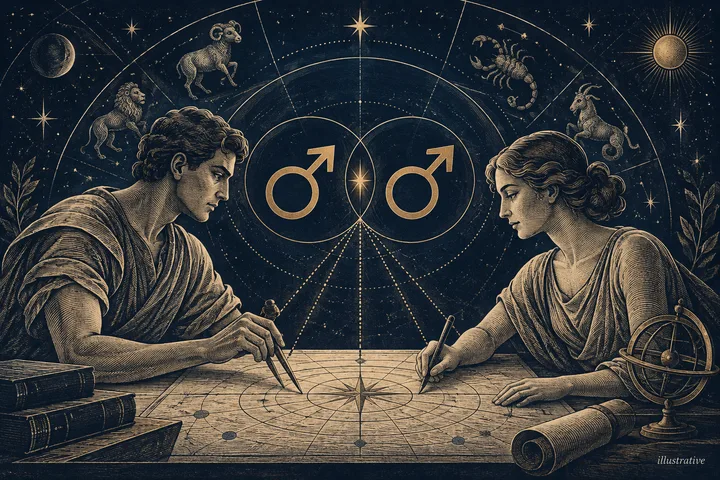
The appealing mistake: treating Mars as the couple’s task manager
A Mars comparison can help a couple plan shared work. It can’t tell you that one person is naturally the worker and the other is naturally the passenger. That is the first distinction to keep in view.
The tempting version of Mars astrology is simple. Mars acts. The couple has work to do. Therefore, the person with the stronger Mars must lead. The faster Mars must decide. The steadier Mars must carry the long project. It sounds tidy. It also turns a living planet into a job title.
Mars is more revealing than that. In a chart, Mars describes energy, action, desire, assertion, anger, and the first instinct to move. Its sign colors the manner of action. Its house shows an area where a person applies drive, when the house is known. Its contacts show where that drive meets another part of life. In synastry, the same principle becomes relational. One person’s way of acting meets the other person’s pace, needs, words, affection, and sense of self.
That is why a Mars comparison adds something practical to a couple’s plan. It names the force behind the plan. Who starts? Who needs time before committing? Who works best with a clear target? Who pushes through resistance? Who gets irritated when the other person changes the method halfway through? These are not the same question, and one Mars sign will not answer all of them.
Astrology sources often describe Mars as action rather than contemplation, as the push that gets us moving and as the planet tied to assertiveness, drive, conflict, and desire. A useful reading keeps that core intact while giving it a human scale. Mars is not a moral grade. It is a style of force.
The common assumption fails in another way. Couples don’t share work only by splitting visible tasks. They share initiation, follow-through, interruption, urgency, recovery, and the right to say that a plan needs to change. One person may make the first call. The other may notice the missing detail that keeps the call from becoming a result. Both are Mars functions, expressed differently.
Notice how much disappears when you ask only who is more motivated. Motivation can show up as speed, endurance, protection, precision, courage, or the willingness to return after a setback. Mars in a fixed sign may not volunteer for every new idea, yet it may be the placement that keeps paying, repairing, lifting, or finishing after everyone else has moved on. Mars in a mutable sign may change the method three times and still be the person who finds the route that works. Name the kind of effort, not just the visible activity.
The same caution applies to gendered shorthand. Mars belongs to every chart. A woman’s Mars can describe her initiative, desire, and boundary-setting. A man’s Mars can describe his pace and conflict style. Synastry compares planets, not stereotypes. If you assign leadership by gender before reading the chart, you’ve already narrowed the answer.
So begin with a supported position. Mars comparison is strongest as a map of action between two people. It helps you design the plan around pace and friction. It is weakest when you use it to crown a permanent leader or excuse one person from carrying their share.
Imagine Maria and Daniel planning a move. Maria has Mars in Aries. Daniel has Mars in Taurus. If you read only speed, Maria becomes the initiator and Daniel becomes the drag. If you read the signs as action styles, a better picture appears. Maria can open the search, call the estate agent, and choose a date. Daniel can compare contracts, measure the rooms, and stay with the details after the excitement fades. The question isn’t who works harder in the abstract. It’s where each person’s Mars enters the plan, and where the two styles need an agreement.
A Mars comparison shows how two people start, push, divide effort, handle resistance, and respond when a plan stalls. That makes it useful for a couple deciding who will take the lead on a move, a budget, a home project, or an ordinary weekly chore. Compare each Mars by sign first, then check the exact degree contacts between the two Mars placements and between Mars and the other person’s Sun, Moon, Mercury, and Venus. A flowing contact can make action feel natural. A square or opposition can create heat, urgency, and arguments. Neither one assigns a permanent role. The practical reading is a question: what kind of initiative does each person bring, and what agreement lets both styles work? If you have supplied signs and optional degrees, a synastry report can organize those layers. It can’t calculate missing natal positions, houses, or a relationship outcome from the comparison alone.
Sources: Mars, God of War, in Astrology/Zodiac; Mars in the Signs
What each Mars brings before you compare the two
Read each Mars alone before you read the contact. This prevents the comparison from becoming a vague story about chemistry. You want two clear baselines: how does each person move when nobody is telling them how to move?
Start with sign. Mars in Aries tends to begin quickly, speak directly, and prefer a clean first move. Mars in Taurus tends to build through patience, repetition, and resistance to being rushed. Mars in Gemini may need variety, conversation, and several active problems to stay engaged. Mars in Cancer may act protectively, especially when security or family is at stake, but may take a defensive route when it feels exposed.
Mars in Leo often wants its effort to matter. Recognition, pride, and a sense of creative purpose can feed the work. Mars in Virgo tends to bring method, correction, useful detail, and a strong wish to improve the process. Mars in Libra may weigh the effect of action on the partnership and can hesitate when the choice feels unfair. Mars in Scorpio can concentrate fiercely, hold a long aim, and act with privacy. Mars in Sagittarius often moves toward the larger horizon, the open road, or the belief that gives the work meaning.
Mars in Capricorn can organize effort around a goal, a deadline, or a result that will last. Mars in Aquarius may act through an unusual plan, a group, or a need to remain free from stale rules. Mars in Pisces may move through feeling, imagination, compassion, and changing currents rather than a straight line. Those are starting points, not complete portraits. A natal Mars also has a house, condition, and aspects that refine the expression, if those inputs are available.
The element gives a second layer. Fire Mars wants movement and challenge. Earth Mars wants something solid to build or finish. Air Mars acts through ideas, language, options, and coordination. Water Mars responds to emotional or protective meaning. The modality adds pace. Cardinal Mars starts. Fixed Mars sustains or resists change. Mutable Mars adapts, redirects, and can scatter when the task loses life.
These categories become useful when you attach them to a real decision. Ask what each person does at the beginning, middle, and difficult point of a project. A cardinal placement may volunteer before the full plan exists. A fixed placement may hold the line when the first enthusiasm passes. A mutable placement may see the better route after new information arrives. None is automatically superior. A couple needs all three moments.
Consider an example. Maria’s Aries Mars says, “Let’s choose the weekend and get the first ten boxes.” Daniel’s Taurus Mars says, “Before we choose, what will the truck cost and where will the heavy furniture go?” If Maria hears delay, she may push harder. If Daniel hears recklessness, he may slow down further. Their Mars styles are not yet a conflict. They become a conflict when neither person translates the style into a task.
A practical translation could be: Maria owns the first shortlist and the calls. Daniel owns the cost check and the physical plan. They meet at a fixed time to decide. The agreement gives Aries a door to open and Taurus something real to secure. It also keeps Maria from carrying every first move and Daniel from turning preparation into an endless veto.
This is the point of reading each Mars first. The comparison should explain how two complete action styles meet. It should not flatten either person into the role created by the contact.
You can make the baseline concrete by writing four lines for each person: “I start by…”, “I keep going when…”, “I lose energy when…”, and “When I’m angry, I tend to…”. Use the Mars sign as a prompt, then compare the answer with lived behavior. A chart reading gains value when it helps a person recognize a choice they can make. It loses value when it replaces observation with a fixed identity.
For example, Mars in Libra may begin by asking what is fair, who is affected, and whether both people agree. In a rushed household, that can look like delay. In a delicate negotiation, it can be the skill that prevents one person from making a decision the other must quietly absorb. Mars in Capricorn may see the deadline clearly, but can also over-identify with the result and forget to ask whether the plan still serves the relationship. Every placement has a gift and a pressure point.
When you compare the two baselines, look for complement and mismatch. Complement means the styles can cover different stages of the work. Mismatch means one person’s preferred stage is the other person’s stress point. The second finding is often more useful. It tells you where to add a handoff, a pause, or a specific request.
Sources: Mars, God of War, in Astrology/Zodiac; Mars in the Signs
What a Mars-to-Mars contact changes in the work plan
Mars-to-Mars is the most direct comparison for shared initiative. It asks how one person’s action meets the other person’s action. You can read it through sign relationship first, then through the exact aspect if both degrees are known.
A conjunction brings the two Mars functions into the same field. The couple may move quickly together, compete for control, or amplify one another’s urgency. If the signs are compatible and the natal Mars placements work well, the conjunction can feel like immediate mobilization. If the signs differ sharply, the same contact can make the couple act on top of each other. The remedy is a clear division of first move and final decision.
A sextile gives cooperation a handle. The styles differ, but they can make room for each other with less strain. One person may generate the opening while the other supplies a useful skill. The contact still needs activation. A sextile doesn’t complete the project by itself. It becomes visible when the couple chooses to use the difference.
A trine can make shared action feel easy. The danger is not failure. It is assumption. Each person may think the other understands the plan, or both may enjoy the same activity without deciding who handles the less enjoyable part. Easy motion helps, but it doesn’t replace a calendar, a budget, or a promise kept.
A square creates friction that demands a method. One person’s timing presses against the other’s timing. The couple may fight over sequence, standards, speed, or who gets to decide when enough is enough. A square can also provide force. It makes the issue hard to ignore, and it can push two people to define a stronger working agreement than they would have made under a soft aspect.
An opposition puts the two Mars styles across from each other. Each person can experience the other as excessive, stubborn, intrusive, passive, or strangely compelling. The work plan needs alternating authority. Let one person lead one stage, then let the other lead the next. Otherwise every decision becomes a referendum on whose way of acting is valid.
No aspect should be read without its orb. In the method used for this report, a selected major aspect uses a six-degree orb. The closer the degree contact, the more sharply it deserves attention. A sign-based relationship can still describe a style contrast, but it is not the same thing as an exact Mars-to-Mars aspect. If degrees are rounded, the distinction matters.
The strongest exception is a close hard aspect that the couple handles well. A Mars square is not a sentence of endless fighting. It may describe two people who can move mountains once they stop trying to move each other. The opposite exception also matters: a flowing contact can coexist with poor task habits. Astrology shows the pattern of force. The couple still has to choose conduct.
Imagine Maria at 8 degrees Aries and Daniel at 10 degrees Taurus. Their signs sit next to each other, but those supplied degrees don’t form a major Mars-to-Mars aspect under a six-degree orb. You can discuss fast versus steady initiative. You should not call the comparison an exact sextile or conjunction. Precision protects the useful reading.
Now change Daniel’s Mars to 14 degrees Cancer. Maria’s Mars at 8 degrees Aries forms a close square by degree. The plan may carry more heat. Maria wants the direct move. Daniel may need emotional security or a sense that the home is protected before he commits. Their work agreement should name both needs: decide a first step, then explain what makes the step safe enough to take.
Sign relationships add texture to the aspect. Fire and air can feed one another through movement and ideas. Earth and water can combine persistence with care. Fire and water may disagree about how quickly a feeling should become action. Earth and air may disagree about whether discussion is preparation or avoidance. These are interpretive patterns, not replacement aspects. A conjunction is still a conjunction. A square is still a square. The sign relationship tells you what the friction is made of.
Modality can be practical for a couple’s calendar. Two cardinal Mars placements may fill the week with starts. Two fixed placements may protect the plan but resist a necessary change. Two mutable placements may keep adapting until the original task loses its shape. With cardinal and fixed Mars, decide who starts and who confirms the commitment. With fixed and mutable Mars, decide when the plan may change. With cardinal and mutable Mars, decide how many new options can enter before action begins.
A Mars-to-Mars contact can describe the way a couple handles physical effort. One person may want to cook together, build furniture, exercise, travel, or solve a crisis side by side. Another may prefer parallel work in separate rooms. Neither arrangement is less intimate. Mars asks how energy moves between bodies and choices. Shared motion can bond the couple, but so can respect when one person needs a different rhythm.
If the contact is one-way in a larger synastry pattern, preserve the direction in your notes. The planet person initiates or carries the Mars function. The receiving person experiences that action through their own planet. This doesn’t make one person more powerful in every situation. It does tell you why the same interaction may feel obvious to one person and intrusive to the other.
The best use of a hard contact is not to soften it into a hidden blessing. Call the friction what it is. Then ask what it can make visible. A square may expose an unspoken assumption about speed. An opposition may expose a fight over authority. A conjunction may expose competition that both people thought was teamwork. The reading becomes constructive when it names the issue plainly and gives the couple a way to test a new arrangement.
Sources: Mars, God of War, in Astrology/Zodiac; Introduction to Relationship Astrology 2: Synastry
Why Mars contacts to the other person’s planets matter more than a single sign match
Mars-to-Mars matters, but it is not the whole work story. A person’s Mars can contact the other person’s Sun, Moon, Mercury, or Venus. Each contact changes what initiative touches in the relationship.
Mars to the Sun brings action into contact with identity and self-direction. The Mars person may energize the Sun person, challenge their confidence, or press against their chosen way of leading. In a shared plan, this can look like one person pushing the other to act, or like a struggle over whose vision defines the project. The practical question is simple: are you helping the other person express their purpose, or taking over the steering wheel?
Mars to the Moon connects action with feeling, instinct, home, and emotional safety. The contact can help a couple protect one another and respond quickly when life gets difficult. It can also make ordinary initiative feel personal. A blunt request about dishes may land as a threat to care. A quiet pause may feel like refusal when it is really self-protection. The plan needs a way to separate the task from the emotional meaning attached to it.
Mars to Mercury brings force into words. This can be excellent for brainstorming, debate, scheduling, and getting a vague idea into motion. It can also turn a planning meeting into a contest. Watch the verbs. Does one person ask, or command? Does the other clarify, or cross-examine? A useful agreement might limit the meeting to one decision, one objection, and one next action.
Mars to Venus links initiative with affection, pleasure, values, and the way a person relates. The attraction can be strong. In shared work, one person’s push may wake up the other person’s desire to participate, or may feel intrusive if the Venus person needs a more graceful pace. The couple should state what care looks like during the task. Romance does not erase logistics. Logistics can become a form of care.
The receiving planet matters. Mars in one person’s chart is not experienced exactly the same way by every partner. A Mars person may feel that they are simply helping, while the Moon person feels hurried or the Mercury person feels interrupted. The synastry language of planet person and receiving person can describe this asymmetry without assigning blame. Both people are inside the contact, but they are not standing in the same place.
This is where Moon, Venus, and Mars comparisons can be ranked. Mars tells you how the couple mobilizes. The Moon tells you what helps the work feel emotionally safe. Venus tells you what feels fair, pleasant, and worth preserving. If the couple is designing a weekly division of labor, Mars may set the action sequence, while Moon and Venus reveal the conditions that make the sequence livable.
Consider an example. Maria’s Mars squares Daniel’s Mercury. She brings urgency to every discussion. He responds with more questions. If they call her urgency decisiveness and his questions avoidance, the contact becomes a label. If they name the pattern, they can use it. Maria states the decision needed. Daniel gets ten minutes to identify missing information. Then they choose a next step. The square has become a planning rhythm.
The strongest exception is a Mars contact to a sensitive planet that is also supported elsewhere in the synastry. A difficult contact may describe heat in one channel while Moon-Venus or Saturn contacts provide steadiness, care, or follow-through. Read the whole pattern available in the supplied placements. Don’t let one vivid aspect swallow the chart.
The Moon contact deserves special care in domestic planning. The Moon person may not object to the task itself. They may object to the tone, timing, or suddenness of the request. Mars can say, “This needs doing now.” The Moon may hear, “Your way of keeping life safe is wrong.” If you know the contact, ask what makes action feel caring. A meal prepared before a difficult conversation may matter more than a perfectly efficient schedule.
Mercury contacts need a different repair. Don’t ask the Mercury person to stop questioning. Ask them to group the questions and identify which one changes the decision. Don’t ask the Mars person to lose urgency. Ask them to state the deadline and the consequence of waiting. These translations keep a planning conversation from becoming a character judgment.
Venus contacts bring values into the work. One person may spend money to save time. The other may save money because security matters more than speed. One may treat a shared project as an adventure. The other may want it to feel calm and considerate. Mars gets the action moving, but Venus tells you what the action is for. If the values remain unnamed, the couple may argue about methods while actually arguing about care.
The Sun contact asks a question about dignity. Can both people contribute without making one person feel small? A Mars person who corrects every step may think they are improving the outcome, while the Sun person experiences the correction as a challenge to competence. Agree on the area where help is welcome. Ask before taking the tool, rewriting the plan, or announcing the fix.
You can compare the same Mars contact from both sides. If Maria’s Mars contacts Daniel’s Moon, record Maria as the Mars person and Daniel as the receiving Moon person. If Daniel’s Mars contacts Maria’s Venus, record the second dynamic separately. Don’t merge them into “strong Mars energy.” The direction may reverse the feeling, the trigger, and the useful question.

Sources: Mars, God of War, in Astrology/Zodiac; Introduction to Relationship Astrology 2: Synastry
How to turn the comparison into a fair division of initiative
A Mars comparison becomes useful when it changes the plan on the table. Use it to design roles, handoffs, and repair points. Don’t use it to avoid the plain conversation about who has been doing the work.
First, name the project in one sentence. “We want the move arranged by the fifteenth.” “We want dinner, laundry, and bills covered without reminders.” “We want to decide whether to take the course.” Mars needs a target. Without one, the reading drifts into personality language.
Second, separate initiation from execution. Initiation is noticing that something must happen and opening the task. Execution is carrying it through the boring middle. Review is checking whether the result works. Recovery is responding when the plan breaks. A couple may divide these stages evenly, or they may trade them. What matters is that the invisible stages count.
Third, match the task to the style without making the match permanent. A fast cardinal Mars may take the first call. A fixed Earth Mars may own the materials and deadline. A mutable Mars may handle changes and options. But rotate the roles on purpose. If one person always initiates, that person becomes the household alarm. If one person always checks details, that person becomes the household parent. Neither outcome honors the relationship.
Fourth, choose the level of detail before you begin. Mars in Virgo may need a list. Mars in Sagittarius may need the destination. Mars in Cancer may need reassurance that the change won’t threaten the home. Mars in Aquarius may need room to invent a better system. You can ask for the needed condition directly. “Do you need the full plan, the reason, or permission to change the method?” That question saves time.
Fifth, define the stop condition. Hard Mars contacts often become exhausting because the argument has no finish line. Decide what counts as enough discussion, enough cleaning, enough research, or enough revision. A stop condition is not surrender. It gives force somewhere to land.
Sixth, make consent and ownership visible. If Maria asks Daniel to take over the moving quote, he needs authority to choose the vendor within an agreed budget. If Daniel asks Maria to start the search, she needs permission to reject options without being blamed for the first imperfect choice. Initiative dies when a person owns a task but not the decision attached to it.
Here is a compact Mars plan for a couple with a fast-stable contrast:
Maria opens the task by Wednesday. Daniel checks cost, tools, and risk by Friday. They choose together on Saturday. Maria handles the first action. Daniel handles the quality check. If either person objects, they name the specific problem and offer a replacement step. They stop at the agreed time and revisit the plan after one week.
That plan doesn’t come from Mars alone. It comes from translating Mars into behavior. Astrology contributes the questions: where does urgency appear, what slows action, what kind of pressure motivates, and what kind of pressure shuts the person down? The agreement supplies the answer the chart cannot supply by itself.
The strongest exception is a couple whose life already has a clear external structure. Work schedules, children, illness, finances, or a move may assign tasks regardless of the synastry. In that case, Mars comparison still helps with the style of cooperation, but it shouldn’t pretend to explain every role. Circumstance can outrank symbolism in the immediate plan. Read the chart in the life that actually exists.
A fair plan distinguishes responsibility from availability. The person with more flexible time may carry more of a task for a season. That doesn’t mean their Mars is stronger or that the arrangement is permanent. Write down the reason for the temporary division and the date when you’ll review it. Mars needs a place to act, but continuity decides whether action becomes a shared life.
Watch for the hidden work around every visible task. Someone notices that supplies are low. Someone remembers the appointment. Someone checks whether the other person is rested enough to discuss the budget. Someone absorbs the disappointment when a plan fails. These acts sit outside a neat chore list, yet they still require initiative. If your Mars reading identifies who starts the visible job but ignores who carries the mental start of it, the plan will feel unfair within a week.
For a hard Mars contact, build in a pause that doesn’t function as punishment. Ten minutes can be enough. One person says, “I’m still committed to the task, but I’m too activated to choose well.” The other person agrees on a return time. This keeps the pause from becoming disappearance and keeps urgency from becoming coercion. The chart’s role is to show why the ritual may be needed.
For a soft Mars contact, build in a challenge. Set a review date. Ask who has done the invisible work. Check whether the easy arrangement has turned into one person quietly accommodating the other. Trines and sextiles support cooperation, but they can also make imbalance hard to notice because nobody has to fight about it. Ease is a resource. Spend it consciously.
If both people want to lead, alternate the domain rather than dividing every task into tiny pieces. One person can lead travel decisions while the other leads home repairs. Or alternate weekly planning. Shared authority feels more real when each person gets to define a standard, not merely complete an assignment created by the other.
If neither person wants to lead, start with the smallest action that creates information. Send one email. Price one option. Put one date on the calendar. Mars doesn’t need a heroic gesture. It needs a first movement that the couple can see and revise.
Sources: Mars in the Signs; Introduction to Relationship Astrology 2: Synastry
What the comparison can clarify, and what it should leave open
A good Mars comparison leaves you with a sharper conversation, not a final verdict. It can clarify why the same request lands differently, why one person starts while the other prepares, or why a shared project becomes a contest at one particular stage. It can show where initiative has charge.
It should leave open the question of conduct. A Mars square may describe conflict, but it does not excuse contempt. A Mars trine may describe ease, but it does not prove that both people contribute equally. A sign match may suggest a familiar rhythm, but it does not replace exact degrees when you are claiming an aspect. Keep the layers separate.
For a placement comparison, record the inputs you actually have. Write each Mars sign. Add the degree and minutes if supplied. Note the zodiac reference frame if the source report gives one. List only the contacts supported by those values. If a degree is missing, say that the sign comparison remains available while exact aspect strength is not. If birth times are absent, don’t add houses or angles. A clean report is easier to trust and easier for two people to discuss.
Then rank the reading. Start with the closest major Mars contact, if one exists. Next read Mars to the other person’s personal planets. Then return to the sign, element, and modality pattern. Finally, compare the interpretation with the actual behavior around the named project. If the pattern fits, turn it into a question. If it doesn’t, keep the chart as a possibility rather than forcing the event to match it.
This rank matters because astrology offers many possible signals. A Mars-to-Mars square at two degrees deserves more weight than a loose sign resemblance. A Mars-Moon contact may explain the emotional charge around chores better than a generic description of Mars in Libra. A repeated cardinal pattern across both charts may describe pace, but it still won’t tell you who paid the bill last month. Strong interpretation stays close to the evidence and the life.
Here is the decision this article supports. Use Mars comparison when you need to make initiative visible. Let it help you divide the first move, the hard middle, the review, and the repair. If the comparison shows heat, add rules for timing and speech. If it shows ease, add a check that prevents invisible labor from disappearing. If one person’s Mars repeatedly dominates, ask whether the plan gives the other person real authority or only assigned chores.
A Synastry Comparison Report can organize supplied Moon, Venus, and Mars signs, optional degrees, and selected major aspects under a stated six-degree orb. That makes it a useful bridge when you already know the placements and want to compare the layers. It does not calculate a natal chart from birth details, calculate houses, or promise a relationship outcome. The report can frame the conversation. You still have to have it.
Start with one question: “When we plan this together, where do you want me to take initiative, and where do you want room to do it your way?” That question honors Mars. It gives force a direction.
Ask a second question after the first answer: “What would make my initiative feel like support instead of pressure?” Listen for a concrete answer. It may be advance notice, a spending limit, a chance to finish a sentence, a promise not to redo the work, or permission to change the method. Then offer your own condition. A synastry reading is doing its job when both people leave with a sentence they can use on Tuesday morning.
Keep the scope honest. A placement-only comparison can speak clearly about known Moon, Venus, and Mars signs. Optional degrees can support selected major aspects. It cannot add a house overlay when the birth time is uncertain, and it cannot invent a natal placement that was never supplied. Technical restraint gives the interpretation a clean edge. It tells you which question the chart can illuminate and which question belongs to direct observation.
The report shouldn’t be treated as a court ruling. If one person says the pattern doesn’t fit, that response is part of the reading. Ask what part fails: the pace, the trigger, the direction, or the proposed use of the contact. Perhaps the chart layer is too broad. Perhaps a closer aspect or a natal condition changes the expression. Perhaps the real issue is a schedule, a promise, or a boundary that astrology cannot replace.
The useful result is modest and concrete. You know which action styles are meeting. You know where the heat is likely to rise. You know which planet receives the pressure. You know what agreement could distribute authority more fairly. That is enough to change a plan. It is more valuable than a dramatic label that gives you nothing to do.
Sources: Mars, God of War, in Astrology/Zodiac; Mars in the Signs; Introduction to Relationship Astrology 2: Synastry
Sources & further reading
- Mars, God of War, in Astrology/Zodiac
Supports Mars as energy, action, desire, assertion, anger, first instinct, and the chart role of sign, house, and planetary contacts.
- Mars in the Signs
Supports the sign-by-sign distinctions used for Mars pace, persistence, protection, productivity, initiative, and conflict style.
- Introduction to Relationship Astrology 2: Synastry
Supports comparing two charts through interplanetary aspects and distinguishing energetic Mars contacts, easy aspects, and harder aspects.
Synastry Comparison Report
Enter known placements for two people. Get an input-by-input comparison, selected aspect calculations and a clear record of what remains uncertain.
Compare our placements