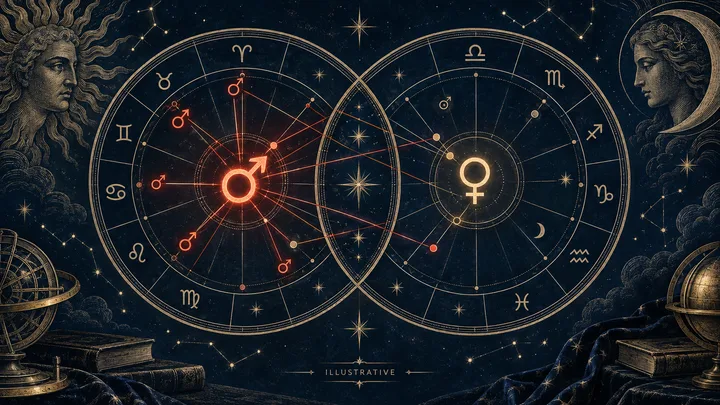
Read many Mars contacts with little Venus emphasis as a bond with a strong engine, not a finished love story. Mars describes pursuit, desire, initiative, friction, and the way two people act on one another. Venus describes attraction with pleasure, affection, values, and the ease of receiving care. When Mars dominates, chemistry may be obvious while tenderness stays harder to name. Start with the tightest Mars contact and the planet it activates. Then audit Venus by sign, degree, and aspect. Use the Moon for emotional receptivity, Mercury for repair language, and Saturn for pace, limits, and staying power. One close Venus contact can outweigh several loose Mars contacts because function and exactness matter more than a raw count. Your next step is to ask what happens after the spark: does the connection create care, or only another round of pursuit?
The short answer: Mars gives the bond motion, Venus gives it pleasure
Many Mars contacts can make a connection feel immediate. Someone reaches out first. A conversation turns physical. A small disagreement carries more charge than the subject deserves. Mars brings heat, courage, pursuit, and friction. It shows how the relationship moves.
That movement doesn't tell you everything about affection. Venus shows how each person enjoys closeness, offers appreciation, receives pleasure, and expresses values. A Mars-heavy chart may therefore feel compelling while leaving a quieter question behind: what makes this bond pleasant when nobody is chasing, proving, or arguing?
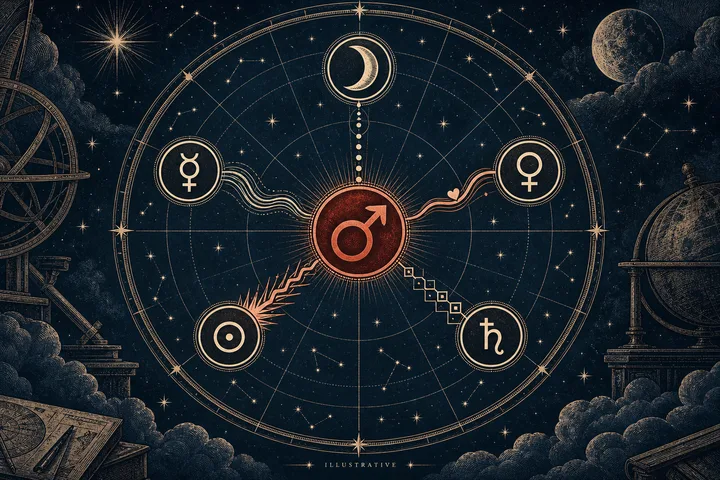
Read the chart in that order. First identify the Mars contacts. Then ask whether they activate desire, feeling, words, identity, or limits. After that, find the Venus factor that gives the heat a softer place to land. The Moon can make desire emotionally receptive. Mercury can help the pair speak after friction. Saturn can turn effort into reliability.
Astrodienst describes synastry as a comparison of two horoscopes, where interaspects show how the charts meet. Its central lesson helps here: don't treat the wheel as a scorecard. The contacts are a pattern. Your job is to decide which contacts are closest, which answer the reader's question, and which merely repeat a theme.
This article uses supplied placements and optional degrees. The Synastry Comparison Report can organize Moon, Venus, and Mars placements and selected major aspects under a six-degree orb. It doesn't calculate natal positions from birth details, add houses, or turn the comparison into a compatibility grade. If degrees are missing, compare sign roles and mark exact aspects as unconfirmed.
Sources: Synastry - Astrodienst Astrowiki; Synastry: Venus-Mars Aspects Between Two Charts; Synastry: Moon-Mars Aspects
Rank Mars by what it touches, not by how many lines you see
Begin with the closest Mars contact. An aspect is the angular relationship between two chart factors; its orb is the distance from the exact angle. A one-degree contact deserves more attention than a six-degree contact when both speak to the same question. A wide contact may still add color, but it shouldn't lead the reading simply because it appears on the grid.
Next, group Mars by the receiving planet. Mars-Moon brings instinct and feeling close to the surface. It can feel protective, erotic, reactive, or all three. Mars-Mercury gives conversation speed and bite. It can produce lively problem-solving, but it can also turn a question into a contest. Mars-Sun activates will, confidence, and leadership. It may encourage action or provoke a fight over who gets to decide.
Mars-Venus is the clearest bridge between desire and romantic attraction. A conjunction blends the two functions. A trine or sextile can let pursuit and affection cooperate with less strain. A square or opposition can bring strong attraction with mismatched timing or style. The attraction is real in the symbolism, but the contact still asks for translation. One person may move faster. The other may need a gentler invitation.
Mars-Saturn changes the question again. Mars wants movement; Saturn brings timing, limits, responsibility, and endurance. A flowing contact can help initiative become dependable. A tense contact can feel like pressure meeting a brake. That is not the same as little Venus. It is a story about how desire meets permission and structure.
Write each leading contact in one sentence: whose planet acts, what it touches, what behavior it may stir, and what response would help. 'Her Mars activates his Moon, so her direct approach stirs his feelings; he needs room to name the reaction before she presses for an answer.' This keeps the reading mutual. It describes an exchange, not a guilty person.
Sources: Synastry - Astrodienst Astrowiki; Synastry: Venus-Mars Aspects Between Two Charts; Synastry: Moon-Mars Aspects
Audit Venus before you call the chart Venus-light
Little Venus emphasis can mean Venus is genuinely quiet. It can also mean Mars contacts are tighter, Venus contacts were omitted from a selected report, or Venus is speaking through sign style rather than a close cross-chart aspect. Inspect first. Count later.
Start with each Venus sign. The sign describes the style of affection and pleasure. An earth Venus may value steadiness, touch, practical help, and a comfortable rhythm. An air Venus may need conversation, wit, and room to think. A fire Venus may answer warmth, enthusiasm, and direct admiration. A water Venus may seek privacy, tenderness, and emotional attunement. These are interpretive starting points, not fixed labels.
Then compare Venus with the other person's Moon, Sun, Mercury, angles, and Saturn, if those placements and degrees are actually supplied. Venus-Moon can help affection reach emotional needs. Venus-Sun can bring appreciation. Venus-Mercury gives care a voice. Venus-Saturn can make affection deliberate and loyal, though it can also introduce reserve or criticism. A quiet Venus may still support the whole reading through one close contact.
Keep sign resonance separate from degree-based evidence. Two Venus signs may share an element or understand one another's pace without forming a major aspect. That can describe a shared style. It doesn't prove an exact connection. Likewise, two planets in the same sign aren't automatically conjunct. Without degrees, say what the signs suggest and leave the aspect ranking open.
The practical Venus test is simple. Watch what happens when desire is unavailable. During a tiring week, a long-distance stretch, or an ordinary evening with no sexual charge, how do you offer pleasure and appreciation? Do you recognize the other person's care when it arrives as a meal, a plan, a compliment, a task, or quiet company? Venus becomes visible in these choices. Mars may get you together, but Venus shows what you enjoy doing there.
Sources: Synastry - Astrodienst Astrowiki; Synastry: Venus-Mars Aspects Between Two Charts; Mars Saturn Aspects in Synastry
Use the Moon, Mercury, and Saturn to find the soft landing
Once Mars has been ranked and Venus has been audited, ask what the relationship can hold. The Moon describes instinctive comfort and emotional rhythm. Mercury describes how the pair names what happened. Saturn describes time, boundaries, and the work of keeping a promise. These planets don't replace Venus. They show whether affection can be received, understood, and sustained.
A close Mars-Moon contact is the important exception to a purely physical reading. Mars can stir the Moon's emotional body, so the bond may feel intimate because reactions are immediate and personal. The same contact can make one person feel pushed or exposed. Look at the sign, aspect, orb, and direction. Then watch the first minute after tension: does the couple slow down enough for the feeling to become speakable?
Mercury supplies the repair route. Mars-Mercury can make talk bright and brave, but it can also make every disagreement feel like a race. A useful practice is to ask one question without attaching a counterargument. That small change lets Mercury describe the feeling instead of helping Mars win the exchange.
Saturn supplies the terms. In a supportive contact, predictability and effort can give Mars somewhere to go. In a tense contact, one person may feel blocked while the other feels burdened or judged. Name the limit plainly. Decide who needs more time, what counts as a welcome approach, and how both people will return to the subject. Saturn is useful when responsibility stays mutual.
A chart can show a resource without showing that the couple uses it. So compare the symbols with ordinary behavior. After a charged encounter, do you reassure each other, pause, repair, or reunite physically and skip the original problem? The last option may restore closeness for a moment. It doesn't necessarily change the pattern. The soft landing is the action that lets desire return without requiring another crisis.
Sources: Synastry - Astrodienst Astrowiki; Synastry: Moon-Mars Aspects; Mars Saturn Aspects in Synastry
Worked example: strong chemistry, sharp reactions, and a quiet Venus layer
Imagine Maria and Daniel comparing supplied placements. Their report shows Maria's Mars conjunct Daniel's Venus within two degrees, Maria's Mars square Daniel's Moon within four degrees, Daniel's Mars trine Maria's Sun within three degrees, and Daniel's Mars conjunct Maria's Mercury within one degree. The report contains no houses and doesn't calculate extra positions from birth details.
The first reading is clear attraction with a high activation level. Maria's Mars on Daniel's Venus joins pursuit with romantic receptivity, so the contact deserves priority. It doesn't set their pace for them. Daniel may enjoy being pursued and still need time to decide what kind of closeness feels right. Maria may experience direct initiative as honesty while Daniel experiences it as intensity.
Mars square Moon explains the likely complication. Maria's actions stir Daniel's emotional body in a tense way. He may want contact, then need quiet. She may read the retreat as rejection and push for clarity, which increases his defensiveness. The chart doesn't declare either person wrong. It gives them a loop to observe.
Daniel's Mars trine Maria's Sun supports confidence and shared action. His initiative may help her feel visible, and they may work well side by side. His Mars conjunct her Mercury adds quick, charged conversation. They could text for hours and still miss the feeling underneath the argument. Their repair needs a pause and one clean question.
The Venus layer is quiet in this supplied set, not absent from their lives. They should compare Venus by sign and inspect any Venus-Moon, Venus-Mercury, Venus-Saturn, or angle contacts that the report doesn't include. If degrees are unavailable, those possibilities stay open. The useful conclusion is not 'they lack love.' It is 'their attraction is easy to notice, while their habits of appreciation need deliberate attention.'
Their next conversation could be: 'When I take the lead, what feels exciting, and what feels like pressure?' Then: 'When you need quiet, what would help me feel reassured rather than dismissed?' Each person should name two visible forms of affection they recognize. The chart identifies the heat. Their answers show whether Venus has a place in the room.
The strongest exception and the conversation to have next
The strongest exception is one exact Venus contact that a raw count misses. Venus on an angle, Venus with the Moon, or Venus with Saturn can quietly organize the relationship even when Mars supplies most of the visible lines. Astrodienst also stresses that individual charts matter before synastry is interpreted. A partner can activate a natal Venus story that this placement-only comparison cannot see.
That exception doesn't undo the ranking. It refines it. Keep three columns: confirmed close contact, supporting sign pattern, and unconfirmed possibility. Place a one-degree personal-planet contact in the first column. Place a shared Venus element in the second. Put an angle or natal claim there only when the needed degrees and chart scope are available. This prevents a compelling possibility from posing as calculated evidence.
The governing judgment is firm: many Mars contacts describe activation, not a complete account of affection. Don't let the number of lines turn chemistry into proof of tenderness. Don't let a quiet Venus become proof of emptiness. Rank function and exactness first. Then look at what the couple actually does when the chase stops.
Bring that question into the conversation: 'What helps this attraction feel affectionate and safe when neither of us is pursuing, debating, or recovering from a fight?' Listen for an action, not a mood. It might be a slower invitation, a clear boundary, a plan for the next meeting, a reassuring touch, or ten minutes to cool down before returning.
If you want the comparison organized, use the supplied Moon, Venus, and Mars signs, adding degrees where you know them, in the Synastry Comparison Report. It can sort selected major contacts under the stated six-degree orb. It won't calculate a natal chart or houses from birth details. Start with the loudest Mars contact, find the missing support, and test one response together.
Sources: Synastry - Astrodienst Astrowiki; Synastry: Venus-Mars Aspects Between Two Charts; Synastry: Moon-Mars Aspects; Mars Saturn Aspects in Synastry
A little more clarity
Does many Mars contacts and little Venus mean there is no love?
No. It means activation, desire, pursuit, or friction is easier to see in the supplied synastry pattern than ease and affection. Check Venus by sign, degree, and contact, then read the Moon, Mercury, and Saturn for receptivity, repair, and steadiness. One close Venus contact can matter more than several loose Mars contacts. The real question is whether the pair turns heat into care when the chase is over.
Sources & further reading
- Synastry - Astrodienst Astrowiki
Supports synastry as a comparison of two horoscopes and the need to read personal planets, Saturn contacts, and the individual charts together.
- Synastry: Venus-Mars Aspects Between Two Charts
Supports the Venus-Mars attraction distinction and the different expressions of conjunction, square, opposition, trine, and sextile.
- Synastry: Moon-Mars Aspects
Supports reading Mars-Moon as an emotionally immediate contact that can bring attraction, reactivity, and a need for sensitivity.
- Mars Saturn Aspects in Synastry
Supports the contrast between restrictive and stabilizing Mars-Saturn expressions and the importance of natal condition.
Synastry Comparison Report
Enter known placements for two people. Get an input-by-input comparison, selected aspect calculations and a clear record of what remains uncertain.
Compare our placements