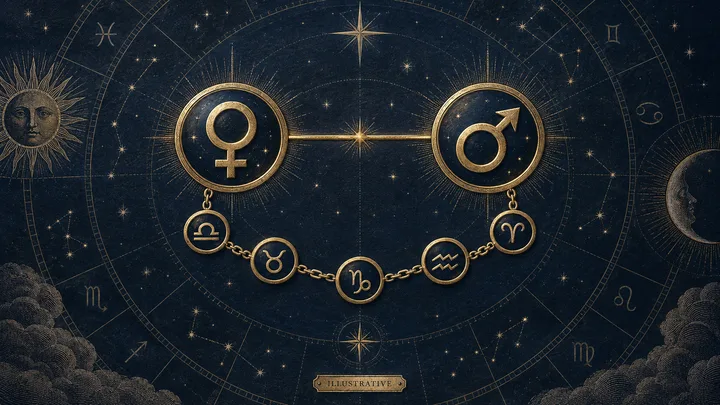
The contact comes first, and the chain comes second
Imagine Maria has Venus in Libra and the man she is seeing has Mars in Aries. If the degrees place them in opposition within the chosen orb, that opposition is the first statement in the reading. It describes a direct Venus-Mars exchange: attraction, pursuit, response, and the friction that can arise when one person’s way of seeking closeness meets the other person’s way of acting on desire. The signs add style. Libra Venus may seek grace, reciprocity, and a pleasant social rhythm. Aries Mars may move quickly, plainly, and with little patience for hints. The aspect tells you these two principles face each other across the synastry wheel. The chain then asks what directs Libra Venus and Aries Mars in their own charts.
A dispositor is the planet that rules the sign another planet occupies. Venus in Libra is disposed by Venus because Venus rules Libra. Mars in Aries is disposed by Mars because Mars rules Aries. Each planet sits in its own sign in this narrow illustration, so each is a strong endpoint. That does not turn the opposition into a promise of ease. It tells you that both sides have direct access to their own nature. Maria’s Venus can speak in Venusian terms. His Mars can act in Martian terms. The contact stays live because the planets still oppose one another.
The distinction becomes even clearer when the planets are not in their own signs. Venus in Taurus has Venus as its dispositor, so its values have a direct channel. Venus in Gemini answers to Mercury, so affection may depend more on language, variety, and the way a person makes meaning. Mars in Capricorn answers to Saturn, which can make action more deliberate, strategic, or aware of consequences. These are not replacements for Venus or Mars. They are the conditions through which those planets try to operate.
You can also compare the role each planet plays in the contact. When one person’s Venus meets the other person’s Mars, the Venus person may experience the Mars person as active, compelling, or physically expressive, while the Mars person may respond to the Venus person’s charm and receptivity. Reverse the planets and the emphasis shifts. This is why a chain should be traced separately for each person. A single shared label such as “Venus-Mars chemistry” hides who is carrying which function and how each function gets directed.
There is another reason to keep the contact visible: synastry is relational by nature. Person A’s Venus does not become Person B’s Mars, even when the two placements fall in signs ruled by related planets. Each person brings a natal pattern, and the interaspect describes the exchange between those patterns. The dispositor belongs to the planet’s own chart first. Only after you understand that internal route should you ask how it meets the other person’s route. This keeps the reading personal without making it presumptuous.
This order matters. If you begin with the chain, you may drift into a story about the final dispositor and forget the actual relationship between the two people’s planets. If you begin with the contact, the chain has a job. It explains how the contact is likely to express, where it draws support, and where it may lose force. The contact is the meeting. The dispositor is the route each planet takes to reach that meeting.
Astrodienst defines a dispositor as the ruler of the sign in which another planet is placed, and notes that the dispositor’s sign, house, and general condition help interpret the planet it receives. Its chain reference presents the technique as a schematic relationship between planets, with arrows moving from a planet to the ruler of its sign. Those definitions give us a sound working image: Venus or Mars is not erased by the chain. Its expression is colored by the planet receiving its report. [1][2]
Cafe Astrology’s synastry guide gives Venus-Mars interaspects priority as classic indicators of romantic and physical attraction, while separating the easier flow of sextiles and trines from the friction of squares and oppositions. Its Mars discussion also keeps Mars from carrying a whole relationship by itself. Mars can show desire, assertion, and conflict, but it does not by itself describe a need to remain together. That is exactly why the chain belongs after the contact. It adds texture to the planet pair instead of pretending to settle the entire chart. [3]
For your notes, write the contact in one line: Person A Venus, sign and degree if known; Person B Mars, sign and degree if known; aspect; orb. Then write each planet’s dispositor below it. This keeps the symbolic explanation from becoming the relationship’s main evidence.
A dispositor chain refines a Venus or Mars synastry contact by showing where that planet’s sign expression reports for direction. It can explain why a warm Venus-Mars trine feels cautious, why a sharp square becomes productive, or why attraction keeps returning to one shared theme. It can’t replace the contact itself. Start with the interaspect: identify the planets, signs, aspect, and orb. Then trace each planet to its sign ruler, and continue until you reach a planet in its own sign or a loop. Finally, compare the chain’s condition with the direct contact. A strong shared ruler can give the connection a common language. A strained ruler can describe where desire or affection gets stuck. The reading becomes most useful when you turn that distinction into an observable question: how do you actually show interest, handle timing, and respond after friction? This report compares supplied Moon, Venus, and Mars placements, optional degrees, and selected major aspects using a six-degree orb. It does not calculate natal charts or houses from birth details.
Sources: Dispositor - Astrodienst Astrowiki; Chain of Dispositors - Astrodienst Astrowiki; Synastry: Venus-Mars Aspects Between Two Charts - Cafe Astrology; Dispositor - Skyscript Glossary
Why the chain feels like a hidden explanation
The dispositor chain is appealing because sign descriptions can feel too flat. Venus in Virgo may be described as careful, useful, and selective. Mars in Sagittarius may be described as candid, adventurous, and restless. Those words help, but they do not show what happens when the planets need to act. The ruler gives the sign a living channel. If Venus in Virgo answers to Mercury in Scorpio, affection may become more observant, private, and probing than a simple Virgo label suggests. If Mars in Sagittarius answers to Jupiter in Taurus, pursuit may need tangible proof, time, and physical steadiness before enthusiasm becomes a plan.
That added layer can change the question. Instead of asking, “Is Virgo Venus compatible with Sagittarius Mars?” ask, “What planet directs Virgo Venus, what planet directs Sagittarius Mars, and how do those two directors relate?” The contact describes attraction and friction. The chain describes the habits, values, or decisions through which that attraction finds a form.
This prevents sign stereotypes from doing too much work. A person with Venus in Virgo may not show care through criticism or constant correction. If Mercury, its dispositor, is in Libra, the person may work hard to keep affection civil and balanced. If Mercury is in Scorpio, the same Venus may need emotional honesty and trust before it can relax. The Virgo placement remains. The ruler tells you what kind of attention the placement seeks when the relationship becomes personal.
The same care applies to Mars. Sagittarius Mars is not automatically careless, just as Capricorn Mars is not automatically cold. Follow the ruler. Jupiter in Pisces may move through compassion, imagination, and faith. Jupiter in Virgo may act through service, analysis, and the wish to make an improvement. When Mars meets another person’s Venus, these differences can explain why one person calls a gesture romantic while the other calls a different gesture proof of desire.
The chain can also reveal a mismatch between what attracts and what sustains. A direct contact may be vivid because Venus and Mars recognize each other, while their dispositors lead toward very different environments. One route may need privacy and emotional depth. The other may need public movement and constant novelty. The contact explains the spark. The chains explain why the spark may need a particular setting before it becomes warmth rather than restlessness.
Consider a supplied comparison in which Venus answers to Mercury and Mars answers to Jupiter. The first question is not whether Mercury and Jupiter sound harmonious. It is what they make easier. Mercury in Libra may route affection through tact, naming, and a wish to keep the exchange fair. Jupiter in Gemini may route desire through curiosity, humor, and movement between ideas. The pair may recover warmth by talking, but they may also talk around the decision that needs to be made.
Change the rulers without changing the Venus-Mars contact. Mercury in Cancer may need emotional continuity before affection settles, while Jupiter in Capricorn may turn desire toward proof, timing, and responsibility. The pair may recover warmth through a plan they can keep. That route can steady the bond, but it can also become guarded if no one says what the plan is meant to protect. The direct aspect has not changed. The route has.
Used well, the chain turns a sign-pair reading into a comparison of mechanisms. Lay the two versions beside each other and ask which one matches what you observe. Do conversations open the door? Does practical reliability matter more than verbal chemistry? Does desire surge when life feels spacious, or when a concrete task brings you together? The chart language points toward those questions. It does not invent an answer from missing placements.
Read the layers as different questions. Venus asks what feels valuable and how affection is offered. Mars asks how desire moves and how a person asserts. The aspect asks what happens when those functions meet. The dispositor asks what each function answers to before it reaches the other person.
Sources: Dispositor - Astrodienst Astrowiki; Chain of Dispositors - Astrodienst Astrowiki; Synastry: Venus-Mars Aspects Between Two Charts - Cafe Astrology
How to trace Venus and Mars through their rulers
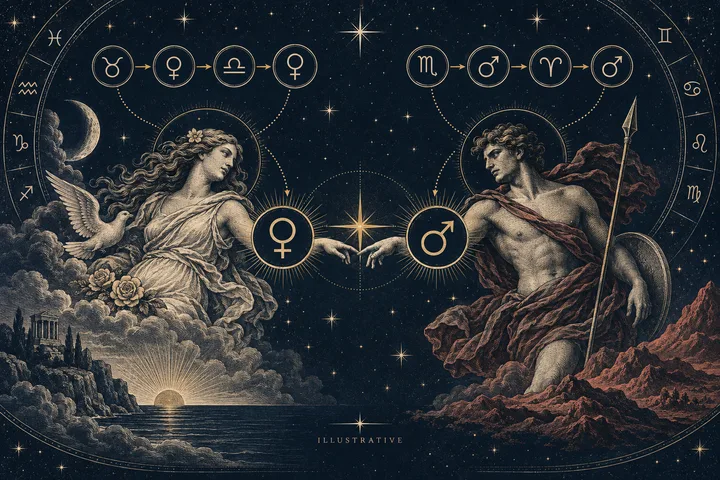
Start with sign rulership. In the traditional scheme, Mars rules Aries and Scorpio, Venus rules Taurus and Libra, Mercury rules Gemini and Virgo, the Moon rules Cancer, the Sun rules Leo, Jupiter rules Sagittarius and Pisces, and Saturn rules Capricorn and Aquarius. Modern astrologers may use Uranus, Neptune, or Pluto as rulers for Aquarius, Pisces, or Scorpio, or use traditional and modern rulers together. Choose the system before you trace the chain. A mixed rulebook can produce a chain that looks precise but changes its destination halfway through.
Next, make an arrow. Venus in Virgo goes to Mercury. If Mercury is in Scorpio, Mercury goes to Mars under traditional rulership. If Mars is in Taurus, Mars goes to Venus. You have a loop: Venus to Mercury to Mars to Venus. A chain does not always end at one final dispositor. It may close into mutual reception or a larger circuit. Astrodienst describes mutual reception as the special case in which each planet disposes the other, and its chain material notes that planets in reception point toward each other. [1][2]
The useful question is not, “Which planet wins?” Ask, “What themes keep receiving the matter?” In the Venus-Mercury-Mars loop above, affection, language, and action pass the concern around. A disagreement about timing may become a conversation. The conversation may become a challenge. The challenge may revive desire. That is an interpretive possibility, not a forecast. You test it against the actual behavior of the pair and against the rest of the supplied placements.
Then inspect condition. A dispositor in its own sign has a direct relationship with its nature. A dispositor in a sign that strains its expression may still work, but it may need more effort or another planet’s support. Skyscript describes the dispositor as a manager of affairs and says its general condition can affect the planet in its sign. That language is useful if you keep it proportional. A difficult dispositor can show a bottleneck. It does not cancel a beautiful Venus trine or manufacture a hostile one. [4]
Watch for branches when several planets occupy the same sign. If Venus and Mercury are both in Virgo, they may both point to Mercury’s next link, while Mars in Leo points to the Sun on a separate route. Don’t force every branch into one winner. Read the branch attached to the planet you’re studying, then note where another branch joins it or stays apart. A Venus question may gather around Mercury, while a Mars question gathers around the Sun, even in the same chart. If two planets dispose each other, mark the loop as a relationship between them rather than hunting for a final endpoint. Astrodienst’s chain reference treats domicile planets as the beginning of a branch and planets in reception as pointing toward one another. [1][2]
Houses can add another layer when accurate birth times are available, because the dispositor’s house can show where the sign’s concerns are carried. But this article’s report boundary is narrower. It uses supplied placements, optional degrees, and selected major aspects. It does not calculate houses from birth details. If you know a house placement from a trusted chart, you may discuss it separately. Do not smuggle it into a sign-only comparison as though the report calculated it.
Keep a visible chain table in your notes. Put the planet at the left, its sign beside it, the sign ruler next, and the ruler’s sign after that. Stop at domicile or mark a loop. Circle the first planet that directly disposes Venus or Mars. Underline the endpoint only after you have written the original contact. This method is plain on purpose. It makes a dramatic interpretive claim earn its place on the page.
Sources: Dispositor - Astrodienst Astrowiki; Chain of Dispositors - Astrodienst Astrowiki; Dispositor - Skyscript Glossary
A worked comparison: the same contact, two different chains
Here is the comparison in full. It is an illustrative example, not a calculated personal chart. Person A has Venus at 14 degrees Virgo. Person B has Mars at 16 degrees Sagittarius. The angular distance between those placements is about 92 degrees, so the contact is a Virgo-Sagittarius square with an orb of about two degrees. Under the report’s six-degree rule, that is a close major synastry aspect. The starting interpretation is direct: Person A’s way of giving and receiving affection meets Person B’s desire and pursuit through tension between detail and expansion.
Person A’s Venus in Virgo may want care to show itself in useful acts, discernment, and attention to what can be improved. Person B’s Mars in Sagittarius may want movement, candor, room to act, and a goal that feels larger than the immediate moment. A square creates friction, but friction is not the same as absence. The two planets engage. One person may find the other compelling because the other brings a quality that is hard to ignore. The same quality may later irritate them when the relationship asks for ordinary cooperation.
Version one gives Person A Mercury in Libra as Venus’s dispositor and Person B Jupiter in Gemini as Mars’s dispositor. Mercury and Jupiter both carry an air-sign route in this example. The square may then find relief through language and perspective. Person A might ask for a balanced conversation before feeling close. Person B might regain desire when the relationship stays curious and mentally alive. Their practical decision is to make the difficult topic discussable before either person turns it into criticism or evasion.
Version two gives Person A Mercury in Cancer and Person B Jupiter in Capricorn. Again, the Venus-Mars square is unchanged. But the route is more guarded and concrete. Person A may need emotional continuity before affection feels safe. Person B may translate desire into responsibility, scheduling, or measurable progress. The practical decision is different: the pair should define what reliability looks like, how quickly plans become real, and what happens when one person needs reassurance while the other reaches for control.
Compare the routes by asking what each one makes easier and what it asks the couple to practice. Mercury in Libra and Jupiter in Gemini may give the square a quick mental bridge, but a quick bridge can become endless analysis if no one chooses. Mercury in Cancer and Jupiter in Capricorn may offer continuity and follow-through, but those qualities can harden into caution or control when feelings stay unnamed. The dispositor condition is not a grade for either person. It tells you where the contact may find help and where its preferred method could become excessive. That is why the same chain can look supportive in one situation and demanding in another.
Which version is more useful? Choose the one that matches the recurring scene, not the one with the prettier symbolism. In the first version, watch whether a difficult exchange becomes clearer after both people speak. In the second, watch whether reassurance and a kept plan lower the temperature. The chain has refined the question from “what does this aspect mean?” to “what lets this aspect work here?” That is a stronger use of astrology because it gives you something to notice and compare.
The two versions also show what the chain cannot decide. It can identify a likely channel, but it cannot tell you whether either person will use that channel well. Talk can become endless analysis. Steadiness can become control. If you are comparing known placements, ask which practice you can both sustain and what would show that it is helping. The lived pattern ranks the interpretation.
Consider an example from an ordinary week. The pair plans dinner, one person changes the time, and the other goes quiet. The direct square describes the live tension between desire and response. The first chain may suggest that a clear conversation restores warmth, so the useful test is whether they name the change and renegotiate. The second chain may suggest that reassurance and a firm plan matter more, so the useful test is whether they acknowledge the disappointment and set a time they can keep. The event is the same. The astrological emphasis changes the question you ask about it. That is refinement in practice: not a new verdict, but a more exact way to notice the contact at work.
Now test the strongest exception. Suppose the same square has a dispositor that looks well placed, but the direct contact is wide, outside the six-degree rule, or based only on sign resemblance with no degree connection. The chain can still describe each person’s natal pattern if you have the complete charts, but it cannot be promoted into a synastry contact. The chain refines a bridge that exists. It does not build the bridge by itself.
That exception keeps the method useful. If your inputs contain signs but no degrees, discuss the sign-based theme and mark the exact major-aspect status as unconfirmed. If degrees are supplied, calculate the distance and record the orb. Then let the example earn its place by explaining a recurring exchange, a repair, or a choice. Precision gives the interpretation a floor. The pattern you can actually recognize gives it weight.
Sources: Chain of Dispositors - Astrodienst Astrowiki; Synastry: Venus-Mars Aspects Between Two Charts - Cafe Astrology; Dispositor - Skyscript Glossary
Degrees, orbs, and the limits of a beautiful chain
A synastry interpretation becomes sharper when you know degrees. An aspect is an angular relationship between two chart points. A conjunction is near zero degrees, a sextile near 60, a square near 90, a trine near 120, and an opposition near 180. The orb is the difference between the exact angle and the actual distance. AstroNet’s guide gives the simple formula as the absolute difference between the actual distance and the exact aspect angle. That is enough for a careful placement comparison. [5]
The report uses a six-degree maximum for selected major contacts. Treat that as a working boundary, not a universal law. Astrology traditions use different orb practices. Skyscript explains that traditional astrologers may work with planetary rays and that modern astrologers often use broader allowances for major aspects, with narrower allowances for smaller ones. AstroNet likewise says there is no universal orb rule and that a consistent method matters. Astrodienst also describes synastry as a reason to use a smaller orb than in a single natal chart. In this report, the six-degree rule keeps the comparison selective and prevents every nearby sign from becoming a dramatic connection. [4][5][6]
When degrees are available, write them in full before naming the aspect. “Venus 14 Virgo, Mars 16 Sagittarius, square, 2-degree orb” is stronger than “Virgo and Sagittarius are intense together.” The first sentence can be checked and ranked. The second may be a useful sign impression, but it has no stated geometry. This habit makes it easier to compare several contacts without letting a glamorous dispositor story outrank the closest valid interaspect. Geometry first. Meaning second. Chain third.
A close contact deserves attention before a distant supporting aspect, but closeness never decides meaning by itself. A 1-degree Venus-Mars trine generally comes before a 5-degree Venus-Mercury sextile when the question is attraction. The planets still determine what kind of attention each contact deserves.
Sign-based aspects have their place. Many astrologers read planets in signs that relate by element or mode even before degrees are known. Use that layer honestly. Say that the signs suggest a square relationship in the zodiac, then say that the exact degree orb remains unknown. This lets the reader keep the symbolic pattern without confusing a broad sign relationship with a measured interaspect. The chain works the same way: it can describe the sign’s ruler, but it cannot supply missing precision.
The same degree number does not name an aspect by itself. Venus at 15 degrees and Mars at 15 degrees form a same-degree conjunction only when their signs place them together. Put those placements in opposite signs and they describe an opposition instead. Once the signs establish the geometry, compare exactness: Venus at 15 degrees and Mars at 15 degrees is closer than Venus at 15 degrees and Mars at 20 degrees within the same aspect. Exactness is not a score for love. It tells you how close the geometry is, while the planets, signs, rulers, and wider chart tell you what it means.
This is where a dispositor chain can tempt a reader into overreach. You may find Venus in a sign ruled by a planet that forms a dazzling aspect to the other person’s Moon. You may find Mars’s ruler in the other person’s Venus sign. Those are interesting connections. They may describe a sympathetic route. But they remain secondary unless the actual cross-chart relationship is defined and supported by the inputs. A chain can strengthen your confidence in a reading’s texture. It cannot turn a possibility into a calculated contact.
When degrees are missing, list the known placements, mark degree-dependent aspects as unconfirmed, and then trace the available dispositors. Keep the rank clear: direct contact first, sign context second, dispositor refinement third. The result is narrower, but it gives the reader a clean place to continue when better inputs arrive.
A chain can be long, too. If you trace through five or six planets, pause. The extra links may add a broad chart theme, but they often reduce the clarity of a Venus or Mars question. iHorary’s current glossary notes that chains are usually short and that loops should be checked rather than treated as failed endpoints. For a relationship comparison, two or three meaningful steps are usually enough to identify the active channel. [8]
Sources: Dispositor - Astrodienst Astrowiki; Dispositor - Skyscript Glossary; Astrological Orbs Explained - AstroNet; Interaspect - Astrodienst Astrowiki; Orbs (or rays) - Skyscript Glossary; Dispositor Chain in Horary Astrology - iHorary
How to turn the refined reading into a relationship decision
The value of this technique appears after the symbols. Suppose your Venus-Mars contact looks easy, but the dispositors point to different needs. You may feel real attraction and still disagree about pace, privacy, money, social life, or how much initiative each person should take. The chart does not ask you to deny the chemistry. It helps you name the conditions that let chemistry become a livable bond.
This is especially helpful for women reading a man’s Mars in synastry, because attraction can make a sharp approach feel meaningful before you know whether it is respectful. Astrology can describe the charge between Venus and Mars. It cannot give you permission to ignore your own boundary. If his Mars activates your Venus but his actions push past a clear no, the practical reading is not to explain the behavior away through a dispositor. Your boundary remains the clearest fact in the room.
The chart can still help you phrase the next question. If his Mars dispositor is Mercury, ask whether he can talk plainly about pace and consent. If it is Saturn, ask whether his reliability appears in repeated actions, not only promises. If it is Jupiter, ask whether enthusiasm includes room for your limits. These are interpretive prompts, not claims about his private motive. They keep the astrological language attached to what you can actually see.
You can make the decision aid even more practical by tracking one repeated moment. Notice what happens when plans change. Does affection become criticism? Does desire become pressure? Does someone explain, repair, and try again? The dispositor gives you a language for the pattern, while the repeated moment gives you evidence from the relationship itself. If the chain points toward communication but no one communicates, the interpretation has reached its limit. If it points toward steadiness and steadiness appears in practice, the chart’s refinement has found a living expression.
Start with the Venus person’s observable need. What makes affection feel real? Is it a thoughtful message, a plan made in advance, physical presence, shared beauty, practical help, or room to choose? Then ask how that need relates to Venus’s dispositor. If Venus answers to Mercury, words and interpretation may matter. If Venus answers to Saturn, consistency and boundaries may carry more weight. If Venus answers to Mars, desire and initiative may be braided into the experience of being loved.
Then read the Mars person’s route to action. What turns desire into movement? Mars may act through direct pursuit, work, courage, pleasure, conversation, protection, or a larger goal, depending on its sign and ruler. Ask what happens when action is blocked. Does the person talk, withdraw, press harder, make a plan, change the subject, or seek a fresh horizon? Those are useful observations because they let you test the dispositor chain without asking it to reveal another person’s hidden intentions.
Now compare the two routes at the point of contact. A Venus-Mars trine whose dispositors cooperate may feel easy to enact. A Venus-Mars square whose dispositors connect through Mercury may turn conflict into a conversation, but it may also create too much talking. A Venus-Mars opposition with dispositors in mutual reception may show a strong relational loop, but the pair still has to manage timing and difference. The chain refines the task. It does not complete it for you.
Make one conversation from the reading. Keep it concrete. “When I feel close, I need plans that become real.” “When I want you, I move fast, but I don’t want my speed to decide the whole relationship.” “I hear the attraction, and I also want to know how we handle a no.” These sentences do more than a label. They let both people answer. They bring the astrological pattern into choice, where synastry becomes useful.
Keep the question small enough to answer. Ask what happened, what each person needed, and what will change next time. A dispositor chain is most helpful when it turns a large feeling into one clear exchange, one visible promise, or one boundary you can revisit.
Use the report as a prompt for this comparison. Enter the Moon, Venus, and Mars signs you already know, add degrees when available, and read selected major contacts within the six-degree orb. Then choose one practice to test for a week. If the direct contact and chain describe a pattern you can both work with, repeat the practice and watch the follow-through. If the symbols look promising but the lived pattern stays one-sided, believe what you can observe.
Sources: Dispositor - Astrodienst Astrowiki; Synastry: Venus-Mars Aspects Between Two Charts - Cafe Astrology; Dispositor - Skyscript Glossary; Astrological Orbs Explained - AstroNet
A little more clarity
Can a dispositor chain create a Venus-Mars synastry aspect?
No. The Venus-Mars aspect must be established directly between the two charts, by sign and, when available, by degree and orb. The dispositor chain explains how Venus or Mars may express inside its sign. It can add a shared theme, a supporting route, or a bottleneck. It cannot replace the cross-chart contact or turn a missing contact into a present one.
What if Venus and Mars have no degrees?
You can compare their signs and trace their dispositors, but you should not claim a tight conjunction, square, trine, sextile, or opposition without degree data. Record the sign-based reading as a possibility and mark the exact aspect status as unconfirmed. Once degrees are supplied, calculate the angular distance and apply the stated six-degree maximum for the selected major contact.
Should I use traditional or modern rulers for a dispositor chain?
Choose one rulership system and state it before tracing the chain. Traditional rulership gives Mars Aries and Scorpio, Jupiter Sagittarius and Pisces, and Saturn Capricorn and Aquarius. Many modern astrologers also use Uranus, Neptune, and Pluto for Aquarius, Pisces, and Scorpio. You can compare both systems when a placement is involved, but don’t switch systems silently or treat two different endpoints as one settled answer.
What is the most useful question after reading the chain?
Ask how the direct Venus-Mars pattern becomes visible in ordinary life. What shows affection? What turns desire into action? How do you handle pace, refusal, frustration, and repair? Then ask whether the dispositor chain supports that route or describes where it gets stuck. The best reading gives you a conversation and a practice, not a verdict about the relationship’s future.
Sources & further reading
- Dispositor - Astrodienst Astrowiki
Defines a dispositor, explains its influence on a planet, and describes final dispositors and mutual reception.
- Chain of Dispositors - Astrodienst Astrowiki
Describes the arrow-based chain method and the role of domicile and reception in tracing it.
- Synastry: Venus-Mars Aspects Between Two Charts - Cafe Astrology
Explains Venus-Mars attraction, differences among major aspects, and the friction that can accompany desire.
- Dispositor - Skyscript Glossary
Explains sign rulership, dispositor condition, reception, and how a dispositor can support or weaken expression.
- Astrological Orbs Explained - AstroNet
Defines aspect orbs, shows the angular-distance formula, and explains why synastry orbs should be applied consistently.
- Interaspect - Astrodienst Astrowiki
Defines an interaspect in synastry and recommends a smaller orb when comparing two charts.
- Orbs (or rays) - Skyscript Glossary
Compares modern aspect orbs with traditional planetary rays and explains application and separation.
- Dispositor Chain in Horary Astrology - iHorary
Explains chain endpoints, loops, short chains, and why a chain should remain contextual rather than decisive.
Synastry Comparison Report
Enter known placements for two people. Get an input-by-input comparison, selected aspect calculations and a clear record of what remains uncertain.
Compare our placements