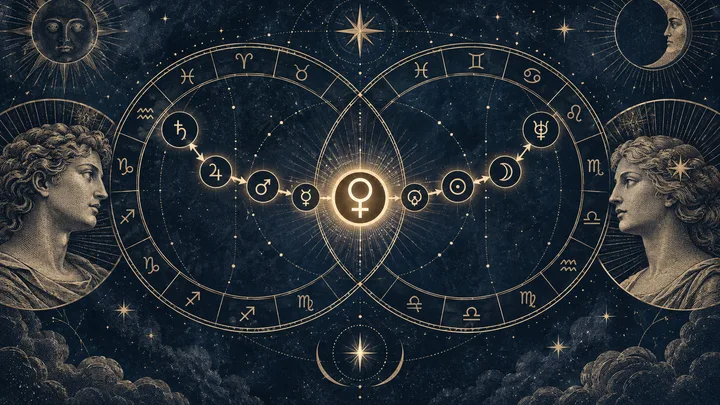
A dispositor chain contextualizes a Venus contact by showing what each person’s Venus depends on before it meets the other chart. Start with the Venus sign, name its ruler, then follow that ruler to its sign and next ruler. Read the chain as a route of expression, not as a verdict. A Venus contact can describe attraction and affection, but its dispositor can show whether the affection needs words, steadiness, privacy, adventure, proof, or practical care. The strongest reading combines three layers: the Venus contact itself, the condition and sign of each Venus dispositor, and any direct aspects to those dispositors. Use supplied signs first. Add degrees only when you have them, and apply the report’s six-degree orb consistently. Then turn the interpretation into one observable question: what does love need here to feel welcome and sustainable?
Read the Venus contact first, then ask who manages it
Picture the moment you compare two charts and see one person’s Venus touching the other person’s planet. The first impression is often immediate. Venus suggests liking, attraction, affection, pleasure, taste, and the wish to relate. A conjunction may feel obvious and close. A trine can make appreciation flow. A square can create attraction with friction. An opposition can make the other person’s style of love feel compelling and unfamiliar at the same time. Those meanings belong to the contact. They’re the front door.
The dispositor chain is the hallway behind that door. It asks a quieter question: where does this Venus go for direction? In sign-based astrology, the dispositor of a planet is the planet that rules the sign where it sits. Venus in Aries answers to Mars. Venus in Gemini answers to Mercury. Venus in Capricorn answers to Saturn. You can then follow the ruler. If Mars is in Virgo, Mars answers to Mercury. If Mercury is in Taurus, Mercury answers to Venus. The route is Venus to Mars to Mercury to Venus, a loop rather than a single final dispositor.
This matters in synastry because the same Venus contact can behave differently in two people’s charts. Venus is never only a floating symbol of romance. It has a sign, and that sign places Venus under another planet’s management. The contact tells you what gets activated between the two people. Its dispositor tells you what that activation needs in order to work through the person.
Astrodienst describes a dispositor chain as a sequence built from sign rulers, with arrows showing where the rulership leads. Skyscript calls the dispositor a manager of affairs and notes that the condition of the manager can affect the planet in its sign. That gives us a disciplined way to use the technique. We don’t erase Venus. We don’t hand the whole relationship to the last planet in a chain. We ask which planet receives Venus’s concerns and what that planet can offer.
Suppose Person A’s Venus is in Aries and Person B’s Saturn aspects it. The Venus-Saturn contact may describe attraction shaped by caution, responsibility, timing, or fear of rejection. But Person A’s Venus first answers to Mars. If that Mars is in Libra, the person may seek agreement and fairness even while Venus in Aries wants direct desire. If Mars is in Capricorn, the same Venus may express affection through effort, achievement, and control of the pace. The Saturn contact remains. The chain changes the route by which it gets lived.
That is the central rule for this article: interpret the aspect as the meeting, then interpret the dispositor as the operating context. This technique earns its place when it changes a concrete reading. If it only gives you more keywords, leave it out. A good dispositor reading should help you notice a pattern, ask a better question, or choose a more useful response.
Sources: Dispositor, Skyscript Glossary; Chain of Dispositors, Astrodienst Astrowiki; Aspect, Astrodienst Astrowiki
How to trace a Venus dispositor chain from known placements
You don’t need a full natal chart to begin this exercise. You need the Venus sign for each person, the sign of each Venus dispositor, and the sign of the next planet in the chain. If you have degrees, record them separately. If you don’t have degrees, keep your interpretation at the sign and planet level. Don’t invent precision that the input doesn’t contain.
Start with a small worksheet. Write Person A Venus, its sign, and its ruler. Then write the ruler’s sign and that sign’s ruler. Continue until you reach a planet in its own sign or a loop. Do the same for Person B. Finally, compare the two chains with the original Venus contact. Traditional rulership keeps the method stable: Mars rules Aries and Scorpio, Venus rules Taurus and Libra, Mercury rules Gemini and Virgo, the Moon rules Cancer, the Sun rules Leo, Jupiter rules Sagittarius and Pisces, and Saturn rules Capricorn and Aquarius. Modern astrologers may use outer-planet rulers for some signs. If you choose that system, name it and use it consistently.
Here’s a simple sign-only example. Person A has Venus in Virgo. Virgo is ruled by Mercury, so A’s chain begins Venus to Mercury. Mercury is in Sagittarius, which is ruled by Jupiter. Jupiter is in Pisces, its traditional domicile, so the chain stops there: Venus to Mercury to Jupiter. Person B has Venus in Taurus. Taurus is ruled by Venus, so B’s Venus disposits itself. That is a self-contained Venus line. Neither chain is automatically better. A’s affection may move through language, analysis, learning, and then meaning. B’s affection may return to steadiness, touch, comfort, and value.
Now add the contact. If A’s Venus in Virgo trines B’s Venus in Taurus, the signs already describe an earth connection. The contact can support practical affection, shared standards, and a preference for actions that prove care. A’s chain adds Mercury and Jupiter. A may need the relationship to make sense and to open into a larger story. B’s Venus remains more direct and self-referential. B may ask, ‘Does this feel good and dependable?’ A may ask, ‘What does this mean, and how do we improve it?’ The trine doesn’t remove the difference. It gives the difference a workable ground.
If you’re working with a calculated chart, add houses and exact aspects only after the sign chain is clear. The offered comparison report has a narrower scope: supplied Moon, Venus, and Mars signs, optional degrees, and selected major aspects using a six-degree orb. It does not calculate natal positions from birth details or houses. That boundary is useful. It keeps the chain tied to information you can actually inspect.
Make one more note beside every planet in the chain: sign dignity, direct or retrograde motion if known, close aspects if supplied, and whether another planet in the other chart touches it. You’re building a map of dependencies. The map is not the interpretation yet. It’s the order in which you’ll ask your questions.
Sources: Dispositor, Skyscript Glossary; Chain of Dispositors, Astrodienst Astrowiki; Orb, Astrodienst Astrowiki
Three ways the chain can change the meaning of a Venus contact
The dispositor earns its place when it changes the emphasis of the Venus contact. In practice, it does this in three main ways. It can show the need beneath the attraction. It can identify the planet that carries the relationship theme into daily behavior. And it can explain why a contact that looks easy still asks for work, or why a tense contact remains productive.
First, the chain can reveal the need beneath the attraction. Venus in Gemini may enjoy wit, variety, and conversation, but Mercury’s sign tells you what kind of conversation opens the heart. Mercury in Cancer may want emotional memory and reassurance. Mercury in Capricorn may prefer useful plans and measured speech. Mercury in Aquarius may value independence and unusual ideas. The phrase ‘Venus in Gemini likes communication’ is true but thin. The dispositor gives it a sharper edge: communication about what? In what tone? Under what conditions does interest stay alive?
Second, the chain can identify the planet that carries Venus into behavior. Venus in Pisces answers to Jupiter in traditional rulership. If Jupiter is in Virgo, affection may move through service, editing, problem-solving, and careful attention. If Jupiter is in Sagittarius, affection may move through honesty, travel, teaching, risk, and a search for shared meaning. The Venus sign describes the style of desire. The dispositor describes the channel through which that desire seeks satisfaction.
Third, the chain can explain a mismatch between surface ease and lived experience. Consider Venus in Libra disposed by Venus itself, making partnership and balance central to the placement. If that Venus receives a square from Saturn, the person may still value harmony but experience love through tests of patience, boundaries, and reliability. The chain doesn’t cancel the square. It shows what the square is pressing on. The person may not want less relationship. They may want a form of relationship that can carry weight.
This is also where dignity matters. Skyscript’s discussion of planetary dignity stresses that a planet’s sign relationship shapes how it can express its nature, while other factors can strengthen or burden its action. In a dispositor reading, the condition of the host matters because Venus has to work through that host. Venus in Capricorn disposed by Saturn in Aquarius may find Saturn’s structure more coherent than Venus in Capricorn disposed by Saturn in Aries, where the same planet must manage a sharper conflict between restraint and immediate action. These are interpretive differences, not automatic outcomes.
A chain can also converge. Several planets may answer to the same ruler, making that planet a shared manager inside one chart. If Venus, Mars, and Mercury all point to Jupiter, then attraction, pursuit, and speech may all depend on Jupiter’s sign and condition. In synastry, the other person may activate that Jupiter directly. The relationship then reaches more than Venus. It touches the system that organizes Venus’s choices.
Convergence gives you a useful test for emphasis. If Venus points to Mercury and Mars also points to Mercury, affection and pursuit may arrive through the same doorway. Words, timing, interpretation, and the handling of information become central. The couple may flirt through conversation, solve conflict by talking, or create conflict by talking around the real issue. If the partner’s Moon makes a close aspect to that Mercury, emotional response joins the same doorway. If Saturn makes a close aspect, the doorway may become formal, careful, or slow.
But convergence is not a score. Three arrows don’t mean three times the importance. They tell you that one planet has several jobs. A Jupiter receiving Venus and Mercury may carry affection and speech into beliefs, generosity, teaching, or excess. A Saturn receiving Venus and Mars may carry love and desire into patience, limits, duty, or fear. Ask which job the planet can perform well, and which job tends to exhaust it.
A dispositor doesn’t always describe what a person consciously wants. It can describe the planet Venus must consult before it can act. Venus in Cancer may want immediate emotional shelter, but its Moon in Sagittarius may need room, honesty, and movement before it can settle. The person may genuinely want closeness and genuinely resist the conditions that closeness seems to require. This route gives language to that inner handoff. In synastry, a partner may feel it as mixed signals. Name the sequence before judging the behavior.
Rank the evidence. The exact Venus aspect comes first. The Venus sign and its first dispositor come next. A longer chain adds context after those layers, especially when it converges, ends in a domicile, forms a mutual reception, or receives a close contact from the other chart. This ranking protects the reading from becoming a maze.
Sources: Dispositor, Skyscript Glossary; Chain of Dispositors, Astrodienst Astrowiki; Aspect, Astrodienst Astrowiki; Orb, Astrodienst Astrowiki
A worked example: Venus square Mars through two different chains
Imagine Maria has Venus in Cancer and Leo has Mars in Libra. Their Venus-Mars relationship is a square by sign. At the surface level, the contact can describe desire with different habits. Maria’s Venus seeks tenderness, emotional safety, and signs of care that feel personal. Leo’s Mars moves through Libra, where action weighs response, fairness, and the effect on the partnership. The attraction may be strong because each person activates the other’s relationship and desire nature. The square adds heat, but also timing problems. One person reaches for closeness. The other pauses to negotiate the terms.
Now trace Maria’s Venus. Venus in Cancer is disposed by the Moon. Imagine her Moon is in Virgo. The Moon then answers to Mercury. Imagine Mercury is in Leo, where the Sun rules. The chain becomes Venus to Moon to Mercury to Sun. This is an illustrative placement set, not a personal chart calculation. It lets us watch the method.
What does the chain add? Maria’s Venus doesn’t only want warmth. It carries emotional needs into Virgo’s careful observation, Mercury’s need to name and sort experience, and the Sun’s wish to speak from a clear center. When she feels uncertain, she may not simply ask for a hug. She may notice details, ask precise questions, explain what changed, and then need a direct sign that her feelings matter. Her Venus-Mars square may appear as a conflict about closeness, but the chain shows the sequence inside the conflict: feeling, noticing, naming, then asking to be recognized.
Trace Leo’s Mars. Mars in Libra is disposed by Venus. Imagine Leo’s Venus is in Capricorn, disposed by Saturn. Imagine Saturn is in Pisces, disposed by Jupiter, and Jupiter is in Sagittarius, its traditional domicile. Leo’s chain begins Mars to Venus to Saturn to Jupiter. His action moves through relationship response, then duty and timing, then compassion or porous boundaries, and finally a strong need for meaning and freedom. He may pursue through charm and cooperation, slow down when responsibility appears, soften when emotion rises, and return to the question of whether the bond supports a larger life.
The aspect now has a richer shape. Maria may experience Leo’s pause as a lack of care. Leo may experience Maria’s detailed questions as pressure. But the chains show that both people are translating desire through another planet before it reaches the other. Maria’s Venus needs emotional reassurance that survives scrutiny. Leo’s Mars needs partnership that remains fair without becoming a cage. The practical question is not ‘Who is right?’ It’s ‘What action lets care stay visible while each person’s dispositor needs are respected?’
A workable response might sound like this: ‘When plans change, I need a clear message and a new time, not just a promise that we’re fine.’ Leo might answer, ‘I can do that, but I need us to agree on a plan that leaves room for change.’ The square remains active. The chain has turned it into a negotiation with specific terms.
This is the value of a worked example. We didn’t use the chain to predict a breakup, certify a soulmate bond, or assign a compatibility score. We used it to move from symbol to behavior. The Venus-Mars square names the charge. The chains suggest what each person needs in order to handle that charge well.
How mutual reception and loops alter the reading
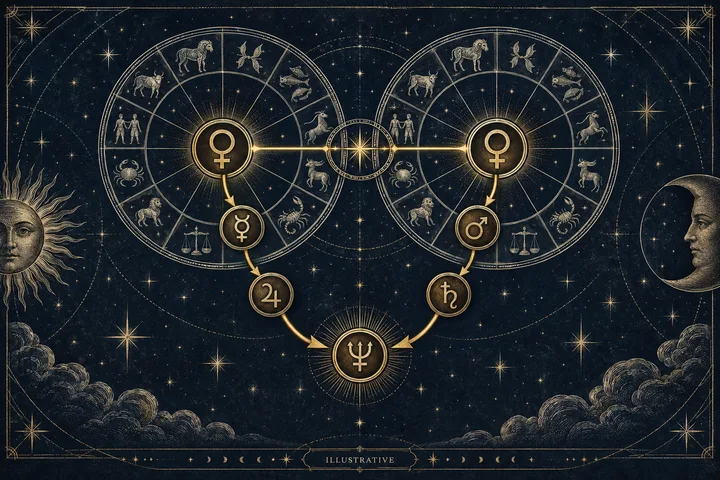
Not every dispositor chain ends at one planet. Many loop. That isn’t a failure in the chart. It’s information about exchange. A mutual reception occurs when two planets occupy each other’s signs. Venus in Aries with Mars in Libra is a classic example under traditional rulership: Venus is in Mars’s sign, and Mars is in Venus’s sign. Each planet has a claim on the other. The chain points both ways.
In synastry, mutual reception can make a Venus contact more interactive than a simple one-way story suggests. Suppose Person A’s Venus is in Scorpio and Person B’s Mars is in Taurus. Using traditional rulers, A’s Venus answers to Mars, while B’s Mars answers to Venus. If the planets also contact each other by opposition or another major aspect, the relationship has a strong circuit. Desire and action keep returning to one another. The circuit can support responsiveness, but it can also keep tension alive if every move demands an answer.
Read the reception as a condition, not a guarantee. It can show that two planets have a route to exchange resources, attention, or motive. The quality of that exchange still depends on the signs, the aspect, the dignity of each planet, and the rest of the chart information you actually have. A mutual reception may help two people understand each other’s operating language. It may also bind them to a repeating argument when the planets are under strain.
A loop can be longer. Venus in Aquarius may answer to Saturn. Saturn in Gemini may answer to Mercury. Mercury in Taurus may answer to Venus. The line returns to Venus. This can describe a relationship style that moves from affection to rules, from rules to language, from language to values, and back to affection. If the couple argues about commitment, the disagreement may keep changing clothes while holding the same structure. One person asks for love. The other asks for a definition. The definition reveals a value. The value returns to the question of how love is shown.
When you see a loop, don’t force a final dispositor. The loop itself becomes the interpretive endpoint. Ask what the planets exchange and what keeps circulating. If Venus and Saturn are in mutual reception, love and limits may need to be read together. If Venus, Mercury, and Jupiter form a cycle, affection may depend on words, meaning, and shared beliefs in turn.
The ruler system can change the shape of the loop. Traditional rulers keep Aquarius with Saturn, Pisces with Jupiter, and Scorpio with Mars. A modern chain may send those signs to Uranus, Neptune, or Pluto instead. Neither choice should be smuggled into the middle of a reading. If your chain changes when you change rulers, say so. You can compare the routes, but keep one system as the baseline so the reader can tell whether the difference comes from the charts or the method.
Mutual reception also helps you avoid one-sided language. Instead of saying, ‘Mars controls Venus,’ say, ‘Venus and Mars refer to each other.’ That wording is more accurate and more useful in a couple’s reading. It leaves room for response. One partner’s desire may call forth the other’s action, while that action changes the first partner’s willingness to receive. The chart picture is reciprocal even when the people experience the exchange at different speeds.
A loop can produce both ease and repetition. The ease comes from familiarity. Each planet knows where to send the matter next. The repetition comes when the same route becomes automatic. Venus sends the problem to Saturn, Saturn sends it to Mercury, Mercury sends it back to Venus, and the couple keeps discussing whether love is safe without changing the conditions that would make it safer. The remedy is a new behavior at the point where the loop stalls.
Astrodienst’s chain description notes that planets in reception point toward each other. Skyscript also distinguishes the dispositor’s role from a simple judgment of good or bad. That distinction is important for couples. A loop doesn’t tell you that the bond is trapped. It tells you where conscious participation matters. Someone has to interrupt the automatic circuit with a clear request, a boundary, a new habit, or a more honest name for the need.
Use the loop to write a sentence you can test. ‘When affection feels uncertain, we move into planning, then debate, then principles, and eventually return to affection without resolving the first hurt.’ If real life confirms that pattern, the chain has helped. If it doesn’t, set the theory aside. The chart should sharpen observation, not replace it.
Sources: Dispositor, Skyscript Glossary; Chain of Dispositors, Astrodienst Astrowiki
Degrees, orbs, and the strongest exception to a chain reading
A dispositor chain can add context, but a loose contact shouldn’t outrank a close one. This is where degrees matter. An aspect is an angular relationship between chart factors. The orb is the distance from exactness that an astrologer allows. Astrodienst’s aspect and orb references describe major aspects such as conjunction, sextile, square, trine, and opposition, and explain that astrologers use different orb rules for different methods. Your report uses a stated six-degree orb for selected major aspects. Keep that rule visible.
If Person A’s Venus is at 12 degrees Virgo and Person B’s Mars is at 13 degrees Sagittarius, their longitudes are about 91 degrees apart. That is a square within one degree of exact, so it belongs within a six-degree orb. If A’s Venus is at 12 degrees Virgo and B’s Mars is at 17 degrees Gemini, the square is five degrees wide by longitude. Under the same rule, you can include it. If B’s Mars is at 25 degrees Gemini, the separation from the 90-degree square is thirteen degrees, so the aspect falls outside the orb. Don’t rescue an aspect because the story feels tempting.
Exactness helps you rank. A Venus contact at one degree deserves more attention than a similar contact at five degrees, all else equal. A dispositor contact can also matter. If A’s Venus touches B’s Moon closely, that remains the main connection. If B’s Moon also aspects A’s Venus dispositor within the allowed orb, the second contact can explain why the first one feels emotionally specific. It does not replace the first contact.
The strongest exception is a dispositor chain that looks elegant but is unsupported by the available chart scope. If you only know that Venus is in a sign, you can trace its sign ruler. You can’t claim the dispositor is angular, retrograde, combust, in a particular house, or tightly aspected unless those inputs were supplied or calculated within the product’s scope. You also can’t infer that a person’s Venus dispositor is strong because the relationship looks pleasant. That would reverse the method.
A second exception concerns competing testimony. Suppose Venus in Taurus is conjunct another person’s Jupiter within one degree, while the dispositor Venus is in a sign that describes caution or strain. The close Venus-Jupiter contact may lead the reading because it directly links affection, pleasure, and generosity. The dispositor still tells you how the Venus person handles value and attachment, but it shouldn’t drown out the exact synastry contact.
A third exception is a chain with no clear end. Don’t manufacture a final message from a loop. Report the loop and its exchange. Don’t call a final dispositor the most important planet in the whole chart simply because it appears at the end of one branch. A final dispositor gathers a chain. It doesn’t erase the luminaries, angles, close aspects, or the person’s own choices.
The practical order is simple. Verify the signs. Calculate or record the degrees you truly have. Identify the major aspect and its orb. Note whether the contact is close, sign-consistent, or part of a larger pattern. Then trace the Venus dispositor. Let the most exact and direct testimony lead. Let the chain explain the texture.
You can record the result in a compact sentence. ‘A’s Venus in Virgo trines B’s Venus in Taurus within four degrees. A’s Venus is disposed by Mercury in Sagittarius, then Jupiter in Pisces. B’s Venus disposits itself. The direct contact supports practical affection. A’s chain adds a need for meaning and explanation, while B’s chain returns to steadiness and sensory trust.’ That sentence separates what the aspect shows from what the chain adds. If you don’t know the degrees, remove the orb claim. If you don’t know Mercury’s sign, stop the chain at the first ruler.
This discipline protects against false precision. A chart can contain a compelling pattern, but a reader still needs to know which part is supplied, which part is calculated, and which part is interpretive synthesis. State the scope once, then get on with the reading. Precision should make the symbolism feel more alive, not make the prose defensive.
Sources: Chain of Dispositors, Astrodienst Astrowiki; Aspect, Astrodienst Astrowiki; Orb, Astrodienst Astrowiki
Turn the chain into a relationship question you can actually use
Astrology becomes useful when interpretation returns to life. A dispositor gives you a sequence to watch. Venus’s wish for closeness may pass through Mercury, so words matter. Its attraction may pass through Saturn, so timing and reliability matter. Or Venus may return to itself, keeping pleasure, values, and self-worth central. The next step is to name the behavior that would honor that route without turning the symbol into a demand.
Take Venus in Sagittarius disposed by Jupiter. The broad reading may include enthusiasm, candor, exploration, and a love of possibility. Now suppose Jupiter is in Capricorn. The affection may need a plan. A person may enjoy the spark but trust it more when it leads somewhere concrete. The relationship question becomes, ‘What shared adventure can we schedule and finish?’ Not ‘Are we destined?’ The first question gives both people something to do.
Take Venus in Virgo disposed by Mercury in Pisces. Affection may move through careful attention, but the managing planet may speak in images, moods, or indirect impressions. A partner who wants clear proof may miss the tenderness because it arrives through atmosphere and suggestion. The useful question becomes, ‘Can we name what care looks like when one person shows it through details and the other through feeling?’ That question protects both the Venus sign and its dispositor.
Take Venus in Leo disposed by the Sun in Aquarius. A person may want warmth, loyalty, and visible appreciation, yet the chain points toward independence, community, and a wider social identity. In a relationship, praise may matter, but so may room to remain a distinct person. The useful question is, ‘How do we make devotion visible without making attention the price of belonging?’ That is a real decision about habits and boundaries.
Now bring in the other chart. If the partner’s Moon touches the Venus or its dispositor, emotional safety may be part of the exchange. If the partner’s Mars touches the chain, pursuit and conflict may activate it. If Saturn contacts the chain, commitments and limits may become the place where affection proves itself. Don’t list every possible planet. Use the supplied aspects and rank them. One clear pattern beats a cloud of associations.
A simple conversation can follow the chain in order. First ask what the Venus contact feels like. Then ask what makes that feeling easier or harder to express. Next ask which action would make care visible this week. Finally ask what each person can’t promise. The last question matters. A chart can reveal a need without making the other person responsible for meeting it in every form.
If you’re comparing known Moon, Venus, and Mars placements, the Synastry Comparison Report can help organize those layers. It uses supplied placements and optional degrees, with selected major aspects under a six-degree orb. It doesn’t calculate a natal chart from birth details or add houses. That makes the next action clear: gather the placements you know, mark missing degrees, and compare the strongest contacts with the dispositor paths they activate.
Then test the reading against ordinary life. Does affection become easier when you talk, plan, reassure, touch, create space, or share a purpose? Notice what actually changes. Keep the part that helps you see each other more clearly. Drop the part that only sounds impressive.
A useful review takes three passes. In the first, mark the direct contacts. Circle the closest Venus aspect and write the planet pair in ordinary language: affection and speech, affection and restraint, affection and desire, affection and feeling. In the second, draw the arrows. Venus to ruler, ruler to ruler, and so on. In the third, compare the two maps. Where do they meet? Where do they ask for different conditions? This sequence keeps the reading from becoming a list of sign stereotypes.
Use the chain to choose a question, not to label a person. If the chain runs through Mercury, ask how the couple handles unclear messages. If it runs through Saturn, ask what commitment means in practice. If it runs through Mars, ask how desire and anger share space. If it runs through Jupiter, ask what shared belief or future gives the attraction room to grow. The question should be answerable through a conversation or an observed habit.
The answer may be modest. One person needs a plan before they can relax, while the other needs flexibility before they can agree. One person offers affection through acts of service, while the other recognizes affection through spoken praise. The chain doesn’t make either style superior. It tells you why the Venus contact may need translation. Compatibility grows in the translation, not in the label.
And sometimes the reading shows a limit. If one person can’t offer the condition the other’s Venus requires, the issue deserves a plain conversation. A dispositor chain can describe why the need feels central. It can’t make an unavailable resource appear. This is where a symbolic reading becomes a decision aid. You can honor the attraction and still ask whether the relationship has the time, honesty, freedom, or steadiness that lets it breathe.
Sources: Dispositor, Skyscript Glossary; Chain of Dispositors, Astrodienst Astrowiki; Venus, Astrodienst Astrowiki
A little more clarity
Does a final dispositor decide whether a Venus synastry contact will last?
No. A final dispositor shows where a sign-rulership chain ends, if it ends in a self-ruled planet. It can gather themes, but it doesn’t decide the relationship. Read the direct Venus contact first, then the signs, degrees, aspect condition, and observable pattern between the people.
Should I use modern or traditional rulers for a dispositor chain?
Either approach can be used if you name it and stay consistent. Traditional rulership keeps the seven visible planets as sign rulers and gives a stable chain. Some modern astrologers assign Uranus, Neptune, or Pluto to certain signs. Don’t switch systems halfway through one interpretation.
What if I know the Venus signs but not the degrees?
You can still trace the sign-based dispositor chains and describe the Venus themes. You can’t honestly confirm an exact aspect or apply a six-degree orb without degrees. Treat missing degrees as a limit on aspect ranking, then use the known signs for the interpretive context.
Can a Venus dispositor explain why a good aspect still feels difficult?
Yes, as context. A trine or conjunction may support contact, while Venus’s dispositor shows the conditions that make affection feel safe or satisfying. A tense dispositor can add caution, analysis, duty, or uncertainty. It doesn’t cancel the supportive aspect. It shows the work required to express it.
Sources & further reading
- Dispositor, Skyscript Glossary
Defines a dispositor as the ruler of the sign occupied by a planet and explains how its condition can affect that planet.
- Chain of Dispositors, Astrodienst Astrowiki
Describes chains as successive sign-rulership links and notes how planets in reception point toward each other.
- Aspect, Astrodienst Astrowiki
Defines aspects, lists the major aspect families, and explains that interpretation considers both planets involved.
- Orb, Astrodienst Astrowiki
Explains orb as the allowed distance from exactness and shows that astrologers use different orb practices.
- Venus, Astrodienst Astrowiki
Supports Venus meanings involving attraction, harmony, relationships, affection, pleasure, and sign rulerships.
Synastry Comparison Report
Enter known placements for two people. Get an input-by-input comparison, selected aspect calculations and a clear record of what remains uncertain.
Compare our placements