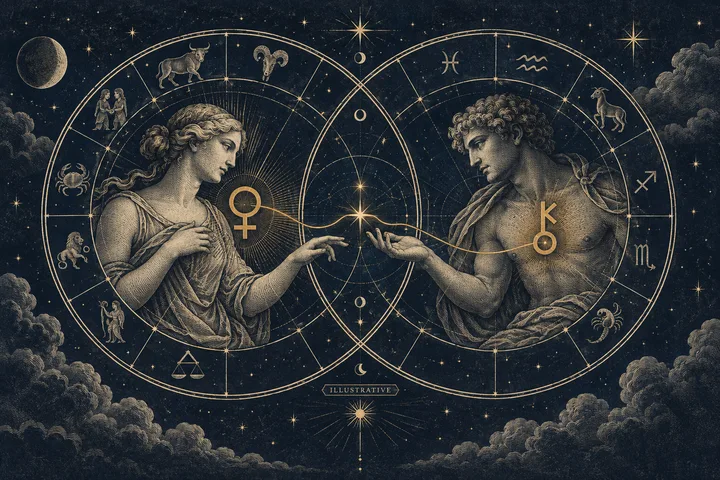
What does a Chiron-Venus contact add?
Imagine Maria has Venus at 14 degrees Taurus and her partner has Chiron at 15 degrees Taurus. Their one-degree conjunction says more than, "They like each other." It puts Venusian subjects such as affection, pleasure, taste, values, and self-worth in direct contact with a Chiron theme of sensitivity, wisdom, and repair.
That is the added layer. Venus shows what feels lovable and worth preserving. Chiron shows where experience has made a person unusually alert to pain, while also giving them a way to understand it. In synastry, affection can become a way of noticing what needs care. A compliment may soothe. A careless remark may land hard. The same closeness can feel gentle and exposing.
The supported interpretation is narrow and useful: love touches a tender subject here. It may deepen compassion, but it does not promise romance, permanence, or mutual healing. A conjunction blends the symbols. A trine or sextile may make the contact easier to use. A square or opposition may make the tension harder to ignore. The rest of the chart decides how much weight it deserves.
Keep the symbolism close to ordinary life. Someone accepts a compliment without deflecting it. Someone asks for space and is not punished for asking. Someone names a preference and waits for an answer. Venus shows the wish to connect. Chiron shows what that wish might expose.
Sources: Synastry | Cafe Astrology; Chiron | Astrodienst Astrowiki
Which chart inputs do you need first?
You need each person’s Venus sign and degree, each person’s Chiron sign and degree, the angular relationship between the two points, and the direction of the contact. Write it plainly: "Person A’s Venus contacts Person B’s Chiron." Then check the reverse contact. A mutual Venus-Chiron connection can make the theme more shared, but it will not make both experiences identical.
For this placement-only reading, the scope is supplied positions and optional degrees. It is not a birth-chart calculation from dates, times, and places. Without degrees, you can discuss a broad sign relationship, but you cannot call the contact exact or close. Without reliable birth times, do not add houses or angles. A polished chart wheel cannot supply information that was not provided.
A useful record might say: "Person A Venus, 14 degrees Taurus. Person B Chiron, 15 degrees Taurus. Major-aspect check uses a six-degree orb. Houses not assessed because birth times were not supplied." That line keeps the method visible and stops a dramatic interpretation from growing around a contact that may not exist.
Same-sign placements are not automatically a conjunction. The degree distance decides whether the geometry is present. Keep signs, aspects, houses, and roles as separate layers. That makes the eventual reading easier to reproduce and easier to correct.
Sources: Aspect | Astrodienst Astrowiki; Interaspect | Astrodienst Astrowiki; Partner horoscopes | Astrodienst FAQ
How do degrees and orbs change the weight?
An orb is the distance between an exact aspect and the actual positions of two chart factors. A conjunction is exact at 0 degrees, a sextile at 60, a square at 90, a trine at 120, and an opposition at 180. The farther a contact sits from its exact angle, the more carefully you should rank it.
Synastry needs a disciplined orb because two charts create many possible interaspects. Astrodienst recommends a smaller orb for interaspects than for a single natal chart, and its partner-chart guidance describes using half the natal orb when drawing synastry aspects. The report method used here sets a six-degree maximum for major-aspect checks. That does not make a six-degree contact as prominent as a one-degree contact.
Use three practical bands. Within one degree, a contact is sharp and easy to prioritize. At two or three degrees, it remains prominent. Four to six degrees can support the story when other chart layers repeat it, but it should not lead the whole reading by itself. Beyond the chosen orb, call the symbolism sign-based rather than a confirmed major aspect.
Consider Maria’s Venus at 14 Taurus and Leo’s Chiron at 20 Taurus. The six-degree conjunction qualifies under this method, but a one-degree Venus-Moon conjunction elsewhere would outrank it. If Leo’s Chiron is at 15 Taurus, the close contact deserves earlier attention. State the degrees. State the rule. Then say what changes if a tighter orb is used.
Sources: Aspect | Astrodienst Astrowiki; Interaspect | Astrodienst Astrowiki; Partner horoscopes | Astrodienst FAQ
What does Venus bring to the meeting?
Venus speaks through attraction, taste, reciprocity, pleasure, values, and the small acts that make closeness feel welcome. In synastry, it can show how one person appreciates the other and how affection moves between them. It belongs to romance, but also to friendship, art, money, style, and social ease. Cafe Astrology places Venus among the central relationship factors and reads its contacts through attraction and values.
When another person’s Chiron contacts your Venus, your Venus becomes more conscious. You may notice what you need to feel desired. You may also notice how quickly approval becomes important. A comment about appearance can touch worth. A disagreement about spending can touch security. The contact does not declare the Venus person fragile. It makes Venusian subjects more charged and more revealing.
The sign gives the subject a style. Venus in an earth sign may seek consistency, touch, and practical devotion. Venus in an air sign may need conversation and room to name the relationship. Venus in fire may respond to enthusiasm and direct desire. Venus in water may look for emotional attunement. These are starting points, not finished portraits.
Read the sign, then ask what affection looks like on an ordinary day. One person may want regular touch. Another may trust practical help. One may need public acknowledgment. Another may protect the bond by keeping it private. The chart gives the language. The relationship supplies the sentence.
A Chiron-Venus contact adds a tender, exposing layer to synastry. Venus describes affection, pleasure, taste, values, and the ways a person gives and receives love. Chiron brings the place where love can touch an old hurt, along with the wisdom that can grow from meeting it. The contact may make praise, desire, beauty, money, or physical closeness feel unusually important. Read it as a sensitive point, not a relationship verdict. First confirm the degrees, aspect, and orb. Then compare it with the Moon, Mercury, Mars, and Saturn contacts. The useful question is not whether this aspect guarantees healing. It is whether both people can meet vulnerability with clear speech, room to choose, and repeated care.
Sources: Synastry | Cafe Astrology
What does Chiron add to affection and vulnerability?
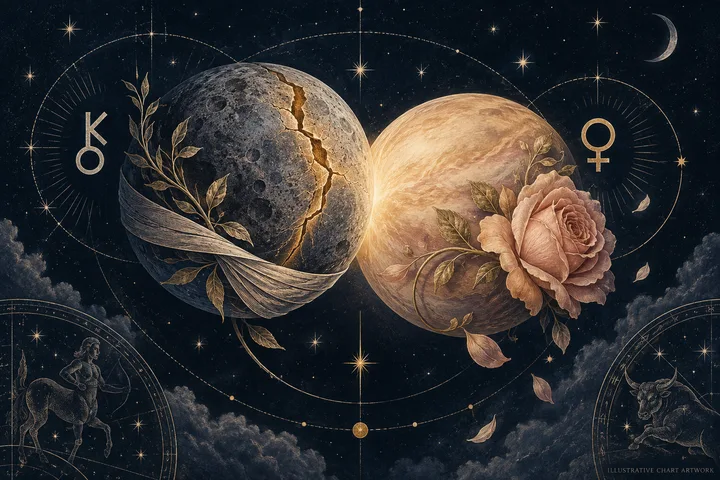
Chiron is often described through the wounded-healer image. Astrodienst’s Chiron reference keeps both sides of that symbol in view: a lasting wound and the wisdom, teaching, or healing capacity that can grow around it. In a Venus contact, Chiron asks what happens when love reaches the place a person protects.
That place might involve desirability, loyalty, sexuality, money, creativity, or the right to receive pleasure. The Chiron person may recognize what is tender in the Venus person and know how to reassure it. They may also press the sore place without meaning to. The Venus person may feel cherished, watched, or suddenly responsible for keeping the other person calm.
Do not turn the symbols into diagnoses. "Affection may touch an old question about being worthy of desire" is a useful astrological statement. "This person has abandonment trauma" claims knowledge the supplied placements cannot provide. Roles can move, too. The Chiron person is not always the more vulnerable one, and the Venus person is not always the one who needs reassurance.
The mature reading leaves room for compassion and choice. You can understand why someone is guarded and still ask for honesty. You can offer patience and still keep a boundary. Chiron shows a place where meaning may grow. It does not make either person an expert on the other’s pain.
Sources: Chiron | Astrodienst Astrowiki
How does the aspect type change the story?
The aspect tells you how Venus and Chiron meet. It does not replace their meanings. A conjunction blends them. A sextile offers an opening that needs participation. A trine can let tenderness flow with less friction. A square creates pressure that asks for a new response. An opposition places the experiences across from each other and can make the other person feel like a mirror.
With a conjunction, affection and vulnerability arrive together. The bond may feel immediate, and it may be hard to separate comfort from exposure. With a sextile, a thoughtful conversation or steady act of care can use the opening, but somebody has to begin. A trine may feel natural enough that the sensitive point stays hidden until disappointment brings it forward.
A square asks Venus and Chiron to learn a skill. Sweetness may feel risky to one person and necessary to the other. If they name that tension, the contact can build capacity. If they make each other wrong, the same pressure becomes a loop. An opposition can create a pull between closeness and distance, reassurance and autonomy. It needs reciprocity, not a contest over who is more hurt.
Do not label the aspects good or bad and stop there. Read the geometry, then check the degrees and signs. The practical ranking is simple: conjunction for a blended theme, sextile for a usable opening, trine for ease that still needs attention, square for a skill under pressure, and opposition for a balance that must be negotiated.
Sources: Synastry | Cafe Astrology; Aspect | Astrodienst Astrowiki
How does a worked example clarify the method?
Consider an example. Maria has Venus at 14 degrees Taurus. Leo has Chiron at 15 degrees Taurus. This is a one-degree conjunction under the six-degree method. We know the signs and degrees. We do not know their houses, Moon signs, Mars signs, or the rest of their synastry, so we will not pretend to know those layers.
Start with geometry. The close conjunction makes affection and vulnerability a tightly linked theme. Add Taurus. Pleasure, touch, beauty, food, money, the body, and the right to enjoy something without apology may become the language of the contact. Those are astrological possibilities, not facts about Maria or Leo.
Now rank the claim. The strongest supported reading is that affection may raise questions about worth, pleasure, and trust. A weaker claim would be that they will heal each other. One aspect cannot carry that promise. The contact may offer a place to explore tenderness. The wider chart and their conduct decide whether that exploration becomes nourishing.
Change one input and watch the meaning change. If Leo’s Chiron were 25 Taurus, the same-sign symbolism would remain, but the conjunction would lose priority under this method. If the same one-degree pattern occurred in Libra, the subject could shift toward fairness, approval, partnership, and the fear of disturbing harmony. The geometry supplies the structure. The sign supplies the room it inhabits.
That is the reusable order: verify the degrees, name the aspect, read Venus, read Chiron, combine the meanings, and rank the result beside the rest of the chart. Keep Maria and Leo visibly imagined. Use actual supplied placements only when they are known.
Which chart layers should outrank Chiron-Venus?
Chiron-Venus can be meaningful without being the main story. Start with the closest contacts among the Moon, Venus, Mars, Mercury, Sun, and known angles. Then look for the layers that describe emotional rhythm, communication, desire, commitment, and pressure. Return to Chiron-Venus after that first pass and ask what sensitive subject it adds.
A close Moon-Venus contact may say more about daily tenderness than a wide Chiron-Venus contact. Mercury contacts can clarify how the pair talks and repairs. Mars shows desire and action. Saturn can show where care must become reliable and where one person feels restricted. Jupiter may add generosity and perspective. These contacts do not cancel Chiron. They give it a place in the whole sentence.
Give the Chiron-Venus contact more weight when another layer repeats its subject. A Moon link may reinforce tenderness. A Saturn link may show whether tenderness becomes dependable. A close contact gets priority over a distant one, and a repeated theme gets more space than a lone dramatic symbol. This ranking prevents one vivid aspect from explaining every powerful feeling.
The strongest exception is also the clearest boundary: a soft Chiron-Venus aspect does not excuse contempt, dishonesty, coercion, or repeated disregard for a stated limit. An aspect can describe tenderness. It cannot turn pressure into care. If the chart feels beautiful but the pattern feels harmful, rank the pattern first.
Sources: Synastry | Cafe Astrology; Romantic Compatibility Synastry Analysis in Astrology | Cafe Astrology
How can the contact become useful in daily life?
Translate the symbolism into one question and one observable action. What kind of affection helps each person relax? What makes either person feel watched or tested? What happens after someone says no, changes their mind, or asks for time? These questions give Venus and Chiron somewhere to go.
A Venus person can practice receiving care without demanding that the Chiron person prove devotion through pain. A Chiron person can name sensitivity without making the Venus person responsible for every old ache. Both people can separate support from rescue. Support respects agency. Rescue quietly takes it away.
Watch the repair pattern once, then watch it again. After a hurt, does the person who caused it listen without arguing about intent? Does the other person say what would help next time? Can affection return without pretending the rupture did not happen? A constructive expression of the contact becomes visible through a small change that both people can repeat.
Make the action concrete. "Care must be steady" can become, "We will keep the agreement we made." "Praise feels exposing" can become, "Ask before discussing my appearance in public." "Repair matters" can become, "We will return to this conversation at a time we both choose." Astrology can show why a moment feels charged. The action shows what the bond does with that charge.
How should you rank the reading and choose the next step?
Use this order. Verify the degrees and orb. Name the Venus subject and the Chiron sensitivity. Identify the aspect type. Compare the contact with the Moon, Mercury, Mars, and Saturn layers. Then write one sentence that the supplied information can support: "Your close Taurus Venus-Chiron conjunction links affection with questions about worth, pleasure, and trust; it may deepen tenderness, but it needs room for honest limits."
Choose one small conversation rather than another round of symbolism. Ask how each person likes to receive reassurance, or name one preference without apologizing. If money, privacy, appearance, or physical touch is the tender subject, make the agreement specific. Then watch what happens after the conversation. That is the point where a chart reading becomes useful.
If you are comparing known placements for the Synastry Comparison Report, /compatibility-test is the natural next step. Bring the Venus and Chiron signs and degrees you already have, plus any Moon, Venus, Mars, or major-aspect information you want to compare. The report uses supplied placements and optional degrees. It does not calculate a natal chart from birth details, add houses that were not supplied, or turn one contact into a compatibility score.
Your decision point is clear. Keep exploring when both people can name the tender place and respond with respect. Slow down when affection is used to demand access, proof, rescue, or endurance. Step back when the harmful pattern continues. Chiron-Venus can show where love reaches vulnerability. Your choices show what happens next.
Sources: Synastry | Cafe Astrology; Romantic Compatibility Synastry Analysis in Astrology | Cafe Astrology; Aspect | Astrodienst Astrowiki
Sources & further reading
- Synastry | Cafe Astrology
Supports Venus as a central synastry significator for attraction, pleasure, romance, values, and interaspects, including Venus-Chiron symbolism and aspect differences.
- Romantic Compatibility Synastry Analysis in Astrology | Cafe Astrology
Supports weighing Venus-Chiron alongside other synastry factors instead of treating one romantic contact as a complete relationship judgment.
- Aspect | Astrodienst Astrowiki
Supports defining aspects as angular relationships within an accepted orb and reading the planets involved before assigning an aspect meaning.
- Interaspect | Astrodienst Astrowiki
Supports using a smaller orb in synastry because two charts create many interaspects that can otherwise make the comparison difficult to read.
- Partner horoscopes | Astrodienst FAQ
Supports the technical practice of using half the natal orb when drawing synastry aspects and keeping the comparison bounded by its method.
- Chiron | Astrodienst Astrowiki
Supports Chiron’s astrological symbolism through the mythic link between enduring wound, spiritual strength, teaching, and healing.
Synastry Comparison Report
Enter known placements for two people. Get an input-by-input comparison, selected aspect calculations and a clear record of what remains uncertain.
Compare our placements