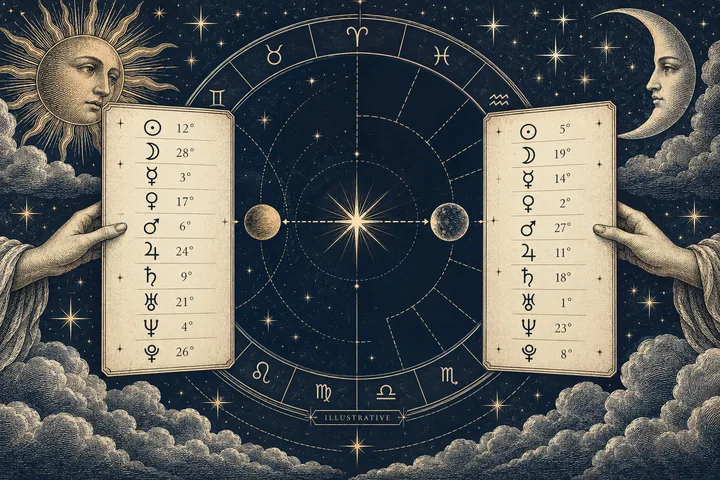
What does a planetary degree add to a sign comparison?
A sign describes a planet's broad astrological language. Its degree adds a finer measure: where that planet sits within the sign, and how far it lies from another planet. In synastry, the chart reader compares a planet in one chart with a planet in the other. AstroWay's guide, “Synastry: how to read compatibility between two charts,” defines a cross-chart aspect as the angle between those planetary positions. Degrees let you assess whether that angle approaches a recognized aspect, such as a square or trine.
Consider a schematic example, not a personal chart. Imagine one supplied planet at 10° of a sign and another at 100° along the zodiac. Their separation is 90°, the exact angle of a square. If the second position were farther away, the angle would differ from exact; that difference is the orb. The Astro.com guide “Getting the Most from Your Professional Natal Report” describes allowable orb as how far an aspect may be from exact and still count. This report uses its stated six-degree rule for selected major aspects, showing how close a contact is to its chosen boundary.
That geometry identifies a possible aspect; astrology supplies its meaning. A degree can refine a sign-based reading by showing a connection between two placements. It cannot, by itself, tell you how either person behaves or decide what the relationship means. Nor does a precise-looking number establish that the birth-time input is sound. Before leaning on the contact, ask where each degree came from and whether it remains dependable across the unknown-time person's plausible birth interval. Precision helps when its basis holds.
Sources: Synastry: how to read compatibility between two charts; Getting the Most from Your Professional Natal Report
Where did each supplied degree come from?
A degree earns close attention when you know what moment it represents. Start with the chart source, then ask whether the birth time was recorded, approximate, or assumed. An ephemeris calculates a position from time-based inputs. The Swiss Ephemeris documentation describes its planetary and lunar calculations as ephemerides. A crisp degree on a screen tells you what was calculated, not whether the time entered was the actual birth time. For each supplied placement, keep a short provenance note: where the degree came from, the birth date and place used, the time shown, and whether that time came from a record, a recollection, or an assumption. Note the local timezone or the time standard the source used, too. A birth date belongs to a local calendar day, whose boundaries may not match midnight to midnight in UTC. In “Unknown birth time: what you can still calculate,” Astrologican explains that its full-day check uses the birthplace’s timezone and examines the local date rather than silently substituting noon. The guide also warns that a noon calculation can look exact without establishing the real birth moment. That gives you three practical labels. A recorded-time position has a stated birth moment behind it. A date-stable position has been checked across the plausible interval and remains effectively unchanged for the comparison you want to make. An assumed-time position has a chosen hour but no confirmation that the hour is right. These labels describe the input, not the importance of the placement or the strength of a connection. If you have only an assumed-time degree, don’t treat its extra decimal detail as extra certainty. You can still preserve the sign or broad comparison if it remains stable across the possible hours, but leave the degree-level contact open until its time basis is checked. A date-stable degree can also be useful even when the exact birth hour is unknown, provided someone has checked it across the relevant interval. That check belongs to the source or a separate ephemeris; this article and the Synastry Comparison Report accept supplied placements rather than calculating positions from birth details. Before you interpret an aspect, ask one plain question: “What time does this degree describe, and how do I know?” If the source can answer, proceed at the level that evidence supports. If it cannot, mark the degree unresolved and carry forward only what remains dependable.
Sources: Swiss Ephemeris documentation; Unknown birth time: what you can still calculate
How can you tell whether a supplied position is stable?
Check the placement across the whole interval in which the birth could have occurred. Test the full local birth date, from its start to its end in the birthplace. A position is stable for your comparison when its sign and the aspect classification you plan to use remain the same throughout. If a sign boundary or the report's aspect-orb boundary falls inside the interval, mark the result conditional. If you cannot establish the interval or the source's time basis, leave the degree-level claim unresolved.
The local date matters because it is not always the same span as midnight to midnight in UTC. In “Unknown birth time: what you can still calculate,” Astrologican explains that the birthplace timezone defines the local calendar window, and that using the wrong timezone can move a sign boundary into or out of it. The guide checks the whole day instead of substituting noon. Noon gives one instant; the interval shows what could be true across plausible hours. Confirm the local date and place before testing.
Ask the source that supplied the chart how it handled the missing time. Is its time recorded, approximate, or defaulted? Does it provide a range of positions, or one chart cast for a single moment? The Swiss Ephemeris documentation describes planetary and lunar positions as calculations made for time-based inputs. A precise degree can be exact for the entered moment and still fail to represent the unknown birth moment. Decimal places don't establish provenance.
Write down the earliest and latest plausible local birth times, date, and timezone. Ask a reliable ephemeris or the placement provider for the planet's position at both ends. Then check whether it changes sign or whether its angular distance from the other person's planet could cross the chosen aspect boundary. If so, inspect the interval rather than assuming the change happens evenly or choosing the tidiest reading. This report accepts supplied placements and optional degrees; it does not run that range calculation for you.
A useful status has three outcomes. Stable means the relevant sign and aspect classification hold throughout the plausible interval, so you can use the supplied position at the level your sources support. Conditional means more than one reading remains possible; keep both possibilities visible and say what changes. Unresolved means the interval, timezone, or chart method is too unclear to test, so don't build a degree-specific interpretation on it. A position near a boundary deserves a closer check, but don't assume every planet moves enough in a day to change signs or aspects. Test the actual placement and interval. This record shows which details are firm, which depend on the unknown hour, and what new information could settle them.
Sources: Unknown birth time: what you can still calculate; Swiss Ephemeris documentation
Why does the Moon need a closer check?
The Moon deserves a closer check because a birth-time range can change what you know about its placement. Depending on the date and the interval, the Moon may cross a sign boundary, or it may stay in the same sign while moving enough to alter a close aspect. Check both questions across the actual possible hours. Neither a definite Moon sign nor an uncertain one should be assumed before that check.
The guide “Unknown birth time: what you can still calculate” makes a useful distinction: one Moon sign throughout the tested local date supports that sign as consistent across the interval, but it does not establish the Moon’s exact birth position. If more than one Moon sign appears, the date range crosses a sign boundary and time matters to the sign-level reading. Those are different outcomes, and neither can be settled by choosing a convenient hour. A time-specific position describes that moment. It becomes a birth placement only when the moment is supported by the birth information.
For a synastry comparison, keep two thresholds separate. The sign boundary determines which sign language applies to the Moon. The aspect-orb boundary determines whether the Moon’s angular relationship to another supplied planet qualifies under the method being used. A Moon can remain in one sign throughout the plausible interval while its distance from another planet shifts enough for a borderline contact to fall inside or outside the report’s six-degree orb. In that case, the sign reading may remain steady while the aspect stays conditional. Conversely, the interval may cross a sign boundary even though the Moon remains close to the other planet by degree. The sign interpretation then has alternatives, while the contact’s geometric status may remain similar. These are not contradictions; they are separate layers changing at different thresholds.
The Swiss Ephemeris documentation describes lunar positions as time-based calculations. That matters here because a degree is tied to the instant used to calculate it. To check a supplied Moon, use the plausible birth interval, not just a single displayed degree. The local date and its timezone define the interval: as the unknown-time guide explains, a local calendar day need not begin and end at midnight UTC, and a misplaced timezone can shift the window being checked. If that window spans a sign boundary or changes the Moon’s orb status, carry both possibilities into the reading. If neither changes, keep the stable information and qualify only what does. This preserves the Moon’s useful contribution without giving an uncertain hour more authority than it has.
Yes. Known planetary signs and degrees can support a useful synastry comparison when their source and time basis are reliable. Degrees help measure cross-chart aspects, but they can't recover a missing birth time. Check whether each position stays stable across the plausible birth interval, treat contacts that could cross the report's six-degree orb as conditional, and leave the unknown-time person's Ascendant and houses out. The report reads supplied placements; it doesn't calculate natal positions from birth details.
Sources: Unknown birth time: what you can still calculate; Swiss Ephemeris documentation
How should you read an aspect near the six-degree boundary?
The report uses a six-degree orb as a consistent working cutoff for selected major aspects. An orb is the distance between the measured angle separating two planets and the exact angle of a named aspect. A square is exact at 90 degrees; the orb measures distance from that point. A contact at the boundary needs care when one supplied position comes from an uncertain birth time. If the plausible position range could move the separation from just inside to just outside six degrees, describe the aspect as conditional rather than presenting either version as settled. That boundary is a rule for this comparison, not a line all astrologers must use. In “Getting the Most from Your Professional Natal Report,” the guide describes wider allowable orbs for aspects involving the Sun or Moon than for other planets, and wider allowances for major aspects than minor ones. Its example gives a ten-degree orb for a Sun-Moon conjunction. In “Synastry: how to read compatibility between two charts,” AstroWay treats orb as one factor in a contact’s interpretive weight and says a closer contact carries more weight than a wider one. These sources show that orb conventions can vary by chart context and method; they do not establish one universal cutoff. A published synastry method makes the variation concrete. “Synastry” by the International Centre for Research in Astrology recommends different maximum orbs by aspect, including six degrees for a conjunction, five for an opposition, four and a half for a square, four for a trine, and 2.7 for a sextile. That is one practitioner’s framework, not a consensus rule, and it differs from this report’s single cutoff. Compare the stated methods: under this report’s rule, a qualifying selected aspect falls within six degrees; under an aspect-specific method, the same measured separation might qualify for one aspect and not another. Keep the report’s rule consistent when you read its result. Don’t switch conventions halfway through to include a contact you prefer, and don’t treat the cutoff as a measure of how much two people care about each other. A tighter contact may receive attention first within the chosen framework, but exactness does not predict what a relationship will become. The question here is narrower: does the supplied geometry meet the report’s stated criterion, and is that geometry stable enough to interpret? If the time uncertainty could carry a contact across the six-degree edge, keep the aspect conditional and explain both possible classifications. If the supplied positions support only one side of the boundary, use the report’s rule and interpret the contact within that limit. The reader can then see why another astrologer or comparison may list a different set of aspects, without mistaking a method difference for a contradiction about the relationship itself.
Sources: Getting the Most from Your Professional Natal Report; Synastry; Synastry: how to read compatibility between two charts
What can signs and stable aspects tell you together?
Read the Moon, Venus and Mars signs first, then add only the cross-chart aspects that rest on dependable degrees. The signs give you the broad language of each placement. A stable aspect adds a more specific link between two placements. Neither tells you what a person must feel or what a relationship must become. A useful comparison keeps these layers distinct. In each chart, note the supplied Moon, Venus and Mars signs. The Moon describes emotional needs; Venus, affection and attraction; Mars, desire and initiative. Read them as a pattern, not isolated labels. Someone's Venus sign, for instance, doesn't by itself tell you how that person will show care in every situation. Next, mark which supplied degrees have a sound time basis. Keep degree-level interpretation for positions verified across the plausible birth interval or tied to a recorded birth time. If a position might shift enough to alter its aspect or sign, mark that contact conditional; if you cannot establish how its degree was generated, leave the aspect unresolved. The report accepts supplied placements; it doesn't calculate birth positions or verify a range for you. Then review only the selected major aspects that meet the report's stated six-degree orb. Synastry: how to read compatibility between two charts describes an aspect as the angle between points in the two charts, measured from their planetary longitudes. Geometry asks a different question from sign comparison: signs offer broad themes, while an aspect identifies a particular connection, such as one person's Moon in relation to the other's Venus. The aspect gives a framework for interpretation, not a complete account of either person. Finally, bring the stable contacts back to the signs and planets involved. A Moon-to-Venus contact, for example, joins emotional expression with affection in the symbolic language of astrology. The signs help describe how those planetary themes may be expressed; the aspect describes the link between them. This is a layered interpretation, not a finding about what either person has actually done. Philip Graves's “Introduction to Relationship Astrology 2: Synastry” likewise treats interplanetary aspects as links between charts and notes that each person may experience a connection differently. A shared chart pattern doesn't guarantee a shared account of it. If one birth time is unknown, a sound planetary comparison can still offer useful material for reflection. The reading has less detail where inputs remain uncertain. Keep the signs whose placements are dependable, give stable aspects their place in the interpretation, and let conditional contacts remain possibilities. This is richer than a sign-only pairing, while staying within what the placements support.
Sources: Synastry: how to read compatibility between two charts; Synastry
What does an unknown time leave out of the comparison?
An unknown birth time removes the dependable Ascendant and house framework for that person. It does not automatically remove every comparison between the two charts. Synastry has distinct layers: a planetary interaspect compares a planet in one chart with a planet in the other, while a house overlay places one person’s planet in a house belonging to the other. “Introduction to Relationship Astrology 2: Synastry” treats these as separate procedures: it describes overlays through the receiving chart’s house cusps, then aspects through the signs and degrees of factors in both charts. If both supplied planetary positions have a reliable time basis, their planet-to-planet contact can still be examined even when one person’s houses cannot.
House overlays need the chart whose houses receive the other person’s planets. Those houses are defined by the Ascendant and cusps, which depend on birth time and location. “Synastry Houses: House Overlays” makes the practical consequence clear: an unknown time can make that person’s cusps and overlays unreliable or unavailable, while planetary aspects may remain usable when the positions themselves are known. The two directions of an overlay also depend on two separate house frameworks. A known birth time for one partner supplies that partner’s houses; it does not fill in the other partner’s missing Ascendant or cusps. You may be able to ask where Person A’s planets fall in Person B’s houses, but not where Person B’s planets fall in Person A’s houses, if only the latter chart has a dependable time. Keep the framework attached to the person whose houses are being read.
For the unknown-time person, leave the Ascendant and house placements out unless a dependable birth time becomes available. Do the same with contacts to that person’s time-dependent angles when their position cannot be established. A supplied degree may support a planet-to-planet aspect, but it does not establish an Ascendant or house cusp. “Unknown birth time: what you can still calculate” explains that a chart cast for an assumed hour can display a definite Ascendant and house layout without establishing either for the actual birth. A chart can look complete while some of its layers remain unsupported.
This omission narrows the reading; it need not erase it. Retain stable planetary interaspects and supplied sign placements that have a defensible source, then interpret those layers on their own terms. Treat a house story or angle contact tied to the missing time as unresolved, not as a clue to recover from the other person’s chart. If a reliable record later supplies the birth time, those time-dependent layers can be reconsidered. Until then, keep planetary contacts in view and leave the unsupported house framework open.
Sources: Synastry; Synastry Houses: House Overlays; Unknown birth time: what you can still calculate
How should you handle a contact that changes across the possible hours?
Keep the contact conditional when plausible birth times produce different signs or move its orb across the report's cutoff. If the available interval or source is too vague to test, leave it unresolved and interpret only what remains stable. The point is to preserve what the chart can still say without quietly choosing the version that sounds most appealing.
Imagine a supplied planetary position comes from a chart cast for an assumed hour, though the birth could have occurred earlier or later. One cross-chart contact appears within the report's six-degree orb at that hour. At another plausible hour, the moving position shifts enough to fall outside the cutoff. The fork is simple: under one time, the aspect qualifies; under another, it does not. The Swiss Ephemeris documentation describes positions as calculations tied to time-based inputs. A displayed degree can be precise for the entered moment while the actual birth moment remains unknown. Precision in the output doesn't settle which version belongs to the chart.
Use three labels to keep the distinction clear. Stable means the contact stays in the same relevant sign and remains inside or outside the chosen orb throughout the plausible interval. Conditional means the interval is clear enough to test, but the contact's status changes across it. Unresolved means you can't establish the source or bound the possible hours well enough to compare alternatives. These labels describe confidence in the supplied position, not the importance of the connection or anyone's feelings.
For a conditional contact, state both readings in proportion to what each supports. If the aspect qualifies in one plausible chart, describe its traditional symbolism as a possible layer. If it falls outside the report's orb in another, don't present it as settled. The Astrologican guide to unknown birth times recommends keeping uncertain placements as alternatives rather than choosing the more flattering result. Keep the possible interpretation, but name the condition behind it. If the interval is too vague to test, leave the aspect unresolved and work with stable signs and contacts instead.
The six-degree line is the report's consistent working rule, not a universal boundary. Astrology Basics explains that allowable orbs vary by aspect and by whether the Sun or Moon is involved. That is a reason to name the method, not to switch rules mid-reading. Keep the report's cutoff consistent, then qualify any contact whose uncertain input could move it across the line. A changing contact can enrich reflection as a possibility, but it can't carry the same weight as a stable one. Keep both possibilities visible, and base the rest of the comparison on placements whose time basis you can defend.
Sources: Unknown birth time: what you can still calculate; Swiss Ephemeris documentation; Getting the Most from Your Professional Natal Report
What should you check before comparing the placements?
Before comparing the placements, ask where each sign and degree came from. A chart source should make clear whether it used a recorded birth time, an approximate time, or a default hour. Note the date and local time context too, especially when the birth time is unknown. The Swiss Ephemeris documentation describes positions calculated from time-based inputs; that helps explain why a chart can display many decimal places without confirming that its assumed time matches the birth moment. The Unknown birth time: what you can still calculate guide recommends checking which placements remain unchanged across the possible birth interval. Together, these sources support a practical distinction: a number can be precise as a calculation and still be uncertain as a description of this person's chart. Next, give every supplied placement a reading status. Stable means its sign and relevant aspect classification hold across the plausible interval, so you can interpret the supplied sign and, where appropriate, degree. Conditional means different plausible times could change the sign or move an aspect across the report's six-degree cutoff; describe both versions without choosing the one that sounds more appealing. Unresolved means the source or possible time range is too vague to test, so leave degree-level claims out. These labels describe confidence in the input, not the importance or emotional force of a placement. A compact way to use the statuses is: stable, read the sign and eligible degree contact; conditional, name the alternatives and what changes between them; unresolved, keep to supported information and omit the degree claim. Then set aside the unknown-time person's Ascendant, house cusps, and house overlays. Read the remaining planetary signs as broad themes and compare only eligible cross-chart aspects under the report's stated rule. The Synastry: how to read compatibility between two charts guide describes synastry through the angular relationships between planets in two charts. That makes the sequence useful: first establish which positions you can rely on, then interpret the planetary connection they support. This status framework is a practical synthesis of the cited guidance, not a published empirical method or a feature of the report. The conclusion could change if you find a reliable birth-time record, or documentation from the placement provider showing the time basis and how the positions were generated. If that evidence arrives, reassess only the placements and contacts it can clarify; it does not automatically settle every other chart layer. If it does not, the comparison can still help at the level its inputs support. Keep stable signs and aspects in the reading, describe conditional contacts as possibilities, and leave unresolved details open. That gives you a useful chart conversation without turning a guessed hour into a fact for interpretation.
Sources: Unknown birth time: what you can still calculate; Synastry: how to read compatibility between two charts
What is the useful next step?
Start with the placements you already have, and ask where did it come from, and what time was used to produce it? Keep the signs and degrees with a sound basis. If a position could shift across the plausible birth hours, carry that uncertainty into the reading instead of choosing the version you prefer. Leave the unknown-time person's Ascendant and houses out of the comparison. A planetary contact can still be meaningful when both supplied positions are dependable; synastry compares the angles between one person's planets and the other's, as the AstroWay guide explains. But an aspect pattern describes a connection between chart factors. It doesn't settle what either person will choose or how the relationship will unfold.
Then decide whether you want to interpret the placements yourself or use a report. The Synastry Comparison Report accepts supplied Moon, Venus and Mars signs, with optional degrees, and applies its selected six-degree orb to major aspects. That gives you a structured way to compare the information you can stand behind while keeping uncertain contacts open. The report doesn't calculate natal positions from birth details, verify where a supplied degree came from, or provide houses. a useful reading begins with knowing which details are firm and which remain possibilities. Compare your placements, keep the source and uncertainty in view, and use the resulting themes to guide a conversation or reflection together.
Sources: Synastry: how to read compatibility between two charts
A little more clarity
Can I compare planetary placements without a birth time?
Yes. Supplied planetary signs can still offer broad themes, and degree-based aspects can be considered when their time basis is reliable. Leave the unknown-time person's Ascendant and houses out, and qualify any placement that could change across the plausible birth interval.
Does knowing the planetary degrees make an unknown birth time irrelevant?
No. A displayed degree describes the moment used to calculate it. Check whether it came from a recorded time or remains stable across the plausible interval. A degree calculated for an assumed hour doesn't establish the actual birth position.
What does the report's six-degree orb mean?
An orb measures how far a planetary separation is from the exact angle of an aspect. The report uses six degrees as its working cutoff for selected major aspects. If time uncertainty could move a contact across that boundary, treat it as conditional.
Does the Synastry Comparison Report calculate a chart from birth details?
No. It uses supplied Moon, Venus and Mars signs and optional degrees. It doesn't calculate natal positions from birth details or provide houses.
Sources & further reading
- Synastry: how to read compatibility between two charts
Defines synastry through angular relationships between planetary positions in two charts.
- Swiss Ephemeris documentation
Describes planetary and lunar position calculations based on time inputs.
- Getting the Most from Your Professional Natal Report
Defines allowable orb and illustrates that orb conventions can vary by planets and aspects.
- Synastry
Separates interplanetary aspects from house overlays and gives one aspect-specific orb method.
- Unknown birth time: what you can still calculate
Explains checking date-stable placements across a local birth-date window and the limits of assumed-time charts.
- Synastry Houses: House Overlays
Distinguishes house overlays from planet-to-planet contacts in synastry.
Synastry Comparison Report
Enter known placements for two people. Get an input-by-input comparison, selected aspect calculations and a clear record of what remains uncertain.
Compare our placements